
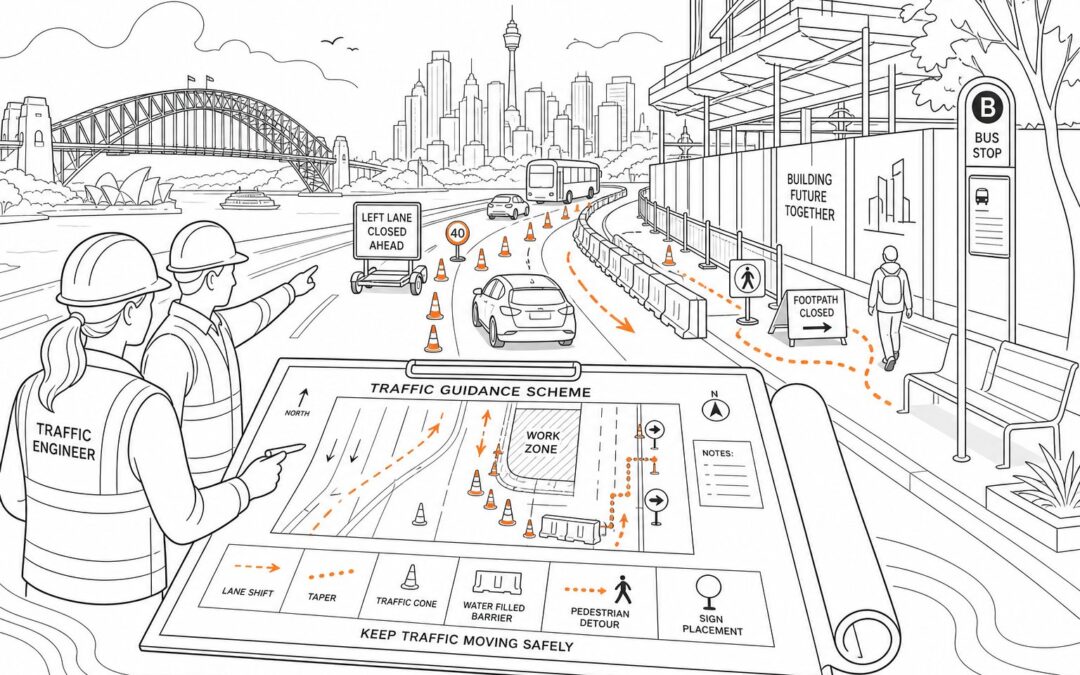
In Sydney, a project can be perfectly sound on paper and still stall the moment it touches a public road, kerbside lane or footpath. That’s where a Traffic Guidance Scheme comes in. For developers, architects and building designers, a TGS isn’t just another drawing in the approval set: it’s the document that shows how work will happen safely without creating avoidable risk for drivers, pedestrians, cyclists, buses or emergency access.
At ML Traffic Engineers, we see this issue early and often. A driveway modification, crane lift, scaffold, hoarding, utility trench or temporary lane closure might look minor in programme terms, but if the traffic planning is incomplete, councils and road authorities tend to push back fast. And fairly so. In NSW, any work affecting the public road environment needs to be planned against current standards, practical site conditions and the realities of how people actually move around Sydney streets.
This is why ML Traffic Engineers for TGS in Sydney matters to approval pathways in 2026. With more scrutiny on pedestrian access, work zone safety, staging and consistency across DA conditions, CTMPs and on-site controls, the quality of the TGS can directly influence speed, compliance and constructability. In the sections below, we explain when a TGS is required, how compliant schemes are prepared, where approvals commonly go wrong, and what to look for when choosing traffic engineers to support your project from first review to final documentation.
Key Takeaways
- ML Traffic Engineers for TGS in Sydney play a critical role in ensuring construction projects safely manage traffic and pedestrian flow, supporting smoother approval pathways.
- A Traffic Guidance Scheme (TGS) is essential whenever construction affects public roads or walkways, detailing safe arrangements that comply with NSW standards.
- Early coordination between design, construction methodology, and traffic engineering prevents redesign delays by addressing site access and pedestrian safety issues upfront.
- A well-prepared TGS aligns with other required documents like CTMPs and development applications, reducing approval delays and ensuring on-site practicality.
- Choosing experienced traffic engineers familiar with Sydney’s local conditions and regulations enhances compliance, site safety, and project efficiency.
- Attention to detail in TGS layouts—covering sign placement, pedestrian routes, lane closures, and emergency access—is vital to avoid common approval risks and redesign.
What TGS Means For Sydney Development And Construction Projects
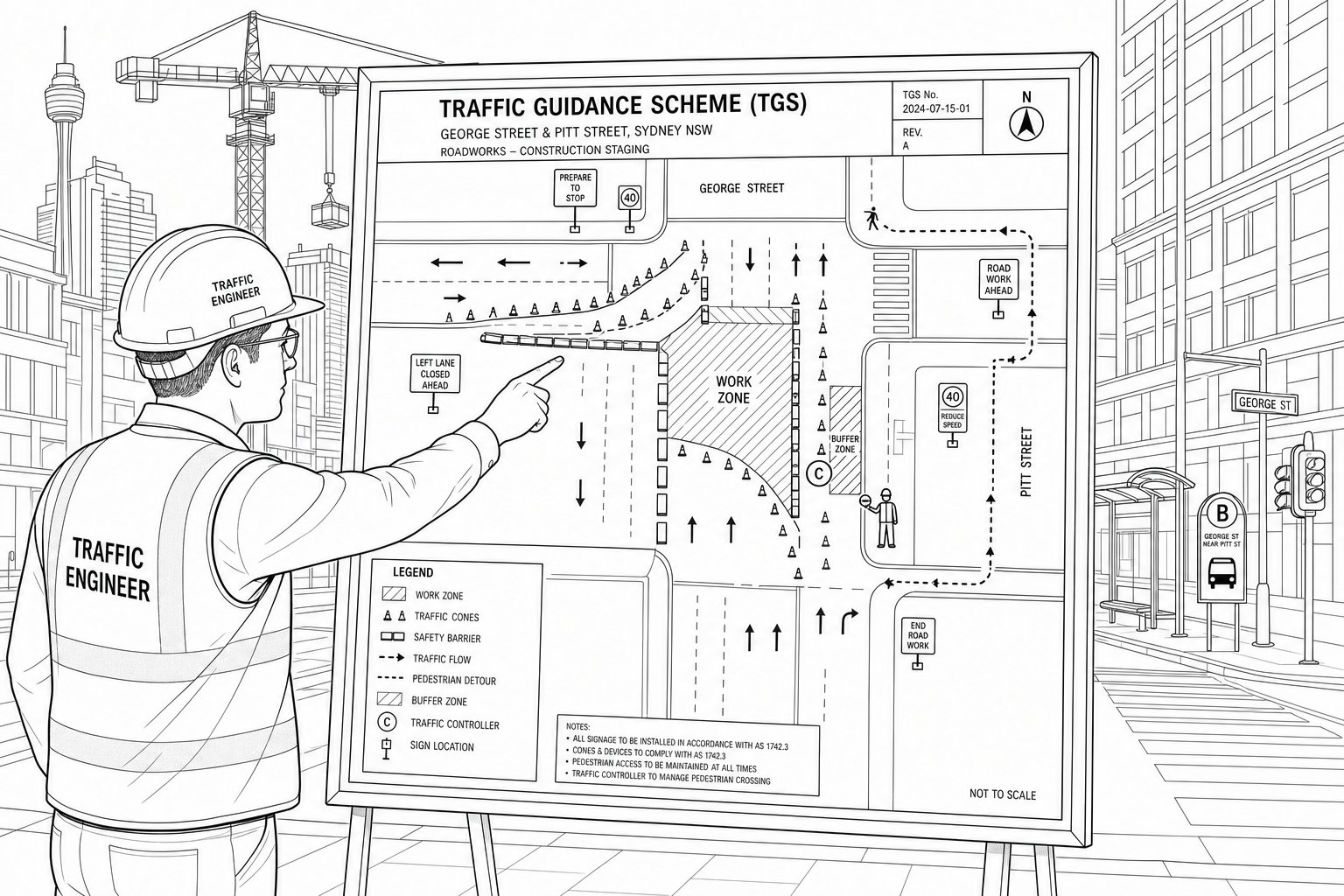
A Traffic Guidance Scheme, or TGS, is a temporary traffic control plan showing how traffic and pedestrians will be managed while works take place on or beside a public road. In practical terms, it maps out the safe arrangement of signs, cones, barriers, tapers, lane shifts, buffers, pedestrian routes and controller positions so that the work zone can operate without creating confusion or unnecessary hazard.
For Sydney development and construction projects, that makes the TGS a core delivery document rather than an afterthought. If works affect kerbside lanes, parking, footpaths, bus stops, intersections, driveways or public access points, authorities want to see exactly how those impacts will be controlled. A good scheme links planning intent with on-site reality.
We often explain it this way: the architectural drawings show what is being built, but the TGS shows how it can be built safely in the public realm.
It also underpins broader approval documentation. TGS drawings commonly sit alongside Construction Traffic Management Plans, Traffic Impact Statements, swept-path reviews and consent conditions. If those documents don’t align, delays follow.
In dense Sydney locations, even a short-term occupation of road space can affect deliveries, pedestrian accessibility, school travel, bus operations and neighbouring properties. That’s why specialist preparation matters. A compliant, site-specific TGS helps demonstrate that the project team has thought through staging, access and safety before works begin, not after the first objection lands.
When A Traffic Guidance Scheme Is Required In NSW
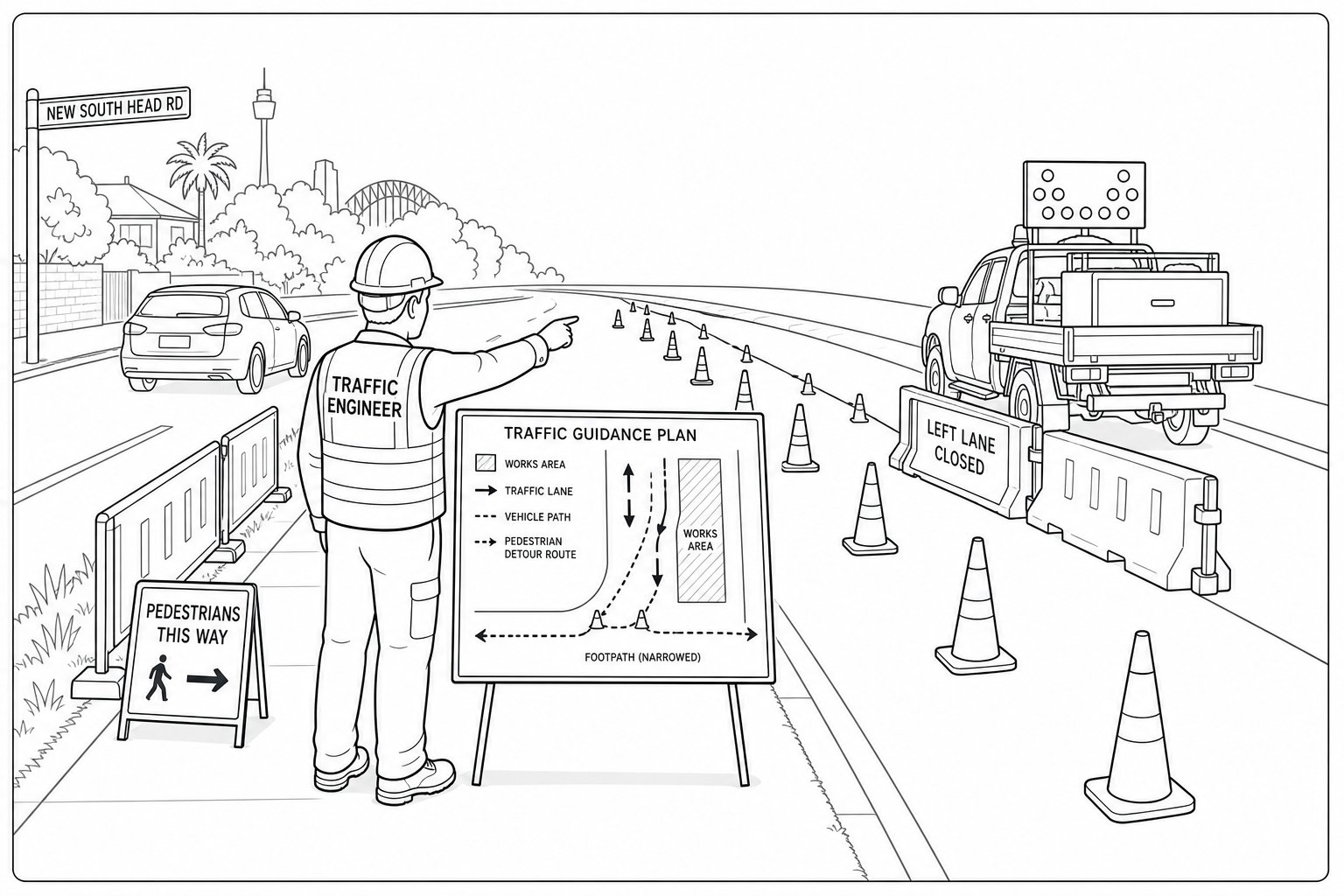
In NSW, a TGS is generally required whenever works affect traffic or pedestrians on a public road, shoulder, verge or footpath. The trigger is not only major road construction. Smaller private development works can need one too if the public domain is affected.
Common examples include:
- partial or full lane closures
- shoulder occupation
- temporary footpath closures or diversions
- crane lifts from the roadway
- hoardings and scaffolding that alter pedestrian paths
- driveway reconstruction or crossover works
- utility trenches and service connections
- work zones that remove parking or change kerbside operations
This catches many private clients off guard. A residential, mixed-use or commercial project may be well into design when someone realises the site setup will narrow a footpath or require temporary traffic control during deliveries. Suddenly, approvals become more complex.
The key point is simple: if your works change the way the public moves through the street environment, a TGS is likely to be part of the approval pathway.
We advise clients to check this well before mobilisation. Councils, Transport for NSW requirements, and site-specific road authority conditions can vary depending on road classification, traffic volumes, speed environment and nearby land uses. A site on a quiet local street is one thing: a frontage near a bus route, school zone or classified road is another entirely.
Early advice saves time because it identifies whether you need only a TGS or a wider suite of traffic documents to support the works.
How Traffic Engineers Prepare A Compliant TGS
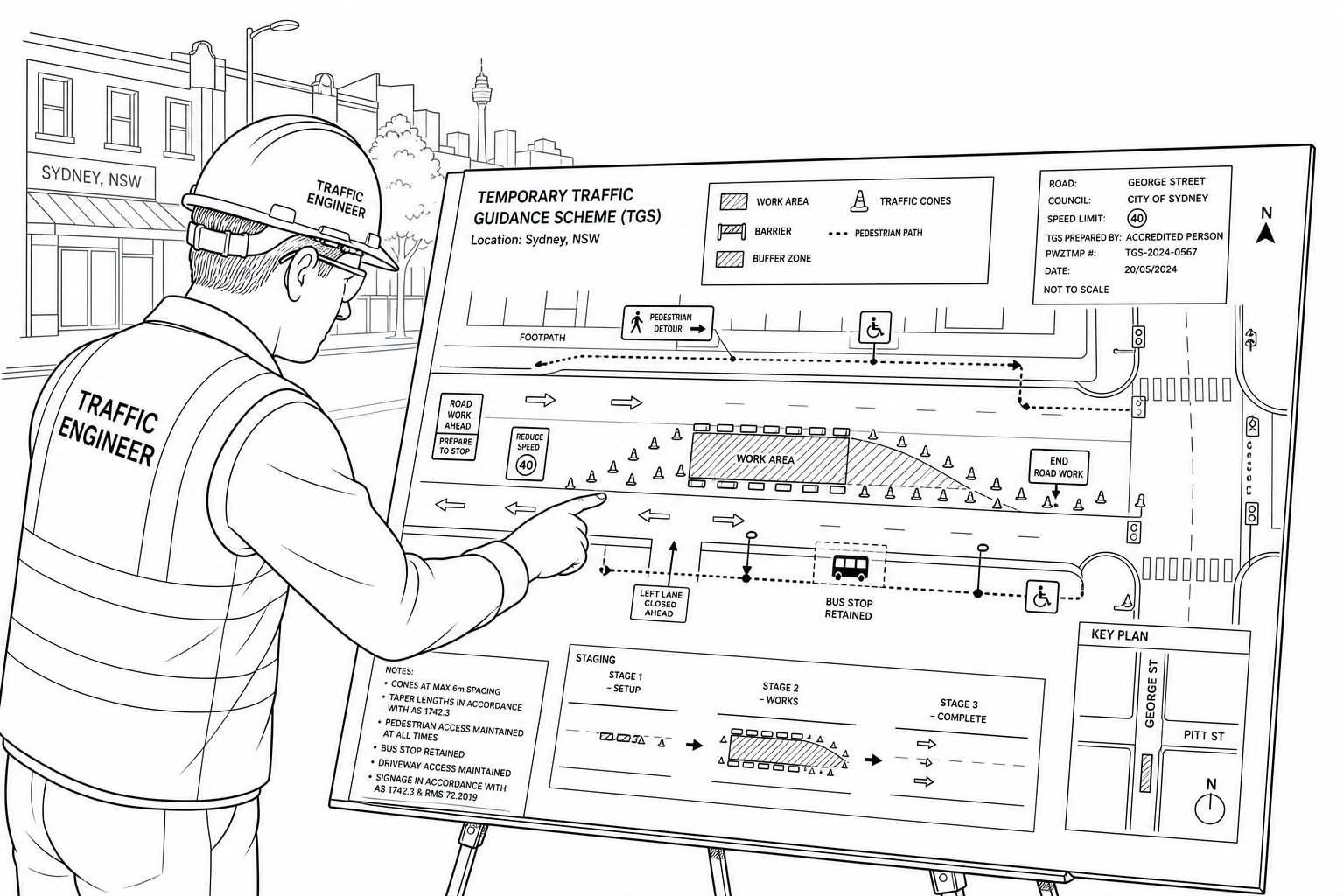
Preparing a compliant TGS is part technical exercise, part practical problem-solving. It’s not enough to place a few standard signs on a sketch and hope it passes review. The scheme has to match the actual road environment, the work activity, the staging sequence and the governing NSW requirements.
Our process starts with understanding the job properly. We review the scope of works, frontage conditions, consent requirements, nearby intersections, traffic volumes, speed limits, pedestrian demand, bus movements and property access constraints. We also look at how the site will function day to day. Where will materials be delivered? Can vehicles queue safely? Will a hoarding push pedestrians into a pinch point?
From there, we apply the relevant NSW and Australian guidance to develop a layout that is both compliant and workable. Sign sequencing, cone spacing, taper lengths, lateral clearances, sight distance, buffer zones and traffic controller warrants all need to be considered together. Miss one of those, and the drawing may be rejected or fail in the field.
Good TGS preparation also means thinking beyond the first stage. If the project will move through demolition, excavation, structure and fit-out with different public domain impacts, the traffic arrangements often need staged documentation rather than one generic plan.
Key Elements Included In A Sydney Traffic Guidance Scheme
A Sydney TGS typically includes the full temporary traffic control layout required to communicate safe operation on site. That usually means:
- all temporary signs, cones, bollards, barriers and delineation devices
- lane arrangements, lane shifts, closures, tapers and buffer lengths
- temporary speed environments where applicable
- pedestrian detours, crossings, protection and accessible paths of travel
- work zone extents and no-go areas
- driveway access treatment and side-street interaction
- provisions for buses, cyclists, service vehicles and emergency access
- notes covering staging, setup conditions and controller requirements
The strongest schemes are clear enough for both approval officers and site teams to use confidently.
Why Site Access, Pedestrian Safety, And Work Zones Need Early Planning
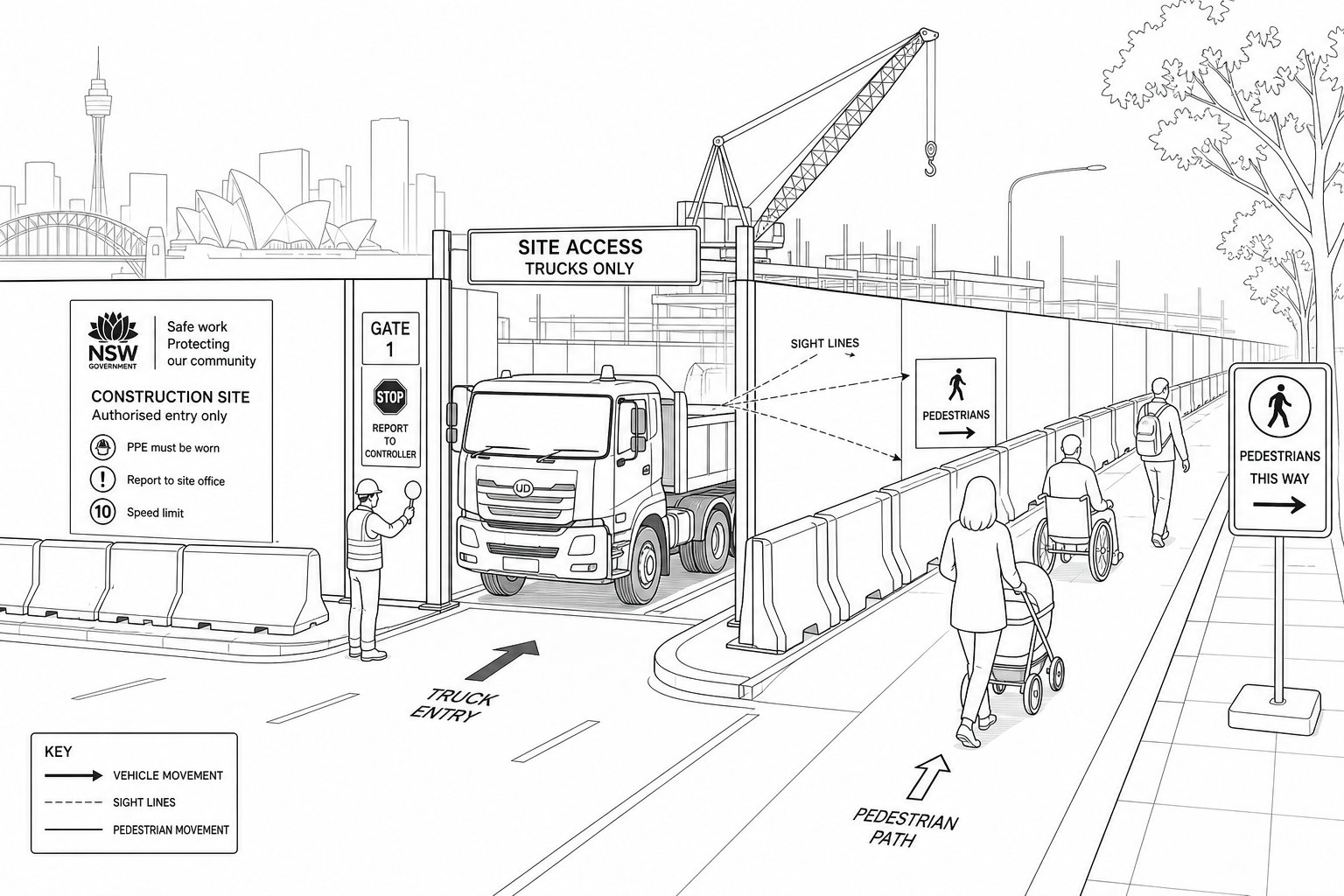
Traffic planning tends to go wrong when it happens too late. By that stage, the building footprint is fixed, the hoarding line is assumed, crane positions are locked in, and someone then discovers there isn’t enough room left for safe pedestrian passage or workable vehicle access.
That’s why we push for early coordination between design, construction methodology and traffic engineering. A TGS should not be developed in isolation after the rest of the project decisions are made. It needs to respond to those decisions while still protecting the public domain.
Site access is usually the first pressure point. Construction vehicles need to enter and leave without blocking through traffic, mounting kerbs unsafely or forcing pedestrians into conflict areas. On constrained urban sites, even a minor change in gate location can affect sight lines, queuing space and controller needs.
Pedestrian safety is the second. Sydney councils and road authorities are rightly strict on this now. A temporary route that is technically open but not accessible, legible or protected won’t satisfy modern expectations. Parents with prams, wheelchair users, school children and commuters all have to be considered.
Then there’s the work zone itself. If barriers, plant, loading activities and public movement aren’t separated properly, risk rises fast.
Early planning reduces redesign later. It helps the architect, builder and traffic engineer resolve clashes before documents are submitted. And frankly, it usually leads to a smoother site setup because the approved traffic arrangements have been thought through with construction logistics in mind rather than patched together at the last minute.
How TGS Supports Development Applications And Council Conditions
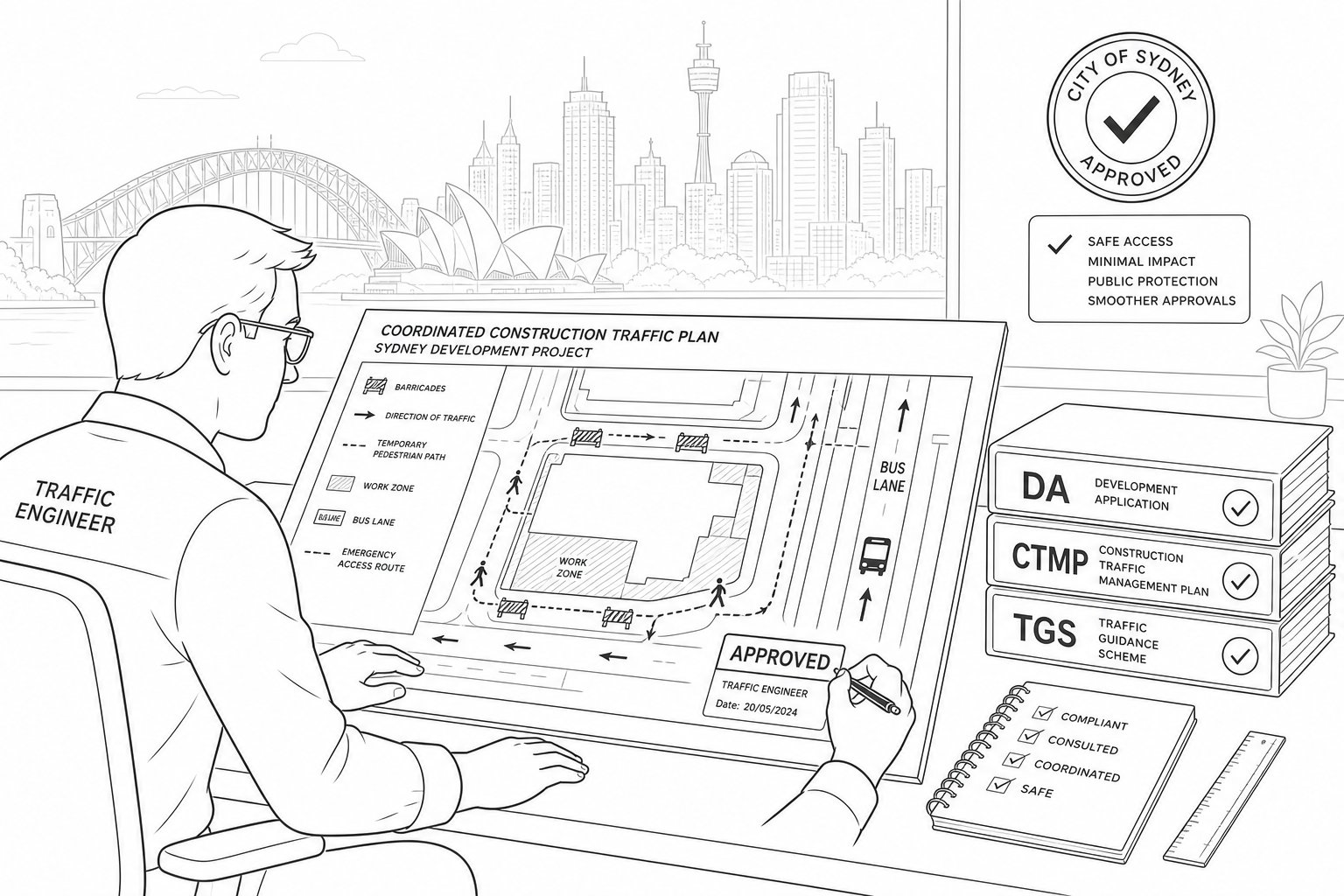
A TGS often sits inside a larger approval ecosystem. For many Sydney projects, it supports development applications indirectly by demonstrating that road and pedestrian impacts can be managed safely and in line with likely consent conditions. In other cases, it becomes a post-consent requirement that must be resolved before works affecting the public domain can begin.
Either way, the value is the same: it gives councils and road authorities confidence that the project team has a credible plan.
We regularly prepare TGS documents alongside Construction Traffic Management Plans, Traffic Impact Statements and other supporting reports. That matters because approval issues often arise at the joins between documents, not inside any one document alone. If the DA says one thing, the CTMP says another, and the TGS shows something else again, reviewers will notice.
A well-prepared TGS helps satisfy conditions relating to:
- temporary occupation of road space
- management of pedestrian access during works
- work zones and loading arrangements
- protection of bus operations and emergency access
- staging of driveway, hoarding or utility works
- consistency with approved construction methodology
For private developers, this has a practical benefit beyond compliance. Strong traffic documentation can shorten back-and-forth with authorities and reduce the risk of late redesign. That’s especially important when programme dates depend on road occupancy permits, utility coordination or contractor sequencing.
In short, a TGS is not just a site drawing. It is evidence that the public-facing part of construction has been planned properly, and that can make approval pathways noticeably smoother.
Common Approval Risks That Delay Traffic Management Plans
Most approval delays we see are not caused by obscure technicalities. They usually come from avoidable gaps in scope, coordination or compliance. The frustrating part is that many of them surface only after submission, when time is already tight.
One common issue is using outdated standards or generic layouts that don’t reflect current NSW expectations. Another is failing to show pedestrian management in enough detail. Reviewers want to know where people will walk, how they will cross, whether the route is accessible, and how they’ll be separated from plant and traffic.
We also see plans that don’t account properly for buses, on-street parking changes, emergency access, waste collection, nearby driveways or side-street interaction. Each omission might seem minor on its own. Together, they can trigger multiple rounds of comments.
Inconsistency is another big one. If the TGS conflicts with the CTMP, the approved DA drawings or the stated construction methodology, authorities may question the whole submission package. That can be more damaging than a single drafting error because it suggests the project team is not coordinated.
And sometimes the real problem is timing. Leaving the traffic planning until permits are needed often means there is no space left to solve design conflicts without affecting programme.
Frequent Design Errors In Temporary Traffic Control Layouts
A few design mistakes appear again and again in rejected or revised TGS packages:
- incorrect sign spacing or sign order
- taper lengths that don’t suit the road speed or lane condition
- missing buffers or inadequate clearances around the work area
- blocked driveways, side streets or property access points
- pedestrian routes that are non-compliant, indirect or unprotected
- unclear staging notes where the arrangement changes over time
- drawings that are too vague for field implementation
These errors are rarely dramatic. But they are exactly the sort of things that slow approvals and create site risk.
Choosing Traffic Engineers For TGS In Sydney
Not all traffic documentation is created to the same standard, and on live Sydney streets that difference shows up quickly. Choosing traffic engineers for TGS in Sydney should come down to more than price or turnaround promises. You need a team that understands approval pathways, local operating conditions and what a workable construction interface actually looks like.
At ML Traffic Engineers, our role is to bridge planning compliance and practical delivery. With 30+ years of combined experience and end-to-end support from first quote through to project completion, we focus on documentation that is clear, authority-ready and useful on site, not just technically correct in theory.
For developers and designers, that matters because TGS work often overlaps with broader needs such as CTMPs, Traffic Impact Statements and swept-path analysis. Keeping those services aligned through one experienced team can reduce inconsistencies and shorten review cycles.
A strong consultant should also be familiar with the range of Sydney contexts: constrained inner-city streets, suburban school environments, industrial access routes, arterial interfaces and local road conditions across multiple council areas. Each setting brings different risks and review sensitivities.
What To Look For In Experience, Compliance Knowledge, And Documentation
When assessing a traffic engineering firm, we suggest looking for three things.
Experience: Have they handled comparable projects, road contexts and work-zone constraints before?
Compliance knowledge: Do they work confidently with NSW guidance, Australian Standards and council or road authority expectations?
Documentation quality: Are the plans CAD-based, precise, readable and consistent with the rest of the project package?
If those three boxes are ticked, approvals tend to move more smoothly, and the site team gets documents they can actually use.
The Typical Process From Initial Review To Final Traffic Documentation
For most projects, the pathway from initial enquiry to final TGS approval is fairly structured, even if the site itself is complicated.
We begin by reviewing the development scope, construction methodology and any DA, council or road authority requirements already on the table. That first step is where we identify whether the project needs only a Traffic Guidance Scheme or a broader package including a CTMP, traffic report or swept-path analysis.
Next comes the site and network review. We assess the road classification, lane configuration, speed environment, parking conditions, nearby intersections, bus activity, pedestrian demand and access constraints. Sometimes the answer is obvious from plans and mapping. Sometimes a site inspection reveals the real issue, an awkward crest, a school pickup pattern, a narrow verge, a driveway conflict.
We then draft the TGS and any related traffic documents. At this stage, the goal is not just compliance but coordination. The traffic layout must match hoardings, staging, work areas and vehicle movements shown elsewhere in the project package.
After drafting, we work through client comments and, where required, authority feedback. This stage can involve refining pedestrian detours, access points, sign layouts or staging notes.
Finally, we issue the completed documentation set, typically including the final stamped TGS and any supporting traffic material required for submission or implementation.
Which areas do we service?
We prepare Traffic Guidance Schemes or Traffic Control Plans in every suburb of Sydney such as Abbotsbury, Abbotsford, Acacia Gardens, Agnes Banks, Airds, Alexandria, Alfords Point, Allambie Heights, Allawah, Ambarvale, Angus, Annandale, Annangrove, Arcadia, Arncliffe, Arndell Park, Artarmon, Ashbury, Ashcroft, Ashfield, Asquith, Auburn, Austral, Avalon Beach, Badgerys Creek, Balgowlah, Balgowlah Heights, Balmain, Balmain East, Bangor, Banksia, Banksmeadow, Bankstown, Bankstown Aerodrome, Barangaroo, Barden Ridge, Bardia, Bardwell Park, Bardwell Valley, Bass Hill, Baulkham Hills, Bayview, Beacon Hill, Beaconsfield, Beaumont Hills, Beecroft, Belfield, Bella Vista, Bellevue Hill, Belmore, Belrose, Berala, Berkshire Park, Berowra, Berowra Heights, Berowra Waters, Berrilee, Beverley Park, Beverly Hills, Bexley, Bexley North, Bidwill, Bilgola Beach, Bilgola Plateau, Birchgrove, Birrong, Blackett, Blacktown, Blair Athol, Blairmount, Blakehurst, Bligh Park, Bondi, Bondi Beach, Bondi Junction, Bonnet Bay, Bonnyrigg, Bonnyrigg Heights, Bossley Park, Botany, Bow Bowing, Box Hill, Bradbury, Bradfield, Breakfast Point, Brighton-Le-Sands, Bringelly, Bronte, Brooklyn, Brookvale, Bundeena, Bungarribee, Burraneer, Burwood, Burwood Heights, Busby, Cabarita, Cabramatta, Cabramatta West, Caddens, Cambridge Gardens, Cambridge Park, Camellia, Cammeray, Campbelltown, Camperdown, Campsie, Canada Bay, Canley Heights, Canley Vale, Canoelands, Canterbury, Caringbah, Caringbah South, Carlingford, Carlton, Carnes Hill, Carramar, Carss Park, Cartwright, Castle Cove, Castle Hill, Castlecrag, Castlereagh, Casula, Catherine Field, Cattai, Cecil Hills, Cecil Park, Centennial Park, Chatswood, Chatswood West, Cheltenham, Cherrybrook, Chester Hill, Chifley, Chippendale, Chipping Norton, Chiswick, Chullora, Church Point, Claremont Meadows, Clarendon, Clareville, Claymore, Clemton Park, Clontarf, Clovelly, Clyde, Coasters Retreat, Cobbitty, Colebee, Collaroy, Collaroy Plateau, Colyton, Como, Concord, Concord West, Condell Park, Connells Point, Constitution Hill, Coogee, Cottage Point, Cowan, Cranebrook, Cremorne, Cremorne Point, Cromer, Cronulla, Crows Nest, Croydon, Croydon Park, Curl Curl, Currans Hill, Currawong Beach, Daceyville, Dangar Island, Darling Point, Darlinghurst, Darlington, Davidson, Dawes Point, Dean Park, Dee Why, Denham Court, Denistone, Denistone East, Denistone West, Dharruk, Dolans Bay, Dolls Point, Doonside, Double Bay, Dover Heights, Drummoyne, Duffys Forest, Dulwich Hill, Dundas, Dundas Valley, Dural, Eagle Vale, Earlwood, East Hills, East Killara, East Lindfield, East Ryde, Eastern Creek, Eastgardens, Eastlakes, Eastwood, Edensor Park, Edgecliff, Edmondson Park, Elanora Heights, Elderslie, Elizabeth Bay, Elizabeth Hills, Elvina Bay, Emerton, Enfield, Engadine, Englorie Park, Enmore, Epping, Ermington, Erskine Park, Erskineville, Eschol Park, Eveleigh, Fairfield, Fairfield East, Fairfield Heights, Fairfield West, Fairlight, Fiddletown, Five Dock, Forest Glen, Forest Lodge, Forestville, Frenchs Forest, Freshwater, Gables, Galston, Georges Hall, Gilead, Girraween, Gladesville, Glebe, Gledswood Hills, Glen Alpine, Glendenning, Glenfield, Glenhaven, Glenmore Park, Glenorie, Glenwood, Gordon, Grantham Farm, Granville, Grays Point, Great Mackerel Beach, Green Valley, Greenacre, Greendale, Greenfield Park, Greenhills Beach, Greenwich, Gregory Hills, Greystanes, Guildford, Guildford West, Gymea, Gymea Bay, Haberfield, Hammondville, Harrington Park, Harris Park, Hassall Grove, Haymarket, Heathcote, Hebersham, Heckenberg, Henley, Hillsdale, Hinchinbrook, Hobartville, Holroyd, Holsworthy, Homebush, Homebush West, Horningsea Park, Hornsby, Hornsby Heights, Horsley Park, Hoxton Park, Hunters Hill, Huntingwood, Huntleys Cove, Huntleys Point, Hurlstone Park, Hurstville, Hurstville Grove, Illawong, Ingleburn, Ingleside, Jamisontown, Jannali, Jordan Springs, Kangaroo Point, Kareela, Kearns, Kellyville, Kellyville Ridge, Kemps Creek, Kensington, Kenthurst, Kentlyn, Killara, Killarney Heights, Kings Langley, Kings Park, Kingsford, Kingsgrove, Kingswood, Kirkham, Kirrawee, Kirribilli, Kogarah, Kogarah Bay, Ku-ring-gai Chase, Kurnell, Kurraba Point, Kyeemagh, Kyle Bay, La Perouse, Lakemba, Lalor Park, Lane Cove, Lane Cove North, Lane Cove West, Lansdowne, Lansvale, Laughtondale, Lavender Bay, Leets Vale, Leichhardt, Len Waters Estate, Leppington, Lethbridge Park, Leumeah, Lewisham, Liberty Grove, Lidcombe, Lilli Pilli, Lilyfield, Lindfield, Linley Point, Little Bay, Liverpool, Llandilo, Loftus, Londonderry, Long Point, Longueville, Lovett Bay, Lower Portland, Lucas Heights, Luddenham, Lugarno, Lurnea, Macquarie Fields, Macquarie Links, Macquarie Park, Maianbar, Malabar, Manly, Manly Vale, Maraylya, Marayong, Maroota, Maroubra, Marrickville, Marsden Park, Marsfield, Mascot, Matraville, Mays Hill, McCarrs Creek, McGraths Hill, McMahons Point, Meadowbank, Melonba, Melrose Park, Menai, Menangle Park, Merrylands, Merrylands West, Middle Cove, Middle Dural, Middleton Grange, Miller, Millers Point, Milperra, Milsons Passage, Milsons Point, Minchinbury, Minto, Minto Heights, Miranda, Mona Vale, Monterey, Moore Park, Moorebank, Morning Bay, Mortdale, Mortlake, Mosman, Mount Annan, Mount Colah, Mount Druitt, Mount Kuring-Gai, Mount Lewis, Mount Pritchard, Mount Vernon, Mulgoa, Mulgrave, Narellan, Narellan Vale, Naremburn, Narrabeen, Narraweena, Narwee, Nelson, Neutral Bay, Newington, Newport, Newtown, Nirimba Fields, Normanhurst, North Balgowlah, North Bondi, North Curl Curl, North Epping, North Kellyville, North Manly, North Narrabeen, North Parramatta, North Rocks, North Ryde, North St Marys, North Strathfield, North Sydney, North Turramurra, North Wahroonga, North Willoughby, Northbridge, Northmead, Northwood, Norwest, Oakhurst, Oakville, Oatlands, Oatley, Old Guildford, Old Toongabbie, Oran Park, Orchard Hills, Oxford Falls, Oxley Park, Oyster Bay, Paddington, Padstow, Padstow Heights, Pagewood, Palm Beach, Panania, Parklea, Parramatta, Peakhurst, Peakhurst Heights, Pemulwuy, Pendle Hill, Pennant Hills, Penrith, Penshurst, Petersham, Phillip Bay, Picnic Point, Pitt Town, Pleasure Point, Plumpton, Point Piper, Port Botany, Port Hacking, Potts Hill, Potts Point, Prairiewood, Prestons, Prospect, Punchbowl, Putney, Pymble, Pyrmont, Quakers Hill, Queens Park, Queenscliff, Raby, Ramsgate, Ramsgate Beach, Randwick, Redfern, Regents Park, Regentville, Revesby, Revesby Heights, Rhodes, Richards, Richmond, Riverstone, Riverview, Riverwood, Rockdale, Rodd Point, Rookwood, Rooty Hill, Ropes Crossing, Rose Bay, Rosebery, Rosehill, Roselands, Rosemeadow, Roseville, Roseville Chase, Rossmore, Rouse Hill, Rozelle, Ruse, Rushcutters Bay, Russell Lea, Rydalmere, Ryde, Sackville North, Sadleir, Sandringham, Sandy Point, Sans Souci, Schofields, Scotland Island, Seaforth, Sefton, Seven Hills, Shalvey, Shanes Park, Silverwater, Singletons Mill, Smeaton Grange, Smithfield, South Coogee, South Granville, South Hurstville, South Maroota, South Penrith, South Turramurra, South Wentworthville, South Windsor, Spring Farm, St Andrews, St Clair, St Helens Park, St Ives, St Ives Chase, St Johns Park, St Leonards, St Marys, St Peters, Stanhope Gardens, Stanmore, Strathfield, Strathfield South, Summer Hill, Surry Hills, Sutherland, Sydenham, Sydney, Sydney Olympic Park, Sylvania, Sylvania Waters, Tallawong, Tamarama, Taren Point, Telopea, Tempe, Tennyson Point, Terrey Hills, The Ponds, The Rocks, Thornleigh, Toongabbie, Tregear, Turramurra, Turrella, Ultimo, Varroville, Vaucluse, Villawood, Vineyard, Voyager Point, Wahroonga, Waitara, Wakeley, Wareemba, Warrawee, Warriewood, Warwick Farm, Waterfall, Waterloo, Watsons Bay, Wattle Grove, Waverley, Waverton, Wedderburn, Wentworth Point, Wentworthville, Werrington, Werrington County, Werrington Downs, West Hoxton, West Pennant Hills, West Pymble, West Ryde, Westleigh, Westmead, Wetherill Park, Whalan, Whale Beach, Wheeler Heights, Wiley Park, Willmot, Willoughby, Willoughby East, Windsor, Windsor Downs, Winston Hills, Wisemans Ferry, Wolli Creek, Wollstonecraft, Woodbine, Woodcroft, Woodpark, Woollahra, Woolloomooloo, Woolooware, Woolwich, Woronora, Woronora Heights, Yagoona, Yarrawarrah, Yennora, Yowie Bay, Zetland.
Conclusion
Traffic Guidance Schemes are one of those documents that seem straightforward until a project hits a real Sydney street. Then every metre matters: lane width, pedestrian access, driveway operation, bus movement, staging, sign placement, authority expectations. That’s why the difference between a generic drawing and a well-prepared, compliant TGS is so significant.
For private developers, architects and building designers, the smartest move is to address traffic impacts early and keep the documentation coordinated from DA through to construction. Done properly, a TGS supports safety, strengthens approvals and helps avoid the slow, expensive cycle of redesign and resubmission.
At ML Traffic Engineers, we approach TGS preparation as part of the wider approval strategy, not a box-ticking exercise. When the traffic planning is accurate, practical and aligned with NSW requirements, projects tend to move with far fewer surprises. And in 2026, with approval scrutiny only getting sharper, that’s not a minor advantage, it’s a real one.
Frequently Asked Questions about ML Traffic Engineers for TGS in Sydney
What is a Traffic Guidance Scheme (TGS) and why is it important for Sydney development projects?
A TGS is a temporary traffic control plan showing how traffic and pedestrians are safely managed during works affecting public roads. For Sydney projects, it is essential for ensuring safety, compliance, and smooth approvals when kerbside lanes, footpaths, or intersections are impacted.
When is a Traffic Guidance Scheme required for construction or development works in NSW?
A TGS is required whenever works affect traffic or pedestrian movement on public roads or footpaths, including lane closures, shoulder occupation, crane lifts, scaffolding, driveway works, or utility trenches. Any public road impact triggers the need for a compliant TGS.
How do ML Traffic Engineers prepare a compliant Traffic Guidance Scheme for Sydney projects?
ML Traffic Engineers review the site, road classification, traffic volumes, pedestrian needs, and council requirements. They apply NSW and Australian standards to design layouts with appropriate signs, cones, buffers, pedestrian routes, and staging to ensure safety and regulatory compliance.
What key elements are included in a typical Sydney Traffic Guidance Scheme provided by ML Traffic Engineers?
A typical Sydney TGS includes all temporary traffic control devices, lane arrangements, tapers, pedestrian detours and protections, speed changes, work zone extents, driveway access treatments, and provisions for buses, cyclists, and emergency vehicles to maintain safe site and public access.
Why is early planning of the TGS critical for construction projects in Sydney?
Early TGS planning ensures site access, pedestrian safety, and work zone management are coordinated with design and construction methods. It prevents conflicts with hoardings or crane positions, reduces redesign risks, and helps achieve smoother approval and safer site operations.
How does ML Traffic Engineers support development applications and council conditions with their TGS services?
ML Traffic Engineers provide TGS alongside Construction Traffic Management Plans and Traffic Impact Statements to satisfy development application conditions and council requirements, ensuring documented traffic and pedestrian impacts are managed for faster approvals and compliance on NSW public roads.
