
Document Overview This report distills, expands, and illustrates every key point from the Western Australian Planning Commission’s Transport Impact Assessment Guidelines Volume 5 – Technical Guidance (published August 2016, 35 pages). Volume 5 serves as the technical appendix to the broader TIA Guidelines series. It supplies detailed methodologies, data sources, derivation explanations, analytical standards, and graphical best practices for preparing and assessing Transport Impact Assessments (TIAs) for developments, structure plans, and activity centres across Western Australia.
The guidelines promote consistent, evidence-based transport planning that balances safety, efficiency, accessibility, and sustainability. They reference Austroads, ITE, NSW RTA, SA guidelines, MRWA data, and software such as SIDRA. Professional judgment, sensitivity testing, and early consultation with approving authorities (MRWA, local councils, PTA) remain mandatory. All content below directly derives from the PDF; expansions add explanatory depth, real-world application notes, hypothetical examples, and visual recreations for clarity.
Part A – Further Technical Guidance
1. Introduction (p.4) The notes expand main-text requirements on data presentation and traffic engineering principles for TIAs. They are not exhaustive; practitioners must consult Austroads Guide to Traffic Management (Parts 3, 6, 9, 10), Guide to Road Design (Parts 4, 4A, 4B), Guide to Road Safety, Highway Capacity Manual (2010), and MRWA publications. Graphical examples in Part C demonstrate professional standards. Key principle: TIAs must use up-to-date, site-specific data scaled to the assessment level (detailed peak-hour turning movements for individual developments; link flows for structure plans).
2. Traffic Data (pp.4-7) Traffic data forms the foundation of every TIA. Collect or source data appropriate to scale:
- Sources: MRWA Statewide Traffic Digest, Network Performance Specifications (NPS), SCATS (for signalised sites), local councils, PTA. Always verify currency (ideally <2 years old).
- Survey types: Automatic Traffic Counts (ATCs) – minimum 7 days, hourly volumes, vehicle classification, speeds. Intersection turning movement counts – 2-hour peaks in 15-minute intervals, including pedestrians/cyclists. Origin-Destination (O/D) via number-plate matching or video. Household interviews for catchments.
- Presentation: 24-hour and peak-hour link flows on plans; turning movements in tables and SIDRA input files. Include heavy vehicles %. Practical expansion: For a 500-dwelling subdivision, combine MRWA link data with new ATCs at proposed accesses. Sensitivity test ±15% growth. Common pitfall: ignoring seasonal retail peaks.
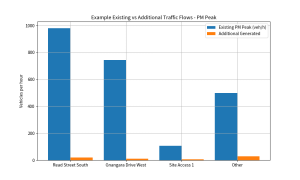
Figure A (recreated from Volume 5 examples): Existing vs Additional PM Peak Flows (veh/h) at sample intersection approaches. Visualises incremental impact assessment.
3. Traffic Crash Data (p.7) Analyse MRWA Crash Analysis Reporting System (CARS) for last 5 years. Identify patterns (rear-end, right-turn, pedestrian) and adjust for infrastructure changes or volume growth. Quote: “Crash history should be analysed to identify any patterns… and consideration given to any changes.” Expansion: High crash locations trigger remedial measures even if LOS is acceptable. Integrate with Safe System principles (Austroads). Hypothetical: A site with 12 rear-end crashes in 5 years on a 60 km/h approach warrants signalisation or channelisation.
4. Time Periods for Analysis (pp.7-9) Analyse worst-case combination of background road peaks + development peaks. Standard windows:
- Residential/Office: AM 7-9 am, PM 4-6 pm.
- Retail: Thursday evening + Saturday midday.
- Schools: school start/finish.
- Entertainment: site-specific (e.g., Friday 7-9 pm). Agree periods with authority; include future years (opening + 5/10). Use SCATS or surveys for precise peaks. Expansion: Thursday PM often worse than Friday for retail due to commuter + shopping overlap. Sensitivity: test 10% higher background growth.
5. Trip Generation Rates (pp.9-11) Person-trips preferred where mode choice applies; otherwise vehicle-trips. Methods (in priority order):
- Site-specific surveys of comparable WA developments.
- Existing approved rates.
- Typical rates (Table 1 below). Document sources, assumptions, adjustments for mixed-use (internal capture 10-30%), walking/cycling (proximity-based reductions). Use 85th percentile for conservatism where data sparse.
Table 1: Typical Land Use Vehicle Trip Rates (extracted verbatim, p.10)
| LAND USE | UNIT | AM Peak IN | AM Peak OUT | AM Peak TOTAL | PM Peak IN | PM Peak OUT | PM Peak TOTAL |
|---|---|---|---|---|---|---|---|
| Residential | Dwellings | 0.2 | 0.6 | 0.8 | 0.5 | 0.3 | 0.8 |
| School | Pupils | 0.5 | 0.5 | 1.0 | 0.5 | 0.5 | 1.0 |
| Commercial | 100 m² GFA | 1.6 | 0.4 | 2.0 | 0.4 | 1.6 | 2.0 |
| Retail (Food) | 100 m² GFA | 2.0 | 0.5 | 2.5 | 5.0 | 5.0 | 10.0 |
| Retail (Non-food) | 100 m² GFA | 1.0 | 0.25 | 1.25 | 2.0 | 2.0 | 4.0 |
| Industrial | 100 m² GFA | 0.8 | 0.2 | 1.0 | 0.2 | 0.8 | 1.0 |
Notes: Apply food rates only to centres with significant food component. Non-food rates vary widely – use caution and site-specific data. GFA = Gross Floor Area.
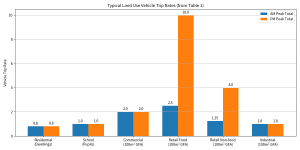
Chart 1: Visual comparison of AM/PM total vehicle trip rates across land uses. Highlights retail food’s extreme PM peak (10.0 trips/100 m²), driving need for detailed parking and access analysis.
6. Mode Choice (p.11) For person-trip assessments: split into car driver, passenger, bus/train, cycle, walk. Factors: distance to PT, service frequency, cycling infrastructure, parking policy. Document assumptions; test scenarios if PT improvements proposed. Omit mode split only for pure vehicle-trip assessments. Expansion: In Perth’s inner suburbs, walking/cycling can reach 20-30% with good design; outer areas <5%. Design measures (covered bike parking, direct paths) can shift 5-10% from cars.
7. Trip Types (p.12)
- Pass-by: Divert from existing through traffic (localised impact).
- Diverted: From nearby routes.
- New: Pure generation. Assess proportions via surveys or literature (e.g., fast-food 50%+ pass-by). Expansion: Pass-by reduces net network impact but increases site access loading. Retail example: 40% pass-by on arterial means only 60% of generated trips add to through traffic.
8. Trip Distribution (pp.13-15)
- Pass-by/diverted: follow existing flows.
- New trips: existing proportions, comparable-site surveys, or gravity model A/Tⁿ (n=1.2–2.5; higher for shopping). Table 2: Example A/T² Trip Distribution (p.14)
| Residential Area | Size (ha) | Travel Time (min) | A/T² | % Trips |
|---|---|---|---|---|
| Area 1 | 5 | 5 | 0.2 | 14% |
| Area 2 | 10 | 4 | 0.625 | 44% |
| Area 3 | 2 | 2 | 0.5 | 35% |
| Area 4 | 10 | 10 | 0.1 | 7% |
| Total | – | – | 1.425 | 100% |

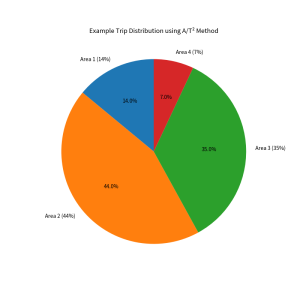
Chart 2: Pie chart of sample gravity-model distribution. Area 2 (closest + largest) dominates at 44%, illustrating how proximity heavily weights trip ends.
9. Parking (pp.15-17) 9.1 Demand: Survey comparable sites or apply rates; count occupancy in 15-min intervals or entry/exit. Consider shared-use peaks, time-of-day variation. 9.2 Layout: 1:500 scale plan; label every space, show dimensions, aisles, manoeuvring. 9.3 Impacts: Comply with SPP 4.2 (Activity Centres), local schemes. Minimise overflow via pricing, shared parking, mode shift. 9.4 Analysis: Realistic turnover; assess on-street contribution if overflow likely. Expansion: Mixed-use centres can achieve 20-30% parking reduction through sharing (office daytime vs retail evening).
10. Analysis of Intersections (pp.17-19) Analyse all site accesses and affected intersections for existing, opening, and future years. Software: SIDRA (signals/roundabouts), Austroads/HCM (unsignalised). Outputs: Volume/Capacity (v/c), Level of Service (LOS A-F), average delay (s), 95th percentile queue (m) per movement. Compare “with” vs “without” development. Document geometry, signal timings, heavy-vehicle %. Liaise MRWA for signals. Expansion: Target LOS C or better on arterials; D acceptable on local roads. Safety warrants may override LOS.
11. Remedial Measures (p.19) Evaluate signals, roundabouts, channelisation, lane additions against Austroads/MRWA warrants. Consider impacts on PT priority, cyclists, pedestrians, coordination. Lower delay thresholds for safety. Quote: “Remedial measures should be evaluated against warrants… and impacts on network operation.” Expansion: Roundabouts often preferred in WA for lower speeds and maintenance.
12. Traffic Noise (p.19) Refer to State Planning Policy 5.4 if development exceeds thresholds. Beyond TIA scope unless requested.
Part B – Derivation of Technical Data
1. Trip Generation Rates (pp.20-22) Rates derive primarily from Perth and Regions Travel Survey (PARTS), TravelSmart surveys, NSW RTA Guide (2002) + 2013/04a updates, and SA 1987 guidelines.
- Residential: PARTS averaged dwelling types → 0.8 veh/dwelling (AM 25% in/75% out; PM 67% in/33% out). Thresholds rounded to 1.0.
- Schools: 65-70% driven, occupancy 1.4-1.5 → 0.5 trips/child each direction.
- Retail food: Adjusted to 10 PM trips/100 m² (50:50 split).
- Non-food: Average 4 PM trips/100 m² (wide variability). Full derivations emphasise WA-specific data scarcity, hence external supplementation and caution notes. Expansion: TravelSmart programs have demonstrated 10-20% trip reduction through behaviour change – incorporate in sensitivity tests.
2. Assessment of Pedestrian/Cycle Networks (pp.22-24) 2.1 Rationale: Major roads become barriers when gaps are insufficient for safe crossing (walking speed 1.2 m/s + 3 s safety margin). Desirable max average delay 65 s (mid LOS E). 2.2 Threshold Volumes (Table below, p.23):
| Road Type | Crossing Width (m) | Crossing Time (s) | 2-way Volume for 65 s Delay (vph) |
|---|---|---|---|
| Four lane divided | 8 | 10 | 1,100 |
| Two lane divided | 5 | 7 | 2,800 |
| Four lane undivided | 14 | 15 | 700 |
| Four lane divided* | 8 | 10 | 1,600 |
*Total delay across both carriageways, 60/40 split.

Chart 3: Bar visualisation of pedestrian crossing thresholds. Two-lane divided roads tolerate highest volumes (2,800 vph) due to narrower crossing; undivided four-lane roads are most restrictive (700 vph).
2.3 Spacing of Crossings: 400 m on low-activity arterials; 200 m on moderate; 100 m in town centres. Based on acceptable detour (max 400 m walk to facilities). 2.4 Supplementary: Refer MRWA Pedestrian and Cycling LOS Guidelines (2006).
Part C – Examples of Graphical Data Representation (pp.25-29)
The document provides seven high-quality examples for TIA reports:
- Figure 1: 2015 Existing PM Peak flows (veh/h) on Read Street/Gnangara Drive with five site accesses (detailed numeric labels on every link and access).
- Figure 2: Directional distribution pie charts per link/access (percentages e.g., 8%, 41%, 18% etc.).
- Figure 3: Additional generated traffic PM Peak (incremental flows overlaid).
- Figure 4: Existing intersection layout (SIDRA-style lane geometry).
- Figure 5: Bus services map (TransPerth extract).
- Figure 6: Bus stop locations diagram.
- Figure 7: Proposed intersection improvements (revised kerb line for swept-path compliance).
These visuals ensure clarity, consistency, and professionalism. Recreated examples above demonstrate application.
Reference List, Useful Links & Appendix A (pp.30-35)
Extensive bibliography (Austroads 2009 series, ITE Trip Generation 9th ed., PARTS 2006, MRWA LOS guidelines, etc.). Appendix A lists contact details for MRWA (traffic data, crashes), PTA (bus), councils, DoT (cycling). Useful links to MRWA Traffic Digest and modelling guidelines.
Expanded Insights & Best-Practice Application
Volume 5 emphasises integration: trip generation feeds distribution and parking; intersection analysis drives remedial measures; pedestrian thresholds inform network planning. In practice, for a 10,000 m² retail centre in Perth’s north-east: apply Table 1 rates (≈1,000 PM trips), 40% pass-by, gravity distribution, SIDRA modelling of four accesses, shared parking with adjacent office (30% reduction), and 200 m crossing spacing on adjacent arterial.
Common pitfalls avoided: using outdated ITE US rates without adjustment; ignoring mode shift potential; inadequate graphical presentation. Benefits: reduced congestion, fewer crashes (target Safe System), higher active transport mode share, better integration with Perth’s PT network.
Since 2016, practitioners continue referencing these core methods while layering newer tools (e.g., PTV Vissim, updated TravelSmart data). Early pre-lodgement meetings remain the single most effective risk-mitigation step.
