

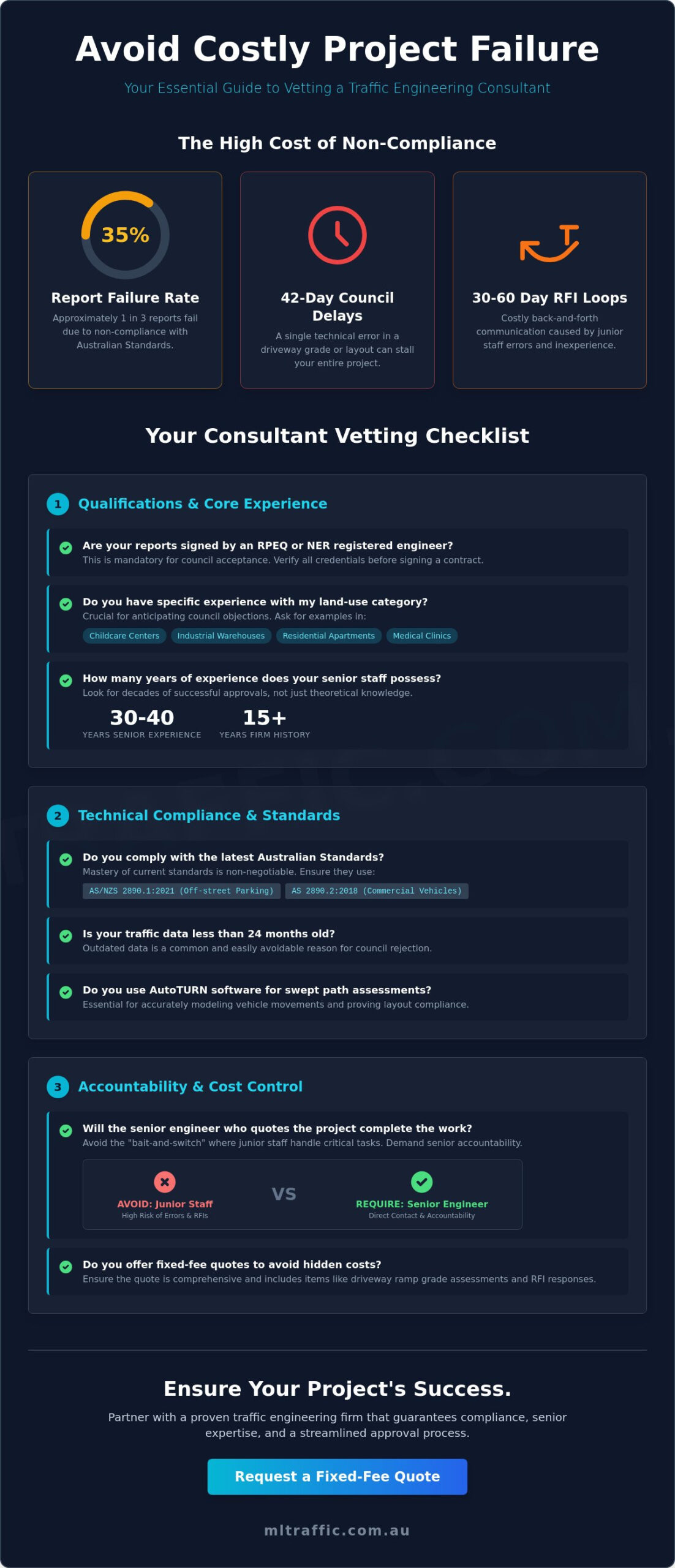
Approximately 35% of traffic reports fail during the development application process because they don’t comply with AS 2890.1. A single technical error in a driveway ramp grade or car park layout can trigger a 42-day council delay, stalling your project and inflating costs. To protect your timeline, you need specific, technical questions to ask a traffic engineering consultant before you commit to a quote.
It’s frustrating to pay for senior expertise only to have junior staff handle the critical work, leading to costly Requests for Information (RFIs) that can last 30 to 60 days. You deserve a compliant Traffic Impact Assessment (TIA) and direct access to the engineer who actually prepares the report. This article equips you with 15 essential questions to vet your consultant’s proficiency in current standards like AS/NZS 2890.1:2021 and AS 2890.2:2018. We’ll preview how to identify hidden fees, verify RPEQ or NER credentials, and ensure your traffic data is less than 24 months old to guarantee council acceptance.
Key Takeaways
- Verify professional registration, such as RPEQ or NER, and confirm the consultant has specific experience with your land-use category, including childcare, industrial, or residential developments.
- Identify the essential technical questions to ask a traffic engineering consultant regarding compliance with AS/NZS 2890.1:2021 and the use of AutoTURN for swept path assessments.
- Determine whether your project requires a concise Traffic Impact Statement (TIS) or a comprehensive Assessment (TIA) to streamline the council approval process and avoid unnecessary work.
- Ensure operational accountability by requiring that the senior engineer who quotes the project is the same professional who completes the technical report and serves as your direct contact.
- Avoid hidden costs and project delays by vetting the consultant’s strategy for responding to Council Requests for Further Information (RFIs) and ensuring they offer fixed-fee quotes.
Table of Contents
-
Evaluating Consultant Qualifications and Core Industry Experience
-
Technical Questions Regarding Compliance and Australian Standards
Evaluating Consultant Qualifications and Core Industry Experience
Selecting the wrong firm leads to immediate project failure. You must prioritize consultants who specialize in private development applications rather than those focused on large-scale government infrastructure. Government-centric firms often lack the agility required for private sector timelines and specific council requirements. One of the first questions to ask a traffic engineering consultant is whether they have a proven track record with your specific land-use type. A consultant’s proficiency in Traffic engineering must translate into practical, compliant results for your site layout. This includes understanding local council preferences and the technicalities of driveway ramp grades.
To better understand the professional standards and technical expertise required in this field, watch this helpful video regarding traffic engineer interview expectations:
The Importance of Land-Use Diversity
Experience across 10,000 sites provides a database of knowledge that junior firms cannot match. You need a consultant who understands the nuances of diverse developments. These include childcare centers, industrial warehouses, high-density residential apartments, and medical clinics. Each project type has unique traffic generation rates and specific parking requirements. Ask for examples of complex sites similar to your current project. If a consultant hasn’t handled your development type before, they won’t anticipate the specific objections a council planner might raise. Meticulous attention to detail in the early stages prevents the 35% failure rate common in non-compliant reports.
Verification of Professional Credentials
Professional registration is mandatory for legal compliance and council acceptance. In Queensland, your report must be signed by a Registered Professional Engineer of Queensland (RPEQ). In other states, the National Engineering Register (NER) serves as the benchmark for professional competence. Verify these credentials before signing any contract. It’s also vital to check the firm’s history. ML Traffic Engineers Australia has been trading since 2005, providing over 15 years of consistent service to the private sector. You can learn more about this history on the ML Traffic About page. Senior staff should possess between 30 and 40 years of experience each. This level of seniority ensures that the technical advice you receive is based on decades of successful approvals rather than theoretical models. Don’t settle for a firm that hides its staff’s lack of experience behind a corporate brand.
Technical Questions Regarding Compliance and Australian Standards
Technical errors in car park design are the leading cause of council rejections. You can’t rely on a consultant who simply claims to know the rules. They must demonstrate absolute mastery of AS/NZS 2890.1:2021 for off-street parking and AS 2890.2:2018 for commercial vehicle facilities. Aligning your selection process with the Institute of Transportation Engineers’ best practices ensures you prioritize technical qualifications over the lowest bid. Approximately 35% of traffic reports fail because they overlook these specific, updated standards.
One of the critical questions to ask a traffic engineering consultant is whether driveway ramp grade assessments are included in their standard fee. Many firms treat these essential calculations as an "add-on" cost. If your site has a steep incline or limited space, an incorrect grade will lead to vehicle scraping and an immediate 42-day council delay. You should also ask how they determine parking demand for developments that deviate from standard council rates. If your project is a niche land use, the engineer must provide a data-backed justification using empirical evidence to prevent a costly Request for Information (RFI).
Mastery of AS 2890 Standards
Compliance isn’t a suggestion; it’s a binary requirement. Your design either meets the Australian Standards or it fails the DA. Ask the consultant how they manage non-compliant existing site conditions. They should identify these constraints during the initial site visit to prevent expensive late-stage redesigns. Refer to this guide to AS 2890.1 for a breakdown of critical compliance triggers. Professional certification of your car park design is a vital milestone that provides legal protection and ensures council planners have no grounds for objection.
Software and Analytical Tools
Precision requires industry-standard software. Ensure your consultant uses AutoTURN for all Swept Path Analysis. This tool simulates vehicle movements, such as a heavy rigid vehicle (HRV) or a standard B99 car, to prove they can navigate your site safely. It’s a non-negotiable requirement for modern council approvals. Ask if they provide clear 2D or 3D diagrams for complex maneuvers. Detailed visual proof reduces the likelihood of council skepticism. You can find more technical context in this Swept Path Analysis guide. If you need immediate technical assistance with your site layout, you can explore our specialized traffic engineering services to ensure your plans are compliant from day one.
Assessing the Consultant’s Approach to Council Approvals
Council traffic officers serve as the final gatekeepers for your development application. A technical report is only as successful as its ability to withstand professional scrutiny. One of the most important questions to ask a traffic engineering consultant is how they handle specific objections regarding sight distances or driveway safety. If a council officer disputes your layout, you need an engineer who can defend the design using precise data and references to Australian Standards. Relying on a junior staff member in these negotiations often leads to project failure and expensive redesigns.
Pre-DA meetings represent a strategic opportunity to streamline your approval. Ask if your consultant is willing to attend these sessions to flag potential issues before you formally lodge your application. Identifying a conflict in the site plan early saves you from the 42-day delay typically triggered by technical errors in car park layouts. A seasoned expert will use these meetings to establish a rapport with council staff, reducing the likelihood of future friction and ensuring your project aligns with local requirements from the outset.
Navigating the RFI Process
A single Request for Information (RFI) can stall a development for 30 to 60 days. You must clarify if RFI responses are included in the initial fixed-fee quote. Many larger firms bill these responses as variations, which significantly increases your total project cost. Inquire about their specific strategy for difficult councils. A proactive approach, such as performing a comprehensive Sight-Line Assessment during the first site visit, prevents the late-stage design changes that council traffic officers frequently demand. This meticulous preparation ensures you aren’t caught off guard by predictable council queries.
TIS vs. TIA: Choosing the Right Report
Understanding the difference between a Traffic Impact Statement (TIS) and a Traffic Impact Assessment (TIA) is essential for budget management. A TIS is a concise document for developments with low traffic impact. A TIA is a comprehensive study required for larger projects with significant traffic generation. Ask which report type is most appropriate for your development scale. Over-scoping leads to unnecessary costs, while under-scoping ensures a council rejection. Detailed definitions of these reports are available in this Traffic Engineering guide. Ensuring you have the correct documentation from the start is the only way to achieve zero council objections regarding parking or access.
Operational Accountability: Who Is Actually Doing the Work?
Large consulting firms often use senior partners to secure contracts while delegating technical reporting to junior graduates. This detachment increases the likelihood of errors in critical car park designs and technical assessments. You must confirm that senior management is directly responsible for drafting and reviewing every document. Accountability ensures that the technical advice provided during your initial consultation remains consistent throughout the council approval process.
One of the most revealing questions to ask a traffic engineering consultant is whether you will have a direct line to the project lead. If your file is managed by staff with limited experience, your development application faces unnecessary risks. Direct access prevents technical details from being lost in a corporate hierarchy. This hands-on involvement is vital for resolving complex site constraints or justifying parking shortfalls to council traffic officers who require immediate, expert answers.
The "Principal-Led" Advantage
Direct communication with senior engineers like Michael Lee or Benny Chen significantly reduces project friction. This principal-led model ensures the professional who understands your strategic goals is the same one performing the technical assessment. You should always request a direct mobile number for the engineer handling your project. ML Traffic Engineers Australia operates on a unique promise: "The traffic consultant who provides the quote, does the work." This eliminates the gatekeepers found in larger firms and ensures meticulous results for every site layout.
Transparency in Project Timelines
Turnaround times must be realistic and backed by a structured workflow. A standard report requires time for site inspections and the collection of current traffic count data. Reports using data older than 24 months are frequently rejected by local authorities. Ask how the firm handles urgent council revisions under tight deadlines. A dependable partner has a clear process for managing these requests without compromising the project timeline. You can view our full range of traffic engineering services to see how we integrate senior expertise into every project phase.
If you want to ensure your report is handled by a seasoned expert from start to finish, contact our senior engineers directly for a fixed-fee quote.
Final Checklist: Selecting Your Traffic Engineering Partner
Selecting a partner requires more than a price comparison. You must ensure they have a deep understanding of the Role of a Traffic Engineer within the broader development team. The right firm acts as a strategic advisor who anticipates council objections before they arise. One of the final questions to ask a traffic engineering consultant is whether they provide national coverage for multi-state portfolios. Consistency across jurisdictions ensures that your internal design standards remain compliant whether the project is in Queensland, Victoria, or New South Wales.
-
Confirm a "no-gatekeeper" communication policy with direct access to the principals.
-
Verify registration status, such as RPEQ or NER, for the specific state of the development.
-
Ensure the use of current standards, including AS/NZS 2890.1:2021 and AS 2890.2:2018.
-
Check that the firm has successfully assessed over 10,000 sites to guarantee deep-seated expertise.
The Fixed-Fee vs. Hourly Rate Debate
Developers should insist on fixed-fee quotes for standard DA reports. Hourly rates often lead to "scope creep," where the final invoice exceeds the initial estimate due to technical complexities that should have been identified during the quoting phase. A professional firm with 30 to 40 years of experience possesses the data to quantify the work required upfront. Ask what specific exclusions are in the contract. Common exclusions often include VCAT or Land and Environment Court attendance. You can identify "hidden" costs by checking if the proposal includes RFI responses and site-specific traffic counts. If these are billed as variations, your project budget is at risk.
Making the Final Call
Watch for three primary red flags during the quoting process: a lack of direct contact with the senior engineer, vague timelines for report delivery, and quotes that don’t reference specific Australian Standards. If a consultant cannot provide a sample report for a similar land-use type, such as a childcare center or industrial warehouse, they likely lack the depth of experience required for your project. A sample report demonstrates their ability to handle Vehicle Swept Path Assessments and justify parking shortfalls using empirical data. This final verification ensures you aren’t part of the 35% of applicants whose reports are rejected for non-compliance. Accountability starts with the first phone call.
For a compliant Traffic Impact Assessment and direct accountability from senior experts, Contact ML Traffic Engineers Australia for a direct quote from our principals.
Securing Your Development Approval with Technical Precision
Vetting your consultant is the most effective way to prevent 60-day council delays and unnecessary redesign costs. Focus on technical compliance with AS/NZS 2890.1:2021 and ensure the engineer who quotes your project is the one performing the technical work. These questions to ask a traffic engineering consultant provide the framework for a successful development application. With over 10,000 sites assessed nationally, our team prioritizes direct accountability and technical accuracy. You’ll gain direct access to senior principals with 30 years of experience, ensuring every report meets Australian Standards without the interference of junior staff or gatekeepers.
It’s essential to secure your project timeline with a fixed-fee quote that eliminates the risk of scope creep. Professional traffic engineering is about more than just data; it’s about navigating the bureaucratic requirements of local councils with precision. By following this checklist, you ensure your project moves forward without technical objections or hidden fees. We look forward to helping you achieve a compliant and successful development approval.
Get a Traffic Engineering Quote from the Experts Who Do the Work
Frequently Asked Questions
What is the difference between a Traffic Impact Statement and an Assessment?
A Traffic Impact Statement (TIS) is a concise document designed for developments with low traffic generation, while a Traffic Impact Assessment (TIA) is a comprehensive study for larger projects. TIAs involve detailed intersection modeling and extensive traffic flow analysis. Council requirements usually dictate which report type is necessary based on the scale of the proposed land use and its potential impact on the local road network.
Why does Council require a Swept Path Analysis for my small development?
Council requires a Swept Path Analysis to verify that vehicles can safely enter, exit, and maneuver within the site without colliding with structures. Even for small residential or commercial developments, planners must see digital proof that a B99 vehicle or a service truck can navigate the layout. Using AutoTURN software for these simulations prevents physical access failures and ensures compliance with AS 2890.1 before construction begins.
How long does it typically take to prepare a Traffic Impact Assessment report?
Preparing a standard Traffic Impact Assessment typically takes between 10 and 15 business days once all site data is received. This timeline depends on the availability of current traffic count data, which must be less than 24 months old to remain valid for council submission. Complex commercial projects requiring SIDRA modeling for intersections might extend this timeframe to ensure the technical accuracy of the traffic flow predictions.
What happens if Council objects to the traffic report provided?
If council traffic officers object to a report, the consultant must provide a formal technical response or a site layout revision. This is one of the critical questions to ask a traffic engineering consultant during the hiring phase to ensure they include RFI responses in their quote. A seasoned engineer will defend the design using Australian Standards or propose minor modifications to resolve the objection without stalling the application.
Do I need a traffic engineer for a simple driveway relocation?
You need a traffic engineer for driveway relocations to ensure the new access point meets mandatory sight-line requirements and safety standards. Moving a driveway can impact existing street parking and pedestrian safety zones. A professional assessment confirms the new location complies with AS 2890.1 and won’t trigger a 42-day council delay due to poor visibility or incorrect driveway ramp grades.
Are Australian Standards for parking (AS 2890) the same in every state?
The AS 2890 series provides a uniform national framework for parking and access, though individual councils may apply specific local planning overlays. While AS/NZS 2890.1:2021 is the national benchmark, states like Queensland require reports to be signed by a Registered Professional Engineer of Queensland (RPEQ). A consultant with national experience ensures your project meets these federal standards while respecting specific local council preferences.
Can a traffic engineer help reduce the number of parking spaces Council requires?
A traffic engineer can justify a reduction in parking spaces by providing a Car Parking Demand Assessment based on empirical data. If council rates are excessive for your specific land use, the engineer uses surveys from similar sites to prove that a lower parking rate is sufficient. This technical justification prevents over-capitalization on parking infrastructure while still meeting the functional operational needs of the development.
What information do I need to provide to get an accurate traffic engineering quote?
To receive an accurate quote, you must provide a current site plan, the development type, and the local council area. Detailed information regarding the project scale, such as the number of residential units or the total floor area of a warehouse, is essential. Providing these details upfront allows the consultant to determine the appropriate scope of work and whether your project requires a TIS or a full TIA.
Which areas do you cover?
We are traffic engineers servicing Melbourne, Sydney, Brisbane, Gold Coast, Hobart, Perth, Adelaide, Darwin, Canberra and surrounding areas.

Disclaimer
The content on www.mltraffic.com.au, including all technical articles, guides, and resources, is provided for general informational and educational purposes only. It is not intended to constitute professional advice in traffic engineering, transportation planning, development approvals, or any other technical or legal field.
While ML Traffic Engineers makes every reasonable effort to ensure the accuracy, completeness, and timeliness of the information published, we do not provide any warranties or representations (express or implied) regarding its reliability, suitability, or availability for any particular purpose. Any reliance you place on the content is strictly at your own risk.
In no event shall ML Traffic Engineers, its directors, employees, authors, or affiliates be liable for any direct, indirect, incidental, special, consequential, or punitive damages (including, without limitation, loss of profits, data, or business opportunities) arising out of or in connection with the use of, or inability to use, any information provided on this website.
The articles and guides on this site are not a substitute for engaging a qualified, registered professional traffic engineer (such as an NPER or RPEQ engineer) to assess your specific project requirements. For tailored advice, compliance assessments, or traffic engineering services, please contact a competent professional.
This disclaimer may be updated from time to time without notice. By accessing or using this website, you agree to be bound by the most current version of this disclaimer.
