
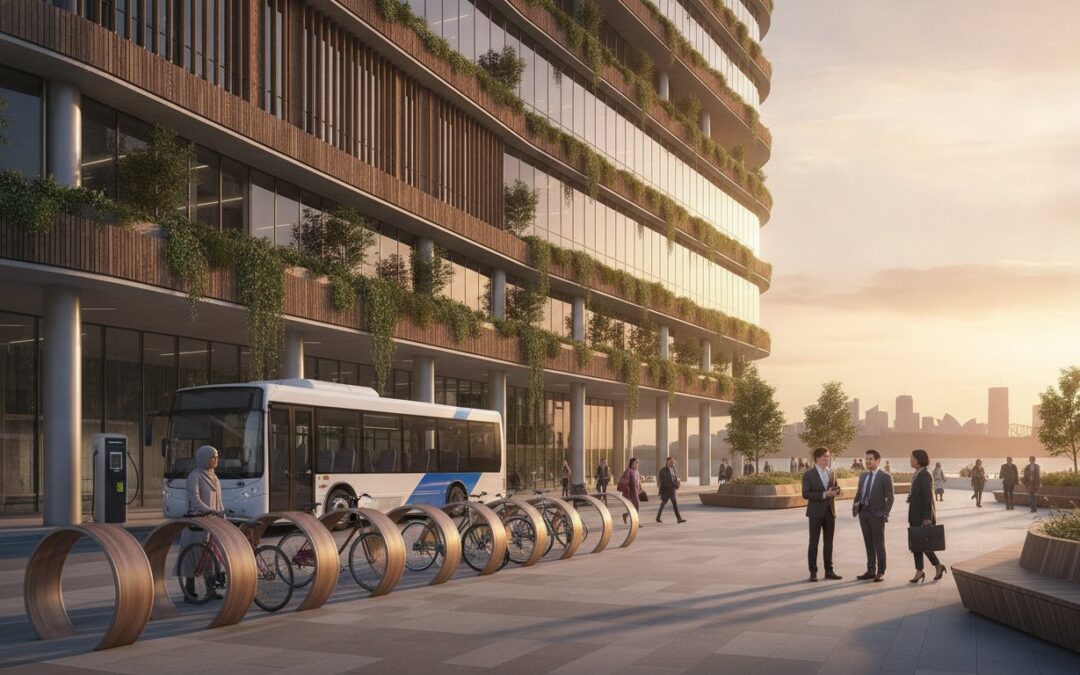
A 6-Star Green Star rating is frequently won or lost in the car park rather than the plant room. While solar arrays and high-performance facades are now standard, the “Movement and Connectivity” category often presents the most significant technical hurdle for developers. Balancing rigid Council parking requirements with the aggressive car-reduction goals of a world-leading project is a complex task. Securing a specialised traffic assessment for a 6-star green star building is the only way to bridge the gap between these competing regulatory demands while protecting your 70-point certification threshold.
We understand the pressure of ensuring every credit is documented to the highest standard of technical accuracy. This guide provides a clear roadmap for earning maximum transport points through optimised movement strategies and sustainable transport planning. You will learn how to integrate technical reports, such as swept path analysis and parking demand assessments, into your Green Star Buildings v1.1 submission. We also detail the shift toward performance-based travel plans and the critical role of senior engineering oversight in achieving compliance with both Australian Standards and Green Star benchmarks.
Key Takeaways
- Understand the transition to Green Star Buildings v1.1 and the critical role of the “Movement and Connectivity” category in achieving World Leadership status.
- Learn how a specialised traffic assessment for a 6-star green star building reconciles Council parking requirements with the car-reduction goals needed for a 70-point rating.
- Identify the technical requirements for active transport facilities to ensure bicycle parking and end-of-trip designs comply with AS 2890.3.
- Discover how vehicle swept path analysis supports circular economy credits by ensuring site access is optimised for sustainable delivery and waste collection vehicles.
- Recognise the value of direct access to senior traffic engineers to eliminate bureaucratic delays and ensure the technical integrity of your Green Star submission.
The Role of Transport in 6-Star Green Star Buildings
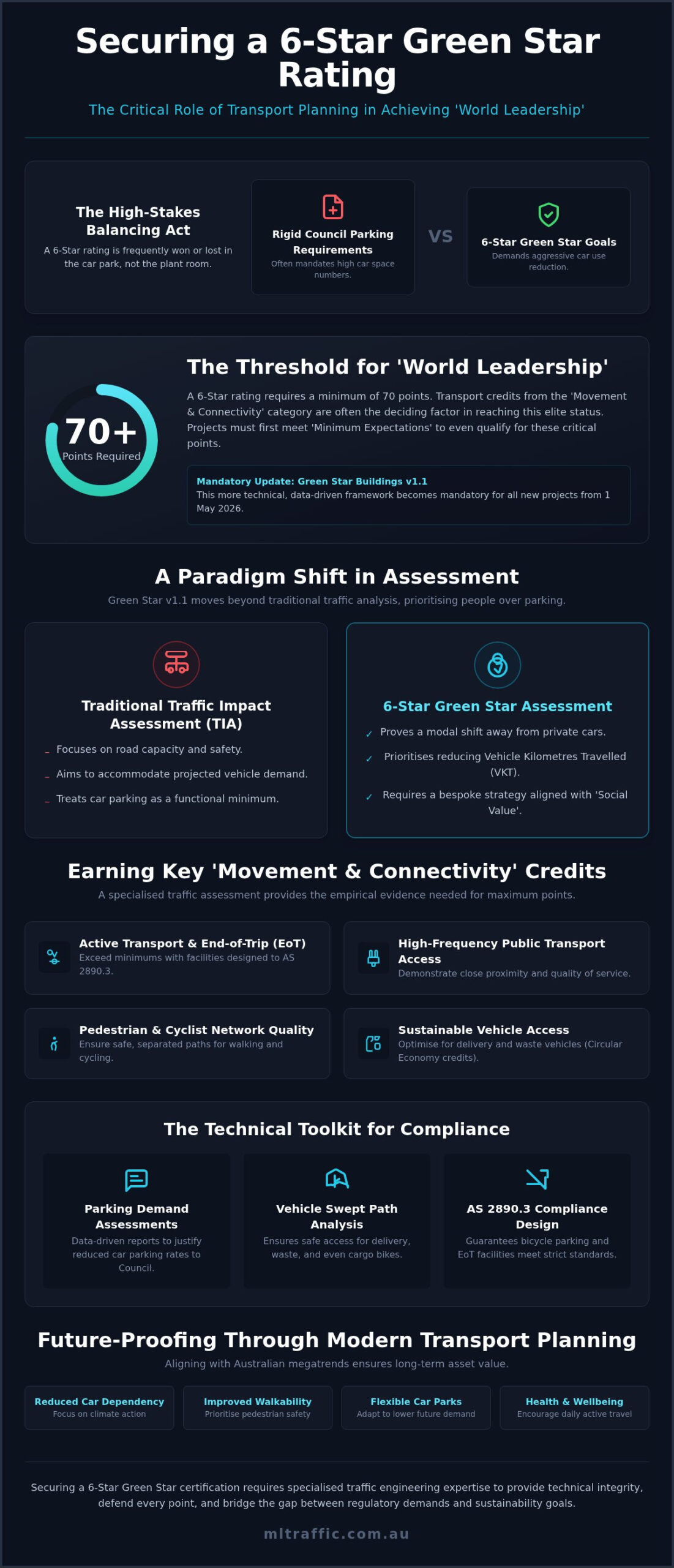
Achieving a 6-Star rating requires a project to demonstrate “World Leadership” in sustainability. Under the Green Star rating system, transport is no longer just a functional requirement; it is a core pillar of the assessment. A standard Traffic Impact Assessment (TIA) typically focuses on road capacity and safety, but a traffic assessment for a 6-star green star building must go further. It needs to prove how a site encourages a modal shift away from private vehicles. As of May 1, 2026, the transition to Green Star Buildings v1.1 is mandatory. This update consolidates transport requirements into the “Movement and Connectivity” category, making the engineer’s role more technical and data-driven than ever before.
The shift to v1.1 removes the previous focus on greenhouse gas emissions within the transport credit and instead prioritises the reduction of private vehicle use. This means developers cannot simply rely on carbon offsets to fix poor transport planning. Successful submissions require a detailed analysis of how people move to and from the site. This involves evaluating proximity to high-frequency public transport and the quality of the surrounding pedestrian network. A generic report will not satisfy the Green Star assessors; you need a bespoke strategy that aligns with the “Social Value” and “Positive” categories of the new framework.
Understanding the 70-Point Threshold
A 6-Star rating requires a minimum of 70 points. Transport credits are often the deciding factor in reaching this total. Before any points can be earned, projects must meet “Minimum Expectations” regarding access and basic infrastructure. Failing to meet these prerequisites disqualifies the project from earning higher-tier credits in the Movement and Connectivity category. World Leadership status represents the highest tier of Australian sustainability. Developers must provide rigorous evidence that their site supports active transport and reduces Vehicle Kilometres Travelled (VKT) to secure these critical points. The expertise provided by ML Traffic Engineers Australia ensures that every potential point is identified and defended with technical data.
Megatrends Shaping Australian Transport Planning
Australian transport planning is shifting toward climate action through reduced car dependency and improved walkability. Modern 6-Star projects prioritise pedestrian safety and high-frequency public transport access over expansive car parking. Traffic engineers now act as the bridge between sustainability goals and technical compliance. They future-proof assets by designing flexible car parks that can adapt to lower demand over the next decade. Integrating health and wellbeing into the movement network is also essential. This includes designing end-of-trip facilities that exceed the requirements of AS 2890.3 to encourage daily cycling and walking. Our specialised traffic services at ML Traffic Engineers Australia ensure your project remains relevant and compliant in a rapidly changing regulatory environment.
Key Movement and Connectivity Credits for Traffic Assessment
The “Movement and Connectivity” category in Green Star Buildings v1.1 rewards projects that facilitate efficient, low-carbon travel. For developers, this is where a technical traffic assessment for a 6-star green star building provides the empirical evidence required by the Green Building Council of Australia (GBCA). Unlike a standard development application, these credits require a granular look at how a site integrates with its broader urban fabric. Points are awarded for proximity to high-frequency transit, the quality of pedestrian routes, and the provision of high-specification active transport infrastructure.
Active Transport and End-of-Trip (EoT) Design
Meeting the 6-Star benchmark requires bicycle parking and locker facilities that significantly exceed minimum Council requirements. We calculate the required number of bike racks based on specific Green Star occupancy rates rather than just gross floor area. This design must comply strictly with AS 2890.3. A critical but often overlooked component is the use of vehicle swept path analysis to ensure access paths are wide enough for cargo bikes and non-standard bicycles. Safe movement within the car park is also paramount. We prioritise the physical separation of pedestrian and vehicle zones to ensure that walking to an EoT facility is as safe as it is convenient. Our specialised car park design services ensure these layouts meet both safety and sustainability criteria.
Public Transport Access and Connectivity
Documenting a project’s connectivity involves mapping transit frequency and “walk scores” for the formal submission. Assessors look for sites located within a short walking distance of high-frequency bus, train, or light rail hubs. A traffic assessment for a 6-star green star building must verify these distances using actual walking paths rather than “as the crow flies” measurements. This data often forms the foundation of a Green Travel Plan (GTP). A GTP is an operational document that supports the building’s ongoing rating by outlining strategies to maintain low private vehicle use throughout the life of the asset.
Reducing car parking is a core strategy for earning points in the “Positive” category. This is achieved through car-share integration and “unbundled parking” models, where car spaces are sold or leased separately from the building units. These strategies reduce the total volume of concrete required and discourage unnecessary vehicle ownership. By providing a technical Car Parking Demand Assessment, we can justify these reductions to local Councils while simultaneously securing the Green Star points needed for your 70-point target. This dual-purpose approach ensures that your transport strategy satisfies both regulatory compliance and world-leading sustainability standards.
Traditional TIA vs. Green Star Traffic Assessment
A standard development application focuses primarily on road safety, intersection capacity, and compliance with the AS 2890 series of Australian Standards. While these metrics remain essential, a traffic assessment for a 6-star green star building introduces a more complex layer of requirements. The Green Building Council of Australia (GBCA) prioritises modal shifts and the reduction of private vehicle kilometres travelled (VKT). This means the technical documentation must demonstrate not just how cars enter the site, but how the design discourages their use in favour of sustainable alternatives.
Managing conflicting goals is a common hurdle for developers in this space. Local Councils often mandate minimum parking rates to prevent overflow into surrounding streets. Conversely, Green Star Buildings v1.1 encourages maximum parking limits to drive sustainability outcomes. Resolving this tension requires a data-led approach. A specialised Traffic Impact Assessment acts as the technical bridge, providing the empirical evidence needed to satisfy both the Council’s safety concerns and the GBCA’s world-leading sustainability benchmarks.
Designing for Electric Vehicle (EV) Readiness
Under the new Green Star framework, EV charging requirements have moved to the “Low-Emissions Transport” credit. Achieving a 6-Star rating requires a significant commitment to EV infrastructure, often involving 100% EV readiness for all parking spaces. This isn’t just about electrical capacity. It’s a traffic engineering challenge. We assess how charging stations and dwell times affect internal traffic flow, car park layout, and sight distances. Proper planning ensures that the transition to electric mobility doesn’t compromise the functional efficiency of the basement car park.
Car Parking Demand and Reduction Strategies
Reducing the total number of car spaces is one of the most effective ways to secure transport points. We use a technical Car Parking Demand Assessment to justify lower parking rates based on the site’s specific connectivity and transit access. Car-sharing pods are another critical tool, providing residents and tenants with on-demand mobility without the need for private vehicle ownership. We also recommend implementing unbundled parking. By separating the cost of a car space from the property title or lease, developers create a direct financial incentive for occupants to choose active or public transport. This strategy is essential for projects aiming for the 70-point 6-Star threshold while simultaneously reducing construction costs associated with deep basement excavation.
Technical Requirements: Swept Paths and Site Access
Technical precision in a traffic assessment for a 6-star green star building extends beyond basic vehicle entry. A world-leading project requires a sophisticated approach to site access that accommodates sustainable delivery vehicles and heavy electric trucks. Unlike traditional developments where loading docks are often an afterthought, Green Star projects must integrate these functional areas without compromising the safety or quality of the pedestrian environment. Using AutoTURN, we perform rigorous Swept Path Analysis to verify that even the most complex urban sites can handle the operational demands of a high-performance building.
Waste management is a critical component of the “Circular Economy” credits within the Green Star framework. To earn these points, the site must facilitate efficient waste separation and collection. This often necessitates larger or more specialised collection vehicles. If the swept path analysis fails to account for these specific vehicle dimensions, the entire waste management strategy is compromised. We ensure that every turn, reverse manoeuvre, and loading bay interaction is technically sound. Our senior principals oversee every traffic assessment for a 6-star green star building to ensure these technical details are never overlooked, preventing operational bottlenecks that could threaten the 70-point certification threshold.
Delivery and Service Vehicle Management
Modern 6-Star developments frequently experience more frequent deliveries from smaller, low-emission vehicles. We optimise loading dock designs to handle this high-turnover traffic while ensuring that service vehicle paths never intersect with active transport zones. This physical separation is essential for maintaining the integrity of bicycle lanes and pedestrian thoroughfares. By integrating waste collection directly into the traffic management plan, we provide a seamless operational flow that supports the building’s long-term sustainability goals. If your project involves tight urban constraints, you can request a vehicle swept path analysis to confirm site feasibility early in the design phase.
Driveway Ramps and Pedestrian Safety
Driveway design in high-density Green Star projects requires a delicate balance between vehicle grade requirements and pedestrian visibility. We ensure all driveway ramps comply with AS 2890.1, but we also prioritise sightlines for people using the adjacent footpaths. A technical Sight Distance Assessment is a non-negotiable requirement for 6-Star submissions. It provides the documented proof that the interface between the building and the public domain is safe for all users. We also specialise in designing “shared zones” where the environment is engineered to prioritise people over cars. These zones use specific paving, signage, and narrowing techniques to naturally reduce vehicle speeds, creating a safer and more inclusive site access network.
Selecting a Traffic Engineer for Your 6-Star Project
Navigating the Green Star Buildings v1.1 framework requires more than just a generalist approach. A traffic assessment for a 6-star green star building is a high-stakes technical document. If the data is flawed or the documentation lacks the required rigour, the project risks falling short of the 70-point threshold. Senior-level expertise is non-negotiable because the “Movement and Connectivity” credits involve reconciling conflicting regulatory requirements. ML Traffic Engineers Australia provides a “no-gatekeepers” approach where you work directly with our senior principals. This ensures that the expert who initiates the project performs the technical work. Continuity is essential for maintaining the integrity of the submission throughout the certification process.
ML Traffic Engineers Australia integrates seamlessly with your wider sustainability team. While sustainability consultants lead the overall rating strategy, we provide the technical engineering data required to defend transport-related claims. We translate sustainability goals into compliant car park designs and functional site access plans. This collaborative approach ensures that the transport strategy doesn’t exist in a vacuum but supports the broader objectives of the project, such as circular economy waste goals and social value outcomes.
Experience with Australian Standards and GBCA
A consultant’s track record with Traffic Engineering for complex developments must be verified before engagement. 6-Star projects require meticulous documentation to withstand GBCA audit trails. Every swept path, car park design choice, and transport demand calculation must be defensible under technical scrutiny. Having 15+ years of experience in Australian transport planning is vital for navigating the specific nuances of both local Council expectations and the GBCA’s stringent world-leadership requirements. Our reports provide the granular data needed to secure points in the Social Value and Positive categories by adhering to the latest 2026 regulatory standards.
Getting Started with Your Traffic Assessment
Engaging a traffic engineer early in the design process is the most effective way to avoid costly redesigns. When we are involved during the concept phase, we can optimise the site layout for active transport and delivery access before the building footprint is finalised. Preparing the brief for a Green Star compliant traffic report requires clear objectives regarding the desired number of transport points. Developers should provide preliminary architectural site plans, target occupancy rates, and specific transport credits being targeted under v1.1. The senior engineers at ML Traffic Engineers Australia handle the technical complexities of the traffic assessment for a 6-star green star building from inception to submission. To discuss your project requirements, contact the experts at ML Traffic Engineers Australia for a tailored assessment plan.
Securing Your World Leadership Rating
Achieving a 6-Star rating requires a precise alignment between your sustainability vision and the technical realities of site movement. As the transition to the new v1.1 framework becomes standard, the technical documentation for transport must be more rigorous than ever. A specialised traffic assessment for a 6-star green star building provides the empirical data needed to defend car-reduction strategies and active transport designs during the GBCA audit process. By prioritising connectivity and pedestrian safety, you secure the points necessary for the 70-point threshold while creating a more functional, future-proof asset.
ML Traffic Engineers Australia brings 15+ years of specialised traffic engineering experience to your development team. We provide direct principal-led consultancy, ensuring that a senior expert manages the technical complexities of your swept path analysis and car park design. This hands-on approach eliminates the delays often associated with larger firms and ensures your traffic reports integrate seamlessly with the broader Green Star submission. With comprehensive AutoTURN swept path capabilities, we act as your technical partner in navigating both Council mandates and world-leading sustainability benchmarks.
Request a 6-Star Green Star Traffic Assessment Quote
We are ready to provide the technical expertise required for your 6-Star submission and look forward to supporting your project’s success.
Frequently Asked Questions
How many points is the transport category worth in Green Star Buildings v1.1?
The “Movement and Connectivity” category is a fundamental part of the performance-based pathway. While a 6-Star rating requires a total of 70 points, the transport-related credits are vital for reaching this world-leadership threshold. Points are awarded for proximity to transit and high-quality active transport provision. You must first meet the “Minimum Expectations” before any points are awarded. This ensures the project has a baseline of accessibility before seeking higher-tier credits.
Do I need a separate traffic report for my Green Star submission and my DA?
You generally need a specialised traffic assessment for a 6-star green star building in addition to your standard DA documentation. A DA report focuses on road safety and intersection capacity. A Green Star submission requires evidence of modal shifts and vehicle kilometres travelled (VKT) reduction. While data sets overlap, the reporting frameworks and technical benchmarks are distinct. We ensure that both reports align to prevent design outcomes that don’t satisfy all regulatory bodies.
What are the bicycle parking requirements for a 6-Star Green Star building?
Bicycle parking must comply with AS 2890.3 and is calculated based on building occupancy rates rather than gross floor area. For 6-Star projects, the provision levels usually exceed local Council requirements significantly. You must also provide end-of-trip facilities, such as showers and lockers, that meet the Green Star “Active Transport Facilities” credit criteria. Meticulous car park design is required to ensure these facilities are accessible and safe for all building users.
Can I earn Green Star points for reducing car parking below Council minimums?
You can earn points by implementing car-reduction strategies such as unbundled parking and car-share integration. These measures discourage private vehicle ownership and support the “Sustainable Transport” credit. We use a Car Parking Demand Assessment to provide the technical justification needed for local Council approval. This allows developers to reduce basement excavation costs while they’re securing the points required for a 6-Star rating.
Is swept path analysis mandatory for Green Star certification?
Swept path analysis is essential for proving the site can accommodate sustainable delivery vehicles and waste collection trucks. Without this technical verification, you cannot satisfy the “Circular Economy” or service-related credits. We use AutoTURN to simulate non-standard vehicle movements, ensuring that loading docks are functional. This prevents operational issues and provides the GBCA with the rigorous evidence needed for a traffic assessment for a 6-star green star building.
How does EV charging infrastructure affect my traffic assessment?
EV infrastructure has moved to the “Low-Emissions Transport” credit under the v1.1 framework. It affects your traffic assessment by requiring specific car park layouts that accommodate charging stations without hindering internal traffic flow. We assess the impact of dwell times and bay locations on overall site safety. Proper planning ensures that the transition to electric mobility is integrated seamlessly into the building’s movement network without creating basement congestion.
What is a Green Travel Plan and who prepares it?
A Green Travel Plan is a strategic document that outlines how the building will encourage sustainable transport modes. It is typically prepared by a qualified traffic engineer during the design phase. The plan includes measurable targets for reducing car dependency and improving transit use. For a 6-Star rating, the GTP must be comprehensive and supported by technical data to prove the building’s long-term operational sustainability to the GBCA.
How do I document public transport frequency for a 6-Star rating?
Public transport frequency is documented by mapping actual pedestrian routes to the nearest transit hubs. You must provide evidence of service frequency during peak periods to satisfy the “Sustainable Transport” credit. This involves verifying that the site is within a specific walking distance of high-frequency bus, train, or light rail networks. We provide the detailed transit mapping required to ensure your submission meets the GBCA’s technical standards.

Disclaimer
The content on www.mltraffic.com.au, including all technical articles, guides, and resources, is provided for general informational and educational purposes only. It is not intended to constitute professional advice in traffic engineering, transportation planning, development approvals, or any other technical or legal field.
While ML Traffic Engineers makes every reasonable effort to ensure the accuracy, completeness, and timeliness of the information published, we do not provide any warranties or representations (express or implied) regarding its reliability, suitability, or availability for any particular purpose. Any reliance you place on the content is strictly at your own risk.
In no event shall ML Traffic Engineers, its directors, employees, authors, or affiliates be liable for any direct, indirect, incidental, special, consequential, or punitive damages (including, without limitation, loss of profits, data, or business opportunities) arising out of or in connection with the use of, or inability to use, any information provided on this website.
The articles and guides on this site are not a substitute for engaging a qualified, registered professional traffic engineer (such as an NPER or RPEQ engineer) to assess your specific project requirements. For tailored advice, compliance assessments, or traffic engineering services, please contact a competent professional.
This disclaimer may be updated from time to time without notice. By accessing or using this website, you agree to be bound by the most current version of this disclaimer.
