

We are traffic engineers servicing Arthurs Creek, Bend of Islands, Briar Hill, Christmas Hills, Cottles Bridge, Diamond Creek, Doreen, Eltham, Eltham North, Greensborough, Hurstbridge, Kangaroo Ground, Kinglake, Kinglake Central, Kinglake West, Nutfield, Panton Hill, Plenty, Research, Smiths Gully, St Andrews, Strathewen, Warrandyte North, Watsons Creek, Wattle Glen, Yan Yean, Yarrambat.
A development application within the Nillumbik Shire can be stalled or rejected for one critical reason: an inadequate traffic and parking assessment. The risk of costly Requests for Information (RFIs) and significant project delays is high when developers are forced to interpret dense planning documents and are unsure of the specific triggers that mandate a formal report. For developers, this uncertainty is a direct threat to project viability. Successfully undertaking Traffic and Car Parking Impact Assessments in Nillumbik Council requires a precise understanding of local requirements that goes beyond generic templates.
This definitive guide eliminates that uncertainty. We provide a clear, step-by-step process designed specifically for navigating the Nillumbik Shire Council’s unique planning controls. Inside, you will learn the exact criteria that trigger the need for a traffic report, the key technical components of a compliant submission, and the professional standards required to satisfy Council planners. Following this guide ensures your traffic and parking report is not a liability, but a tool that supports a smooth and timely approval for your development application.
Key Takeaways
-
Understand why Nillumbik Council’s unique semi-rural character and Green Wedge zones demand a specialised approach to traffic planning beyond standard assumptions.
-
Successfully undertaking Traffic and Car Parking Impact Assessments in Nillumbik Council requires a clear understanding of the specific process and common application pitfalls to prevent delays.
-
Discover the essential components of a compliant traffic and parking report, with an emphasis on data grounded in local Nillumbik conditions, not generic models.
-
Learn how engaging a qualified traffic engineer early is a critical investment to ensure project certainty and streamline the development application approval process.
Table of Contents
-
Understanding Why Nillumbik Council Requires a Traffic & Parking Assessment
-
Core Components of a Nillumbik-Compliant Traffic and Parking Report
-
The Assessment Process with Nillumbik Council: A Step-by-Step Guide
Understanding Why Nillumbik Council Requires a Traffic & Parking Assessment
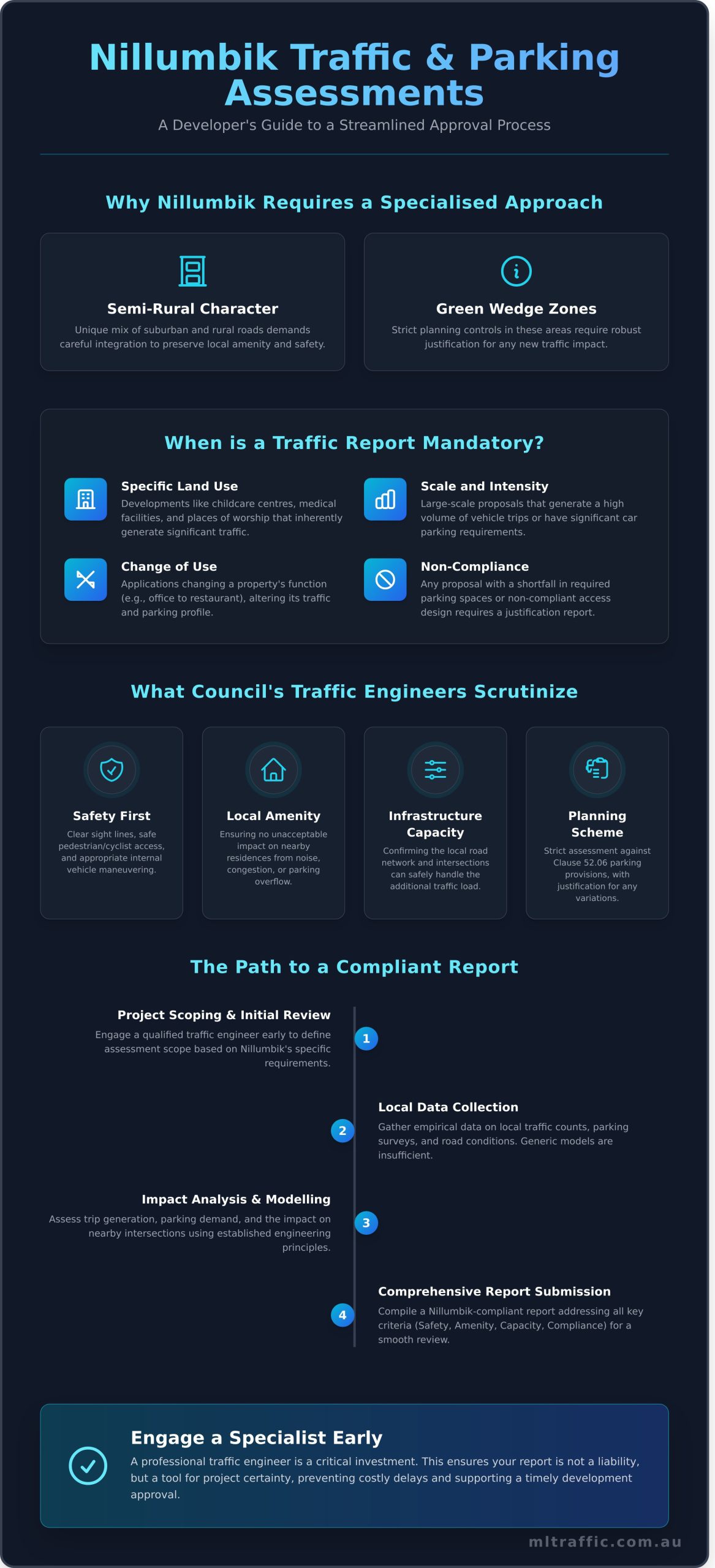
Nillumbik Shire Council mandates a traffic and parking assessment for specific development applications to uphold its core objectives: ensuring public safety, preserving local amenity, and managing the capacity of its road network. For developers, undertaking Traffic and Car Parking Impact Assessments in Nillumbik Council is a critical step. The Shire’s unique mix of suburban areas, Green Wedge zones, and semi-rural roads demands a rigorous approach to ensure new developments integrate safely without overwhelming existing infrastructure. The process is grounded in established traffic engineering principles, which provide the analytical framework for evaluating a development’s impact.
To better understand the core components of this assessment, the following video provides a clear overview:
The Nillumbik Planning Scheme is the primary policy document that dictates these requirements. Depending on a project’s scale and potential impact, the council may require either a brief Traffic Impact Statement (TIS) for smaller issues or a comprehensive Traffic Impact Assessment (TIA) for larger, more complex developments. A successful application demonstrates a clear understanding of these local policies and environmental characteristics.
Key Triggers for a Report in Nillumbik
A formal traffic report is not discretionary; it is mandated when a development application meets certain criteria. Key triggers include:
-
Specific Land Use: Developments known to generate significant traffic, such as childcare centres, medical facilities, places of worship, and larger retail or commercial premises, automatically require an assessment.
-
Scale and Intensity: Proposals that generate a high number of vehicle trips or require a large number of car parking spaces often trigger the need for a TIA.
-
Change of Use: An application to change the use of a property (e.g., from an office to a restaurant) will trigger a new assessment, as the traffic and parking profile will change significantly.
-
Non-Compliance: Any proposal that includes a shortfall in the required number of parking spaces or features a non-compliant access driveway design will require a report to justify the variation.
What Council’s Traffic Engineers Look For
When reviewing a report, Nillumbik Council’s traffic engineers focus on several critical outcomes to ensure the proposed development is acceptable:
-
Safety: The primary consideration is the safety of all road users. This includes assessing sight lines at access points, pedestrian and cyclist safety, and the suitability of internal layouts for vehicle manoeuvring.
-
Amenity: The assessment must demonstrate that traffic increases will not unacceptably impact the amenity of nearby residential areas through excessive noise, congestion, or on-street parking overflow.
-
Infrastructure Capacity: The report must confirm that the surrounding road network and intersections can safely and efficiently accommodate the additional traffic generated by the development.
-
Planning Scheme Compliance: The proposal must be assessed against the car parking provisions outlined in Clause 52.06 of the Nillumbik Planning Scheme, justifying any proposed deviations.
Core Components of a Nillumbik-Compliant Traffic and Parking Report
A successful development application hinges on a traffic and parking report that is comprehensive, data-driven, and meticulously aligned with council expectations. Generic reports based on broad assumptions are insufficient. The process of undertaking Traffic and Car Parking Impact Assessments in Nillumbik Council demands an analysis grounded in local conditions and empirical data, operating within the framework established by state bodies like the Victorian Department of Transport and Planning. A compliant report is structured around three critical assessments, each requiring specific technical detail and clear, professional presentation.
Traffic Impact Assessment (TIA)
The TIA quantifies the development’s effect on the surrounding road network. It is not a theoretical exercise but a factual analysis. Key components mandated by the council include:
-
Existing Conditions: Defining the current baseline through on-site traffic counts, intersection surveys, and analysis of existing road performance.
-
Traffic Generation: Forecasting future traffic volumes generated by the development, calculated using recognised sources such as the RMS Guide to Traffic Generating Developments.
-
Impact Analysis: Modelling the performance of nearby intersections and road links with the additional traffic load to identify any potential capacity or safety issues.
-
Mitigation Measures: Proposing clear, actionable recommendations to offset any identified negative impacts, such as signal adjustments or minor roadworks.
Car Parking Demand and Design Assessment
This section demonstrates that the proposed parking provisions are adequate and functional. It must prove compliance with both council rates and Australian Standards. The assessment must detail the calculation of required parking spaces based on the Nillumbik Planning Scheme. If a shortfall is proposed, it must be rigorously justified with a site-specific parking demand study. Furthermore, the physical layout of the car park—including space dimensions, aisle widths, ramp grades, and clearances—must strictly comply with AS 2890.1 and AS 2890.6 (for accessible parking). A well-designed car park is a key part of our core services.
Vehicle Access and Swept Path Analysis
Safe and efficient vehicle access is non-negotiable for council approval. This assessment scrutinises the proposed driveway location for adequate sight lines, safety for pedestrians and cyclists, and functionality. A critical element is the provision of scaled AutoTURN diagrams, which demonstrate that the largest expected vehicle (typically a council waste collection truck or delivery vehicle) can safely enter and exit the site in a forward direction without encroaching on opposing traffic lanes. This swept path analysis confirms compliance with AS 2890.2 for heavy vehicle facilities where applicable.
The Assessment Process with Nillumbik Council: A Step-by-Step Guide
Successfully undertaking Traffic and Car Parking Impact Assessments in Nillumbik Council requires a structured, four-step approach. This process maps the journey from initial project conception through to the final Development Application (DA) submission and council review. Engaging a qualified traffic engineer at the earliest design stage is critical to ensure a smooth and efficient assessment, minimising the risk of costly delays and redesigns down the line.
Step 1: Pre-Application Consultation & Scoping
Before significant design costs are incurred, a pre-lodgement meeting with Nillumbik Council’s planning and traffic departments is highly recommended. An experienced traffic consultant can facilitate this meeting, helping to define the precise scope of the required assessment. This early engagement is invaluable for identifying potential ‘red flags’—such as inadequate sight lines, access constraints, or non-compliant parking layouts—allowing for design adjustments before plans are finalised.
Step 2: Data Collection and Site Investigation
The foundation of a robust traffic report is accurate data. This stage involves a thorough site investigation, which includes:
-
Conducting traffic and parking surveys to establish a baseline of existing conditions on the surrounding road network.
-
Photographing key site features, including proposed access points, street frontages, and existing parking arrangements.
-
A detailed review of the site’s unique constraints and opportunities, such as topography, vegetation, and proximity to intersections.
Step 3: Report Preparation and DA Submission
With all data collected, the analysis is consolidated into a professional Traffic and Car Parking Impact Assessment report. This document methodically addresses all requirements stipulated in the Nillumbik Planning Scheme, presenting clear findings on traffic generation, parking demand, and access safety. The completed report is then submitted to the council as a key supporting document within your overall DA package, demonstrating due diligence and compliance.
Step 4: Navigating Council Feedback and RFIs
It is common for council to issue a Request for Further Information (RFI) after their initial review. An RFI is a formal request for clarification or additional analysis on specific points within the report. An experienced consultant can interpret these queries accurately and formulate a comprehensive, evidence-based response. A timely and professional reply is essential to avoid stalling the application process. If you’re facing a complex RFI, contact our senior engineers directly for advice.
Common Pitfalls in Nillumbik and How to Avoid Them
Navigating the development application process requires meticulous attention to detail. When undertaking Traffic and Car Parking Impact Assessments in Nillumbik Council, several common errors can lead to significant delays, requests for further information (RFIs), or outright refusal. Understanding these pitfalls is the first step in avoiding them.
The most effective risk mitigation strategy is engaging an experienced traffic engineering consultant from the outset. A professional assessment identifies and resolves these issues before they reach council, ensuring a more streamlined application process.
Inadequate Parking Provision or Justification
A frequent point of failure is a miscalculation or poor justification of car parking. This typically involves:
-
Misinterpreting Parking Rates: Applying generic rates instead of the specific requirements detailed in Clause 52.06 of the Nillumbik Planning Scheme.
-
Weak Justification for Shortfalls: Failing to provide a robust, data-backed case for any proposed reduction in parking spaces.
-
Non-Compliant Design: Proposing a car park layout that fails to meet Australian Standard AS 2890.1, with impractical turning circles, narrow aisles, or unusable spaces.
Ignoring Local Site Constraints and Amenity
Nillumbik’s unique character, with its blend of suburban and semi-rural environments, presents specific challenges that generic assessments overlook. Key oversights include ignoring sightline issues caused by dense vegetation or the area’s hilly topography. Proposing vehicle access points on narrow, unsealed rural roads without proper analysis is a critical error, as is underestimating the acoustic impact of increased traffic on nearby residential properties.
Submitting a Generic or Incomplete Report
A poorly prepared report signals a lack of due diligence to council planners. A submission is likely to be rejected if it uses outdated or non-local traffic data, which is easily identified by council’s engineers. Reports often fail because they are incomplete, lacking mandatory components like a detailed swept path analysis for delivery or waste collection vehicles. A confusing, poorly written document only serves to frustrate council officers and delay your project. You can learn more about our rigorous approach from our past projects and articles.
Why Engage a Specialist for Your Nillumbik Development?
The process of Undertaking Traffic and Car Parking Impact Assessments in Nillumbik Council is more than a procedural requirement; it is a complex technical analysis with high stakes. An incomplete or inaccurate report inevitably leads to Requests for Further Information (RFIs), causing significant project delays and expensive redesigns. Engaging a specialist traffic engineer is not an operational cost—it is a critical investment in project certainty, speed, and overall viability.
Local Knowledge and Council Experience
An experienced consultant provides value that extends beyond technical calculations. It involves a deep understanding of the specific preferences and unwritten policies of Nillumbik Council’s traffic engineering department. A history of successful submissions builds professional rapport with council officers, which helps streamline the review process. This familiarity with Nillumbik’s unique road network—from its busy arterial roads to its semi-rural streets—ensures your assessment is practical, relevant, and defensible.
Saving Time and Money
The primary financial benefit of expert engagement is risk mitigation. A specialist identifies potential traffic, access, or parking issues early in the design phase, preventing the need for costly and time-consuming architectural changes later. The objective is to deliver a comprehensive, ‘first-time-right’ report that addresses all of council’s likely concerns upfront. This proactive approach helps you avoid the substantial holding costs in A$ associated with a stalled Development Application.
-
Prevent redesigns by providing critical traffic engineering input at the preliminary design stage.
-
Minimise delays with a complete and compliant submission that satisfies council requirements.
-
Avoid holding costs by securing a faster planning permit and moving your project forward.
The ML Traffic Engineers Advantage
At ML Traffic Engineers, we offer a distinct and accountable service model. We eliminate the layers of project managers and junior staff common in larger firms. The consultant who provides your quote is the senior engineer who personally completes the technical work and signs off on the report. With over 15 years of experience focused exclusively on traffic reports for development applications, our principals provide direct, authoritative advice. This ensures every aspect of your Nillumbik project receives the highest level of scrutiny and expertise. Learn more about our experienced team and our hands-on approach.
Secure Your Nillumbik Development Approval with Expert Guidance
Successfully undertaking Traffic and Car Parking Impact Assessments in Nillumbik Council is a critical step for any development. As we’ve outlined, a compliant report is not merely a formality; it is a fundamental component for avoiding costly delays and ensuring your project aligns with the council’s specific planning scheme and local traffic management objectives.
Navigating these requirements demands specialised expertise. At ML Traffic Engineers, our team offers over 15 years of dedicated experience, delivering robust and defensible traffic reports. We have a proven track record with Development Applications across Victorian councils, and our commitment to quality means you receive direct access to senior engineers on every project. This hands-on approach ensures all potential pitfalls are identified and addressed proactively, positioning your application for a smoother assessment process.
Ensure your Nillumbik project moves forward without unnecessary complications. Request a free, no-obligation quote for your Nillumbik project today and let our experts provide the clarity and confidence you need to succeed.
Frequently Asked Questions
How much does a traffic and parking assessment cost for a project in Nillumbik?
A standard Traffic Impact Statement for a small-to-medium development in Nillumbik typically costs between A$2,000 and A$4,000 + GST. More complex projects requiring detailed traffic modelling or on-site surveys can range from A$5,000 to over A$10,000. The final cost is determined by the project’s scale, the specific requirements of the Nillumbik Planning Scheme, and the level of assessment required. We provide a fixed-fee proposal after a preliminary review of your project plans.
How long does it take to prepare a traffic report and get it reviewed by Nillumbik Council?
Our standard turnaround for preparing a traffic report is typically 5-10 business days from receiving all necessary project information. The council’s review time is separate and can vary. Nillumbik Council’s traffic engineering department generally takes 4-8 weeks to review a report as part of the overall development application process. This timeline can be extended if the council issues a Request for Further Information (RFI), making a comprehensive initial submission critical to avoid delays.
My project is very small. Do I still need a full Traffic Impact Assessment?
Not all projects require a full Traffic Impact Assessment (TIA). For smaller developments, such as a dual-occupancy or a minor commercial change of use, Nillumbik Council may only require a more concise Traffic Impact Statement or a Car Parking Demand Assessment. The need for a report is triggered by specific clauses in the Nillumbik Planning Scheme, often related to the number of car spaces proposed or required. We can assess your plans to determine the appropriate level of assessment.
What is a ‘parking waiver’ or ‘car parking reduction’ and how can I justify one to the council?
A car parking reduction, or waiver, is a formal request to provide fewer car parking spaces than the statutory rate required by Clause 52.06 of the Nillumbik Planning Scheme. Justification requires a robust Car Parking Demand Assessment. This report must present evidence, such as proximity to public transport, availability of on-street parking, shared parking arrangements, or data from comparable sites, to demonstrate that the proposed lower rate will not negatively impact the local area’s amenity.
Can my architect or planner prepare the traffic report for me?
No. Nillumbik Council requires traffic and parking assessments to be prepared by a qualified and experienced traffic engineer. These reports involve technical analysis, including swept path diagrams, sightline assessments, and parking demand calculations that must comply with Australian Standards (e.g., AS 2890.1). An architect or planner lacks the specific qualifications for this specialised work. Submitting a report from an unqualified person will almost certainly result in an RFI or rejection from the council.
What are the most common reasons Nillumbik Council issues an RFI for a traffic report?
The most common reasons for an RFI when undertaking Traffic and Car Parking Impact Assessments in Nillumbik Council include non-compliant car park or accessway design that fails to meet Australian Standard AS 2890.1. Other frequent issues are insufficient justification for a car parking reduction, inaccurate traffic generation estimates, or failure to adequately assess vehicle swept paths for service and waste collection vehicles. A professionally prepared report addresses these technical points to minimise delays.
