

We are traffic engineers servicing Ashwood, Burwood, Chadstone, Clayton, Glen Waverley, Hughesdale, Huntingdale, Mount Waverley, Mulgrave, Notting Hill, Oakleigh, Oakleigh East, Oakleigh South, Wheelers Hill.
A development application’s success within the City of Monash often depends on one critical document: the Traffic and Car Parking Impact Assessment. Many developers face costly delays or rejections due to reports that fail to address the council’s specific and often complex local planning policies. The official guidelines can be difficult to interpret, creating uncertainty and risk. For this reason, the process of undertaking Traffic and Car Parking Impact Assessments in Monash Council demands precision and proven local experience to avoid these setbacks.
This definitive guide provides a direct, professional framework for your Monash development. We will detail the essential components of a compliant traffic report, outline the council’s engineering review process from start to finish, and provide a checklist to ensure every requirement is met. Our objective is to equip you with the technical understanding needed to navigate the assessment process with confidence and secure timely council approval for your project.
Key Takeaways
-
Understand the specific triggers in the Monash Planning Scheme that mandate a Traffic Impact Assessment to avoid unexpected application requirements.
-
Successful undertaking of Traffic and Car Parking Impact Assessments in Monash Council requires a report that directly addresses their specific checklist, not a generic template.
-
Learn to correctly interpret Clause 52.06 to determine the precise number of car parking spaces your development must provide for compliance.
-
Identify the most common technical refusal points for Monash DAs, allowing you to proactively address them and prevent costly delays.
Table of Contents
-
When and Why Monash Council Requires a Traffic Impact Assessment
-
Core Components of a Monash-Compliant Traffic & Parking Report
-
Decoding Monash’s Car Parking Requirements: Clause 52.06 and Beyond
-
The Submission & Review Process: A Step-by-Step Guide for Developers
-
Avoiding Common Refusal Points: Expert Insights for Monash DAs
When and Why Monash Council Requires a Traffic Impact Assessment
A Traffic Impact Assessment (TIA) is a mandatory technical report required by the City of Monash for many Development Applications (DAs). The primary objective for Council is to ensure any new development does not adversely affect road safety, network efficiency, or local residential amenity. For those new to the process, it is useful to understand what is a Traffic Impact Assessment? at a foundational level, as it is a formal procedure for evaluating the consequences of a proposed action. Successfully undertaking Traffic and Car Parking Impact Assessments in Monash Council is therefore a critical step for project approval.
To provide a clearer understanding of the assessment process, the following video offers a practical overview:
Common development types that consistently require a traffic report in Monash include childcare centres, medical facilities, places of worship, multi-dwelling residential buildings, and commercial or industrial premises with high vehicle turnover. Council’s review ensures the proposed car parking supply, access arrangements, and traffic generation are appropriate for the site and its context.
Key Triggers in the Monash Planning Scheme
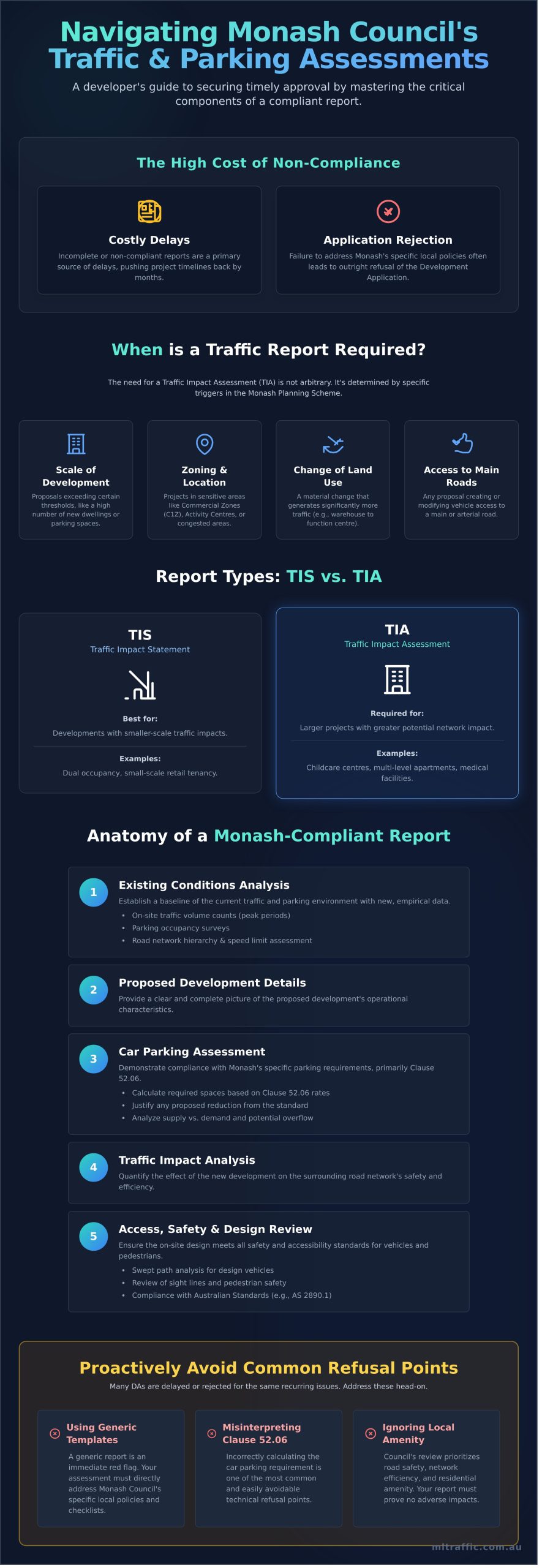
The requirement for a traffic report is not arbitrary; it is determined by specific triggers outlined in the Monash Planning Scheme. While each application is assessed on its merits, a TIA is generally required based on the following factors:
-
Scale of Development: Proposals exceeding certain thresholds, such as a specific number of new dwellings or the provision of a high volume of car parking spaces.
-
Zoning and Location: Developments located within sensitive areas like Commercial 1 Zones (C1Z), Activity Centres, or areas with existing traffic congestion.
-
Change of Land Use: A material change in land use that is likely to generate significantly more traffic than the previous use, for example, converting a warehouse into a function centre.
-
Access to Main Roads: Any proposal that involves creating or modifying a vehicle access point to a main or arterial road.
Traffic Impact Statement (TIS) vs. Traffic Impact Assessment (TIA)
Monash Council may require one of two types of reports. A Traffic Impact Statement (TIS) is a concise report suitable for developments with smaller-scale traffic impacts, such as a dual occupancy or a small-scale retail tenancy. In contrast, a comprehensive Traffic Impact Assessment (TIA) is required for larger projects like childcare centres or multi-level apartment buildings that have a greater potential to affect the surrounding road network. The Council will specify which type of report is necessary during the pre-application stage or upon submission of the DA.
Core Components of a Monash-Compliant Traffic & Parking Report
Submitting a generic traffic report to the City of Monash is insufficient for gaining approval. The Council requires a detailed, evidence-based assessment that directly addresses local planning scheme requirements and engineering standards. A compliant report is not a template; it is a technical document built on rigorous data analysis and a clear, logical structure. The methodology for these reports is well-defined, following principles outlined in publications such as the Austroads Guide to Traffic Management. The following components represent the essential chapters required when undertaking Traffic and Car Parking Impact Assessments in Monash Council and form the basis of our professional traffic engineering services.
Existing Conditions Analysis
This foundational section establishes a baseline of the current traffic and parking environment. It is based on direct observation and data collection, not assumptions. A thorough analysis must document:
-
On-site Surveys: Conducting new traffic volume counts during peak periods and assessing current on-street and off-street parking occupancy levels.
-
Road Network Assessment: An evaluation of the surrounding road hierarchy, posted speed limits, intersection controls, and public transport services.
-
Access and Safety: A detailed review of existing vehicle access points, driveway gradients, and sightline distances to ensure compliance with Australian Standards (AS 2890.1).
Traffic Generation, Distribution, and Assignment
This section quantifies the traffic impact of the proposed development. The process involves estimating the number of new vehicle trips the site will generate based on its size and use, referencing accepted rates from VicRoads or other relevant transport authorities. This new traffic is then distributed onto the local road network and assigned to key intersections. This data is often used in specialised software to model the performance of intersections post-development, identifying potential capacity issues.
Impact Analysis and Mitigation Measures
The final critical component assesses the consequences of the additional traffic. The report must provide a conclusive professional opinion on the development’s impact on road safety and network congestion. Where impacts are identified, practical and effective mitigation measures must be proposed. Examples include:
-
Recommending new line marking or signage.
-
Proposing upgrades to intersections, such as traffic signals or roundabouts.
-
Modifying site access arrangements to improve safety and flow.
This analysis provides Monash Council with the assurance that the development’s traffic impact is understood and can be managed appropriately.
Decoding Monash’s Car Parking Requirements: Clause 52.06 and Beyond
Car parking provision is consistently one of the most scrutinised elements of any development application within the City of Monash. The primary policy governing these requirements is Clause 52.06 of the Monash Planning Scheme. This clause provides the statutory basis for calculating the minimum number of car spaces required for a new use or development. A critical component of undertaking Traffic and Car Parking Impact Assessments in Monash Council is demonstrating full compliance with, or a robust justification for variation from, these established rates.
Calculating Statutory Parking Rates
Clause 52.06 contains a detailed table (Table 1) that specifies parking rates for various land uses. The calculation method varies depending on the use. For example, a medical centre requires 5.5 spaces per 100sqm of net floor area, whereas a residential dwelling requires a set number of spaces per dwelling. Professional assessments must also account for specific requirements for visitor parking, accessible spaces compliant with the Disability Discrimination Act (DDA), and bicycle parking facilities as dictated by the scheme.
Designing Compliant Parking Layouts (AS 2890.1)
Beyond simply providing the correct number of spaces, the physical design of the car park must adhere to strict technical standards. The mandatory document for this is Australian Standard AS 2890.1: Parking facilities – Off-street car parking. This standard dictates every critical geometric detail, including:
-
Minimum parking space and aisle dimensions
-
Ramp grades and transition slopes
-
Headroom clearances
-
Sight line requirements
To verify that vehicles can safely and efficiently access and manoeuvre within the proposed layout, a Swept Path Analysis is essential. This technical assessment demonstrates that the design accommodates the intended vehicle types without conflict.
Justifying a Parking Waiver or Reduction
In certain circumstances, it may be feasible to seek a reduction in the statutory parking requirements. However, any application for a waiver must be supported by a comprehensive Car Parking Demand Assessment. This report provides the evidence-based justification for providing fewer spaces. Common justifications include:
-
Excellent access to public transport: Proximity to train stations (e.g., Clayton, Glen Waverley) or high-frequency bus routes.
-
Shared-use arrangements: Demonstrating that peak demand for different uses on the same site occurs at different times.
-
Availability of public parking: Evidence of sufficient on-street or public car park capacity in the immediate vicinity.
Council will not approve a reduction without a compelling, data-driven case prepared by a qualified traffic engineering consultant. This is a fundamental part of undertaking Traffic and Car Parking Impact Assessments in Monash Council effectively.
The Submission & Review Process: A Step-by-Step Guide for Developers
Navigating the development application process requires a methodical approach. A structured timeline is fundamental when undertaking Traffic and Car Parking Impact Assessments in Monash Council, as it prevents costly delays and streamlines communication. Engaging a consultant with a proven track record within the municipality is the most critical first step to ensuring a smooth progression from initial concept to approval. Our firm’s long history of successful applications within Monash is detailed on our about page.
Step 1: Engage a Qualified Traffic Engineer
Select a consultant with demonstrable experience in the City of Monash. The initial briefing requires clear documentation, including architectural plans and a detailed description of the proposed development. At ML Traffic Engineers Pty Ltd, we operate on a key principle: the consultant who provides the quote, does the work. This ensures the senior engineer you speak with initially is the same expert managing your project, providing consistency and direct accountability.
Step 2: Site Investigation and Data Collection
Your consultant will conduct a thorough on-site assessment to understand existing conditions, including road network characteristics, access points, and on-street parking regulations. Data is gathered using industry-standard methods such as traffic volume counts and parking occupancy surveys. This stage involves close coordination with other project consultants, like architects and town planners, to ensure the traffic and parking design is fully integrated with the overall proposal.
Step 3: Report Submission and Council Review
The completed Traffic and Car Parking Impact Assessment is submitted to Monash Council as a critical component of your overall Development Application package. The report is then forwarded to Council’s internal traffic engineering department for a technical review. Review timelines can vary depending on Council’s workload, but a comprehensive and well-argued report prepared by an experienced consultant is the best way to facilitate an efficient assessment.
Step 4: Responding to a Request for Further Information (RFI)
It is common for Council to issue a Request for Further Information (RFI). This is a standard part of the due diligence process, not a sign of project failure. Typical RFI questions from Monash’s engineers may seek clarification on parking supply calculations, swept path diagrams for service vehicles, or cyclist facility provisions. Your consultant will formulate a precise, professional response that directly addresses each point to satisfy Council’s requirements and advance the application.
Avoiding Common Refusal Points: Expert Insights for Monash DAs
A development application can be delayed or refused based on technical details that are easily overlooked. With decades of experience lodging reports with the City of Monash, we have identified recurring issues that Council planners consistently scrutinise. Understanding these common refusal points provides a significant advantage for your project, ensuring a smoother assessment process.
The following points are critical when undertaking traffic and car parking impact assessments in Monash Council and represent areas where expert input is essential for compliance.
Inadequate Vehicle Crossing (Driveway) Design
Compliance with Monash Council’s specific Vehicle Crossing Specifications is non-negotiable. Council planners will immediately check designs against this document. Common errors that lead to requests for further information or outright refusal include:
-
Incorrect Width: Driveways that are too wide or narrow for the proposed use.
-
Location Conflicts: Crossings located too close to street trees, intersections, or council assets like power poles and drainage pits.
-
Non-compliant Grade: A driveway slope that is too steep, which compromises vehicle clearance and pedestrian safety.
These are not minor administrative checks; they are fundamental safety and accessibility requirements.
Poor Sightline Provision at Access Points
Safety at property access points is paramount. Council requires adequate sightline triangles-unobstructed lines of sight for drivers exiting a property to see oncoming pedestrians, cyclists, and vehicles. This is a frequent point of failure in architectural plans, where high fences, dense landscaping, or building structures are placed within these critical zones. A traffic impact assessment must prove that sightlines meet Australian Standards, as this is a non-negotiable safety requirement for Council approval.
Underestimating Traffic Generation or Parking Demand
Submitting a report based on generic data or outdated surveys is a critical mistake. Monash Council’s traffic engineers possess deep local knowledge and will quickly identify and challenge unrealistic traffic generation rates or insufficient parking provisions. An accurate assessment demands a nuanced understanding of the local context, considering nearby public transport, on-street parking pressures, and the specific nature of the proposed development. An assessment that lacks this localised detail undermines the credibility of the entire application. Ensure your project avoids these pitfalls. Contact our experts for a quote.
Navigating these technical requirements is precisely why engaging a specialist traffic engineering consultant is a critical investment. At ML Traffic Engineers, we ensure every aspect of your report is robust, compliant, and positioned for a successful outcome with Monash Council.
Partner with Experts for Your Monash Traffic Assessment
Navigating the complexities of Monash Council’s planning scheme is a critical step in any development project. A successful outcome hinges on a detailed understanding of when an assessment is required, the specific components of a compliant report, and the nuances of Clause 52.06. Successfully undertaking Traffic and Car Parking Impact Assessments in Monash Council is not just about meeting requirements; it is about presenting a clear, technically sound case that pre-empts council concerns and streamlines the approval process.
Leverage our proven track record of securing DA approvals in Monash. With over 15 years of dedicated experience with Victorian councils and direct access to senior traffic engineers for every project, we provide the authoritative expertise needed to achieve compliance. Avoid common refusal points and ensure your application is positioned for success from the outset. Get a professional quote for your Monash Traffic Impact Assessment today.
Ensure your project moves forward with confidence and professional backing.
Frequently Asked Questions
What is the difference between a Traffic Impact Statement and a full Assessment in Monash?
A Traffic Impact Statement (TIS) is required for smaller-scale developments with minimal traffic generation. It typically assesses site access, parking compliance with statutory rates, and basic safety considerations. A full Traffic Impact Assessment (TIA) is a more comprehensive report for larger projects with significant traffic implications. It involves detailed traffic generation modelling, analysis of intersection performance, and an evaluation of the impact on the wider road network, which is a key part of undertaking traffic and car parking impact assessments in Monash Council.
How much does a traffic report for a Monash Council development application cost?
The cost for a traffic report varies with project scale and complexity. A straightforward Traffic Impact Statement for a small residential or commercial use typically costs between A$2,000 and A$4,000. A comprehensive Traffic Impact Assessment for a larger development requiring new traffic surveys and detailed modelling will start from A$5,000 and increase based on the scope. We provide a fixed-fee proposal after reviewing the specific requirements of your development application.
How long does it take to prepare a traffic assessment for a Monash DA?
The preparation time depends on the report’s complexity. A standard Traffic Impact Statement can often be completed within one to two weeks. A full Traffic Impact Assessment, which may require scheduling and conducting new traffic surveys and undertaking detailed analysis, generally requires a three to four-week timeframe. The key factors influencing the timeline are the need for on-site data collection and the intricacy of the traffic issues that must be addressed for the council.
Does my small development in Monash still need a swept path analysis?
Yes, a swept path analysis is a standard requirement for nearly all developments, regardless of size. Monash Council must verify that vehicles, including service and emergency vehicles, can safely enter and exit the site without encroaching on footpaths or conflicting with other traffic. This analysis is critical to demonstrate that the proposed car park layout and accessway design complies with Australian Standard AS 2890.1, ensuring functional and safe vehicle manoeuvring.
Can I use an old traffic survey from a previous project for my new application?
This is not recommended. Monash Council requires traffic data to be current, typically collected within the last 12 to 24 months, to accurately reflect existing road conditions. Traffic patterns change due to new developments, road modifications, or shifts in travel behaviour. Submitting a report with outdated or irrelevant data can lead to requests for further information or refusal of the application, delaying your project. Site-specific, current data is essential for a credible assessment.
Who specifically reviews the traffic report at the City of Monash?
Your traffic and parking report is reviewed by qualified engineers within the City of Monash’s Traffic and Transport Engineering department. They assess the submission for compliance with the Monash Planning Scheme, relevant Australian Standards, and council’s specific engineering policies. For particularly large or complex projects, the council may also engage an independent, third-party traffic engineering consultant to conduct a peer review of the submitted assessment to ensure a thorough evaluation.
