

We are traffic engineers servicing Centennial Park, Chifley, Clovelly, Coogee, Kensington, Kingsford, La Perouse, Little Bay, Malabar, Maroubra, Matraville, Phillip Bay, Port Botany, Randwick, South Coogee.
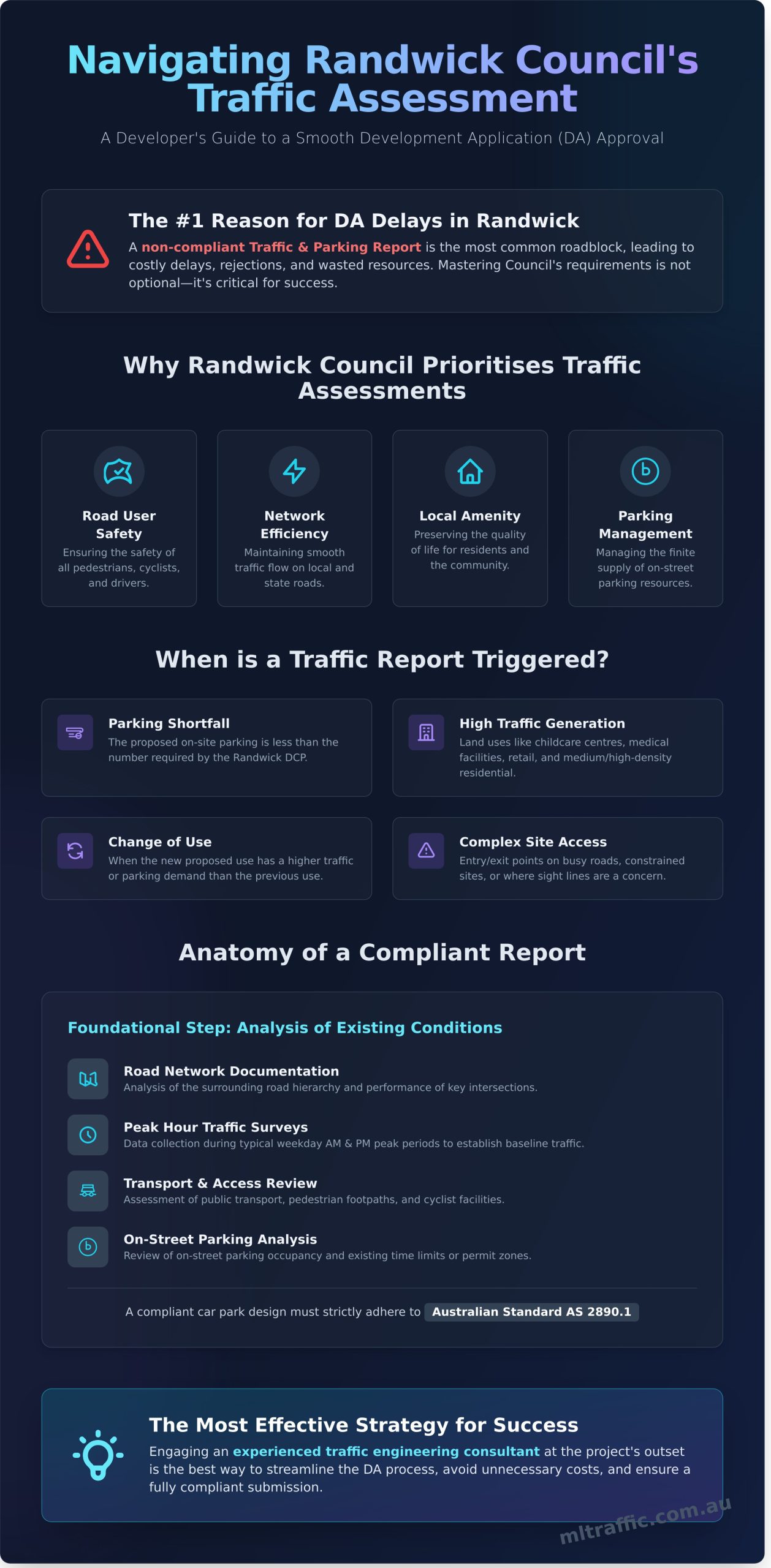
A non-compliant traffic report is one of the most common reasons for costly delays and rejections of Development Applications in the Randwick LGA. Navigating council planning documents can be complex, and a single oversight in your submission can derail your project schedule. This is particularly true when undertaking Traffic and Car Parking Impact Assessments in Randwick Council, where the requirements are specific and rigorously enforced. A report that fails to meet these standards will not proceed, resulting in wasted time and resources.
This definitive guide removes the uncertainty from the process. Here, we provide a clear, technical breakdown of what triggers the need for a traffic report and a comprehensive checklist of what must be included for council approval. Our goal is to provide you with the essential information to confidently manage your DA submission, preemptively address all traffic and parking concerns, and ensure a smooth, efficient path to consent.
Key Takeaways
-
Acknowledge that a Traffic and Parking Assessment is a mandatory component of your DA submission, directly addressing Council’s objectives for road safety and network efficiency.
-
Ensure your development’s car park design strictly complies with Australian Standards (AS 2890.1) to avoid common and costly objections during the assessment phase.
-
Master the requirements for undertaking Traffic and Car Parking Impact Assessments in Randwick Council to prevent an incomplete report, a primary reason for significant DA delays.
-
Engaging an experienced traffic engineering consultant at the project’s outset is the most effective strategy to streamline the DA approval process and avoid unnecessary costs.
Table of Contents
-
Why Randwick Council Prioritises Traffic & Parking Assessments in DAs
-
Core Components of a Compliant Traffic Impact Assessment for Randwick
-
The Assessment Process: From Engaging a Consultant to DA Submission
Why Randwick Council Prioritises Traffic & Parking Assessments in DAs
In the Randwick local government area, a Traffic and Parking Impact Assessment is not an optional document; it is a mandatory component of the Development Application (DA) process for many projects. Randwick City Council enforces this requirement to meet several core objectives fundamental to urban planning. These include ensuring the safety of all road users, maintaining the efficiency of the local and state road network, preserving local amenity for residents, and managing the finite supply of on-street parking.
For a clear overview of what these assessments involve, the following video provides a helpful summary:
This rigorous approach is legally grounded in Section 4.15 of the Environmental Planning and Assessment Act 1979, which requires Council to consider the likely impacts of a development, including traffic and access impacts. The Council’s assessment is guided by established Traffic Engineering Principles to ensure any new development integrates seamlessly and does not adversely affect the existing infrastructure or public safety. Properly undertaking Traffic and Car Parking Impact Assessments in Randwick Council is therefore critical for DA approval.
Key Planning Instruments: The Randwick LEP and DCP
A compliant traffic report must demonstrate a thorough understanding of Randwick’s key planning documents. The Randwick Local Environmental Plan (LEP) provides the high-level strategic framework for land use. However, the Randwick Development Control Plan (DCP) contains the detailed technical requirements, including specific minimum car parking rates for different land uses, bicycle parking requirements, and geometric design standards for vehicle access and circulation, often referencing Australian Standard AS 2890.1.
When is a Traffic and Parking Report Required?
While Council assesses each DA on its merits, a comprehensive Traffic and Parking Impact Assessment is typically triggered by proposals that involve:
-
A shortfall in the number of on-site parking spaces required by the DCP.
-
Land uses known to generate significant new traffic movements, such as childcare centres, medical facilities, retail shops, or medium-to-high density residential buildings.
-
A change-of-use application where the proposed new use has a higher parking demand or traffic generation rate than the previously approved use.
-
Complex site access arrangements, such as entry/exit points located on busy arterial roads, constrained sites, or where sight lines may be an issue.
Core Components of a Compliant Traffic Impact Assessment for Randwick
A compliant Traffic Impact Assessment (TIA) is not a formality; it is a critical, evidence-based document required for development applications. A professional report follows a logical structure designed to provide Randwick Council’s assessors with a clear and comprehensive understanding of the project’s implications. Successfully undertaking traffic and car parking impact assessments in Randwick Council hinges on this clarity and technical rigour. A thorough, well-structured report demonstrates due diligence and significantly simplifies the council’s assessment process, preventing unnecessary delays and requests for further information.
The report must present data-driven analysis, supported by clear plans and diagrams. For developments impacting major arterial roads, adherence to Transport for NSW (TfNSW) guidelines is mandatory.
Analysis of Existing Conditions
This foundational section establishes the baseline environment. Before any impact can be assessed, a professional report must meticulously document the current conditions. This involves:
-
Documenting the surrounding road network, including road hierarchy and current operational performance of key intersections.
-
Undertaking traffic surveys during typical weekday AM and PM peak periods to establish existing baseline traffic volumes.
-
Assessing the availability and accessibility of existing public transport services, pedestrian footpaths, and dedicated cyclist facilities.
-
Reviewing on-street parking occupancy levels and noting any existing parking restrictions, such as time limits or permit zones.
Proposed Development Details
This section provides the council with a precise definition of the proposed development. It must contain a clear description of the land use (e.g., residential, commercial, mixed-use), its proposed gross floor area (GFA), and its intended hours of operation. We calculate the required parking demand based on the specific rates outlined in the Randwick Development Control Plan (DCP). This section also presents detailed plans for proposed vehicle access points, driveway gradients, and sight lines to ensure safety and compliance, along with essential information on loading docks, service vehicle access, and waste collection arrangements.
Traffic and Parking Impact Analysis
This is the predictive core of the assessment. We forecast the volume of traffic likely to be generated by the development using established rates from TfNSW technical guidelines. This new traffic is then modelled to assess its impact on the performance of nearby intersections. The proposed on-site parking supply is rigorously evaluated for adequacy and compliance with both council requirements and the technical specifications of the Australian Standard for Off-street Car Parking (AS 2890.1). If potential adverse impacts are identified, we provide clear, actionable recommendations for mitigation measures. Our services page details the full scope of our comprehensive reports, which are essential when undertaking traffic and car parking impact assessments in Randwick Council.
Mastering Randwick’s Car Parking Requirements (AS 2890.1)
Parking provision is a critical and frequently contentious component of development applications within the Randwick local government area. Council’s assessment is rigorous, and non-compliance is a common reason for delays or refusal. A fundamental requirement when undertaking Traffic and Car Parking Impact Assessments in Randwick Council is to ensure all vehicle access and parking facilities are designed in strict accordance with Australian Standards. The traffic report must provide explicit certification of compliance with AS 2890.1 (off-street car parking), AS 2890.2 (commercial vehicle facilities), and AS 2890.6 (parking for people with disabilities).
Calculating Parking Rates as per the DCP
Parking generation rates are mandated by the Randwick Development Control Plan (DCP). For example, a residential flat building may require 1 space per 1-bedroom unit, 1.5 spaces per 2-bedroom unit, and 1 visitor space per 5 units. For mixed-use developments, the parking demand for each land use is calculated individually and then aggregated. If a development cannot meet these rates, a parking shortfall must be justified through a detailed Car Parking Demand Assessment, demonstrating why the proposed provision is sufficient for the site-specific context.
Ensuring Compliant Car Park and Access Design
A compliant design is more than just meeting parking numbers; it is about functionality and safety. A professional traffic assessment verifies all geometric design elements against AS 2890.1, including:
-
Minimum parking space and aisle dimensions.
-
Acceptable ramp grades and transitions to prevent vehicle scraping.
-
Adequate vertical clearance (headroom) throughout.
-
Safe pedestrian sight lines at driveway crossings.
To prove vehicle accessibility, Swept Path Analysis is mandatory for any challenging access point, such as steep ramps, tight corners, or within basement car parks. These diagrams demonstrate that the nominated design vehicle (e.g., a B99 vehicle) can manoeuvre safely and efficiently. The assessment must also confirm that provisions for bicycle parking and Electric Vehicle (EV) charging spots meet Council’s specific DCP requirements.
The Assessment Process: From Engaging a Consultant to DA Submission
A methodical approach is critical when undertaking Traffic and Car Parking Impact Assessments in Randwick Council. Engaging an experienced traffic engineer early in the design phase is the most effective way to save time, reduce costs, and minimise the risk of council Requests for Information (RFIs). The consultant should function as an integral part of your project team, providing strategic advice that informs the design, rather than simply documenting a completed plan.
This structured process ensures all technical requirements are addressed efficiently, leading to a more robust Development Application (DA).
Step 1: Project Briefing and Fee Proposal
The process begins with a clear project brief. To provide an accurate fee proposal, we require architectural plans (if available), a description of the proposed land use, and key details like the number of dwellings or gross floor area. A defined scope ensures all of Randwick Council’s requirements are met from the outset. Our senior-led approach is central to our service; we guarantee that the experienced consultant who provides your quote is the same person who completes the technical work, ensuring accountability and direct communication.
Step 2: Data Collection and Site Investigation
With the project commissioned, our team proceeds to the data collection phase. This is a critical evidence-gathering stage that informs all subsequent analysis and involves:
-
Conducting traffic counts on adjacent roads and on-site parking occupancy surveys to establish baseline conditions.
-
Detailed measurement of site access points, driveway gradients, and local road geometry to assess vehicle accessibility.
-
Liaising directly with your project architect to ensure our assessment is based on the latest plans.
-
Researching Randwick Council’s Development Control Plan (DCP), historical DA data, and relevant Australian Standards (e.g., AS 2890.1).
Step 3: Analysis, Reporting, and Submission
The final stage involves detailed analysis and reporting. We perform the necessary technical calculations, including traffic generation, parking demand assessments, and vehicle swept path analysis to demonstrate compliance and functionality. This data is synthesised into a comprehensive Traffic and Parking Impact Assessment report, formatted for direct inclusion in your DA package. The final report provides council with the clear, evidence-based justification needed for approval. Ready to ensure your DA submission is robust and complete? Contact us for a project-specific fee proposal.
Common Pitfalls to Avoid for a Smooth Randwick DA Approval
A Development Application (DA) can be significantly delayed by a Request for Information (RFI) from Council, often stemming from an incomplete or inaccurate traffic report. Based on our extensive experience, proactive and meticulous planning is the most effective strategy for a successful outcome. The following common mistakes, frequently seen in submissions prepared by others, can lead to costly setbacks and must be avoided when undertaking Traffic and Car Parking Impact Assessments in Randwick Council.
Underestimating Traffic Generation
An incorrect assessment of traffic generation is a primary reason for Council scrutiny. This critical error can misrepresent the true impact of a development on the local road network. Common failures include:
-
Using outdated or inappropriate traffic generation rates instead of the accepted RMS/TfNSW technical guidelines.
-
Failing to accurately model peak hour traffic impacts, particularly for AM and PM periods.
-
Ignoring the cumulative traffic impact from other approved or under-construction developments in the vicinity.
Non-Compliant Parking or Access Design
The geometric design of car parks and access driveways must strictly comply with Australian Standards (AS 2890.1) and Council’s specific requirements. Non-compliance is a clear reason for rejection. Pay close attention to:
-
Failing to conduct proper swept path analysis for the largest anticipated vehicle, such as delivery vans or Council waste collection vehicles (SRV).
-
Proposing ramp grades that are excessively steep or lack compliant transitions, creating clearance issues for vehicles.
-
Providing inadequate sight lines from the driveway exit to the public footpath, which compromises pedestrian safety.
For clear examples of compliant access and parking layouts, please see our videos section.
Inadequate Data or Justification
A generic, template-based report will not satisfy Randwick Council’s assessment criteria. The report must be a robust, evidence-based document tailored to the specific site and proposal. Key oversights include:
-
Relying on outdated traffic survey data that does not reflect current road conditions or travel patterns.
-
Failing to provide a detailed, first-principles justification for any proposed parking shortfall against Council’s required rates.
-
Submitting a generic report that does not directly address the specific controls and objectives within the Randwick Development Control Plan (DCP).
Avoiding these pitfalls requires deep technical knowledge and local expertise. To ensure your project’s traffic and parking components are compliant from the outset, contact ML Traffic Engineers Pty Ltd for a professional assessment at mltraffic.com.au.
Partner with Experts for a Successful Randwick DA
Navigating the development application process in Randwick demands a meticulous and informed approach to traffic engineering. A successful DA hinges on a comprehensive report that not only addresses the Council’s specific priorities but also demonstrates full compliance with technical standards like AS 2890.1. Avoiding the common pitfalls that lead to costly delays requires specialist expertise from the very beginning.
Successfully undertaking Traffic and Car Parking Impact Assessments in Randwick Council is a critical step for project approval. At ML Traffic Engineers, we leverage over 15 years of specialised experience to deliver reports that satisfy Council requirements. Our proven track record within Randwick and Sydney’s Eastern Suburbs is built on a foundation of technical precision and a deep understanding of local planning controls.
When you partner with us, you gain direct access to our senior traffic engineers for your project. This hands-on approach ensures clarity, accountability, and a strategy designed for a smooth approval process. Request a Quote for Your Randwick Development Project today and let our expertise move your development forward with confidence.
Frequently Asked Questions: Randwick Council Traffic & Parking Reports
How much does a traffic and parking report for Randwick Council typically cost?
The cost for a standard Traffic and Parking Impact Assessment for a development application in Randwick Council generally ranges from A$2,500 to A$5,000 plus GST. This fee is dependent on the scale and complexity of the proposed development. Factors influencing the final quote include the need for on-site traffic surveys, detailed swept path analysis for vehicle access, and the specific requirements outlined in Randwick’s Development Control Plan (DCP). We provide a fixed-fee proposal detailing all inclusions upfront.
How long does it take to prepare a Traffic Impact Assessment?
For a typical development, a comprehensive Traffic Impact Assessment can be prepared within 10 to 15 working days. This timeframe commences after we receive all necessary architectural plans and project details. The schedule can be influenced by the need to conduct site-specific traffic and parking counts, which may require a few days for data collection and analysis. We prioritise efficient delivery to ensure your development application is not delayed, and our senior engineers manage the process directly.
Do I need a traffic report for a minor renovation or addition in Randwick?
A traffic report is generally not required for minor internal renovations that do not alter the building’s use, gross floor area, or parking arrangements. However, a report will likely be necessary if your addition impacts vehicle access, reduces on-site parking (e.g., converting a garage to a habitable room), or intensifies the site’s use. Randwick Council will assess the need based on the specifics of your DA, and it is best to seek professional advice early.
What happens if Randwick Council requests more information (RFI) about my traffic report?
Receiving a Request for Further Information (RFI) from Council is a standard part of the DA process. Should this occur, the senior traffic engineer who prepared your report will personally review Council’s queries. We will then liaise directly with Council’s traffic engineers to provide the required clarifications, additional analysis, or plan amendments. Our extensive experience ensures these matters are addressed efficiently to facilitate a prompt assessment of your application and minimise delays.
Does my development on a State Road (e.g., Anzac Parade) have different requirements?
Yes, developments with frontage or access to a State or Classified Road, such as Anzac Parade, Alison Road, or Darley Road, require separate approval from Transport for NSW (TfNSW) in addition to Council consent. The process of undertaking Traffic and Car Parking Impact Assessments in Randwick Council for these sites is more complex, as the report must satisfy the distinct technical requirements of both authorities. Our consultants are highly experienced in navigating this dual-approval process with TfNSW.
Can ML Traffic Engineers help with developments in neighbouring councils like Waverley or Woollahra?
Absolutely. While we possess specialised expertise in Randwick, our senior traffic consultants have extensive experience across all Sydney metropolitan councils, including neighbouring Waverley Council and Woollahra Municipal Council. The core principles of traffic engineering, vehicle access design to Australian Standards (AS 2890.1), and parking demand assessment are applied consistently. We are proficient in interpreting and addressing the specific Development Control Plan (DCP) requirements for any council in the region.
