
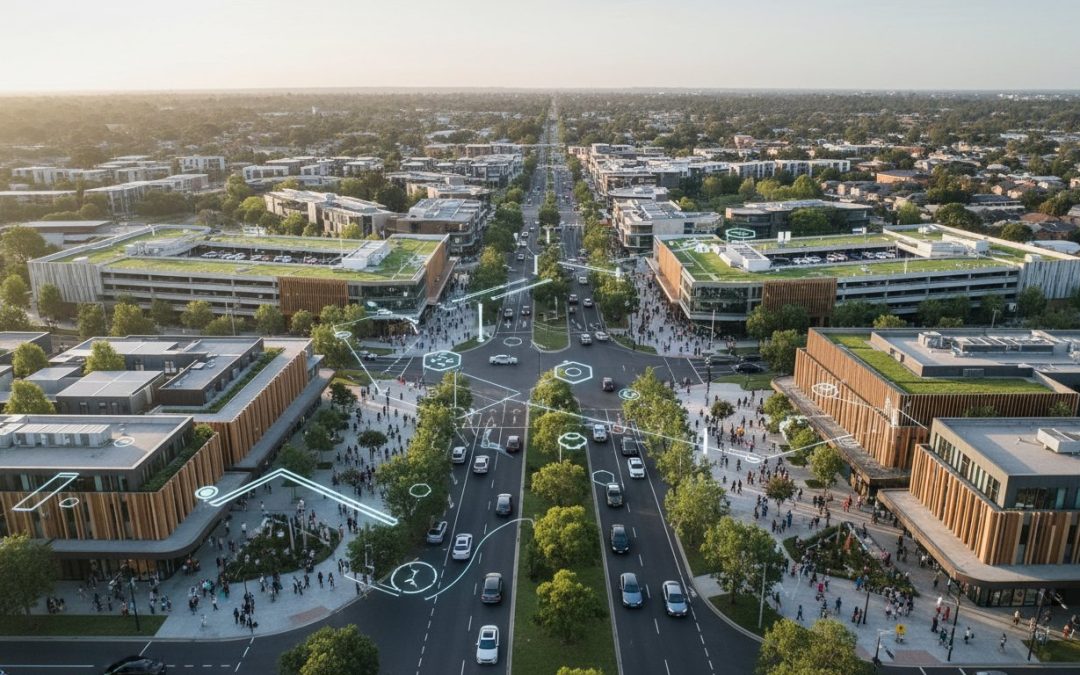
We are traffic engineers servicing Beveridge, Bundoora, Donnybrook, Doreen, Eden Park, Epping, Humevale, Kinglake West, Lalor, Mernda, Mill Park, South Morang, Thomastown, Whittlesea, Wollert, Woodstock, Yan Yean.
A development application within the City of Whittlesea can be stopped by one critical component: the traffic and parking impact assessment. Misinterpreting council’s specific technical requirements or submitting a non-compliant report often results in significant project delays, requests for further information, or even outright refusal. For developers and project managers, successfully undertaking Traffic and Car Parking Impact Assessments in Whittlesea Council is a non-negotiable step toward approval. It requires a meticulous, experienced approach to satisfy council planners and demonstrate that your project will not adversely affect the local road network.
This definitive guide provides the necessary clarity to navigate the process with confidence. We will detail the specific triggers that mandate a traffic report for your development type, break down the essential contents of a compliant assessment according to Whittlesea’s planning scheme, and outline the key data and analysis council planners expect to see. By understanding these requirements, you can ensure your submission is professional, comprehensive, and structured to facilitate a smooth and efficient DA approval, removing uncertainty and securing a positive outcome for your project.
Key Takeaways
- Identify whether your development’s scale and nature triggers the mandatory requirement for a traffic report early in your project timeline to prevent delays.
- A compliant report for Whittlesea Council demands specific, data-driven components. Learn what planners expect to see to avoid common submission errors.
- Successfully undertaking Traffic and Car Parking Impact Assessments in Whittlesea Council means aligning your report with the council’s core objectives for managing local road network performance.
- Avoid costly DA rejections by understanding the most common pitfalls, from inaccurate parking calculations to insufficient justification for traffic generation rates.
Table of Contents
- Why Whittlesea Council Prioritises Traffic and Parking Assessments
- When is a Traffic Report Mandatory for a DA in Whittlesea?
- Core Components of a Whittlesea-Compliant Traffic & Parking Report
- Our Proven Process for Whittlesea Traffic Assessments
- Common Pitfalls in Whittlesea DA Submissions (and How to Avoid Them)
Why Whittlesea Council Prioritises Traffic and Parking Assessments
The City of Whittlesea Council is responsible for ensuring all local infrastructure remains safe, efficient, and capable of supporting community growth. For property developers, this means any new project must be carefully evaluated for its effect on the existing road network. The council’s primary goal is to manage traffic flow and prevent excessive congestion on key arterials like Plenty Road and Epping Road, while also protecting local amenity for existing residents. Properly undertaking Traffic and Car Parking Impact Assessments in Whittlesea Council is therefore a critical step in the development application (DA) process.
To understand the core function of these assessments, the following overview is a valuable resource:
A professionally prepared assessment serves a crucial function: it de-risks your project. By proactively identifying and addressing potential traffic and parking issues, you demonstrate to the council that your development is viable and has considered its community impact. This is fundamental to achieving a smoother DA process. All assessments must align with the specific requirements outlined in the Whittlesea Planning Scheme, which applies established transportation planning principles to local development conditions.
The Purpose of a Traffic Impact Assessment (TIA)
A Traffic Impact Assessment (TIA) provides the council with empirical data on how your development will affect the surrounding transport network. Its core objectives are to:
- Quantify the anticipated volume and type of traffic generated by the proposed land use.
- Analyse the impact of this new traffic on the safety and operational performance of nearby roads and intersections.
- Identify and recommend any necessary road network upgrades or mitigation measures required to accommodate the development.
The Role of a Car Parking Impact Assessment
Equally important is the assessment of on-site parking provisions. This report verifies that your development meets council and user expectations. Its primary functions include:
- Ensuring the development provides adequate on-site car parking to meet the demand generated by its intended use, minimising overflow onto local streets.
- Verifying that all parking layouts, bay dimensions, and access ways comply with mandatory Australian Standards (e.g., AS 2890.1 for off-street car parking).
- Assessing the geometric design of parking areas, including access driveways, ramp grades, and sight lines for safe vehicle and pedestrian movement.
When is a Traffic Report Mandatory for a DA in Whittlesea?
Determining whether a traffic and parking assessment is required for your Development Application (DA) is a critical first step. The need for a report is not arbitrary; it is directly linked to the scale, nature, and potential impact of your proposal on the local road network and parking availability. When undertaking traffic and car parking impact assessments in Whittlesea Council, it is essential to understand the specific triggers.
A significant ‘change of use’-such as converting a standard office space into a high-turnover medical centre-will almost certainly require a formal assessment due to altered traffic generation patterns. Even a seemingly minor project may trigger this requirement if it involves complex site access, such as a new driveway on a busy arterial road.
Common Triggers for Residential Developments
For residential projects, Whittlesea Council typically requires a traffic report under the following circumstances:
- Multi-dwelling proposals: Including apartment buildings, unit developments, and townhouse complexes that intensify land use.
- Location on sensitive roads: Developments situated on main roads (arterial or sub-arterial) or in close proximity to major intersections.
- Parking reduction requests: Any application that seeks a reduction in the statutory car parking rates outlined in the Whittlesea Planning Scheme.
Triggers for Commercial and Industrial Projects
Commercial and industrial developments often generate higher traffic volumes and more complex vehicle movements, triggering the need for an assessment. Key examples include:
- High-traffic land uses: Such as childcare centres, medical centres, places of worship, and educational establishments.
- Retail and industrial operations: Including shops, restaurants, cafes, and industrial uses like warehouses or distribution centres.
- Significant heavy vehicle movements: Any proposal expected to generate substantial traffic from trucks, service vehicles, or delivery vans.
How to Confirm Your Project’s Needs
The definitive requirements for your specific site are detailed in the Whittlesea Planning Scheme and any pre-application advice provided by Council planners. Interpreting these planning controls and state-level guidelines requires specialised expertise. A qualified traffic engineer will assess your proposal against Council’s specific clauses and the broader VicRoads Traffic Impact Assessment Guidelines to provide a clear determination.
Engaging a traffic consultant early in your project lifecycle is the most effective way to confirm your obligations, prevent costly delays, and ensure your DA is robust and compliant. This proactive step clarifies the path forward and identifies potential traffic or parking issues before they become significant problems. Not sure if you need a report? Contact us for a preliminary review.
Core Components of a Whittlesea-Compliant Traffic & Parking Report
A successful development application hinges on a traffic and parking report that is both comprehensive and methodologically sound. When undertaking Traffic and Car Parking Impact Assessments in Whittlesea Council, the objective is to present a clear, data-driven justification for your proposal. Council planners expect a structured report that systematically addresses all potential impacts, referencing key local documents like the Whittlesea Engineering Guidelines and the Planning Scheme.
Existing Conditions and Traffic Surveys
This foundational section establishes the baseline for all subsequent analysis. It involves documenting the existing road network, including lane configurations, traffic controls, and posted speed limits. To gather empirical data, professional traffic engineers conduct on-site surveys to measure current traffic volumes during peak periods and assess existing on-street and off-street parking occupancy. A review of official crash data for the surrounding five-year period is also essential to identify any pre-existing safety issues.
Traffic Generation and Parking Demand Assessment
Here, we quantify the expected traffic impact of your development. Traffic generation is calculated using the widely accepted rates published in the RMS/VicRoads Guide to Traffic Generating Developments. This forecast is then used to determine parking requirements as stipulated by Clause 52.06 of the Whittlesea Planning Scheme. Should your proposal seek a variation from these standard rates, this section must provide a robust, evidence-based justification for the proposed car parking supply.
Proposed Site Access and Car Park Design
This component assesses the practical design elements of your proposal. It includes a detailed review of the proposed driveway location to ensure adequate sight lines for vehicle and pedestrian safety. We use industry-standard AutoTURN software to conduct swept path analysis, demonstrating that the design vehicle (e.g., a B99 waste collection truck) can safely access and manoeuvre within the site. The car park layout, including aisle widths, ramp grades, and pedestrian pathways, is scrutinised for compliance with Australian Standard AS 2890.1.
Impact Analysis and Recommendations
The final step is to analyse the combined effect of the generated traffic on the local road network. Using specialised software like SIDRA Intersection, we model the performance of nearby intersections to assess impacts on delays, queuing, and overall efficiency. If the assessment identifies potential adverse impacts, we recommend specific and practical mitigation works, such as:
- Line marking adjustments
- Installation of new signage
- Minor road geometry changes
The report concludes with a definitive statement on the proposal’s suitability from a traffic and parking engineering perspective, providing the council with the professional assurance it requires.
Our Proven Process for Whittlesea Traffic Assessments
Navigating council requirements for a Development Application (DA) demands a clear, efficient, and expert-led process. Our streamlined approach to undertaking Traffic and Car Parking Impact Assessments in Whittlesea Council is designed to eliminate uncertainty and prevent costly delays. At ML Traffic Engineers, the senior consultant you speak with is the consultant who manages your project from start to finish. This direct-to-expert model ensures accountability and a deep understanding of your project’s specific needs.
Our methodology is built on decades of experience and is structured to deliver a robust, council-ready report with maximum efficiency.
Step 1: Project Briefing and Fee Proposal
The process begins with a direct consultation to establish your project’s requirements. We require:
- A clear understanding of your development goals and scope.
- Your latest architectural plans for our initial review.
- Any relevant correspondence or requests from the City of Whittlesea.
Following this, we provide a comprehensive, fixed-fee proposal. This document details all deliverables and costs, ensuring complete transparency before any work commences.
Step 2: Data Collection and Site Investigation
Our qualified engineers conduct a thorough site visit to observe existing traffic conditions, access points, and the local road network within the Whittlesea municipality. This firsthand assessment is critical for accurate analysis. We then organise and undertake all necessary traffic counts and parking occupancy surveys required by council. If any ambiguities exist, we liaise directly with council officers for clarification, ensuring our assessment is precisely targeted.
Step 3: Detailed Analysis and Report Preparation
With all data collected, our team performs a rigorous technical analysis using industry-standard software to model traffic generation, parking demand, and vehicle movements. This analysis forms the basis of a comprehensive report drafted to meet all of the City of Whittlesea’s specific requirements, addressing relevant planning scheme clauses and Australian Standards. You can see examples of our detailed reporting and technical expertise in our past articles and case studies.
Step 4: Draft Review and Final Submission
We provide you with a draft report for your review and comment, ensuring the final document aligns perfectly with your application. Once approved, we issue the finalised Traffic and Parking Impact Assessment, ready for submission with your DA. Our commitment does not end at submission; we provide ongoing support to respond to any subsequent queries from Whittlesea Council, ensuring a smooth path to approval for your project.
Common Pitfalls in Whittlesea DA Submissions (and How to Avoid Them)
Successfully undertaking Traffic and Car Parking Impact Assessments in Whittlesea Council requires meticulous attention to detail. A submission that fails to meet Council’s specific standards can result in significant delays, requests for further information (RFIs), and costly redesigns. At ML Traffic Engineers, our extensive experience in the municipality allows us to proactively identify and resolve these common issues before they jeopardise your project timeline.
Inadequate Parking Provision or Design
A frequent cause for rejection is a failure to meet the statutory car parking rates detailed in the Whittlesea Planning Scheme. Furthermore, car park layouts that do not strictly adhere to Australian Standard AS 2890.1 for dimensions, aisle widths, and accessibility are immediately flagged. Our approach involves a rigorous design review to ensure full compliance and, where necessary, the preparation of a robust justification for any proposed variations based on first principles.
Unsafe or Impractical Site Access
Council planners place a high priority on safe and functional site access. Common errors include placing driveways too close to intersections, providing inadequate sight lines for exiting vehicles, or failing to demonstrate that the largest expected vehicle can manoeuvre safely. We mitigate this risk by providing early-stage access design advice and certified swept path diagrams to prove compliance and operational efficiency, ensuring your design is practical and approvable from the start.
Ignoring Local Traffic and Community Concerns
A generic report that overlooks the specific context of Whittlesea’s diverse neighbourhoods will not suffice. Underestimating the impact on local street congestion in growing suburbs like Wollert or failing to address on-street parking pressures in established areas can lead to objections. Our expertise is built on deep, location-specific knowledge, ensuring our reports thoroughly address local policies, neighbourhood character, and community expectations from the outset.
Avoiding these common pitfalls is fundamental to a successful DA submission. Engaging a specialist with a proven local track record ensures every technical requirement is met with precision. For expert guidance on your Whittlesea development, contact the professional team at ML Traffic Engineers.
Streamline Your Whittlesea DA with Expert Traffic Engineering
Navigating the City of Whittlesea’s development application process requires a meticulous and informed approach. A comprehensive, compliant traffic and parking report is not merely a procedural step; it is fundamental to demonstrating your project’s viability and avoiding costly delays. Understanding the council’s specific requirements is therefore critical when undertaking Traffic and Car Parking Impact Assessments in Whittlesea Council.
To ensure your project proceeds efficiently, partner with a team that has a proven track record. ML Traffic Engineers offers over 15 years of specialised experience with Victorian councils, including a history of securing DA approvals within the City of Whittlesea. Our clients benefit from direct access to senior traffic engineers who personally manage their project from quote to approval, ensuring precision and accountability. Ready to move your development forward with confidence? Request a Quote for Your Whittlesea Development Project and let our expertise guide your application to a successful outcome.
Frequently Asked Questions
How long does it take to prepare a Traffic and Parking Impact Assessment for Whittlesea Council?
A standard Traffic and Parking Impact Assessment for a development in Whittlesea typically takes one to two weeks to complete. This timeframe allows for a thorough site inspection, analysis of the proposed plans, and preparation of the technical report. More complex projects, or those requiring new traffic surveys during peak periods, may require a longer lead time. We provide a clear delivery schedule with every fee proposal to ensure transparency and manage project timelines effectively.
What is the average cost of a traffic report for a development application in Whittlesea?
The cost for a professional traffic report for a Whittlesea development application typically ranges from A$2,000 to A$5,000 plus GST. The final fee is determined by the scale of the development and the specific assessment requirements mandated by Whittlesea Council. A small residential extension will be at the lower end of this range, whereas a multi-unit development or commercial facility requires a more comprehensive assessment. We provide a fixed-fee proposal after reviewing your plans.
Does ML Traffic Engineers have experience with VCAT appeals related to traffic issues in Whittlesea?
Yes. ML Traffic Engineers has extensive experience representing clients at the Victorian Civil and Administrative Tribunal (VCAT) for matters in the City of Whittlesea. Our senior engineers act as expert witnesses, providing robust evidence and technical statements to support appeals related to traffic generation, car parking provision, and vehicle access design. We have a proven track record of successfully navigating the VCAT process to achieve positive outcomes for our clients’ development proposals.
What information do I need to provide to get a quote for a traffic report?
To provide an accurate, fixed-fee proposal, we require a complete set of architectural drawings, including the site plan, floor plans, and elevations. It is also essential to provide any correspondence you have received from Whittlesea Council, such as a Request for Further Information (RFI) or pre-application advice. A brief description of the proposed development’s use and scale will ensure our quote is comprehensive and tailored to your specific project requirements.
Can you help if Whittlesea Council has already issued a Request for Further Information (RFI) on traffic grounds?
Absolutely. We specialise in responding to council RFIs concerning traffic and parking matters. Our process involves a detailed review of the council’s specific concerns and the preparation of a targeted technical response to address each point. Properly undertaking Traffic and Car Parking Impact Assessments in Whittlesea Council at this stage is critical. Our expert reports are designed to provide the necessary clarification and justification to satisfy council requirements and facilitate a timely planning permit approval.
Why can’t my architect just prepare the traffic assessment component of the DA?
Traffic and parking assessments are a specialist engineering discipline that falls outside the scope of architectural services. Whittlesea Council requires these reports to be prepared by a qualified and experienced traffic engineer. The assessment must demonstrate compliance with specific Australian Standards, such as AS 2890.1 for parking facilities, and adhere to council’s own planning policies. An architect’s report would lack the required technical analysis and would almost certainly be rejected by the council’s traffic engineering department.
