

We are traffic engineers servicing Bayswater, Boronia, Ferntree Gully, Knoxfield, Lysterfield, Rowville, Sassafras, Scoresby, Studfield, The Basin, Upper Ferntree Gully, Wantirna, Wantirna South.
A non-compliant traffic or parking plan is a principal cause of costly delays and rejections for development applications in the City of Knox. The official planning scheme documents can be complex and difficult to interpret, leaving developers uncertain about their specific obligations. This professional guide provides the necessary clarity for undertaking Traffic and Car Parking Impact Assessments in Knox Council, ensuring your project is not stalled by preventable technical issues.
We will demystify the council’s requirements with a definitive roadmap for securing planning approval. Inside, you will find a clear checklist detailing the essential components of a compliant report, a breakdown of when an assessment is mandatory, and the specific information council officers expect to see. Our objective is to provide the expert knowledge required to navigate the process efficiently, giving you the confidence that your development application will not be held up on traffic grounds.
Key Takeaways
-
Identify whether your project requires a traffic report by understanding the specific triggers outlined in the Knox Planning Scheme for most developments.
-
Learn the core components required by Council when undertaking Traffic and Car Parking Impact Assessments in Knox Council to ensure your submission is compliant from the start.
-
Master Knox Council’s specific car park design standards, a frequent point of non-compliance that can significantly delay your development application.
-
Avoid common pitfalls and costly delays by understanding the complete assessment process and the critical points where expert input is required.
Table of Contents
-
When Does Knox Council Require a Traffic and Parking Assessment?
-
The Assessment Process: From Initial Quote to Council Submission
When Does Knox Council Require a Traffic and Parking Assessment?
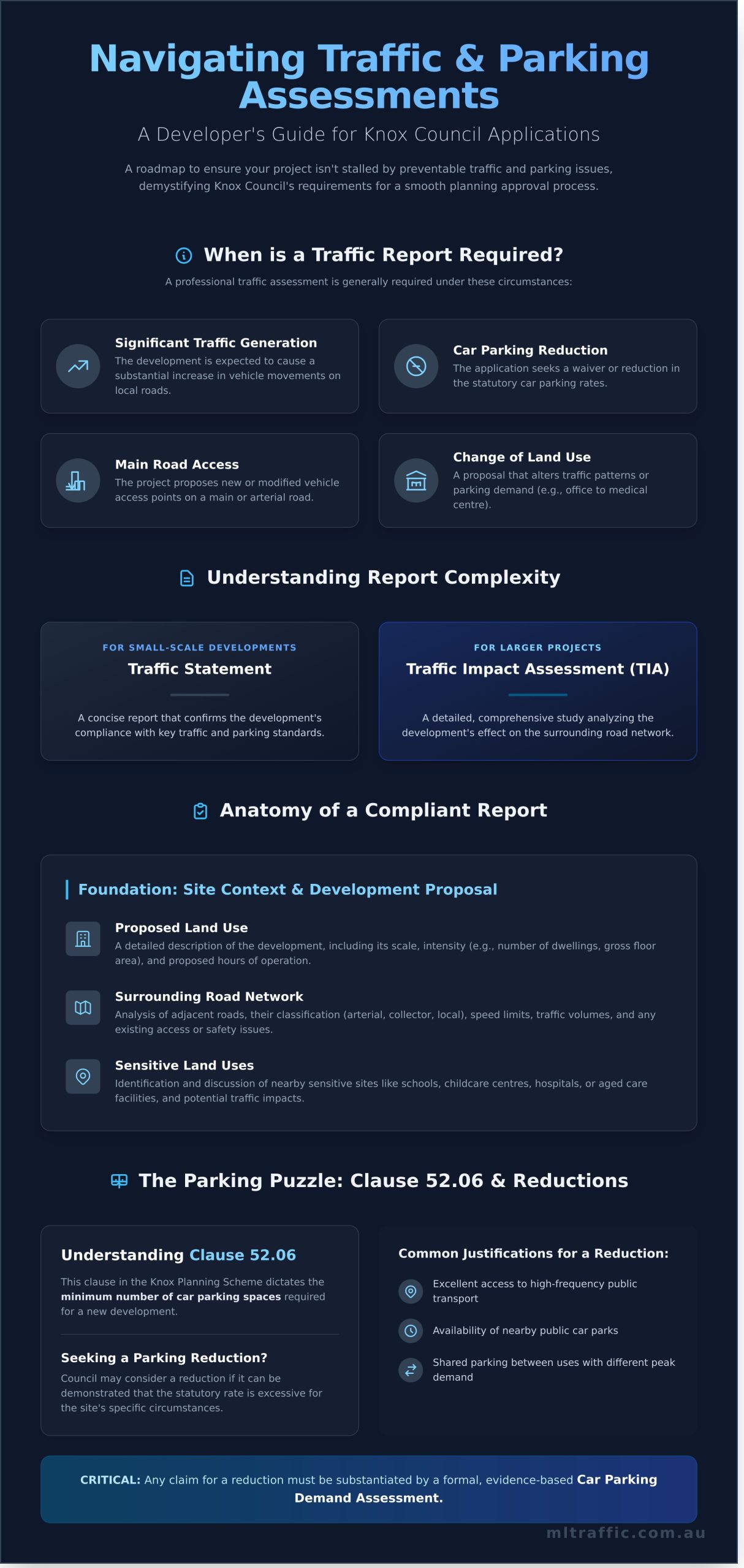
The requirement to provide a traffic and parking report is triggered by the provisions outlined in the Knox Planning Scheme. As a general rule, most applications for multi-dwelling residential, commercial, and industrial developments will require some form of professional traffic engineering assessment to be submitted with the development application.
For a clear overview of what these assessments entail, the following video is a helpful resource:
The complexity of the required report varies. A small-scale development may only need a simple Traffic Statement, which confirms compliance with key standards. In contrast, larger projects necessitate a full Traffic Impact Assessment (TIA), a detailed study analysing the development’s effect on the surrounding road network based on established transportation planning principles. Engaging with Council or a qualified traffic consultant early in the design process is the most effective way to determine the precise reporting requirements for your specific project.
Key Triggers for a Traffic Report
A formal traffic report is generally required under the following circumstances:
-
Significant Traffic Generation: The proposed development is expected to generate a substantial increase in vehicle movements on the local road network.
-
Car Parking Reduction: The application seeks a waiver or reduction in the statutory car parking rates stipulated in the Knox Planning Scheme.
-
Main Road Access: The project proposes new or modified vehicle access points on a main or arterial road, which falls under the jurisdiction of the Department of Transport and Planning.
-
Change of Land Use: The proposal involves a change in land use that alters traffic patterns or parking demand, such as converting an office space into a medical centre.
Understanding Car Parking Waivers and Reductions
Clause 52.06 of the Knox Planning Scheme dictates the minimum number of car parking spaces required for a new development. However, Council may consider an application for a reduction if it can be demonstrated that the statutory rate is excessive for the specific circumstances of the site. The process of Undertaking Traffic and Car Parking Impact Assessments in Knox Council is critical when seeking such a reduction.
Justification for a parking shortfall must be robust and evidence-based. Common arguments include excellent access to high-frequency public transport, availability of nearby public car parks, or opportunities for shared parking between uses with different peak demand periods. Any claim for a reduction must be substantiated by a formal Car Parking Demand Assessment, which provides the empirical data and analysis necessary for Council to make an informed decision.
Core Components of a Compliant Knox Council Traffic Report
To ensure a development application proceeds efficiently, the submitted traffic report must be a comprehensive, standalone document. When undertaking Traffic and Car Parking Impact Assessments in Knox Council, the report is assessed against the ‘Traffic Engineering Guidelines’ and is expected to provide a detailed analysis of both existing site conditions and the future impacts of the proposed development. A compliant report leaves no questions unanswered. The following checklist outlines the core components Council expects to see.
Site Context and Development Proposal
This section establishes the foundation of the assessment. It must clearly define the project and its surrounding environment, providing sufficient detail for Council to understand the proposal without referring to other documents.
-
Proposed Land Use: A detailed description of the development, including its scale, intensity (e.g., number of dwellings, gross floor area), and proposed hours of operation.
-
Surrounding Road Network: An analysis of adjacent roads, their classification (arterial, collector, local), posted speed limits, current traffic volumes, and any existing access or safety issues.
-
Sensitive Land Uses: Identification and discussion of any nearby sensitive sites, such as schools, childcare centres, hospitals, or aged care facilities, and the potential traffic impact on them.
Traffic Generation and Distribution
This component quantifies the traffic impact of the development. The analysis must be based on established, recognised methodologies and presented in a clear, logical format to demonstrate the effect on the local network.
-
Trip Generation Rates: Calculation of anticipated vehicle trips, using recognised sources such as the VicRoads or former RMS ‘Guide to Traffic Generating Developments’.
-
Peak Hour Impact: A specific assessment of the development’s impact during weekday AM and PM peak hours, as these are the most critical periods for the road network.
-
Traffic Distribution: Clear diagrams illustrating the proposed site access points and the anticipated distribution of new traffic onto the surrounding streets.
-
Intersection Performance: Analysis of the operational performance of key nearby intersections with and without the proposed development traffic.
Car Parking and Access Design Assessment
This section is critical for demonstrating compliance with statutory requirements and ensuring a functional, safe site design. A failure in this area is a common reason for delays in the application process.
-
Parking Demand Calculation: A precise calculation of the required number of car parking spaces based on the rates specified in the Knox Planning Scheme. This assessment must align with the principles of the overarching Knox Parking Policy framework.
-
Layout and Design Compliance: Assessment of the proposed car park layout, including space dimensions, aisle widths, and ramp grades, against Australian Standard AS 2890.1.
-
Vehicle Swept Path Analysis: Diagrams demonstrating that design vehicles (e.g., a standard car, delivery van, or waste collection vehicle) can safely manoeuvre into and out of the site, parking spaces, and loading bays.
-
Active Transport Provision: A review of facilities and access for pedestrians and cyclists, ensuring safe and convenient routes are provided.
Navigating Knox Council’s Car Parking Design Standards
A functionally sound and compliant car park design is fundamental to a successful development in the City of Knox. Failures to meet the council’s strict design standards are a leading cause of delays and Requests for Further Information (RFI) during the development application process. When undertaking Traffic and Car Parking Impact Assessments in Knox Council, every dimension, grade, and clearance must be meticulously planned. The governing principles for all off-street parking design are found within the Australian Standards, which set the minimum requirements for safety, accessibility, and efficiency.
Compliance with Australian Standard AS 2890.1
Australian Standard AS 2890.1:2004 (Parking facilities – Part 1: Off-street car parking) is the primary reference document for car park design. It dictates critical dimensions and geometric requirements, including:
-
Parking Spaces: Minimum dimensions for different user classes (e.g., Class 1A residential spaces).
-
Aisle Widths: Required widths for safe manoeuvring based on parking angles.
-
Ramp Grades: Maximum gradients and transition requirements to prevent vehicle scraping.
-
Safety Elements: Mandated headroom clearances, sight lines at intersections, and provisions for pedestrian safety.
Strict adherence to this standard is non-negotiable for council approval.
Swept Path Analysis for Vehicle Manoeuvrability
Swept path analysis is a technical assessment that simulates the movement of a design vehicle through a proposed car park layout. This analysis is critical to demonstrate that vehicles can safely and efficiently enter the site, navigate aisles, and access parking spaces without conflicting with structures or other vehicles. We use standard design vehicles, such as the B85 or B99, to prove compliance. Our professional traffic engineers provide specialised swept path analysis to validate your design and prevent costly rework.
Assessing Loading Docks and Service Vehicles
For commercial, industrial, and mixed-use developments, car park design must extend beyond standard passenger vehicles. AS 2890.2 (Parking facilities – Part 2: Off-street commercial vehicle facilities) governs the design of loading docks and service bays. It is essential to demonstrate that the site can safely accommodate service vehicles, such as council garbage trucks (SRV) and common delivery vans. This assessment ensures operational viability and is a key component of a comprehensive traffic report for non-residential sites.
The Assessment Process: From Initial Quote to Council Submission
Navigating the requirements for a traffic and parking assessment can seem complex. Our process is designed to be structured, transparent, and efficient, providing you with a comprehensive report typically within two to three weeks. At ML Traffic Engineers, we operate on a principle of direct accountability: the senior traffic consultant who provides your quote is the same expert who undertakes the site work, analysis, and preparation of your report. This ensures continuity and a deep understanding of your project from start to finish.
Step 1: Project Scoping and Fee Proposal
The process begins with a thorough understanding of your project’s specific needs. We review your initial development plans and any relevant correspondence from Knox Council, such as a Request for Further Information (RFI). This allows us to define the precise scope of the traffic engineering assessment required. Based on this defined scope, we provide a clear, fixed-fee proposal, ensuring you have complete certainty on costs before any work commences.
Step 2: Data Collection and Site Investigation
Once engaged, our consultant undertakes the necessary fieldwork and data gathering. This is a critical hands-on phase that includes:
-
Site Visit: A comprehensive inspection of the subject site and its surrounding area to observe existing traffic operations, on-street parking conditions, and access arrangements.
-
Data Collection: Gathering of relevant traffic count data for the local road network to establish a baseline for our analysis.
-
Plan Review: A detailed assessment of your architectural plans against the requirements of the Knox Planning Scheme and relevant Australian Standards (such as AS 2890.1 for parking facilities).
Step 3: Analysis, Reporting, and Submission
With all data collected, we proceed with the technical analysis. This involves calculating traffic generation, assessing car parking demand, and ensuring vehicle access and circulation are safe and compliant. We draft clear, concise plans illustrating key elements like driveway access, parking layouts, and vehicle swept paths. The final output is a professional, detailed report that addresses all of Council’s requirements. This comprehensive document is fundamental to successfully undertaking Traffic and Car Parking Impact Assessments in Knox Council and is delivered ready for submission with your development application package.
Ready to start the process? Contact us for a quote.
Common Pitfalls and How to Avoid Delays with Your Knox DA
Lodging a Development Application (DA) with Knox City Council involves detailed scrutiny from their traffic engineering department. An incomplete or poorly justified Traffic and Parking Impact Assessment is one of the most common causes of delays, requests for further information (RFIs), and outright refusals. An experienced traffic consultant foresees these issues before they arise.
Successfully undertaking traffic and car parking impact assessments in Knox Council requires a proactive approach that addresses potential objections before they are raised. Below are critical pitfalls we consistently help our clients avoid.
Pitfall 1: Underestimating Traffic Impact on Local Streets
The Problem: Many assessments focus solely on the main arterial road fronting the development, failing to consider how traffic will disperse into the local street network. Council’s engineers will rigorously examine the potential for ‘rat-running’ and the impact on residential amenity.
The Solution: We conduct a thorough traffic distribution analysis to accurately model vehicle movements on surrounding streets. This allows us to identify potential issues and, if necessary, propose practical mitigation measures like traffic calming or signage, satisfying Council’s requirements for neighbourhood safety.
Pitfall 2: Non-Compliant Access or Car Park Layout
The Problem: An architectural plan may appear functional, but driveways, ramps, or parking aisles often fail vehicle swept path analysis for design vehicles, such as a B99 car or a waste collection truck. This is a non-negotiable compliance point under Australian Standards.
The Solution: ML Traffic Engineers use specialist CAD software to test and verify all access and circulation elements against AS 2890.1 from the outset. Designing for compliance from day one prevents the significant costs and project delays associated with redesigning a car park after a DA has been lodged.
Pitfall 3: Insufficient Justification for Parking Reduction
The Problem: Simply claiming a development will have lower parking demand than the statutory rates in the Knox Planning Scheme is not enough. Without robust, empirical evidence, Council will almost certainly reject the proposed reduction.
The Solution: We prepare a data-driven car parking demand assessment. This report presents a logical, evidence-based argument for a parking reduction by analysing public transport accessibility, local parking availability, and data from comparable sites. Read about our experience to see how we’ve helped countless clients achieve practical and efficient parking outcomes.
Navigating the complexities of Knox Council’s requirements demands specialist expertise. To ensure your project is based on a compliant and defensible traffic engineering strategy, contact the professional consultants at mltraffic.com.au.
Secure Your Knox Development Approval with Expert Guidance
Navigating the requirements for a development application in Knox demands a clear understanding of when a traffic assessment is needed and what constitutes a compliant report. A meticulous approach, from adhering to specific car parking design standards to avoiding common submission errors, is essential for a timely and successful outcome.
Successfully undertaking Traffic and Car Parking Impact Assessments in Knox Council is about more than meeting regulations-it is about ensuring your project moves forward without costly delays. Partnering with a specialist traffic engineering consultant is the most effective path to council approval.
With over 15 years of experience with Victorian councils, ML Traffic Engineers provides the necessary expertise. We offer direct access to our principal engineers for every project, ensuring your report is fully compliant with the Knox Planning Scheme and Australian Standards. Position your development for success. Get a professional quote for your Knox development project.
Frequently Asked Questions
How much does a Traffic and Parking Impact Assessment cost for Knox Council?
A standard Traffic and Parking Impact Assessment for a small to medium-scale development within the Knox City Council area typically costs between A$2,000 and A$4,000 + GST. The final fee is determined by the project’s scale, the complexity of the proposed land use, and the specific requirements outlined by Council. For a precise, fixed-fee proposal, we require your development plans to ensure our assessment comprehensively addresses all necessary criteria without unexpected variations.
How long does it take to prepare a traffic report for a development application?
Our standard turnaround for preparing a traffic report is approximately 5 to 7 working days from the time we receive all required project information, including architectural plans and any preliminary feedback from Knox Council. More complex projects that necessitate detailed traffic modelling or site-specific surveys may require a longer timeframe. We prioritise efficient delivery to avoid delaying your development application and will confirm a delivery date upon our engagement.
What is the difference between a Traffic Impact Assessment and a Car Parking Demand Assessment?
A Traffic Impact Assessment (TIA) evaluates the effects of a development’s generated traffic on the external road network. It focuses on intersection performance, road capacity, public transport, and site access safety. In contrast, a Car Parking Demand Assessment is an internal review focused on the site itself. It determines the appropriate number of car parking spaces required for the proposed land use, ensuring compliance with the Knox Planning Scheme and Australian Standards (AS 2890.1).
Do I need a traffic report for a small extension or a dual occupancy in Knox?
A traffic report is often required, even for smaller developments. Undertaking Traffic and Car Parking Impact Assessments in Knox Council becomes necessary if the proposal involves creating a new crossover, altering existing vehicle access, or results in a shortfall of on-site car parking against planning scheme requirements. For minor extensions with no change to parking or access points, a report may not be needed. We can provide a definitive answer upon reviewing your plans.
Can ML Traffic Engineers help if Council issues a Request for Further Information (RFI)?
Yes. Responding to a Request for Further Information (RFI) from Knox Council is a core component of our professional services. Our senior traffic engineers are highly experienced in interpreting council requests and preparing the detailed technical responses required to address their specific concerns. The consultant who prepared the original report manages the RFI response, liaising directly with council officers to facilitate a timely planning permit approval.
What specific information do you need from me to provide a quote?
To provide an accurate, fixed-fee proposal, we require a clear set of documents for review. Please email us a full set of the latest architectural drawings in PDF format, including site plans, floor plans, and elevations. It is also highly beneficial to include a copy of any correspondence from Knox Council that specifies the need for a traffic engineering assessment. This information allows our senior consultants to precisely scope the work required for your project.
