

A single non-compliant driveway gradient or a failed swept path assessment can trigger a Council Request for Information (RFI) that delays a A$5 million project by 12 weeks or more. Designing access arrangements for commercial developments for 2026 requires precise technical alignment between the National Construction Code (NCC) and Australian Standards like AS 2890.1. You already know that conflicting requirements between building codes and traffic standards often lead to expensive, late-stage redesigns that eat into your profit margins.
It’s a common frustration for developers when a parking layout that prioritises pedestrian safety suddenly fails a Council assessment due to inadequate vehicle manoeuvrability. This guide provides a clear, expert-led roadmap to mastering these dual requirements. You’ll learn how to integrate pedestrian and vehicle safety while minimising the risk of unexpected RFIs. We’ll break down the intersection of NCC compliance and traffic engineering standards to ensure your next DA submission is right the first time.
Key Takeaways
-
Understand the hierarchy of compliance between NCC Volume One and the AS 2890 series to navigate the complex regulatory framework for Australian commercial sites.
-
Master the technical requirements for access arrangements for commercial developments, focusing on mandatory forward-entry/exit maneuvers and vehicle-class-specific driveway widths.
-
Ensure full DDA compliance by implementing continuous accessible paths of travel that seamlessly connect public street networks to building entrances.
-
Discover how strategic access design optimizes the results of your Traffic Impact Assessment (TIA) and minimizes impacts on the surrounding road network.
-
Learn why integrating a principal-led traffic engineering model early in the architectural phase ensures higher DA approval rates and reduces design revisions.
Table of Contents
The Regulatory Framework for Commercial Access Arrangements
Access arrangements for commercial developments define the physical and legal interface between public road networks and private commercial land. Effective design ensures that vehicle movements don’t compromise the safety or efficiency of the surrounding transport infrastructure. In Australia, this process relies on established access management principles to balance property access with traffic flow. For a successful Development Application (DA) in 2026, designers must navigate a strict hierarchy of compliance that begins with federal legislation and filters down to local council requirements.
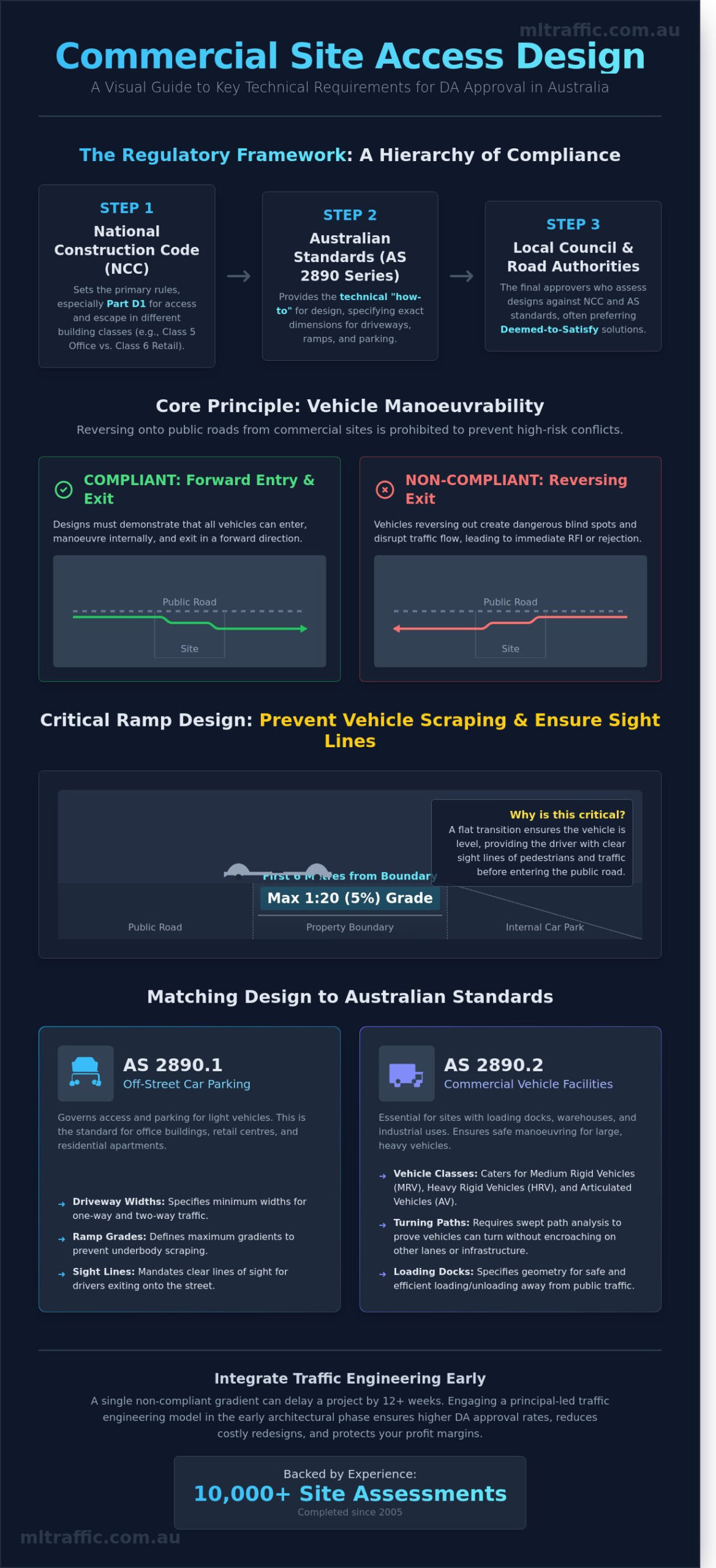
The National Construction Code (NCC) Volume One serves as the primary regulatory document, but technical execution usually falls under the AS 2890 series. For most projects, adhering to Deemed-to-Satisfy (DTS) solutions is the most efficient path to approval. DTS designs follow pre-approved templates that local councils and road authorities accept without additional justification. However, site constraints in dense urban areas often make DTS impossible. In these cases, a Performance Solution is required. This involves a registered traffic engineer proving that an alternative design meets the same safety and functional outcomes as the standard code.
The National Construction Code (NCC) and Access
The NCC 2022 updates, which carry through to 2025 and 2026, place a high priority on Part D1. This section governs provision for escape and general access requirements. In commercial settings, the building classification dictates the width of ingress points and the required clearance for emergency vehicles. For example, a Class 5 office building has different egress volumes compared to a Class 6 retail center or a Class 9b assembly building. Failure to account for these specific ingress/egress requirements early in the design phase often leads to costly redesigns during the construction certificate stage.
Australian Standards for Traffic and Parking
The AS 2890 series provides the technical benchmarks for all access arrangements for commercial developments. Our assessments focus on two primary standards:
-
AS 2890.1: Governs off-street car parking for light vehicles. It specifies driveway widths, ramp grades, and sight-line requirements at the property boundary.
-
AS 2890.2: Essential for commercial vehicle access. This is vital for warehouses and retail hubs where Heavy Rigid Vehicles (HRV) or Articulated Vehicles (AV) must maneuver without blocking public traffic.
A seamless transition from the property boundary to the internal car park is mandatory. This requires precise driveway ramp grades to prevent vehicle scraping and ensure sight-line compliance for exiting drivers. Since 2005, ML Traffic Engineers has completed over 10,000 site assessments, ensuring that every design meets these rigorous technical standards. For more information on our technical capabilities, you can view our services page. Our engineers focus on delivering designs that are both compliant and functional for the end user.
Vehicle Access and Manoeuvrability Requirements
Designing effective access arrangements for commercial developments requires strict adherence to safety and operational efficiency. Council engineers prioritize forward-entry and forward-exit protocols for all vehicles. Reversing onto a public road is generally prohibited for commercial sites because it creates high-risk conflict points with passing traffic. Every design must demonstrate that the largest anticipated vehicle can enter and leave the site in a single continuous movement.
Driveway widths aren’t arbitrary. They’re calculated based on the specific vehicle class and the road frontage category as defined in AS 2890.2. A site serviced by an 8.8m Medium Rigid Vehicle (MRV) requires different geometry than one hosting 19m articulated vehicles. We categorize road frontages from 1 to 5 to determine the necessary width, ensuring that turning movements don’t encroach upon opposing traffic lanes.
The relationship between driveway ramp grades and vehicle underbody clearance is a frequent point of failure in DA submissions. AS 2890.1 specifies maximum gradients to prevent vehicles from "bottoming out" or scraping. We typically design for a maximum 1:20 (5%) grade for the first 6 metres from the property boundary. This flat transition ensures the vehicle is level when the driver assesses the traffic stream, which is critical for maintaining sight lines.
Integrating loading dock access requires careful spatial planning. Loading zones shouldn’t compromise general customer parking or pedestrian safety. It’s essential to separate heavy vehicle paths from light vehicle areas to prevent congestion. If you’re managing a complex site, contact our senior engineers to review your layout before submission.
Vehicle Swept Path Analysis (SPA)
Council requires SPA diagrams for all commercial DAs to prove the site is functional. These diagrams are technical simulations that track the path of a vehicle’s body and tyres during turns. We use AutoTURN software to model the design vehicle’s movement through every gate, ramp, and loading bay. This process identifies potential "pinch points" where a vehicle might strike a column or curb. For a technical breakdown of these requirements, view our Swept Path Analysis Guide.
Sight Distance and Safety
Safety hinges on clear sight lines at the property boundary. Compliance with AS 2890.1 Figure 3.2 is mandatory for exiting vehicles. This usually involves maintaining a 2.0m by 2.5m clear sight triangle on both sides of the driveway. Within this area, there must be no obstructions like fences, signage, or vegetation taller than 0.6 metres. In high-pedestrian zones or areas near school crossings, Councils often require additional mitigation measures. This might include convex mirrors or electronic warning signals to alert pedestrians of an exiting vehicle.
Pedestrian and Disability Access (DDA Compliance)
The Disability Discrimination Act (DDA) 1992 dictates that commercial sites provide equitable and independent access for all users. This legal obligation is non-negotiable for new developments in 2026. Failure to comply results in significant legal liability and the potential for costly retrofitting after construction. Developers must prioritize a continuous accessible path of travel. This path connects the site boundary, accessible parking bays, and all required building entrances without interruption from steps, curbs, or steep inclines exceeding 1:20.
Effective access arrangements for commercial developments integrate disability access into the initial site planning phase. This includes the placement of AS 2890.6 compliant parking spaces. These spaces require a 2.4-metre wide dedicated bay adjacent to a 2.4-metre wide shared zone. This shared area must be marked with cross-hatching and contain a fixed bollard to prevent vehicle encroachment; ensuring wheelchair users have sufficient space to transition from their vehicle safely. For detailed technical reviews of your site layout, our traffic engineering services provide full compliance checks against these Australian Standards.
NCC Part D4: Access for People with a Disability
NCC 2022 Part D4 specifies the access requirements for Class 2 to 9 buildings. You must install Tactile Ground Surface Indicators (TGSIs) at all points where a pedestrian path meets a vehicular way or a change in level, such as ramps and stairs. We specify TGSIs in accordance with AS 1428.4.1 to assist vision-impaired users. Ramp gradients cannot exceed 1:14; these require 1200mm long landings at 9-metre intervals. If the gradient is 1:20, landings are required every 15 metres. All doorways on the accessible path must provide a clear opening width of at least 850mm.
Shared Zones and Pedestrian Safety
Shared zones are necessary where pedestrians and vehicles occupy the same pavement. In commercial car parks, these zones require 10 km/h speed limit signage and R4-4 signs to clearly define pedestrian priority. Managing the conflict between 19-metre articulated vehicles and office staff is a critical safety requirement in industrial access arrangements for commercial developments.
In warehouse environments, we recommend physical separation such as 1100mm high safety railings. If physical barriers aren’t feasible due to operational constraints, use green-backed non-slip pedestrian walkways and dedicated crossing points. For example, a 2025 warehouse project in Western Sydney successfully reduced near-miss incidents by 40% by implementing raised pedestrian crossings and automated warning lights that trigger when forklifts approach office egress points. Meticulous line marking and clear sight-line assessments are essential to maintain safety in these high-traffic environments.
Access Considerations in the Traffic Impact Assessment (TIA)
A Traffic Impact Assessment (TIA) serves as the technical foundation for any major planning application. Access design is the most critical variable in these findings. If your access points are poorly positioned, the assessment may conclude the development is unsustainable without significant external road upgrades. We evaluate how access arrangements for commercial developments interact with through-traffic to ensure the surrounding road network maintains an acceptable Level of Service (LoS) during peak periods.
Council engineers prioritize "internal throat length" to prevent queuing at the site entrance. If a driveway is too short, entering vehicles back up onto the public road, creating safety risks and congestion. Our traffic engineering team utilizes SIDRA intersection modeling to quantify these delays and determine if the proposed entrance can handle the 95th percentile queue length. Engaging an engineer at the concept stage prevents the need for late-stage design changes that often force developers to sacrifice valuable floor space to accommodate wider driveways or longer entry lanes.
Intersection and Driveway Analysis
Determining whether your site requires a simple driveway or a formal intersection depends on projected trip generation and the speed environment of the frontage road. We apply Austroads warrants to determine if specific turn treatments are mandatory. These include:
-
BAL and BAR: Basic left and right turn treatments for lower volume environments.
-
CHR and CHR(S): Channelised right-turn treatments, often required on high-speed rural or semi-rural roads to protect turning vehicles.
-
Sight-Line Compliance: Ensuring all access points meet Safe Intersection Sight Distance (SISD) requirements under AS 2890.1.
Strategic access placement can often bypass the need for expensive external road upgrades by utilizing existing breaks in traffic flow or better-positioned terrain.
Council Requirements and RFI Mitigation
Councils frequently issue a Request for Further Information (RFI) when access arrangements for commercial developments lack detail regarding vehicle swept paths. An RFI can stall a Development Application (DA) for several months. Common reasons for rejection include inadequate sight distances or the inability of heavy vehicles to enter and exit the site in a forward direction. For smaller-scale developments, a proactive Traffic Statement can resolve these concerns before they become formal objections. We focus on providing meticulous Vehicle Swept Path Assessments to prove that the largest expected vehicles, such as 12.5m Heavy Rigid Vehicles (HRVs), can navigate the entrance without encroaching on opposing traffic lanes.
Don’t let access issues delay your project approval. Contact ML Traffic Engineers to discuss your TIA requirements with a senior consultant.
Implementing Compliant Access: The Professional Approach
Securing approval for access arrangements for commercial developments requires technical precision and a deep understanding of local government expectations. At ML Traffic Engineers, we operate under a principal-led model. This ensures that the senior consultant who provides your initial quote is the same expert who performs the technical work and signs off on the report. It’s a direct, accountable approach that eliminates the communication errors common in larger firms and results in significantly higher approval rates from Council assessing officers.
Integrating traffic engineering early in the architectural design phase is a strategic necessity. Waiting until the design is finalised to consider traffic flow often leads to expensive redesigns or project delays. When we review plans during the concept stage, we identify potential issues with driveway ramp grades, heavy vehicle clearance, or sight lines before they’re embedded in your DA submission. Managing the differences between state-specific requirements and national standards like AS 2890 requires this level of seasoned expertise. We apply data from over 10,000 successful site assessments to ensure your project meets every regulatory benchmark.
Professional Certification and RPEQ Requirements
For most commercial projects in Australia, specifically in Queensland, a Registered Professional Engineer (RPEQ) must certify the access design to meet statutory obligations. This certification is a formal guarantee that your car park and entry points comply with Australian Standards. Our qualified traffic consultants provide the technical rigour needed to satisfy both Council engineers and state transport authorities. We focus on the certification of car park designs to AS 2890 standards, ensuring that every Vehicle Swept Path Assessment is accurate to the millimetre.
Final Developer Checklist for Council Submission
-
Confirm all driveway widths and internal circulation paths comply with AS 2890.1.
-
Ensure the largest anticipated service vehicle can enter and exit the site in a forward direction.
-
Verify that sight distance at the property boundary meets the safety requirements for both pedestrians and vehicles.
-
Check that the number of provided parking spaces aligns with the local planning scheme or includes a robust demand assessment.
-
Document all bicycle parking and end-of-trip facilities as required for 2026 compliance.
Get Started with Your Access Assessment
To begin a formal assessment of your access arrangements for commercial developments, you’ll need to provide a current site survey and your proposed architectural floor plans. Our standard turnaround time for a commercial access report is between 7 and 10 business days. This allows our principals to conduct a meticulous review of your site’s specific constraints and opportunities. We don’t use gatekeepers; you’ll have a direct line to the experts handling your file. Contact ML Traffic Engineers to discuss your commercial development access requirements.
Secure Your 2026 Development Approval
Navigating the 2026 regulatory landscape requires strict adherence to AS 2890.1 and DDA compliance. Every site must balance vehicle manoeuvrability with safe pedestrian movement to satisfy council requirements. Detailed access arrangements for commercial developments form the technical foundation of a successful Traffic Impact Assessment. Precision in driveway ramp grades and sight-line assessments isn’t optional; it’s a prerequisite for avoiding costly DA delays or design revisions. Mistakes at the planning stage can derail a project’s timeline and budget.
ML Traffic Engineers provides the technical certainty needed for complex projects. We’ve assessed 10,000+ sites nationwide and bring over 15 years of experience in Australian traffic engineering to your development. You’ll gain direct access to senior principal engineers on every project. Our firm operates on a hands-on model where the consultant who provides your quote is the one who performs the work. This direct accountability ensures your TIA meets every bureaucratic and technical standard required for approval.
Get a Professional Traffic Assessment for Your DA Approval
Expert planning ensures your commercial development moves forward with confidence and full compliance.
Frequently Asked Questions
What is the minimum width for a commercial driveway?
The minimum width for a commercial driveway typically ranges from 3.0 metres for single-lane access to 5.5 metres for two-way traffic, as defined by AS 2890.1. Local Council Development Control Plans often require a minimum width of 6.0 metres for heavy vehicle access to ensure safe passing. We verify these specific dimensions against your site requirements to prevent operational bottlenecks and ensure compliance with 2026 standards.
Do I need a swept path analysis for a small commercial development?
You almost always need a swept path analysis even for small commercial developments to prove that the design vehicle can enter and exit the site in a forward direction. Councils require this technical verification to ensure vehicles don’t cross the centreline of the road or hit structural columns. Our engineers use software like Autodesk Vehicle Tracking to simulate these movements for B99 cars and Small Rigid Vehicles (SRV) during the DA process.
What is the difference between NCC access requirements and AS 2890?
The National Construction Code (NCC) focuses on broad building safety and accessibility standards, while AS 2890 provides the specific technical dimensions for off-street parking and driveway design. Compliance with access arrangements for commercial developments requires meeting both sets of standards simultaneously. While the NCC dictates where access must be provided for fire safety and egress, AS 2890.1 and AS 2890.2 define the exact gradients, widths, and turning circles required for certification.
How does DDA compliance affect my commercial car park layout?
Disability Discrimination Act (DDA) compliance requires specific parking bay dimensions of 2.4 metres width paired with a 2.4 metre wide shared zone. These layouts must provide a continuous accessible path of travel from the car park to the building entrance without steps or steep gradients. You’ll need to account for these 4.8 metre wide modules early in the design phase to avoid losing significant floor area in your commercial development plan.
Can Council refuse my DA based solely on access arrangements?
Council can and will refuse a Development Application (DA) if the proposed access arrangements don’t meet safety or traffic flow standards. Common reasons for refusal include inadequate sight distances at the property boundary or a lack of onsite turning area for the largest expected vehicle. We provide RPEQ-certified reports to mitigate these risks by demonstrating full compliance with local and state planning policies before you submit your application.
What are the requirements for heavy vehicle loading dock access?
Heavy vehicle loading docks must comply with AS 2890.2, which specifies minimum clear heights of 3.5 metres for Small Rigid Vehicles (SRV) and up to 4.5 metres for Large Rigid Vehicles (LRV). Design layouts must allow these vehicles to enter and exit the site in a forward direction without requiring multiple-point turns on public roads. We use swept path assessments to confirm that the service area accommodates the specific wheelbase of your intended delivery fleet.
When is a Traffic Impact Assessment (TIA) mandatory for commercial sites?
A Traffic Impact Assessment (TIA) becomes mandatory when a development exceeds specific trip generation thresholds set by the local Council or state transport authority. For example, a new commercial site generating more than 50 vehicle trips per hour typically triggers a full TIA. This report evaluates how your access arrangements for commercial developments will impact the surrounding road network and intersection performance during peak periods.
How do I ensure my driveway ramp grade is compliant for all vehicles?
You ensure driveway ramp compliance by adhering to the maximum 1 in 20 (5%) grade for the first 6 metres into the property to prevent vehicles from scraping. The main ramp section shouldn’t exceed 1 in 4 (25%) for private use or 1 in 5 (20%) for public use, with appropriate transitions at the top and bottom. Our team calculates these vertical profiles to ensure that B99 vehicles don’t bottom out or lose traction on the incline.
Which areas do you cover?
We are traffic engineers servicing Melbourne, Sydney, Brisbane, Gold Coast, Hobart, Perth, Adelaide, Darwin, Canberra and surrounding areas.
Disclaimer
The content on www.mltraffic.com.au, including all technical articles, guides, and resources, is provided for general informational and educational purposes only. It is not intended to constitute professional advice in traffic engineering, transportation planning, development approvals, or any other technical or legal field.
While ML Traffic Engineers makes every reasonable effort to ensure the accuracy, completeness, and timeliness of the information published, we do not provide any warranties or representations (express or implied) regarding its reliability, suitability, or availability for any particular purpose. Any reliance you place on the content is strictly at your own risk.
In no event shall ML Traffic Engineers, its directors, employees, authors, or affiliates be liable for any direct, indirect, incidental, special, consequential, or punitive damages (including, without limitation, loss of profits, data, or business opportunities) arising out of or in connection with the use of, or inability to use, any information provided on this website.
The articles and guides on this site are not a substitute for engaging a qualified, registered professional traffic engineer (such as an NPER or RPEQ engineer) to assess your specific project requirements. For tailored advice, compliance assessments, or traffic engineering services, please contact a competent professional.
This disclaimer may be updated from time to time without notice. By accessing or using this website, you agree to be bound by the most current version of this disclaimer.
