
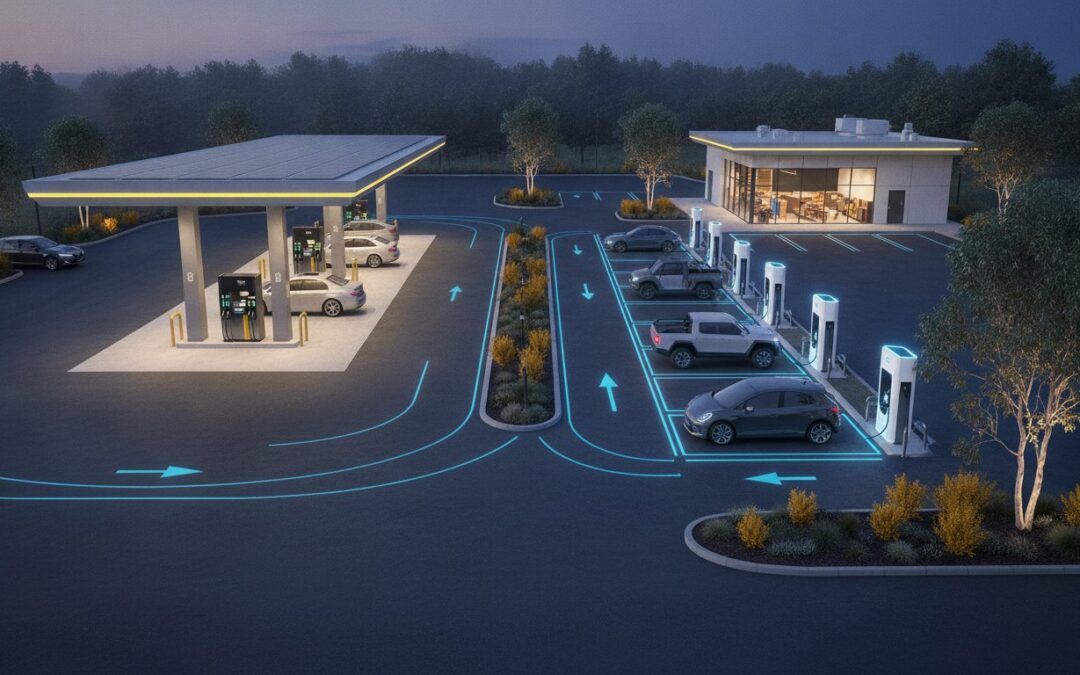
With electric vehicle sales in NSW reaching 8.9% of new light vehicle sales by 2025, the traditional service station layout is facing a critical bottleneck that fuel bowsers alone cannot solve. Integrating high-voltage infrastructure into a multi-fuel site requires more than just finding space for a charger; it demands a total rethink of vehicle movement. You likely understand the difficulty of balancing rapid fuel turnover with the extended dwell times required for charging, especially when trying to prevent site-wide gridlock.
This guide provides the technical framework needed to master access arrangements for service stations with EV charging while ensuring strict compliance with AS 2890.1 and AS 2890.2. You’ll learn how to navigate the complexities of vehicle swept path analysis and queuing theory to secure successful DA approval for your next project. We’ll examine how to optimise site layouts to maintain efficient vehicle flow, mitigate the risk of council rejection, and integrate the latest NCC 2025 requirements for EV-ready infrastructure into your civil design to ensure long-term site viability.
Key Takeaways
- Understand how the transition to multi-fuel energy hubs necessitates a redesign of internal circulation to accommodate significantly longer vehicle dwell times.
- Learn the specific geometry and clearance requirements for EV bays as mandated by AS 2890.1 and AS 2890.2 to ensure technical compliance.
- Master the design of access arrangements for service stations with EV charging by calculating precise queue capacity to prevent site gridlock during peak periods.
- Discover why vehicle swept path analysis is essential for retrofitting chargers to ensure safe manoeuvring for larger SUVs and light commercial vehicles.
- Identify the critical components of a Traffic Impact Assessment (TIA) required to address council concerns regarding congestion and secure DA approval.
The Evolution of Multi-Fuel Service Centres: Why Access Arrangements Matter
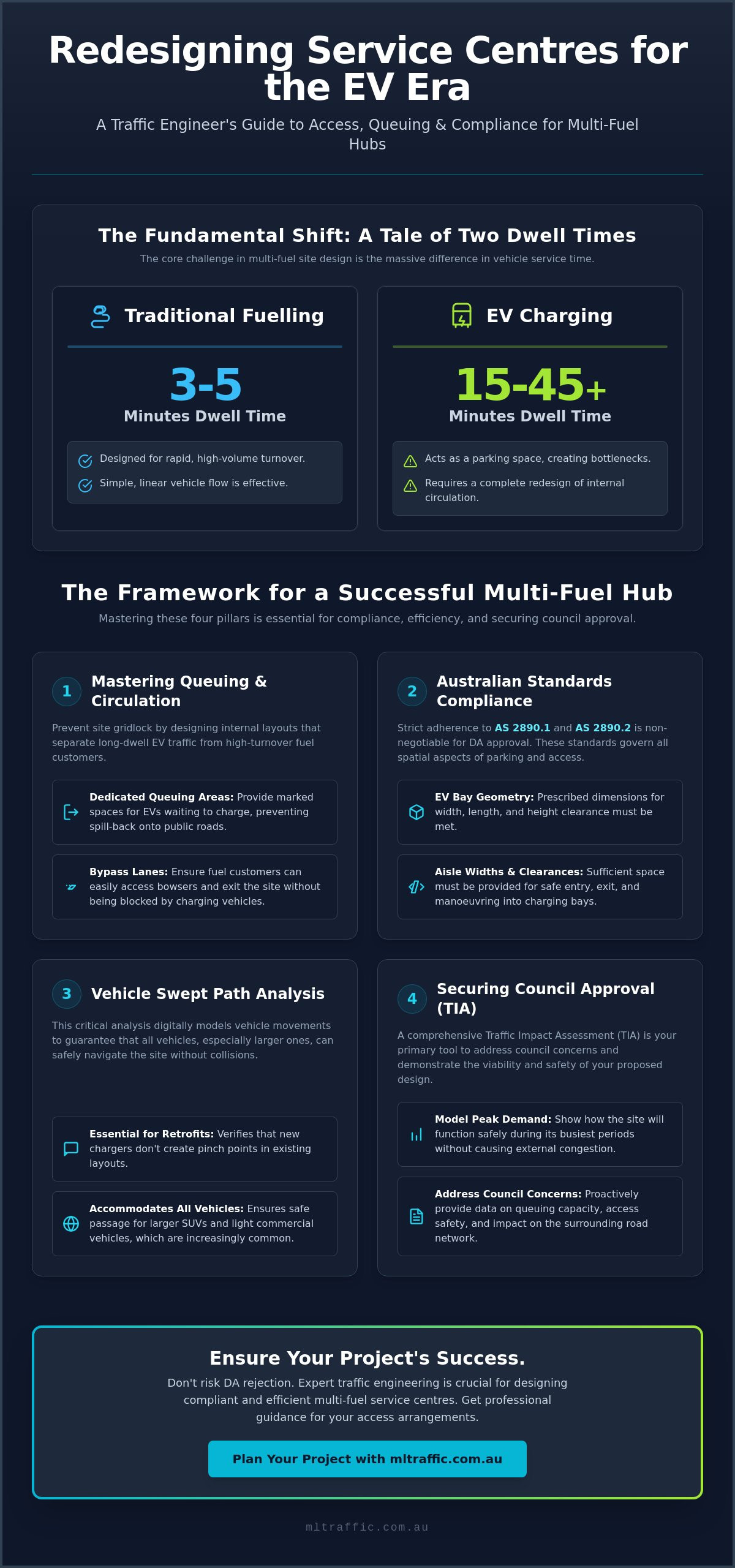
The landscape of Australian roadside infrastructure is undergoing its most significant shift since the introduction of self-service bowsers. Petrol stations are no longer simple refuelling points; they are becoming multi-fuel energy hubs. As EV sales in NSW reached 8.9% of new light vehicle sales by 2025, the demand for high-capacity electric vehicle charging stations has forced a total re-evaluation of site geometry. Designing access arrangements for service stations with EV charging requires a departure from traditional high-turnover models. Unlike a three-minute petrol fill, an EV charge can take anywhere from 15 to 45 minutes. This creates a critical spatial challenge. If vehicle circulation isn’t meticulously planned, the extended dwell times will cause internal gridlock, blocking access to traditional fuel pumps and entry points.
To better understand the operational complexities of these programs, watch this webinar:
Defining the Modern Service Station Layout
Modern sites must now integrate ultra-fast DC chargers alongside traditional liquid fuel lanes. This isn’t just about the physical footprint of the charger itself; it’s about the vehicle waiting to use it. Ancillary services like high-quality cafes and lounges are now standard to accommodate drivers during their charging session. You must balance these long-stay requirements with the needs of high-turnover fuel customers to maintain site profitability. Poorly designed circulation leads to frustrated customers and lost revenue, making the integration of charging bays a complex traffic management exercise rather than a simple electrical upgrade.
The Regulatory Landscape in Australia
Council planners in 2026 prioritise site safety and external traffic impacts above all else. A development application (DA) that fails to account for increased queuing will likely face immediate rejection. Professional traffic engineering input is now a prerequisite in the early design phase. Your access arrangements directly influence the Statement of Environmental Effects. They prove to the authority that the site can handle peak-period demand without spilling over onto the public road network. Meticulous planning ensures the development remains compliant with evolving state-based planning requirements and national standards.
Managing Dwell Time and Queuing Dynamics for EV Charging
Traditional service station design focuses on rapid turnover, usually averaging five minutes per vehicle. EV charging fundamentally alters this rhythm. Ultra-fast DC chargers can reduce wait times to approximately 20 minutes, while standard fast chargers often require 45 minutes or more. This extended duration, known as dwell time, shifts the vehicle’s status from a temporary refuelling stop to a parked state in the eyes of many planning authorities. Designing robust access arrangements for service stations with EV charging requires a data-driven approach to these stationary periods to prevent site-wide gridlock.
Effective queuing management is the only way to ensure that long-stay EV users don’t interfere with high-turnover fuel customers. If your layout does not provide dedicated queuing space for the next vehicle in line, the queue will inevitably obstruct fuel lanes or site exit points. We apply queuing theory to model peak-period arrivals, ensuring that the ‘spill-back’ effect does not reach the public road network. Clear pavement markings and vertical signage are essential to distinguish these zones. Without these markers, driver confusion leads to unnecessary manoeuvring, increasing the risk of low-speed collisions and reducing overall site efficiency.
EV Charging vs. Traditional Refuelling Flow
The disparity in service times means a single EV bay cannot process the same volume of traffic as a petrol bowser. You must design internal circulation to allow petrol and diesel customers to bypass the slower-moving EV queue. This often requires wider internal drive-aisles or dedicated bypass lanes. When calculating capacity, you must account for the fact that an EV bay is occupied for six to nine times longer than a traditional fuel position. If you are unsure how these dynamics will impact your site’s functionality, our team can provide a detailed traffic impact assessment to support your application.
Impact on Car Parking Demand
Integrating EV chargers complicates the mandatory parking ratios set by local councils. Depending on the specific local environmental plan, an EV bay may or may not count toward your minimum parking requirements. A professional car parking demand assessment is necessary to determine the optimal balance for multi-use sites that include ancillary cafes or retail. Managing over-staying vehicles is also a priority. Once a charge is complete, the bay effectively becomes a standard parking space. Implementing idle fees or time-limited parking zones, supported by clear signage, ensures bays remain available for active users and maintains the required turnover for site viability.
Compliance with AS 2890.1 and AS 2890.2 for EV Bays
Compliance with Australian Standards is the foundation of any successful development application. For access arrangements for service stations with EV charging, you must adhere to the AS 2890 series to ensure both safety and functional efficiency. AS 2890.1 governs off-street car parking, but the introduction of charging hardware introduces new spatial constraints. You cannot simply designate a standard parking space as an EV bay without considering the physical footprint of the charging unit and the required clearance for cable deployment. Professional design ensures these additions don’t compromise the site’s primary traffic functions.
AS 2890.2 is equally critical for multi-fuel sites. You must ensure that the placement of EV chargers does not impede the swept paths of heavy vehicles, such as fuel tankers or waste collection trucks. A charger positioned too close to a turning circle can become a high-risk collision point, leading to significant site downtime and repair costs. Additionally, AS 2890.6 mandates specific dimensions for accessible parking. These requirements extend to EV charging infrastructure to ensure equitable access under the Disability Discrimination Act, requiring a 2400mm wide bay with an adjacent 2400mm shared area.
Parking Bay Geometry and Clearances
Designing for EV bays requires choosing between nose-in and rear-in configurations, which significantly impacts internal circulation. Rear-in charging is often preferred for cable reach but requires more sophisticated manoeuvring space within the drive aisle. You must also account for the protection of the charging units themselves. Bollards and wheel stops must be positioned to prevent vehicle impact while maintaining enough clearance for drivers to move around the vehicle safely.
A compliant EV parking bay must adhere to a standard width of 2.4 metres as per the updated as2890.1 guidelines, though designers should allow for additional clearance to accommodate charging cables and hardware.
- Maintain a minimum clearance of 600mm around charging bollards to prevent vehicle strikes.
- Ensure bay lengths accommodate the largest expected passenger vehicles, including dual-cab utes and large SUVs.
- Align charging unit placement with vehicle inlets to minimise cable extension across paths of travel.
Pedestrian Safety and Shared Zones
The integration of high-voltage equipment into a high-traffic environment necessitates strict separation of pedestrian and vehicle zones. Charging cables present a significant trip hazard, particularly in low-light conditions. Your site design must include dedicated pedestrian paths that bypass charging areas. Lighting must meet the standards for 24/7 commercial facilities to ensure user safety and discourage antisocial behaviour. We recommend using high-visibility pavement markings to clearly define shared zones where pedestrians and vehicles may interact near charging points. Meticulous planning in these zones reduces liability and improves the user experience for all customers.
Vehicle Swept Path Analysis: Ensuring Safe Manoeuvring
Integrating chargers into an existing service station is not a simple plug-and-play operation. It requires a detailed swept path analysis to ensure the new infrastructure does not obstruct the established flow of the site. Retrofitting chargers often happens in tight corners where space is at a premium. You must verify that the added hardware does not impede the movement of fuel tankers or emergency services. If a tanker cannot safely reach the fill points due to poorly positioned charging units, the site’s core business is compromised.
Designing robust access arrangements for service stations with EV charging also involves managing the turn-around requirement. When all charging bays are occupied, drivers need a clear, safe path to exit the site or rejoin a queue without performing dangerous multi-point turns. This internal circulation is a frequent point of scrutiny during the council approval process. We use computer-aided design to simulate these movements, identifying potential conflict points before they become physical hazards.
Handling Diverse Vehicle Types
Modern electric vehicles come in vastly different dimensions. We model turning paths for vehicles ranging from compact cars to large electric SUVs like the Tesla Model X and electric light commercial vehicles. Charging port locations vary by manufacturer, appearing on the front, rear, or sides of the vehicle. This variability means your access arrangements for service stations with EV charging must account for multiple entry and exit angles to ensure all users can access the chargers without clipping bollards or kerbs. If your site serves heavy vehicles, maintaining B-double access is a non-negotiable requirement that must be demonstrated through rigorous modelling.
Driveway Crossover and Sight Distance Design
Driveway crossovers must comply with strict local council widths and gradients to facilitate safe entry and exit for all vehicle types. Maintaining clear sight lines is vital, especially for vehicles exiting charging bays into the main internal drive aisle. Sight distance assessments are mandatory for service station DAs because they prove to the consent authority that exiting motorists have sufficient visibility to identify and react to oncoming traffic or pedestrians, thereby minimising the risk of on-site collisions. Our team ensures that your site layout adheres to these visibility requirements while maximising the available space for charging infrastructure.
If you need to verify your site’s manoeuvrability and compliance, we provide professional vehicle swept path analysis to ensure your layout remains functional and safe.
Securing Council Approval for Your EV Service Station
Securing a development application (DA) for a multi-fuel site requires a robust technical argument. The primary hurdle is often convincing council planners that your access arrangements for service stations with EV charging won’t negatively impact the surrounding road network. A comprehensive Traffic Impact Assessment (TIA) is the most critical document in your submission. It serves as the bridge between your engineering design and the council’s planning objectives. It provides a data-backed justification for your layout, proving the site can accommodate increased dwell times without causing external queuing.
Council objections often centre on the fear of traffic congestion and site gridlock. You must address these concerns by presenting technical data in a format that’s accessible to planning committees. This involves moving beyond simple compliance and demonstrating operational resilience. When you partner with ML Traffic Engineers Australia, you gain the ability to pre-empt council concerns regarding vehicle turnover and internal circulation. We provide the technical weight needed to streamline the approval process, ensuring your project moves from the design phase to construction without unnecessary bureaucratic delays.
Components of a Successful Traffic Report
A successful traffic report for an EV-integrated service station must be meticulous and data-driven. It should include the following elements:
- Detailed queuing analysis for peak station hours, accounting for the extended dwell times of EV users.
- Documented swept path diagrams that prove compliant entry and exit for both passenger vehicles and heavy service tankers.
- Verification of compliance with AS 2890.1, AS 2890.2, and the NCC 2025 requirements for EV-ready infrastructure.
- Analysis of site-specific access arrangements for service stations with EV charging to ensure no ‘spill-back’ onto public roads.
The ML Traffic Engineers Australia Advantage
Our firm brings over 15 years of experience in Australian transport planning and civil engineering. We understand the specific requirements of local councils and state road authorities. We offer direct access to senior principals for all complex project negotiations, ensuring your DA is supported by seasoned expertise. Our commitment to personnel continuity means the expert you start with is the expert who performs the technical work. This hands-on approach ensures your project’s specific constraints are understood and addressed at every stage of the assessment.
We specialise in car park design, vehicle swept path analysis, and car parking demand assessments for diverse project environments. Our results-oriented methodology is designed to minimise risk and optimise site functionality. Contact ML Traffic Engineers Australia for a comprehensive access assessment.
Future-Proofing Your Service Centre Design
Integrating high-capacity charging into traditional service stations is a complex engineering task that requires balancing rapid fuel turnover with extended dwell times. By adhering to AS 2890 standards and utilising precise swept path modelling, you can create a layout that satisfies both council requirements and operational needs. As discussed throughout this guide, the transition to multi-fuel hubs necessitates a fundamental shift in how we approach access arrangements for service stations with EV charging to prevent site-wide gridlock and ensure long-term viability.
ML Traffic Engineers Australia provides over 15 years of specialised transport planning experience to ensure your site is technically sound and compliant. We guarantee senior principal involvement in every TIA report and maintain national coverage for all commercial development types. Our personnel continuity promise ensures the expert who initiates your project performs the technical work, providing a consistent and accountable service that avoids unnecessary bureaucracy. This direct access to leadership is essential for navigating complex negotiations with consent authorities.
Get a professional Traffic Impact Assessment for your EV project to secure your DA approval and optimise your site’s performance. Our team is ready to help you deliver a robust, future-proof energy hub that meets the demands of the evolving Australian vehicle fleet.
Frequently Asked Questions
Do EV charging bays count as parking spaces for council requirements?
Whether EV charging bays count toward minimum parking requirements depends on the specific Local Environmental Plan (LEP) of your council. Some authorities categorise these bays as active refuelling positions rather than stationary parking. This distinction is critical for multi-use sites where ancillary retail or cafe services already strain the available parking supply. You must verify the specific definitions within your local planning instruments to ensure the development remains compliant with mandatory parking ratios.
What is the minimum width for a compliant EV charging bay in Australia?
A compliant EV charging bay typically requires a minimum width of 2.4 metres according to AS 2890.1 guidelines. However, we recommend designing for 3.0 metres to accommodate charging hardware, cable deployment, and the increased door-opening width of larger electric SUVs. If the bay is designated for accessible use, AS 2890.6 mandates a 2.4-metre wide bay with an adjacent 2.4-metre wide shared area to ensure safety and equitable access.
How much queuing space do I need for a 4-bay ultra-fast charging station?
Queuing requirements are determined by modelling peak-hour arrival rates against the average 20-minute dwell time of ultra-fast chargers. For a 4-bay station, you generally need enough internal queuing space for at least two vehicles per bay to prevent spill-back into fuel lanes. Professional traffic modelling identifies the exact queue capacity required to maintain site efficiency. This prevents internal gridlock and ensures that the access arrangements for service stations with EV charging don’t negatively impact the public road network.
Is swept path analysis required for retrofitting chargers into an existing station?
Yes, a Vehicle Swept Path Analysis is essential whenever you introduce physical infrastructure into an existing station layout. Retrofitting chargers often reduces the available manoeuvring area for heavy vehicles like fuel tankers and waste collection trucks. You must demonstrate that these critical service vehicles can still navigate the site safely without risk of collision with the new charging bollards. Failure to provide this analysis often leads to immediate DA rejection by council traffic committees.
How do EV charging dwell times impact overall service station traffic flow?
EV charging dwell times, which range from 20 to 45 minutes, fundamentally shift the site dynamic from high-turnover to a hybrid long-stay model. This extended occupancy increases the risk of internal congestion if the layout does not include dedicated bypass lanes for traditional fuel customers. Without careful planning, the static nature of charging vehicles can block access to bowsers, significantly reducing the service station’s overall throughput and revenue potential during peak periods.
What Australian Standards govern the design of EV access arrangements?
The primary standards governing access arrangements for service stations with EV charging are AS 2890.1 (Off-street car parking) and AS 2890.2 (Off-street commercial vehicle facilities). These standards define the geometry, clearances, and swept paths required for safe operation. Additionally, AS 2890.6 provides the technical specifications for accessible parking bays, which must be integrated into the charging network. Adhering to these national standards is mandatory for securing council approval and ensuring site safety.
Can a service station operate with both fuel tankers and EV chargers in close proximity?
Service stations can operate both fuel tankers and EV chargers simultaneously, provided the layout respects hazardous zone clearances and heavy vehicle swept paths. You must ensure that the electrical infrastructure is positioned outside of fuel decanting areas and venting points to comply with safety regulations. Meticulous design ensures that tanker movements aren’t restricted by the placement of charging bays, maintaining the operational integrity of the liquid fuel components of the site.
What happens if my site cannot accommodate the required swept paths for EVs?
If a site cannot accommodate the required swept paths for the design vehicle, you must either redesign the layout or limit the types of vehicles permitted to use the chargers. Council planners will not approve a DA that shows vehicles clipping kerbs or performing unsafe multi-point turns. In these instances, we often explore alternative bay configurations, such as parallel or angled charging, to meet compliance while maximising the functional utility of the available space.

Disclaimer
The content on www.mltraffic.com.au, including all technical articles, guides, and resources, is provided for general informational and educational purposes only. It is not intended to constitute professional advice in traffic engineering, transportation planning, development approvals, or any other technical or legal field. While ML Traffic Engineers makes every reasonable effort to ensure the accuracy, completeness, and timeliness of the information published, we do not provide any warranties or representations (express or implied) regarding its reliability, suitability, or availability for any particular purpose. Any reliance you place on the content is strictly at your own risk. In no event shall ML Traffic Engineers, its directors, employees, authors, or affiliates be liable for any direct, indirect, incidental, special, consequential, or punitive damages (including, without limitation, loss of profits, data, or business opportunities) arising out of or in connection with the use of, or inability to use, any information provided on this website. The articles and guides on this site are not a substitute for engaging a qualified, registered professional traffic engineer (such as an NPER or RPEQ engineer) to assess your specific project requirements. For tailored advice, compliance assessments, or traffic engineering services, please contact a competent professional. This disclaimer may be updated from time to time without notice. By accessing or using this website, you agree to be bound by the most current version of this disclaimer.
