

Will your next project survive the transition to the new Heavy Vehicle National Law on 1 August 2026? For many developers, the complexity of NHVR permit requirements and the risk of infrastructure damage turn heavy vehicle logistics into a significant liability. It’s frustrating to see a development application delayed because a traffic report lacks the technical depth required by road managers. Managing an access assessment for over-dimensional loads requires more than just basic planning; it demands a rigorous understanding of civil engineering and current regulatory frameworks.
This guide provides the technical clarity needed to master OSOM access assessments and permit requirements for total compliance. You’ll learn how to ensure your heavy vehicle movements are both safe and efficient while adhering to the rigorous standards of the new HVA scheme. We’ll examine the critical role of AutoTURN Pro 2026 in swept path analysis, the impact of the Heavy Vehicle Structural Assessment Permit System launching on 12 January 2026, and the essential steps to maintain compliance with AS 2890.2 for all commercial vehicle access.
Key Takeaways
- Understand how the Heavy Vehicle National Law (HVNL) governs Oversize Overmass (OSOM) movements and your legal obligations under the new 2026 reforms.
- Recognise the necessity of a formal access assessment for over-dimensional loads to identify potential infrastructure conflicts before they cause costly site delays.
- Learn the technical requirements for Vehicle Swept Path Analysis using AutoTURN software to simulate and verify complex heavy vehicle movements.
- Discover how a professionally prepared Traffic Management Plan (TMP) streamlines the NHVR permit application process and reduces road manager Request for Information (RFI) cycles.
- Identify the specific mass and dimension thresholds that trigger the requirement for specialised OSOM permits and technical engineering assessments.
What is an Access Assessment for Over-Dimensional Loads?
An access assessment for over-dimensional loads is a rigorous technical evaluation conducted by traffic engineers to determine if an Oversize load or overmass vehicle can safely navigate a specific road corridor. This process is mandated under the Heavy Vehicle National Law (HVNL) to manage the impact of heavy vehicles on the Australian road network. It isn’t merely a bureaucratic step; it’s a critical safety check that bridges the gap between logistical requirements and physical infrastructure limits. Every assessment must consider the unique geometry of the route and the structural capacity of the assets along it.
To better understand the technicalities of these movements, watch this helpful video:
The National Heavy Vehicle Regulator (NHVR) coordinates these assessments, but final approval often rests with local road managers who hold intimate knowledge of their assets. For developers, an access assessment for over-dimensional loads serves as proof that a proposed haulage route won’t compromise public safety or damage government property. This is especially vital when transporting “large indivisible items,” such as bridge girders, wind turbine blades, or pre-cast concrete panels that cannot be broken down into smaller loads without extreme expense or risk of damage.
Defining OSOM: Oversize and Overmass Vehicles
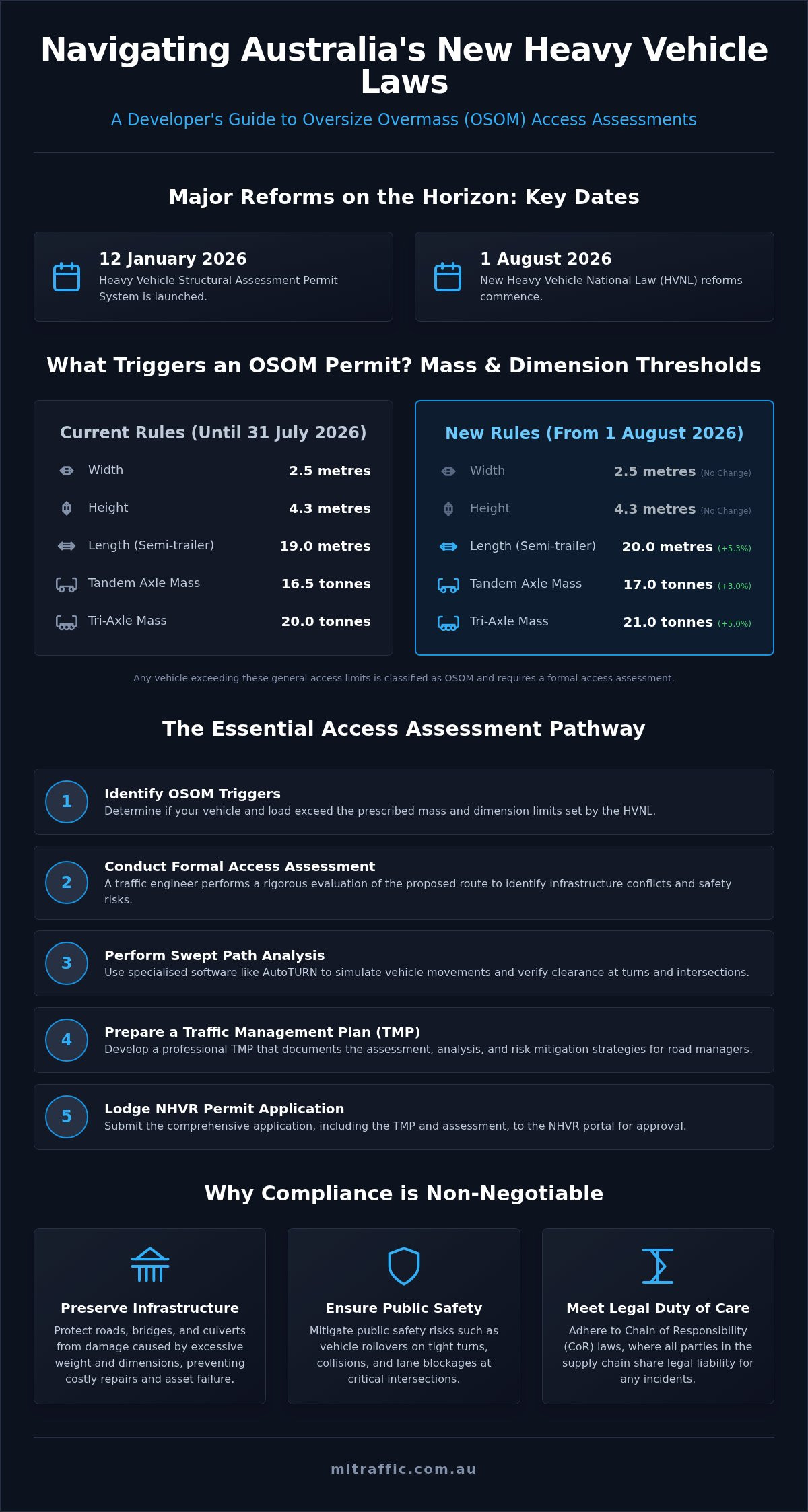
Vehicles exceed standard limits when they surpass a width of 2.5 metres, a height of 4.3 metres, or a length of 19 metres for a standard semi-trailer. Mass thresholds are equally strict. For instance, until the August 2026 reforms, a tandem axle group is generally limited to 16.5 tonnes. These vehicles are classified as Class 1 load-carrying vehicles. They differ from general access vehicles because their physical footprint requires specific route clearances and, in many cases, pilot vehicle escorts to manage traffic flow through narrow sections or intersections.
Why Access Assessments are Mandatory
The primary objective is the preservation of infrastructure and public safety. Heavy vehicles exert immense pressure on culverts and bridge decks. Exceeding structural capacities can lead to catastrophic failure or long-term fatigue. Beyond physical damage, assessments address public safety risks like vehicle rollovers on tight radius turns or lane blockages at intersections. Under the Chain of Responsibility (CoR) provisions of the HVNL, every party in the logistics chain shares a legal “Duty of Care.” Failing to secure a professional engineering assessment from a qualified traffic specialist can lead to significant legal liability if an incident occurs.
Mass and Dimension Limits: The OSOM Framework
The regulatory framework for heavy vehicles in Australia is built upon strict mass and dimension thresholds. Until 31 July 2026, standard heavy vehicles are limited to a width of 2.5 metres, a height of 4.3 metres, and a length of 19 metres for a standard semi-trailer. Weight limits are equally precise, with tandem axle groups capped at 16.5 tonnes and tri-axle groups at 20.0 tonnes. When a load exceeds any of these prescribed limits, it transitions from a general access movement to an Oversize Overmass (OSOM) operation. This transition necessitates a formal access assessment for over-dimensional loads to ensure the proposed route can physically accommodate the vehicle’s footprint.
From 1 August 2026, the Heavy Vehicle National Law (HVNL) reforms will introduce significant changes to these productivity metrics. General length for certain combinations will increase to 20 metres, while tandem axle group weights will rise to 17.0 tonnes and tri-axle groups to 21.0 tonnes. Despite these increases, the requirement for accurate measurement remains absolute. Every millimetre of height, width, length, and rear overhang must be documented. While Australian standards are specific, they share common goals with international Federal guidelines for oversize permits by prioritising infrastructure longevity and public safety during transport.
Depending on the final dimensions, the NHVR may mandate the use of pilot or escort vehicles. For movements in Victoria, as of July 2026, heavy vehicle escort services are billed at $275 per hour. These requirements are determined during the assessment phase to mitigate risks at narrow points or complex intersections. If you’re unsure how these new limits affect your project, consulting with a traffic specialist can prevent costly compliance errors.
Class 1 Load-Carrying Vehicles
Class 1 vehicles typically carry “large indivisible items” that cannot be dismantled without disproportionate cost or risk. This category includes everything from construction components like bridge girders to Special Purpose Vehicles (SPVs) such as mobile cranes and drill rigs. Agricultural vehicles also fall under this umbrella when they exceed standard dimensions. Each of these vehicle types requires a specific assessment because their turning circles and weight distributions differ significantly from standard freight haulage.
Restricted Access vs. General Access Networks
Australia’s road network is divided into general access and restricted access routes. General access vehicles can travel almost anywhere, but OSOM loads are often confined to the National Network Map’s approved corridors. Any movement “off-route” or onto local council roads triggers the need for a site-specific access assessment for over-dimensional loads. Developers must also account for seasonal curfews and travel restrictions during long weekends or public holidays, which can halt OSOM movements entirely to ensure holiday traffic safety.
Technical Tools for Assessment: Swept Path Analysis
A successful access assessment for over-dimensional loads relies on engineering precision rather than general GIS mapping. While regulatory bodies provide high-level route planners, these tools often lack the granularity required for complex urban manoeuvres or site-specific entries. Swept Path Analysis is the industry-standard methodology used to prove that a specific Oversize Overmass (OSOM) vehicle can navigate a proposed corridor without striking infrastructure. Using AutoTURN Pro 2026, engineers simulate the dynamic footprint of the vehicle, accounting for articulated joints and rear-steering axles. This technical verification is essential for meeting the requirements of AS 2890.2, which governs off-street commercial vehicle facilities in Australia.
The simulation process identifies critical pinch points such as roundabouts, tight radius corners, and narrow gateways. These obstacles often present the highest risk for infrastructure damage or vehicle grounding. By following established FHWA Best Practices for OS/OW Permitting, traffic specialists provide road managers with the empirical data needed to approve high-risk movements. This evidence-based approach reduces the likelihood of permit refusals and ensures that every turn is technically feasible before the vehicle leaves the depot.
Simulating the Vehicle Movement
Engineers create bespoke digital vehicle profiles that mirror the exact specifications of the OSOM load. This includes the prime mover, trailer configuration, and the dimensions of the indivisible item itself. The analysis focuses on low-speed off-tracking, where the rear wheels follow a different path than the front wheels during a turn. We examine the swept width on curves to ensure the load doesn’t encroach on oncoming traffic lanes or strike roadside assets like power poles and traffic signals.
Desktop Assessment vs. Physical Route Scoping
While digital simulations are powerful, a comprehensive access assessment for over-dimensional loads often requires physical route scoping. Engineers verify vertical clearances for overhead power lines, bridges, and signage that may not be accurately recorded in public databases. We also evaluate the road surface capacity to handle extreme mass loads, particularly on unsealed roads or older culverts. Combining desktop AutoTURN analysis with on-site measurements provides the highest level of certainty for developers and regulatory authorities.
Navigating Permits and Transport Management Plans (TMP)
Securing regulatory approval for OSOM movements is a sequential process that relies on the technical data gathered during the initial access assessment for over-dimensional loads. The journey from project inception to final permit issuance involves multiple stakeholders and strict adherence to the Heavy Vehicle National Law (HVNL). As of July 2026, the standard access permit application fee is $94, but the real cost of a project lies in the delays caused by inadequate documentation. A structured approach ensures that road managers have the necessary confidence to grant consent for restricted access routes.
The process follows five critical stages:
- Step 1: Route scoping and initial feasibility assessment. Engineers verify the physical constraints of the proposed path.
- Step 2: Preparation of the Traffic Management Plan (TMP). This document integrates swept path results and operational safety protocols.
- Step 3: Submission via the NHVR Portal. Digital applications are processed through a centralised system, including the Heavy Vehicle Structural Assessment Permit System (HVSAPS).
- Step 4: Road Manager consent and third-party approvals. This includes local councils and utility providers like rail or power authorities.
- Step 5: Final permit issuance and compliance monitoring. The move must proceed exactly as documented in the approved plan.
For developers, the complexity of this workflow often requires professional intervention to avoid the “Request for Information” (RFI) cycles that stall project timelines. If your project involves complex logistics, obtaining a professional Traffic Impact Assessment Report is the most efficient way to satisfy regulatory requirements.
High-Risk Moves and Critical Loads
Regulators classify certain movements as “High Risk” based on extreme dimensions. Loads exceeding 5.0 metres in width or 30.0 metres in length trigger additional oversight. In New South Wales and other jurisdictions, these moves often require NSW Police escorts or state-specific pilot vehicles to manage traffic flow and public safety. The launch of the new Heavy Vehicle Accreditation (HVA) scheme on 1 August 2026 further strengthens the requirement for documented Safety Management Systems (SMS) for these sensitive operations.
Essential Components of an OSOM TMP
An effective OSOM TMP must be more than a simple map. It acts as a live operational guide for the entire transport team. Key components include a detailed risk assessment with contingency planning for mechanical breakdowns or unexpected road closures. It must also outline communication protocols between pilots, drivers, and local authorities. Precise route maps must include specific instructions for navigating difficult intersections identified during the access assessment for over-dimensional loads, ensuring every participant understands their role in maintaining safety and compliance.
Why Professional Traffic Engineering is the Key to Approval
The National Heavy Vehicle Regulator (NHVR) and local road managers act as gatekeepers to the road network. Their primary objective is the preservation of public assets and safety, not the success of a developer’s logistics schedule. When a permit is refused, it’s frequently because the application lacks the technical evidence required to satisfy a road manager’s risk concerns. Professional Traffic Engineering serves as the bridge between these regulatory requirements and operational reality. By providing a technical access assessment for over-dimensional loads, engineers replace regulatory uncertainty with empirical data, significantly reducing the “Request for Information” (RFI) cycles that often stall projects for weeks.
Expert reports do more than just tick boxes. They provide the specific simulations and structural considerations that road managers cannot perform themselves. This high-level technical advocacy is particularly valuable when a standard route is unavailable and a custom path must be carved through sensitive urban environments. Integrating a formal Traffic Impact Assessment early in the project lifecycle allows developers to identify OSOM constraints during the feasibility stage. This proactive approach prevents the costly discovery of access issues after construction contracts are already signed.
Meticulous Compliance and Expert Witness Support
Every access assessment for over-dimensional loads must meet the rigorous standards set by local councils and state transport authorities. At ML Traffic Engineers Australia, we prioritise personnel continuity; the senior principal who initiates your project is the same expert who performs the technical analysis and signs off on the final report. This direct access to leadership ensures accountability and technical depth that larger, more impersonal firms often struggle to replicate. A qualified traffic engineer provides the technical certification required to verify that a specific vehicle configuration won’t compromise the structural integrity or operational safety of the public road network. This certification is essential if an application ever requires expert witness support during a planning appeal or legal dispute.
Streamlining the Development Application (DA) Process
Access assessments shouldn’t exist in a vacuum. For a successful Development Application, these reports must be seamlessly integrated into the wider Statement of Environmental Effects. A professional traffic engineer identifies potential conflicts early and offers proactive problem-solving, such as recommending minor site modifications or temporary infrastructure adjustments to enable OSOM access. These modifications can include the temporary removal of bollards, the relocation of signage, or the reinforcement of specific driveway crossings to handle extreme mass loads. By resolving these technical hurdles before submission, developers can present a complete, low-risk solution to consent authorities. For expert assistance with your next heavy vehicle movement, contact the specialists at ML Traffic Engineers Australia to ensure your project remains compliant and on schedule.
Securing Your Heavy Vehicle Access
Mastering the logistics of Oversize Overmass (OSOM) movements requires a shift from general planning to technical engineering. You now understand that a successful access assessment for over-dimensional loads relies on precise AutoTURN simulations and a deep knowledge of the 2026 HVNL reforms. These technical reports provide the empirical evidence road managers need to grant consent. They also ensure your project avoids the structural risks and bureaucratic delays that often derail development timelines.
ML Traffic Engineers Australia brings over 15 years of specialist experience to every project. We provide comprehensive national service coverage and guarantee direct senior principal involvement in every assessment. This ensures the person you speak with is the person performing the technical work. Don’t let complex permit requirements stall your progress. Contact ML Traffic Engineers Australia for your Access Assessment today. Our team is ready to help you navigate the complexities of heavy vehicle logistics with authority and precision. We look forward to ensuring your next load movement is safe, compliant, and efficient.
Frequently Asked Questions
Do I need a permit for an over-dimensional load on private property?
No permit is required for movements that occur strictly within the boundaries of private property. However, the moment any part of the vehicle or load enters a public road, an access assessment for over-dimensional loads and a corresponding NHVR permit become mandatory. Developers must also ensure that internal site roads and gates can physically accommodate the vehicle’s footprint to prevent onsite infrastructure damage or vehicle grounding.
How long does a heavy vehicle access permit assessment typically take?
The timeframe for an assessment depends on the complexity of the route and the number of road managers involved. A standard technical engineering assessment is usually completed within 5 to 10 business days. The subsequent NHVR permit approval process can take several weeks, particularly if road managers require additional structural data or if third-party approvals from rail or power authorities are necessary for the move.
What is the difference between an OSOM permit and a notice?
A notice is a standing exemption that allows specific vehicle categories to operate on certain networks without a separate application. A permit is a specific authorisation for a single vehicle or fleet to move a particular load on a defined route. Most OSOM movements for development projects require a permit because the loads are unique and often require travel on roads outside the standard heavy vehicle networks.
Can a traffic engineer help if my NHVR permit application was refused?
Yes, a traffic engineer is essential for resolving permit refusals. Refusals typically occur when a road manager lacks technical certainty regarding infrastructure safety or vehicle clearance. We provide the detailed swept path diagrams and structural evidence required to address these specific concerns. This technical advocacy often turns a refusal into an approval by providing the empirical proof that the movement is technically feasible and safe.
What information do I need to provide for a swept path analysis?
You must provide the exact dimensions of the load and the specific vehicle configuration used for the transport. This includes the width, height, overall length, and rear overhang. Detailed site plans or CAD files of the proposed route and entry points are also required. This data allows our engineers to perform an accurate access assessment for over-dimensional loads using specialised AutoTURN software to simulate the movement.
Are there specific times of day when over-dimensional loads cannot travel?
Yes, travel curfews are frequently applied to OSOM movements to minimise the impact on peak-period traffic. Restrictions generally apply during morning and afternoon peak hours in metropolitan areas. Many states also enforce total travel bans during long weekends and public holidays. These specific windows are clearly detailed in the permit conditions and must be strictly followed to maintain legal compliance during the move.
Who is responsible for the cost of bridge or road assessments for heavy loads?
The applicant or developer is responsible for all costs associated with specialised structural assessments. If a road manager determines that a bridge or culvert requires a detailed engineering check to handle an overmass load, they will request a formal report. These costs are separate from the standard NHVR application fee and must be factored into the project’s logistical budget during the initial planning phase.
What happens if I move an over-dimensional load without a permit?
Moving an over-dimensional load without a valid permit results in severe legal and financial consequences. Fines can reach tens of thousands of dollars under the Chain of Responsibility provisions of the HVNL. The vehicle may be grounded immediately, leading to significant project delays. Furthermore, the operator and developer assume full legal liability for any infrastructure damage or safety incidents that occur during an unauthorised movement.

Disclaimer
The content on www.mltraffic.com.au, including all technical articles, guides, and resources, is provided for general informational and educational purposes only. It is not intended to constitute professional advice in traffic engineering, transportation planning, development approvals, or any other technical or legal field.
While ML Traffic Engineers makes every reasonable effort to ensure the accuracy, completeness, and timeliness of the information published, we do not provide any warranties or representations (express or implied) regarding its reliability, suitability, or availability for any particular purpose. Any reliance you place on the content is strictly at your own risk.
In no event shall ML Traffic Engineers, its directors, employees, authors, or affiliates be liable for any direct, indirect, incidental, special, consequential, or punitive damages (including, without limitation, loss of profits, data, or business opportunities) arising out of or in connection with the use of, or inability to use, any information provided on this website.
The articles and guides on this site are not a substitute for engaging a qualified, registered professional traffic engineer (such as an NPER or RPEQ engineer) to assess your specific project requirements. For tailored advice, compliance assessments, or traffic engineering services, please contact a competent professional.
This disclaimer may be updated from time to time without notice. By accessing or using this website, you agree to be bound by the most current version of this disclaimer.
