

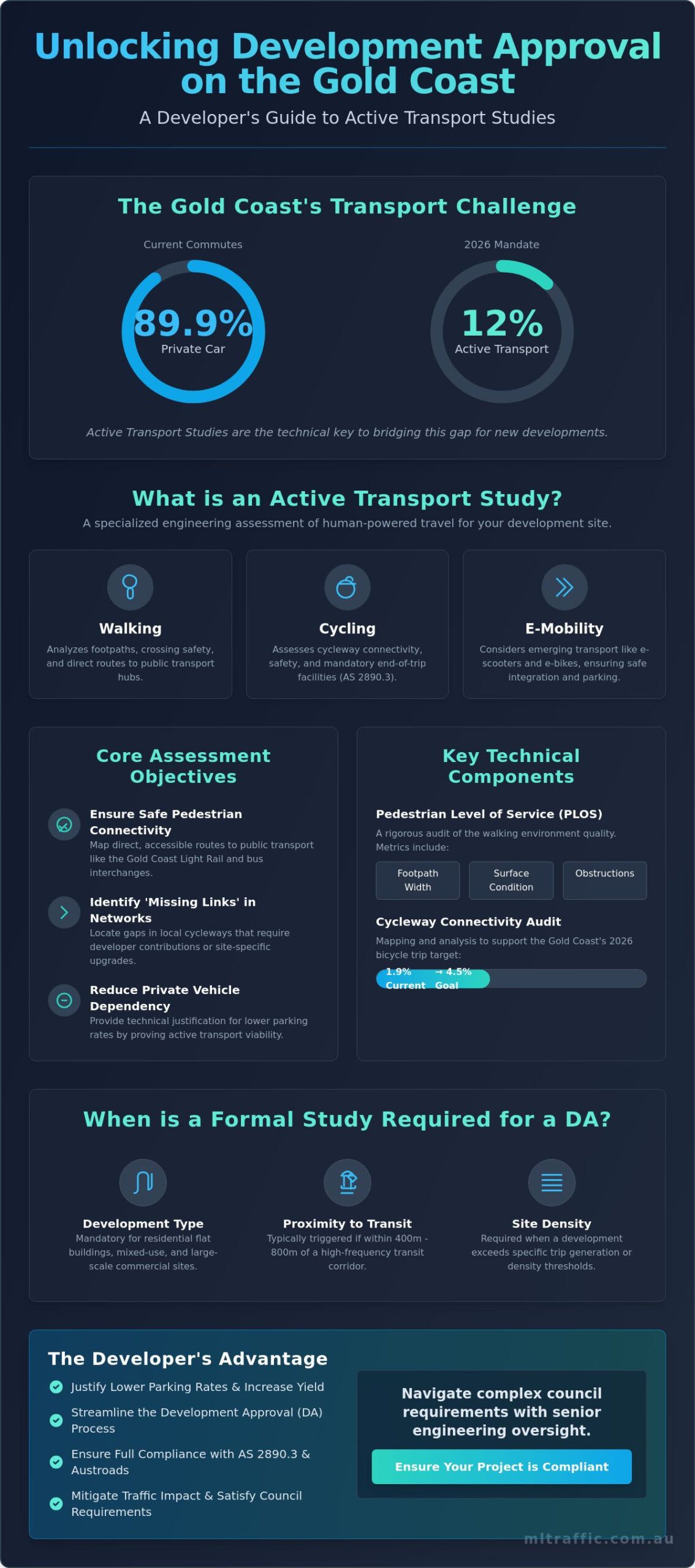
With 89.9% of Gold Coast commutes currently made by private car, the city’s mandate for a 12% active transport mode share by 2026 represents a significant shift in planning expectations. Developers often face ambiguous council requirements for pedestrian paths and cycleways that conflict with site yield and traditional parking layouts. Integrating professional active transport studies gold coast into your traffic impact assessment is now a technical necessity for securing development approval in this evolving regulatory environment.
We understand the difficulty of balancing site yield with mandated green infrastructure. This article explains how active transport studies integrate into the traffic engineering process to secure development approvals across Australia. You’ll learn how to achieve full AS 2890.3 compliance and satisfy the Gold Coast City Transport Strategy 2031 without compromising your site’s operational efficiency. We’ll provide a technical overview of balancing mandated infrastructure with functional design to ensure a successful, compliant project outcome.
Key Takeaways
- Understand how active transport studies gold coast identify critical infrastructure gaps and define requirements for walking, cycling, and e-mobility.
- Learn the technical metrics used in Pedestrian Level of Service (PLOS) analysis and cycleway audits to ensure seamless precinct connectivity.
- Discover how to justify lower parking rates and modify vehicle trip generation by integrating active transport data into your Traffic Impact Assessment (TIA).
- Ensure project compliance with mandatory standards including AS 2890.3 for bicycle parking and Austroads design guidelines.
- Gain insights into why senior-led engineering oversight is critical for navigating complex council requirements and securing DA approval.
What are Active Transport Studies in Australian Development?
Active transport studies gold coast are specialized engineering assessments that analyze how human-powered travel integrates with a specific development site. This technical field covers walking, cycling, and the rapidly expanding category of e-mobility solutions. Understanding What is Active Transport? is essential for modern developers, as it represents a fundamental shift from car-centric planning to multi-modal transport engineering. These studies identify existing infrastructure gaps, such as disconnected footpaths or a lack of secure end-of-trip facilities, which could hinder a project’s compliance with local planning schemes.
To better understand this concept, watch this helpful video:
Modern Australian councils now view active transport studies gold coast as a technical pillar of a compliant Development Application (DA). This shift is driven by the need to manage projected trip growth, which is expected to increase by 44% on the Gold Coast by 2031. Engineers use these studies to justify development intensity by demonstrating that the site can support residents and visitors without solely relying on the existing road network. It’s a core requirement for high-density and commercial projects that seek to reduce their environmental footprint and improve urban permeability.
The Core Objectives of an Active Transport Assessment
A professional assessment focuses on three primary technical outcomes to ensure site viability and regulatory approval:
- Ensuring safe pedestrian connectivity: Mapping direct, accessible routes to public transport hubs, including the Gold Coast Light Rail network and major bus interchanges.
- Identifying “missing links”: Locating gaps in the local cycleway network that may require developer contributions or site-specific infrastructure upgrades to meet council standards.
- Reducing private vehicle dependency: Providing the technical justification for “mode share” targets, aiming to convert short-trip commutes from private cars to active modes.
When is a Formal Study Required for Your DA?
Councils typically mandate a formal active transport study for residential flat buildings, mixed-use developments, and large-scale commercial sites. Proximity to high-frequency transit corridors, such as the planned Light Rail Stage 4 extension, often increases the likelihood of this requirement during the information request phase. A formal study is typically triggered when a development exceeds specific density thresholds or sits within 400 to 800 meters of a high-frequency transit corridor. For detailed assistance with your project’s specific requirements, view our full range of traffic engineering services.
Technical Components of a Comprehensive Active Transport Study
A professional active transport study gold coast goes beyond basic mapping; it provides a rigorous engineering audit of the urban environment surrounding a development. These assessments must align with the strategic objectives of the Gold Coast Active Transport Plan, which targets a 12% total mode share by 2026. To reach these benchmarks, engineers perform a Pedestrian Level of Service (PLOS) analysis. This process evaluates the quality of the walking environment based on footpath width, surface condition, and the presence of physical obstructions. It’s a critical metric for councils when determining if existing infrastructure can handle the increased foot traffic from a new high-density residential or commercial site.
Cycleway connectivity mapping is equally essential for site viability. Currently, only 1.9% of daily trips on the Gold Coast are made by bicycle, while the 2026 target is 4.5%. Increasing this figure requires identifying “missing links” in the immediate precinct. Safety assessments also account for non-motorized users by verifying sight distance at driveway crossovers and ensuring lighting levels meet Australian Standards. We integrate this data with public transport accessibility metrics to create a multi-modal profile of the site. This ensures every transport mode is optimized for safety and efficiency. You can explore our full range of traffic engineering services to see how these audits fit into the broader DA process.
Pedestrian and Cyclist Infrastructure Audits
Audits evaluate footpath widths and surface conditions against Austroads and council-specific standards. Engineers assess intersection crossing times to ensure they’re sufficient for vulnerable users, such as the elderly or those with mobility aids. We identify potential conflict points between vehicles and pedestrians, particularly at entry and exit ramps. These findings often dictate the final site layout and the placement of pedestrian access points to minimize risk.
End-of-Trip Facility Requirements
End-of-trip (EoT) facilities are mandatory for many commercial and high-density developments. We calculate the required number of bicycle parking spaces for residents and visitors based on the specific land-use category. Design compliance is strictly measured against AS 2890.3 (Bicycle Parking Facilities). This includes specific requirements for showers, lockers, and secure storage areas. Proper EoT design is a key factor in justifying lower vehicle parking rates. If you need assistance with technical compliance, it’s worth consulting an expert in car park design and transport planning to avoid costly redesigns during the DA phase.
Integrating Active Transport into Traffic Impact Assessments (TIA)
Active transport data provides the technical basis for modifying standard trip generation rates within a Traffic Impact Assessment (TIA). In high-density precincts, relying solely on generic trip rates often overestimates vehicle impact. Professional active transport studies gold coast allow engineers to apply a “mode share” reduction. This reflects the percentage of trips taken via walking, cycling, or light rail. By accurately calculating this split, we provide a more realistic projection of a development’s impact on the local road network.
Providing high-quality active infrastructure can serve as a technical mitigation strategy for traffic congestion. Instead of proposing road widening, which is often physically or financially impossible, a developer may upgrade a nearby green bridge or cycleway. This trade-off is increasingly accepted by councils aiming to meet the 14% daily active trip target by 2031. It demonstrates a commitment to sustainable growth while managing the operational capacity of existing intersections.
Reducing Parking Demand through Active Transport
Developers often struggle to balance site yield with mandated car parking. A Car Parking Demand Assessment supported by active transport data provides the evidence needed for rate reductions. In urban centers, high walkability scores and proximity to high-frequency transit justify lower on-site parking provision. We use local census data and precinct-specific surveys to demonstrate that residents in highly connected areas own fewer vehicles. This technical justification prevents over-capitalization on basement parking levels that may remain underutilized.
Traffic Modelling and Non-Motorised Users
Traffic modelling must account for the physical presence of pedestrians and cyclists to be accurate. In SIDRA modelling, we incorporate specific pedestrian crossing phases at signalized intersections to assess their impact on vehicle saturation levels. Increased cycling activity can reduce local road capacity if dedicated lanes aren’t managed correctly. SIDRA modelling accounts for pedestrian delays by calculating the interaction between crossing volumes and vehicle turn capacities at each approach. This ensures the intersection analysis reflects the true multi-modal environment of the Gold Coast.
Achieving a cohesive site design requires direct collaboration between traffic engineers and town planners. We ensure that the pedestrian access points identified in our study align with both the architectural vision and council’s urban design requirements. This integrated approach ensures the TIA is a functional part of the site’s operational design rather than just a standalone compliance document. For expert assistance with your TIA, you can contact our senior principals directly.
Navigating Compliance: Australian Standards and Council Requirements
Engineering certification for any new development requires strict adherence to national benchmarks. While local strategies provide the vision, AS 2890.3 (Bicycle Parking Facilities) provides the technical mandate that designers must follow. Our active transport studies gold coast ensure that every pedestrian path, cycleway, and storage facility meets these rigorous requirements. We also reference Austroads Guides to guarantee that the geometry of non-motorised infrastructure supports safe and functional movement for all users.
Swept path analysis is a critical component for shared zones where vehicles and pedestrians interact. In high-density projects, loading areas and waste collection points often overlap with active transport corridors. We use specialized software to simulate vehicle movements, ensuring that heavy vehicles can maneuver without compromising the safety of walkers or cyclists. If your project involves complex shared environments, contact our senior principals to discuss your compliance requirements.
Australian Standards for Bicycle Parking
AS 2890.3 categorizes bicycle parking into three distinct classes based on security and duration of stay. Class 1 facilities provide high-security individual lockers for long-term use, while Class 3 refers to short-term rails for visitors. Compliance involves more than just counting racks; it requires specific spacing, aisle widths, and maneuvering clearances. For example, a standard bicycle requires a minimum envelope that must be maintained even when adjacent racks are occupied. We conduct a Swept Path Analysis to verify that these facilities are accessible and don’t create bottlenecks in basement or podium levels.
Meeting Council Expectations for DA Approval
Councils often issue standard conditions of consent that mandate specific active transport infrastructure. These requirements are typically outlined in the local Development Control Plan (DCP) or through “Public Benefit” contributions. We help developers navigate these requests by providing technical evidence that balances council expectations with site viability. Our reports address potential objections regarding pedestrian safety by providing clear sight distance assessments and lighting design compliance. This proactive approach prevents delays during the information request phase of your DA.
Why Professional Engineering is Essential for Active Transport Compliance
Professional engineering oversight is the primary factor in determining the success of a complex development application. Active transport studies gold coast must integrate seamlessly with other technical assessments to be effective. ML Traffic Engineers Australia utilizes a results-oriented approach based on over 15 years of professional experience. We manage the entire lifecycle of the assessment, from the initial site audit to final council liaison. This ensures the technical justifications used to support your site yield are robust and remain defensible under regulatory scrutiny.
Our methodology balances mandatory regulatory standards with your specific commercial objectives. We don’t just identify infrastructure gaps; we propose engineering solutions that optimize the site layout for all transport modes. This meticulous attention to detail prevents unnecessary site redesigns and cost overruns. Senior leadership oversees every project. This ensures the expert who understands your site’s unique constraints is the one performing the technical work. We prioritize accountability and technical precision over the generic narratives found in larger, impersonal firms.
The ML Traffic Engineers Australia Advantage
We provide a comprehensive range of traffic engineering services tailored to the Australian development landscape. Our experience covers diverse project environments including residential flat buildings, mixed-use towers, and industrial warehouses. Our core advantage lies in our personnel continuity promise. The expert who initiates your client relationship remains your primary point of contact until the project is finalized. This “no-gatekeepers” approach ensures technical information isn’t lost in translation between junior staff and senior reviewers.
- Direct access to senior principals with specialized qualifications in transport planning.
- Personnel continuity that guarantees the same expert performs the technical work.
- Technical reports designed for clarity and easy digestion by council planning officers.
- Proven results across wide-ranging land-use categories and project scales.
Streamlining Your Development Approval
Proactive active transport planning reduces the volume and frequency of Requests for Information (RFI) from local authorities. By addressing pedestrian and cycle requirements in the initial submission, we prevent the delays common in the planning process. We also provide expert representation in council meetings or planning panels to defend our technical findings if required. Our goal is to secure your DA approval while maintaining the operational efficiency of your site layout. To discuss your specific site requirements and ensure compliance, contact ML Traffic Engineers Australia directly to speak with a senior principal.
Securing Your Development Through Technical Compliance
Integrating active transport studies gold coast into the broader traffic engineering process is essential for navigating the complexities of modern development approvals across Australia. We have explored how these studies identify infrastructure gaps, justify parking reductions within a TIA, and ensure rigorous compliance with Australian Standards. By moving beyond car-centric design, developers can optimize site layouts while meeting the specific mode-share targets established by local authorities without compromising project yield.
ML Traffic Engineers Australia offers over 15 years of industry experience and direct access to senior principals who manage every technical detail of your assessment. This expertise ensures that your project adheres to AS 2890.1, AS 2890.2, and AS 2890.3, minimizing the risk of costly redesigns or planning delays. Our personnel continuity promise ensures the expert who starts your project is the one who finishes it. Get a professional Traffic Impact Assessment for your next project to ensure your development is both compliant and commercially viable. We look forward to facilitating your project’s successful approval.
Frequently Asked Questions
What is the difference between an active transport study and a traffic impact assessment?
A Traffic Impact Assessment (TIA) primarily focuses on the capacity and safety of the road network for motorized vehicles. In contrast, active transport studies gold coast evaluate the infrastructure and connectivity for pedestrians, cyclists, and e-mobility users. While a TIA manages vehicle congestion, the active transport study identifies gaps in the non-motorized network to support multi-modal travel.
Does every new development in Australia require an active transport study?
No, the requirement for a formal study depends on the development scale, land-use type, and proximity to high-frequency transit. Councils typically mandate these assessments for high-density residential flat buildings, mixed-use towers, and large-scale commercial developments. Smaller projects may only need to demonstrate basic compliance with bicycle parking standards rather than a full precinct connectivity audit.
How much bicycle parking is required for a standard commercial development?
Bicycle parking rates are determined by the local planning scheme and are generally calculated based on Gross Floor Area (GFA) or total employee numbers. A typical commercial office might require one secure staff space per 200 square meters of GFA, supplemented by visitor rails near the main entrance. These requirements vary significantly between CBD locations and suburban industrial zones.
Can an active transport study help reduce the amount of car parking I need to provide?
Yes, professional active transport studies provide the technical justification needed to argue for car parking rate reductions. By demonstrating high accessibility to cycleways and public transport, engineers can prove that the actual parking demand will be lower than standard code requirements. This evidence-based approach prevents over-capitalization on expensive basement parking levels that may remain underutilized.
What is AS 2890.3 and why is it important for my development application?
AS 2890.3 is the Australian Standard for Bicycle Parking Facilities, which defines the mandatory design, spacing, and security requirements for bike storage. Compliance is essential for DA approval because it ensures that facilities are physically accessible and functional for all bicycle types. Failure to meet these standards often results in costly redesigns during the construction certificate phase.
How do engineers measure the “Pedestrian Level of Service” for a site?
Engineers measure the Pedestrian Level of Service (PLOS) by auditing physical factors such as footpath width, surface condition, and crossing delays. This technical process assigns a grade from A to F based on the comfort and safety of the walking environment. High-quality active transport studies gold coast use this data to identify specific infrastructure upgrades required to support increased foot traffic.
What are end-of-trip facilities and who needs to provide them?
End-of-trip (EoT) facilities are on-site amenities including secure bicycle storage, showers, changing rooms, and lockers for commuters. These are typically mandated for major commercial developments and high-density residential buildings to encourage active commuting. Proper EoT design is a critical component of “green travel” plans and is often a condition of consent for modern urban projects.
Can I use a swept path analysis to prove my cycleway design is safe?
Yes, swept path analysis is a vital tool for verifying that shared zones and cycleways provide sufficient clearance for all users. Engineers use this software to simulate the movement of cargo bikes, maintenance vehicles, or emergency services within tight urban corridors. This analysis proves that the geometry of your design is functional and safe for both motorized and non-motorized transport modes.

Disclaimer
The content on www.mltraffic.com.au, including all technical articles, guides, and resources, is provided for general informational and educational purposes only. It is not intended to constitute professional advice in traffic engineering, transportation planning, development approvals, or any other technical or legal field.
While ML Traffic Engineers makes every reasonable effort to ensure the accuracy, completeness, and timeliness of the information published, we do not provide any warranties or representations (express or implied) regarding its reliability, suitability, or availability for any particular purpose. Any reliance you place on the content is strictly at your own risk.
In no event shall ML Traffic Engineers, its directors, employees, authors, or affiliates be liable for any direct, indirect, incidental, special, consequential, or punitive damages (including, without limitation, loss of profits, data, or business opportunities) arising out of or in connection with the use of, or inability to use, any information provided on this website.
The articles and guides on this site are not a substitute for engaging a qualified, registered professional traffic engineer (such as an NPER or RPEQ engineer) to assess your specific project requirements. For tailored advice, compliance assessments, or traffic engineering services, please contact a competent professional.
This disclaimer may be updated from time to time without notice. By accessing or using this website, you agree to be bound by the most current version of this disclaimer.
