

A Council traffic refusal is rarely the final word on your development application. It is often just the start of a technical debate that local authorities are frequently unprepared to win. You likely feel the frustration of a project stalled by subjective objections, watching costs climb while you struggle to separate legal requirements from engineering realities. Appealing a council traffic decision at NCAT is the most effective way to move past these roadblocks by shifting the focus back to objective data and merit.
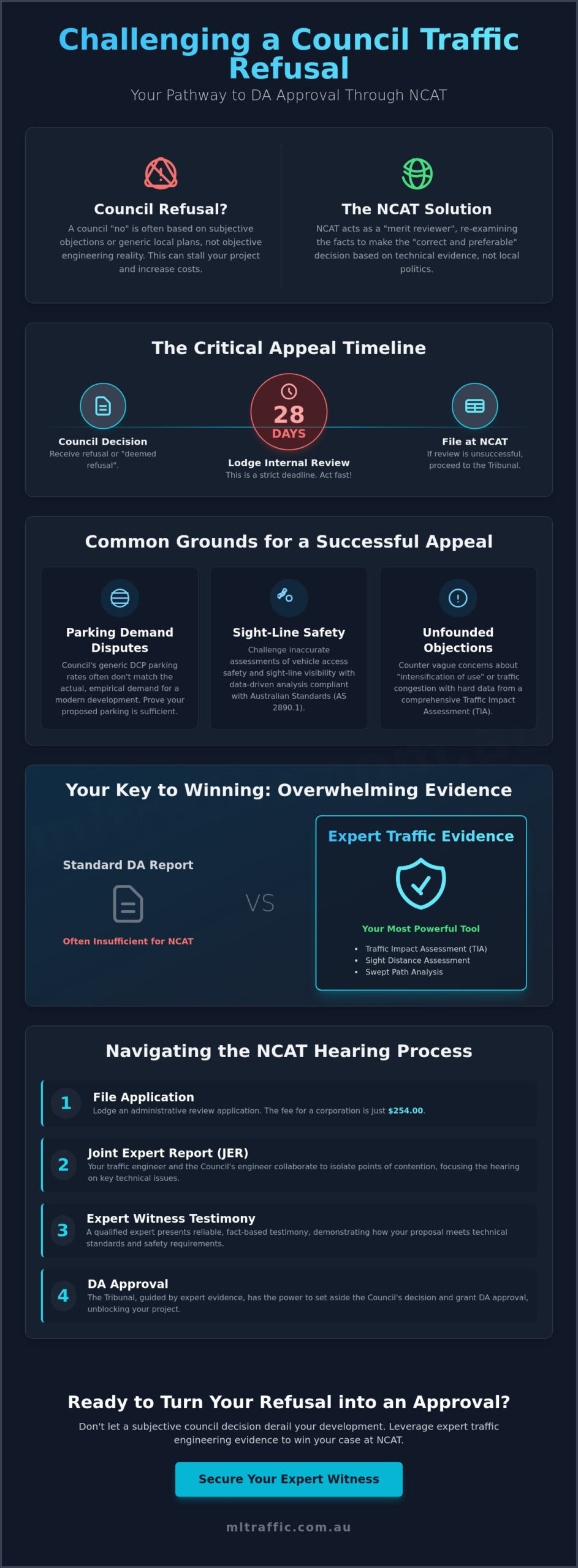
Timing is critical. You must lodge an internal review with the council within 28 days of the original decision. If that is unsuccessful, a corporation can file an administrative review application at NCAT for a $254.00 fee. This guide explains how to challenge unfavorable decisions using rigorous expert engineering evidence and impact assessments. We will preview how to leverage Traffic Impact Assessments (TIA) and Sight Distance Assessments to override Council’s stance. You will learn how the right expert witness testimony can turn a merit appeal into a confirmed DA approval.
Key Takeaways
- Understand how NCAT serves as a merit reviewer for local government decisions, providing a path to challenge administrative rulings through its Administrative and Equal Opportunity Division.
- Identify common grounds for appealing a council traffic decision at NCAT, specifically focusing on disputes regarding parking demand and sight-line safety requirements.
- Learn why a standard DA report is often insufficient and how a comprehensive Traffic Impact Assessment (TIA) provides the technical evidence required for a tribunal hearing.
- Navigate the procedural requirements of the Joint Expert Report (JER), where traffic engineers from both parties collaborate to isolate and resolve technical points of contention.
- Recognize the vital role of a qualified expert witness in gaining DA approval by providing reliable, fact-based testimony that adheres to strict tribunal standards.
Understanding the NCAT Jurisdiction for Council Traffic Decisions
The New South Wales Civil and Administrative Tribunal (NCAT) acts as an independent body that reviews administrative decisions made by government agencies. In the context of property development and traffic management, it functions as a “merit reviewer.” This means the Tribunal doesn’t just look for legal errors in a Council’s process. It re-examines the facts of the case to reach the “correct and preferable” decision. If a Council rejects a development based on traffic impact, NCAT has the power to set that decision aside and grant approval based on the technical merits of the proposal.
Most traffic-related disputes are handled within the Administrative and Equal Opportunity Division. A common trigger for appealing a council traffic decision at NCAT is a “deemed refusal.” This occurs when a Council fails to determine a development application within the statutory timeframe. Developers use this mechanism to bypass local bureaucracy and put their technical evidence before a member who prioritizes objective engineering data over local political pressure. It’s vital to distinguish between a question of law, which involves interpreting legislation, and a merit dispute. Most traffic engineering cases are merit-based, focusing on whether the proposed vehicle access or parking provision is actually sufficient for the site’s intended use.
To better understand this concept, watch this helpful video:
What is a Merit Appeal in Traffic Engineering?
In a merit appeal, the Tribunal effectively “stands in the shoes” of the original decision-maker. It isn’t enough for a Council officer to state that they “feel” a project will cause congestion. The Tribunal requires evidence-backed conclusions. At ML Traffic Engineers, our traffic engineering services focus on strict compliance with Australian Standards, specifically AS 2890.1 for off-street car parking. We use objective data from Traffic Impact Assessments (TIA) to prove that a design is safe and functional. The Tribunal prioritizes these technical assessments over subjective opinions because they provide a measurable basis for safety and compliance.
When to File an Appeal Against a Traffic Decision
Timing is the most critical factor in the appeal process. You must lodge an appeal within 28 days from the date you receive notification of the decision or the reasons for it. This tight deadline means you can’t afford to hesitate. You should consider appealing a council traffic decision at NCAT if the Council imposes “unreasonable” conditions, such as excessive parking requirements that make a project unviable. While the NCAT administrative review application fee for a corporation is $254.00 as of July 2025, the return on investment from gaining DA approval far outweighs the initial costs. Inaction leads to stalled projects and mounting holding costs that can jeopardize the entire development.
Common Grounds for Challenging a Council Traffic Refusal
A successful case for appealing a council traffic decision at NCAT relies on identifying where a Council’s assessment failed to account for real-world technical data. Council officers often prioritize strict adherence to local Development Control Plans (DCPs). These documents are frequently generic and don’t reflect the specific operational needs of a modern development. A merit appeal allows a developer to demonstrate that a proposal is technically sound even if it deviates from local policy. This shift from legal compliance to engineering merit is where most cases are won or lost.
Grounds for appeal usually fall into four technical categories:
- Discrepancies between generic DCP parking rates and actual empirical demand.
- Inaccurate assessments of vehicle access safety or sight-line visibility.
- Unfounded objections regarding the “intensification of use” and its impact on road network capacity.
- Mathematical or modeling errors in the Council’s initial traffic impact assessment.
Understanding these distinctions is essential because the Tribunal seeks to resolve technical disputes rather than just procedural ones. This process is distinct from appealing a court decision; it’s a fresh look at the facts. If you believe your project has been unfairly blocked, you can speak directly with our principal engineers to review the Council’s refusal reasons and identify technical flaws.
Parking Demand and Supply Disputes
Councils frequently refuse applications based on a numerical parking shortfall. However, we often prove that the required supply exceeds actual demand. By conducting a Car Parking Demand Assessment, we use empirical data from similar land uses to demonstrate that the proposed supply is sufficient. We also ensure every design element aligns with the AS 2890.1 guide for compliant car park design. This technical evidence overrides the generic requirements found in many DCPs by focusing on how the site will actually function.
Safety and Access Objections
Safety is a common reason for refusal, yet it is often the most subjective. When appealing a council traffic decision at NCAT, we replace vague safety concerns with precise engineering assessments. We prove sight-line visibility meets national standards through Sight Distance Assessments. If a Council claims a driveway is non-compliant, we use Vehicle Swept Path Analysis to show that the largest expected vehicle can enter and exit the site safely. These technical mitigation plans address pedestrian safety and vehicle flow with mathematical certainty, leaving little room for subjective disagreement.
The Role of Expert Evidence: TIAs and Swept Path Analysis
A standard report submitted during the initial application phase is rarely sufficient for a tribunal hearing. While a basic statement might satisfy a planning officer, appealing a council traffic decision at NCAT requires a transition from general planning summaries to rigorous technical defense. The Tribunal demands objective proof that a design functions according to Australian Standards. This level of detail is necessary because the Tribunal must resolve specific points of contention that the Council has used as grounds for refusal. Without granular data, your appeal relies on opinion rather than fact, which is a high-risk strategy in a merit review.
The primary technical weapon in these proceedings is a comprehensive Traffic Impact Assessment (TIA). This document does more than list parking spots. It provides a deep dive into trip generation rates, intersection performance, and local road capacity. Tribunal members place significant weight on reports certified by senior engineers with RPEQ status or decades of experience. At ML Traffic Engineers, we ensure every report is prepared by the same consultant who will provide testimony, ensuring there are no gaps in accountability or technical understanding during the hearing.
Swept Path Analysis as a “Visual Fact”
Council objections often center on the perceived inability of vehicles to maneuver within a site. We use AutoTURN software to generate a “visual fact” that disproves these claims. This technology allows us to simulate the exact movements of trucks, service vehicles, or standard cars within your proposed layout. By providing a clear, mathematical demonstration of vehicle maneuverability, we can prove that a design is safe and functional. You can see how Swept Path Analysis works in practice to resolve access disputes. These diagrams are often the most persuasive evidence presented at NCAT because they leave no room for subjective interpretation of driveway safety or aisle widths.
Traffic Impact Statements for Small-Scale Developments
Don’t assume that a small-scale project is immune to complex traffic objections. Even a minor development can be derailed by subjective community complaints about local “traffic congestion” or “street safety.” In these cases, a professional Traffic Impact Statement (TIS) is essential. It provides a technical rebuttal to neighbor objections that are often based on emotion rather than engineering reality. We use hard data to show that the actual trip generation from a small development is negligible. This evidence helps the Tribunal look past local political pressure and focus on the technical merit of the application, ensuring that small developments aren’t unfairly blocked by unfounded traffic fears.
Navigating the NCAT Hearing: Process and Procedure
The process of appealing a council traffic decision at NCAT begins with a preliminary conference. This is a procedural meeting where the Tribunal member sets a timetable for evidence and explores the possibility of mediation. Mediation is an effective tool for resolving technical disputes without the need for a full hearing. If mediation fails, the matter proceeds to a formal hearing where the Tribunal examines the technical evidence in detail. This structured approach ensures that both parties have ample time to present their data and respond to opposing arguments.
Site inspections are a standard part of the procedure. The Tribunal member visits the development site to observe existing traffic conditions and physical constraints. This allows them to visualize the technical data provided in the TIA and Swept Path Analysis in a real-world context. During the final hearing, expert witnesses are cross-examined on their reports. Success depends on the engineer’s ability to defend their data under pressure. Appealing a council traffic decision at NCAT requires a witness who is not only technically proficient but also experienced in the specific procedures of the Tribunal.
The Joint Expert Report (JER) Process
The Joint Expert Report is the most critical technical document in the appeal. In this phase, the applicant’s traffic engineer meets privately with the Council’s engineer to discuss the points of contention. They produce a joint statement that categorizes issues as “Agreed” or “Disputed.” This process prevents the Tribunal from wasting time on non-issues. Having a senior engineer involved is vital during this negotiation. A seasoned expert can often convince the Council’s engineer to concede on points where the technical data is irrefutable, narrowing the focus of the hearing to the core disagreements.
Preparation: The Key to a Successful Hearing
Preparation starts long before the hearing date. All traffic data must be current and site-specific to withstand scrutiny. Outdated counts or generic assumptions will be dismissed by the Tribunal. Every expert must also adhere to the Expert Witness Code of Conduct, which mandates that their primary duty is to the Tribunal, not the client. This independence increases the weight given to the evidence. During the hearing, the member may ask “on-the-spot” technical questions regarding driveway ramp grades or intersection saturation levels. At ML Traffic Engineers, the principal who writes the report is the one who attends the hearing. This ensures total accountability and the ability to provide immediate, accurate answers to complex engineering queries. Contact ML Traffic Engineers to discuss your appeal and ensure your technical evidence is handled by an expert who understands the NCAT process.
Securing Expert Traffic Engineering for Your Appeal
The success of your matter depends on the distinction between a general traffic consultant and a qualified expert witness. While many firms provide standard reports, appealing a council traffic decision at NCAT requires an engineer who understands the legal obligations of the Tribunal. An expert witness is bound by the Expert Witness Code of Conduct. This code mandates that the engineer’s primary duty is to the Tribunal to provide independent, impartial, and unbiased evidence. A solicitor can argue your case, but they cannot provide the technical “weaponry” required to overturn a Council’s engineering objection. Only a senior traffic engineer with extensive experience in car park design and intersection analysis can fulfill this role.
At ML Traffic Engineers, we operate under a strict “Principal-led” philosophy. The traffic consultant who provides your quote is the same senior engineer who does the work and provides testimony. This eliminates the risk of a junior staff member’s error being exposed during cross-examination. We have been trading since 2005 and have completed assessments for over 10,000 sites across Australia. This deep-seated expertise ensures that when we stand before a Tribunal member, our evidence is backed by decades of practical application and technical precision. We don’t just provide a report; we provide a robust technical defense of your development’s merit.
The ML Traffic Advantage in Tribunal Matters
Our firm brings a proven track record to every NCAT appeal. We possess specialized knowledge of Australian Standards, specifically AS 2890.1 and AS 2890.2, which are the benchmarks the Tribunal uses to assess compliance. Our experience spans an exhaustive range of land uses, including apartments, childcare centers, medical clinics, warehouses, and shopping centers. This breadth of experience allows us to provide strategic advice that anticipates Council objections before they are even raised. You gain direct access to our principals, Michael Lee and Benny Chen, ensuring your appeal is guided by senior experts who understand the bureaucratic requirements of traffic engineering inside and out.
Next Steps: From Refusal to Resolution
If your development has been refused, the first step is a preliminary review of the Council’s reasons for refusal. We analyze the Council’s traffic objections to determine if they are based on subjective opinion or verifiable technical errors. Once we identify the flaws in their stance, we provide a quote for the necessary technical evidence, whether it is a revised TIA or a detailed Swept Path Analysis. Briefing your traffic engineer early is essential to meet the 28-day lodgement window for internal reviews or subsequent NCAT filings. Contact ML Traffic Engineers today to discuss your appeal and secure the technical evidence needed to gain your DA approval.
Secure Your Development Approval Through Technical Merit
Winning a merit appeal requires a shift from legal arguments to rigorous engineering evidence. You have learned that appealing a council traffic decision at NCAT is most effective when supported by objective data like Swept Path Analysis and comprehensive Traffic Impact Assessments. These tools replace subjective Council objections with “visual facts” that are difficult to dispute during the Joint Expert Report process or a formal hearing. Relying on a senior traffic engineer who understands the Expert Witness Code of Conduct is the most reliable way to navigate this complex tribunal environment.
ML Traffic Engineers offers the deep-seated expertise required for successful outcomes. We have completed over 10,000 projects nationally and bring more than 15 years of experience to every matter. You get direct access to our principals, Michael Lee and Benny Chen; this ensures the expert who quotes your project is the one who defends it at the hearing. Don’t let a subjective refusal stall your project further. You can discuss your Council traffic appeal with a senior engineer at ML Traffic to start building your technical defense. Your project deserves a fact-based resolution that leads to a confirmed DA approval.
Frequently Asked Questions
Can I appeal a Council traffic decision if my DA was refused?
Yes. You can lodge an administrative review application at NCAT if the Council refuses your Development Application based on traffic, access, or parking objections. The Tribunal acts as a merit reviewer, meaning it can re-examine the technical facts of your case. This allows you to challenge subjective Council decisions by presenting objective engineering data and expert witness testimony.
What is the time limit for lodging an appeal at NCAT?
You must lodge your application within 28 days from the date you were notified of the decision or provided with the reasons for refusal. Additionally, if you seek an internal review from the Council first, that request must also be made within 28 days of the original decision. Missing these statutory deadlines typically terminates your right to pursue a merit appeal through the Tribunal.
Do I need a traffic engineer if I already have a lawyer for NCAT?
Yes. A lawyer manages the legal procedure and arguments, but they cannot provide the technical evidence or expert testimony required for a merit-based dispute. Appealing a council traffic decision at NCAT relies on engineering data such as Traffic Impact Assessments and Swept Path Analysis. Only a qualified traffic engineer can serve as an expert witness to defend the technical merits of your design.
What is a Swept Path Analysis and why does NCAT require it?
Swept Path Analysis is a technical simulation that maps the path of a vehicle as it maneuvers through a site. NCAT requires this evidence to resolve disputes regarding vehicle access safety and maneuverability. It provides a visual fact that proves whether trucks, service vehicles, or residents can safely enter and exit the property. This removes subjective doubt and replaces it with mathematical certainty.
How much does it cost to appeal a traffic decision at NCAT?
As of July 1, 2025, the NCAT administrative review application fee for a corporation is $254.00. The standard fee for an individual is $127.00. If the matter proceeds to an internal appeal with the NCAT Appeal Panel, the corporate fee is $1,038.00 and the standard individual fee is $519.00. These figures represent the Tribunal’s filing fees and do not include costs for expert engineering reports or legal representation.
What happens if the Council’s traffic engineer disagrees with my expert?
Disagreements are managed through the Joint Expert Report (JER) process. Appealing a council traffic decision at NCAT involves a private meeting between both traffic engineers to identify agreed and disputed technical points. They produce a joint statement for the Tribunal that narrows the focus of the hearing. The Tribunal member then weighs the conflicting evidence to determine which engineering argument is more robust and data-driven.
Can NCAT override Council parking requirements?
Yes. NCAT has the authority to approve a development even if it does not meet the parking rates specified in a Council’s Development Control Plan (DCP). The Tribunal prioritizes empirical data over generic local policies. If a Car Parking Demand Assessment proves that the proposed supply is sufficient for the specific land use, the Tribunal can override the Council’s initial refusal based on the project’s technical merit.
How long does the NCAT appeal process typically take for planning matters?
The timeline for planning matters at NCAT generally spans several months from the initial lodgement to the final hearing. This period includes mandatory steps such as the preliminary conference, mediation sessions, and the exchange of expert witness reports. The exact duration depends on the complexity of the traffic dispute and the current caseload of the Administrative and Equal Opportunity Division.

Disclaimer
The content on www.mltraffic.com.au, including all technical articles, guides, and resources, is provided for general informational and educational purposes only. It is not intended to constitute professional advice in traffic engineering, transportation planning, development approvals, or any other technical or legal field.
While ML Traffic Engineers makes every reasonable effort to ensure the accuracy, completeness, and timeliness of the information published, we do not provide any warranties or representations (express or implied) regarding its reliability, suitability, or availability for any particular purpose. Any reliance you place on the content is strictly at your own risk.
In no event shall ML Traffic Engineers, its directors, employees, authors, or affiliates be liable for any direct, indirect, incidental, special, consequential, or punitive damages (including, without limitation, loss of profits, data, or business opportunities) arising out of or in connection with the use of, or inability to use, any information provided on this website.
The articles and guides on this site are not a substitute for engaging a qualified, registered professional traffic engineer (such as an NPER or RPEQ engineer) to assess your specific project requirements. For tailored advice, compliance assessments, or traffic engineering services, please contact a competent professional.
This disclaimer may be updated from time to time without notice. By accessing or using this website, you agree to be bound by the most current version of this disclaimer.
