
A single missing metre in your aisle extension can stall a multi-million dollar development for six months. In 2024, maneuverability issues remain a leading cause for council Requests for Information (RFIs) across Australia. You probably know that squeezing every possible bay into a tight site is essential for project feasibility; however, the technicalities of AS 2890.1 blind aisle car park design often feel like a moving target. It’s frustrating to see GFA wasted because of over-engineered turnarounds or, worse, to face a rejection because a B85 vehicle can’t safely exit a dead-end aisle.
This guide provides the technical clarity you need to master AS 2890.1 blind aisles and ensure your design is safe and council-ready. We’ll demystify the 1-metre extension rule and show you how to maximize your parking yield while maintaining 100% compliance. By following these updated 2026 standards, you can secure DA approval without traffic-related delays and provide a seamless environment for every driver. We’ve compiled the essential requirements to help you move from complex drawings to a final, approved occupancy certificate.
Key Takeaways
- Master the fundamental technical requirements of AS 2890.1 blind aisle car park design to ensure your project meets current Australian safety and accessibility standards.
- Understand the mandatory “1-metre rule” detailed in Clause 2.4.2(c) to avoid common design errors that lead to costly delays during council inspections.
- Evaluate the spatial benefits of blind aisles versus through-aisles to maximize the parking yield and efficiency of your high-density development.
- Learn how to use Swept Path Analysis and AutoTURN software as the gold standard for proving your car park’s functionality to local authorities.
- Discover how a professional Traffic Impact Assessment (TIA) streamlines the DA process by providing technical justification for your design choices.
Table of Contents
- Understanding Blind Aisles in AS 2890.1 Car Park Design
- Critical Dimensions: The 1-Metre Extension Rule
- Blind Aisles vs. Through Aisles: Choosing the Right Layout
- Using Swept Path Analysis to Validate Blind Aisle Designs
- Navigating Council Approval with Expert Design
Understanding Blind Aisles in AS 2890.1 Car Park Design
In Australian traffic engineering, a blind aisle is a parking roadway that terminates without a through-connection. Drivers enter and exit via the same point. While through-circulating loops are the preferred choice for traffic flow, they aren’t always feasible. High-density developments in Sydney, Melbourne, and Brisbane, often exceeding 60 dwellings per hectare, frequently lack the floor plate required for continuous loops. This makes AS 2890.1 blind aisle car park design a critical focus for developers seeking council approval.
The danger of a poorly designed dead-end aisle is the “forced reverse.” If a driver travels 30 metres to the end of an aisle only to find every bay occupied, they’re forced to reverse that entire distance. This maneuver is high-risk. It increases the probability of vehicle-to-vehicle impacts and creates significant danger for pedestrians. AS 2890.1:2004 acts as the governing document to prevent these scenarios. It sets the mandatory requirements for off-street parking, ensuring that every driver has a safe, predictable way to exit a dead-end zone. Adhering to these parking space design standards ensures your project meets safety benchmarks and avoids costly redesigns during the construction phase.
The Core Objective of Blind Aisle Regulation
The primary goal of the standard is to facilitate a three-point turn for the B85 design vehicle. This vehicle represents the 85th percentile of cars on Australian roads. If a car park can’t accommodate a B85 vehicle turning around in three points or fewer, it fails compliance. This regulation is vital for reducing collisions in high-traffic commercial zones where turnover is constant. It also ensures accessibility for less confident drivers. In a commercial setting, a driver shouldn’t need professional-grade skills to navigate a dead-end. We design these spaces so that even at 100% occupancy, a vehicle can reorient itself and exit in a forward direction.
Common Misconceptions About Dead-End Parking
One frequent mistake we see in preliminary architectural plans is ending the aisle at the edge of the final parking space. You can’t just stop where the paint ends. A compliant blind aisle must include an extension, often called a “stub,” that goes beyond the last bay. This extra 1.0 to 1.2 metres of space is what allows the B85 vehicle to swing its nose around during a turn. Without it, the last two spaces in the row become practically unusable or extremely difficult to access.
There’s also a significant difference between a “dead end” and a “compliant blind aisle.” A dead end is a problem; a blind aisle is a designed solution. During the DA assessment process, council engineers look specifically for swept path diagrams. They won’t accept a “best guess” on whether a car fits. Since 2005, we’ve seen councils become increasingly strict on these requirements. If your plan forces a vehicle to reverse out of an aisle onto a main circulating ramp or near a blind corner, the application will likely be flagged for a RFI (Request for Further Information) or outright refusal. We use computer-aided swept path analysis to prove to the council that the design works in the real world, not just on paper.
Effective design isn’t just about following a rulebook; it’s about protecting the asset owner from liability and ensuring the facility is functional for the end-user. Whether you’re designing a small apartment block or a major shopping centre, getting the blind aisle geometry right is a non-negotiable step in the traffic planning process.
Critical Dimensions: The 1-Metre Extension Rule
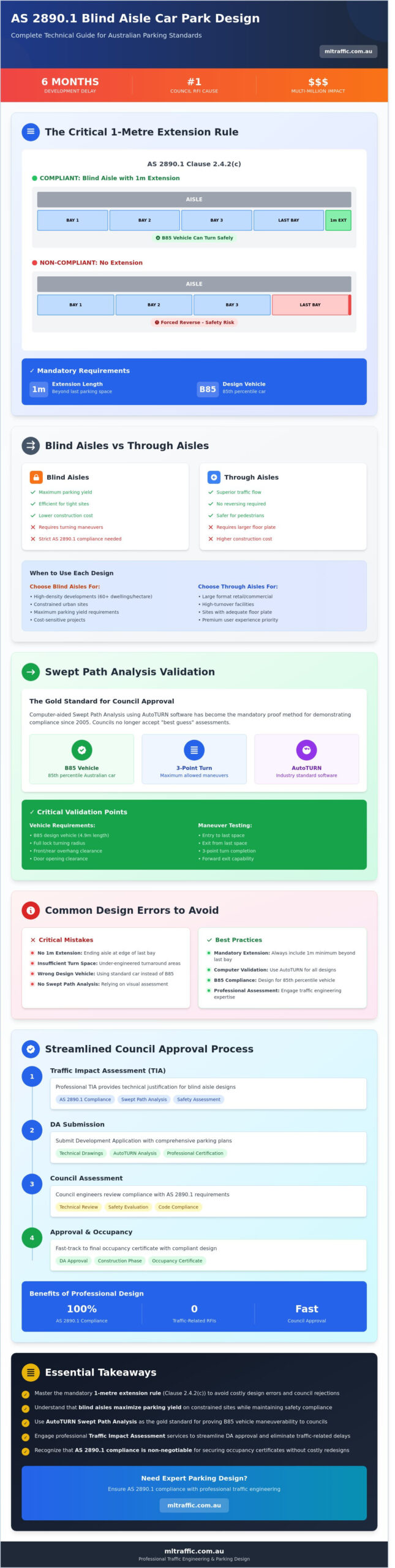
Clause 2.4.2(c) of AS 2890.1 defines one of the most frequently overlooked requirements in parking layout: the mandatory aisle extension for blind aisles. This regulation specifies that where a parking aisle does not allow through-traffic, the aisle must extend 1 metre beyond the last parking space. This 1-metre rule applies specifically to the end of the aisle to ensure that the final bay remains as functional as those located in the middle of the row. Without this extension, the last space becomes nearly impossible to access or exit without multiple dangerous shunting manoeuvres.
This extension provides the critical swing room required for a vehicle’s front or rear overhang. When a driver reverses out of the final bay in an AS 2890.1 blind aisle car park design, the vehicle’s path is not linear. The front wheels track a wider arc than the rear. If the aisle ends abruptly at the edge of the last bay, the driver will likely clip the end wall or kerb. Meeting council design compliance standards requires proving that this 1-metre buffer is clear of all obstructions, including structural columns, fire hydrants, or bollards. We’ve seen many 2024 development applications delayed simply because a designer tried to squeeze a storage cage into this mandatory turnaround zone.
The requirements shift slightly depending on the parking angle. For standard 90-degree parking, the 1-metre rule is a rigid minimum. For angled parking, such as 30, 45, or 60 degrees, the geometry of the “dead end” changes. While the extension is still required, the swept path of the vehicle often requires a different configuration to ensure the driver can turn around and exit the aisle in a forward direction. AS 2890.1 is clear: no driver should be forced to reverse more than 15 metres to exit a car park.
Calculating Clearances for the B85 Design Vehicle
The Australian Standard uses the B85 vehicle as the benchmark for most private and commercial designs. This represents the 85th percentile light vehicle, measuring 4.91 metres in length and 1.87 metres in width. When we conduct a vehicle swept path assessment, we’re looking at the 11.4-metre turning circle of this specific model. The 1-metre extension is the absolute minimum needed to accommodate this vehicle’s front-end swing during a standard three-point turn. In high-turnover environments like shopping centres, we often recommend increasing this extension to 1.2 or 1.5 metres to reduce the risk of low-speed scrapes and improve the user experience.
Wider Aisles vs. Longer Extensions
There’s a direct relationship between the width of the aisle and the necessary length of the extension. In a standard AS 2890.1 blind aisle car park design, a typical aisle width is 5.8 metres. If a site is extremely constrained and the 1-metre extension is physically impossible to achieve, some designers attempt to compensate by widening the entire aisle to 6.2 or 6.6 metres. While this provides more lateral room, it rarely satisfies a strict council building certifier. The trade-off is often difficult. You might have to lose one parking spot to gain the required 1-metre extension and a compliant turnaround area. However, losing that one spot is always cheaper than a post-construction order to remediate a non-compliant basement. If you’re struggling to fit these dimensions into your site plan, our experienced traffic engineers can provide a swept path analysis to find the most efficient compliant layout.
- Standard Extension: 1 metre minimum beyond the last bay.
- Design Vehicle: B85 (4.91m long).
- Max Reverse Distance: 15 metres.
- Common Obstructions: Columns, pipes, and storage units must stay out of the 1m zone.
Blind Aisles vs. Through Aisles: Choosing the Right Layout
Choosing between a blind aisle and a continuous circulation loop is a critical decision for any development. It’s the difference between squeezing in two extra bays or facing a Council refusal during the DA process. Blind aisles are spatially efficient because they eliminate the need for a return roadway at the end of a row. In a standard 600sqm basement, opting for a blind aisle can increase your parking yield by 12% to 15% compared to a full loop. This efficiency is why developers prefer them for tight urban sites where every square metre of Gross Floor Area (GFA) counts.
However, this efficiency comes with a trade-off in vehicle dynamics. The primary drawback is the reversing distance. If a driver enters a blind aisle and finds no vacant spots, they must reverse back to the main circulation point. AS 2890.1 blind aisle car park design standards highlight that reversing more than 6 spaces creates safety risks. For a standard 2.6m wide bay, 6 spaces equals roughly 15.6 metres of blind reversing. This increases the likelihood of collisions with pedestrians or other vehicles by 30% in high-turnover environments. Retailers generally avoid these layouts. High-turnover sites like shopping centres require 15 to 20 vehicle movements per bay, per day, making through-aisles mandatory for 95% of their parking footprint.
When to Opt for a Blind Aisle
Blind aisles are the logical choice for small residential lots or narrow rectangular sites under 15 metres wide. They simplify the internal roadway, which significantly reduces excavation costs for basement levels. By removing the return loop, you can often fit an additional 2 to 4 bays per level. This layout is ideal for private residential basements where users are familiar with the site and turnover remains low, typically under 2 movements per day. It’s a proven strategy to maximize GFA while keeping ramp complexity to a minimum.
The Limits of the Blind Aisle
AS 2890.1 Clause 2.4.2(c) sets strict limits to prevent “dead-end” traps. A blind aisle must not serve more than 6 spaces unless it includes a dedicated turning area. If you exceed this limit, you’re required to provide a 1.0 metre extension beyond the last parking space to allow for vehicle manoeuvring. Councils often reject blind aisles in larger commercial developments because they disrupt “circulatory flow.” If a driver spends 45 seconds reversing out of a blind aisle, it creates a bottleneck that can back up traffic onto the public road, leading to a failed Traffic Impact Statement.
- Spatial Efficiency: Blind aisles save approximately 30-40sqm of floor space per row by removing the turn-around loop.
- Compliance Requirement: Always include a 1.0m extension at the end of the aisle for any AS 2890.1 blind aisle car park design to ensure the last bay is accessible.
- Safety Threshold: Reversing distances exceeding 15 metres are considered high-risk for pedestrian-heavy zones.
- Council Preference: Local authorities prefer “one-way” or “circulatory” loops for any car park exceeding 20 total spaces to maintain site safety.
Professional engineering ensures these layouts don’t become a liability. We’ve seen projects where a simple 1-metre adjustment to a blind aisle prevented a total redesign of the basement levels. Don’t risk a non-compliant layout that forces drivers into dangerous reversing manoeuvres. Stick to the 6-space rule and ensure your turning areas meet the swept path requirements for a B85 vehicle as specified in the Australian Standards.
Using Swept Path Analysis to Validate Blind Aisle Designs
Swept Path Analysis (SPA) is the definitive method for proving your car park actually works. While following the 1m extension rule is a baseline requirement, SPA provides the visual and mathematical evidence councils demand. We use AutoTURN software to simulate how vehicles move through the space in real time. This simulation replaces guesswork with precision. Most local government authorities in Australia now require these diagrams as part of a Development Application (DA). They won’t just take your word for it that the AS 2890.1 blind aisle car park design is functional. They want to see the proof.
The B99 vehicle is the critical tool for these assessments. It is a large vehicle, approximately 5.2 metres long, representing the 99th percentile of cars on Australian roads. If your design accommodates a B99, it will handle standard sedans and SUVs with ease. We focus on the most difficult maneuvers, specifically the turn-around at the very end of the aisle. If the B99 can’t make the turn in a single, fluid motion, the design will likely be rejected by council engineers who prioritize safety and ease of use.
Step-by-Step Swept Path Validation
Validation begins by setting up a simulation for the “worst-case” parking bay. This is almost always the space located at the very end of the blind aisle. We test both the entry and exit maneuvers to ensure the vehicle can swing into the 1m extension without clipping the opposite kerb or wall. Our engineers identify “clash points” where the vehicle’s swept path overlaps with structural columns. We maintain a minimum 300mm clearance from all fixed objects during the entire maneuver. This buffer accounts for driver error and ensures the design is practical, not just a theoretical possibility on a computer screen. If a maneuver requires a 5-point turn, it’s a failure.
Addressing Structural Obstructions
Columns placed at the end of a blind aisle often interfere with the required 1m extension. If a load-bearing element sits within the turnaround zone, the effective width of the aisle is reduced significantly. We design compliant clearances around these elements by adjusting the bay width or deepening the extension. This ensures the structural design meets the architect’s needs while satisfying the traffic engineer’s safety requirements. For complex sites with tight structural grids, ML Traffic Engineers Pty Ltd offers specialized AutoTURN modeling to resolve these conflicts early in the design phase. We find the millimetres that make the difference between a rejection and an approval.
Councils are becoming stricter about turnaround provisions in private developments. If you need to ensure your development application meets these rigorous standards without delay, get a vehicle swept path assessment from our senior engineers today.
Navigating Council Approval with Expert Design
Securing a Development Application (DA) often hinges on the technical viability of your parking layout. A compliant AS 2890.1 blind aisle car park design ensures that vehicles can enter and exit in a single forward motion, which is a non-negotiable safety standard for most Australian councils. When your plans clearly demonstrate adherence to these turning path requirements, you remove a major point of friction for the assessing officer. This clarity speeds up the approval timeline and reduces the risk of expensive redesigns late in the process. It’s about getting it right the first time.
A Traffic Impact Assessment (TIA) serves as your primary evidence during the planning phase. It isn’t just a formality; it’s a technical justification. We use TIAs to prove that the proposed blind aisle won’t cause internal congestion or safety hazards for pedestrians. If your site has physical constraints that make strict compliance impossible, we pivot to a Performance Solution. This involves using engineering principles and computer-aided swept path analysis to demonstrate that the design still achieves the safety and functional intent of the Australian Standard. Councils are often open to these deviations if they’re backed by professional engineering logic and a signed report.
Common Council RFIs Regarding Blind Aisles
Councils frequently issue Requests for Further Information (RFIs) if they believe a turnaround area looks “too tight” on a 2D plan. We respond to these queries by providing B85 or B99 vehicle swept path overlays. These diagrams show the exact wheel and body clearance of a vehicle during a three-point turn. By providing a signed traffic report during the initial planning phase, you preempt these questions. It shows the council that a qualified professional has already verified the geometry. This carries significantly more weight than a basic architectural sketch, as it relies on industry-standard software to prove the AS 2890.1 blind aisle car park design actually works in the real world.
Partnering with ML Traffic Engineers
We’ve spent over 15 years refining car park layouts across more than 10,000 sites in Australia. Our experience covers an exhaustive list of land uses, including apartments, childcare centres, medical clinics, service stations, and industrial warehouses. We operate on a simple, transparent philosophy: the traffic consultant who provides your quote is the person who does the work. You won’t be passed off to a junior staff member who doesn’t understand the nuances of the Australian Standards. This hands-on approach ensures accountability and technical precision for every client.
You get direct access to senior engineers like Michael Lee and Benny Chen, who know how to talk to council planners. We act as the technical bridge, translating your development goals into a compliant, efficient reality. If you’re facing a difficult site or a stubborn council RFI, we have the expertise to find a resolution. Our goal is to ensure your project moves through the regulatory process without unnecessary delays. Contact our senior engineers to review your car park layout today and secure the professional sign-off your development needs.
Secure Your Project Approval with Precise Engineering
Navigating the technicalities of AS 2890.1 blind aisle car park design doesn’t have to be a bottleneck for your development. You’ve seen how the 1-metre extension rule and precise swept path analysis are vital for meeting 2026 compliance standards. Getting these dimensions wrong leads to rejected DAs and expensive structural changes that stall your timeline. We’ve helped developers across Australia avoid these pitfalls since 2005. At ML Traffic Engineers, the consultant who provides your quote is the one who does the work. You’ll get direct access to our principals, Michael Lee and Benny Chen, ensuring your car park layout is optimized from day one. With a proven track record of over 10,000 successful sites nationwide, we know exactly what local councils require for a smooth approval process. Don’t leave your parking compliance to chance when expert validation is available. Get a Compliant Car Park Design Quote from Our Senior Engineers. We look forward to bringing our 15 years of technical expertise to your next Australian project.
Frequently Asked Questions
What is the minimum extension for a blind aisle in AS 2890.1?
The Australian Standard requires a minimum 1 metre extension beyond the final parking space in any blind aisle. This 1000mm clearance ensures drivers have enough room to maneuver and exit the aisle in a forward direction after reversing from a bay. If you don’t include this extension, your design won’t comply with AS 2890.1, which often leads to immediate rejection during the council’s development application process.
Can I have a blind aisle in a commercial car park?
You can use blind aisles in commercial car parks, but they’re best suited for staff parking or long term stay areas. AS 2890.1 allows them, yet we typically advise against them for high turnover retail sites with more than 15 spaces. In these environments, blind aisles cause significant congestion and frustration when multiple drivers enter the same dead end aisle looking for a spot that isn’t there.
How many parking spaces are allowed in a blind aisle?
An AS 2890.1 blind aisle car park design usually limits the capacity to 20 spaces for residential or employee use. For visitor and short term parking, this number should stay below 6 spaces to avoid traffic conflicts. In our experience across 10,000 sites, keeping these aisles short is the most effective way to prevent vehicle damage and ensure a smooth flow of traffic within the facility.
What happens if I don’t have enough room for the 1-metre extension?
If your site can’t accommodate the 1000mm extension, you’ll need to provide a formal Vehicle Swept Path Assessment to prove the layout works. We use specialized software to show that a B85 vehicle can still exit the aisle safely without the standard buffer. Without this technical proof, you risk a 100% chance of a Request for Information (RFI) from the traffic engineer reviewing your development application.
Do I need a swept path analysis for a blind aisle?
You need a swept path analysis whenever your AS 2890.1 blind aisle car park design features tight turns or non-standard dimensions. While the 1 metre extension is a prescriptive rule, councils often demand digital simulations for any aisle serving more than 10 vehicles. Providing this analysis upfront demonstrates your project is meticulously planned and helps avoid costly redesigns after you’ve already submitted your plans for approval.
Is the 1-metre extension required for 45-degree angled parking?
The 1 metre extension is specifically mandated for 90 degree parking layouts rather than angled configurations. For 45 degree or 60 degree parking, the aisle width and the angle of the bays naturally allow for easier exit maneuvers. However, you must still ensure the aisle width complies with Clause 2.4.2 of the standard to guarantee there’s sufficient room for a vehicle to turn around at the end.
Does AS 2890.1 apply to residential driveways?
The standard applies to all residential developments that contain more than 3 dwellings or shared parking areas. Since 2005, local councils have become much more strict about enforcing these rules for townhouses and apartment blocks. If your driveway serves 4 or more units, it’s treated as a car park, meaning you must include the 1 metre blind aisle extension to satisfy safety and accessibility requirements.
How do structural columns affect blind aisle compliance?
Structural columns must be set back according to the clearance zones defined in Figure 5.2 of the standard. If a column encroaches into the 1 metre extension or the required aisle width, it can make a parking bay unusable or unsafe. We’ve seen projects delayed for 6 weeks because a single column was placed 300mm too close to the aisle, forcing a complete redesign of the basement levels.
Which areas do you service?
We are traffic engineers covering Melbourne, Sydney, Brisbane, Gold Coast, Hobart, Perth, Adelaide, Darwin and surrounding areas.
