

With the construction cost for a single basement parking bay reaching upwards of A$85,000 in 2026, a single design error is a liability you can’t afford. Local councils are rigorously enforcing compliance; a minor oversight in ramp grades or user class classification often leads to immediate DA rejection. You need a design that balances site constraints with the reality that SUVs and light commercial vehicles now constitute over 75% of new car sales in Australia. This shift makes adhering to the AS 2890.1 car park design standards australia more complex than it was just a few years ago.
At ML Traffic Engineers Australia, we understand the frustration of costly site re-works caused by failed swept path assessments or non-compliant driveway gradients. This guide provides the technical clarity needed to master the AS 2890.1 car park design standards australia, ensuring your project achieves 100% compliance while maximizing parking yield. We’ll break down the critical requirements for vehicle clearance, gradient transitions, and the specific 2021 updates that impact your development application. By following this professional framework, you can secure successful DA approval and ensure safe, functional vehicle access for every user class.
Key Takeaways
- Identify the correct User Class (1, 1A, 2, or 3) to determine mandatory stall dimensions and aisle widths for your specific land use.
- Ensure full compliance with AS 2890.1 car park design standards australia by integrating 2021 updates regarding larger vehicle geometries and SUV requirements.
- Coordinate off-street parking designs with AS 2890.6 and AS 1428.1 to prevent obstructions in accessible paths and shared zones.
- Utilize Vehicle Swept Path Analysis and Traffic Impact Assessments (TIA) to prove design viability and secure Council DA approval.
- Reduce the risk of costly re-works by conducting professional driveway ramp grade assessments during the initial design phase.
Table of Contents
-
What is AS 2890.1? The Foundation of Australian Car Park Design
-
Core Technical Specifications: Dimensions, Gradients, and Aisle Widths
-
Compliance Synergy: Integrating AS 2890.1 with AS 2890.6 and AS 1428.1
-
Navigating the DA Process: Swept Paths and Council Certification
What is AS 2890.1? The Foundation of Australian Car Park Design
AS/NZS 2890.1:2021 serves as the governing regulatory document for all off-street parking facilities in Australia, superseding the previous 2004 edition. It provides the technical foundation for parking space dimensions, aisle widths, and ramp gradients. For developers, this standard isn’t an optional guide; it carries significant legal weight during the Development Application (DA) process. Councils won’t issue a construction certificate if the site plan fails to demonstrate strict compliance. Adherence is also vital for professional indemnity and public liability insurance, as non-compliant designs increase the risk of vehicle damage and pedestrian accidents.
The scope of the AS 2890.1 car park design standards australia encompasses private residential garages, commercial office blocks, and large-scale multi-residential developments. Every project requires a meticulous assessment of vehicle access and parking yield to ensure the site remains functional and safe. Failure to meet these mandatory requirements often leads to costly redesigns and delays in project timelines. Our consultants focus on providing clear, technical assessments to help you navigate these bureaucratic hurdles without compromising on site efficiency.
To better understand this concept, watch this helpful video:
The Evolution of Parking Standards
The 2021 revision of AS 2890.1 updated dimensions to accommodate the increasing size of the Australian vehicle fleet, specifically the prevalence of large SUVs and light commercial vehicles. This standard interacts directly with the National Construction Code (NCC), which references Australian Standards to define minimum safety and accessibility requirements. The primary objective of these standards is to ensure vehicle maneuverability safety for all users within the facility. Modern traffic engineering requires staying current with these amendments to avoid the pitfalls of outdated design practices that no longer suit the 2026 vehicle market.
Key Definitions: B85 and B99 Vehicles
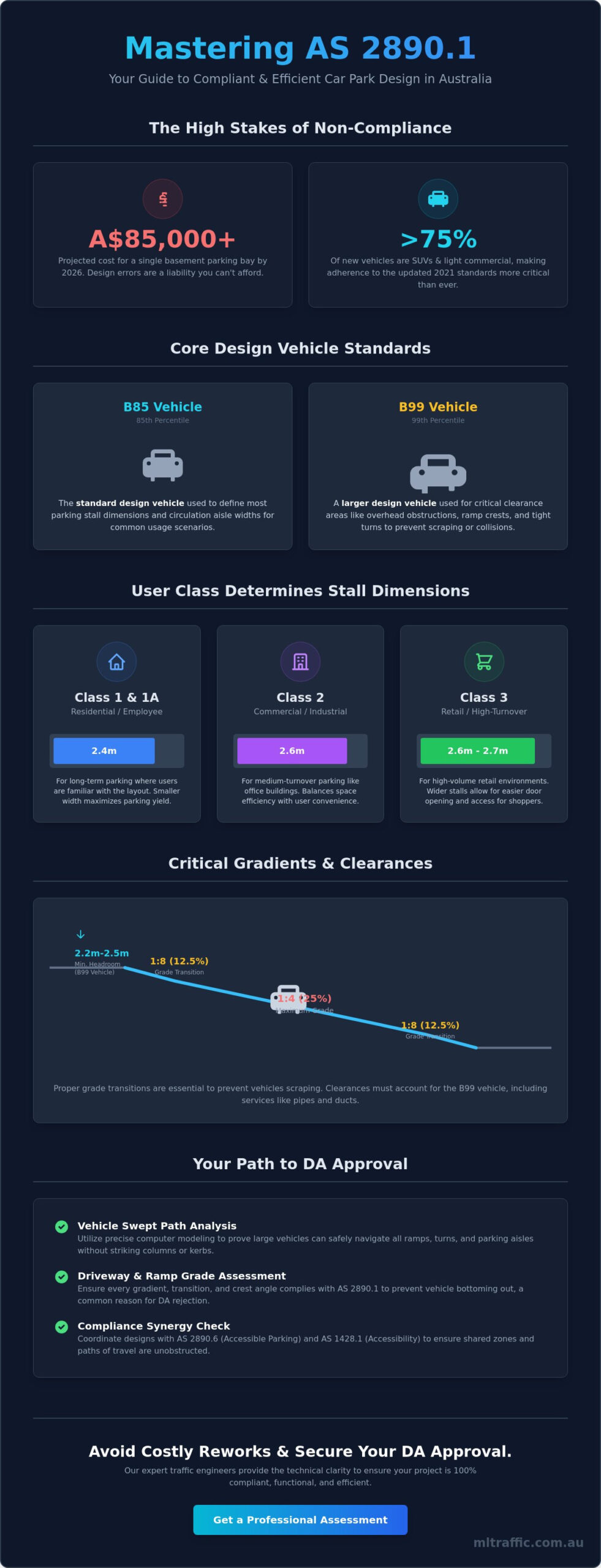
Effective car park design relies on two specific design vehicles: the B85 and the B99. The B85 vehicle represents the 85th percentile of the vehicle population; it’s the standard used for defining most parking stall dimensions and aisle widths. The B99 vehicle, representing the 99th percentile, is used for critical clearance areas such as overhead obstructions, ramp summits, and tight turns where larger vehicles require more space. We use computerized design templates and Vehicle Swept Path Analysis to predict vehicle behavior accurately. This data-driven approach prevents the risk of vehicles striking structural columns or scraping on driveway ramps, ensuring your car park design is both compliant and practical.
Core Technical Specifications: Dimensions, Gradients, and Aisle Widths
The technical specifications outlined in AS/NZS 2890.1:2004 aren’t a one-size-fits-all solution. Compliance depends entirely on the intended user class and turnover frequency. Unlike basic guides that list a single stall size, the AS 2890.1 car park design standards australia utilize a categorized system to balance vehicle size with ease of use. This system ensures that a residential basement doesn’t waste space, while a retail car park remains functional for high-volume traffic.
The User Class system is the most critical factor in determining stall width. Class 1 and 1A apply to residential or employee parking where drivers are familiar with the layout and stay for long periods. Class 3 covers high-turnover retail environments like shopping centres. For a standard 90-degree stall, Class 1 requires a width of 2.4m. Class 3 requires 2.6m or 2.7m to allow for wider door opening and pedestrian movement. If your design misclassifies these users, your parking yield calculations will be incorrect, leading to potential DA rejection.
Aisle width calculations share an inverse relationship with stall width. If you design wider parking spaces, the required aisle width decreases. Conversely, narrower stalls demand wider aisles to ensure vehicles can safely execute a turn into the space. Headroom is another non-negotiable metric. Basement car parks must maintain a minimum vertical clearance of 2.2m for standard vehicles. This height must be verified against structural beams, sprinklers, and service pipes to avoid costly site re-works.
Driveway and Ramp Gradients
Ramp design is where many DA rejections occur. For domestic driveways, the maximum allowable grade is 1 in 4 (25%). For public or commercial car parks, this steepness is restricted to 1 in 5 (20%) to ensure safety for a broader range of driver skills. The "Change of Grade" rule is vital; transitions between different slopes must be gradual to prevent the vehicle’s chassis from scraping. We provide professional driveway ramp grade assessment services to verify these transitions before construction begins. A maximum gradient of 1:20 is mandatory for all disabled access paths to ensure safe mobility.
Aisle and Circulation Requirements
Circulation efficiency depends on aisle configuration. For 90-degree parking, a two-way aisle generally requires a minimum width of 5.8m to 6.6m, depending on the chosen stall width. Angled parking (30, 45, or 60 degrees) allows for narrower aisles but usually restricts traffic to one-way flow. Dead-end aisles present a specific challenge; they must include a 1.0m extension beyond the final parking stall to provide necessary maneuvering room. Blind aisles that don’t offer a clear exit path are generally restricted due to safety concerns and the risk of vehicle congestion.
Compliance Synergy: Integrating AS 2890.1 with AS 2890.6 and AS 1428.1
Successful car park design requires more than just following the AS 2890.1 car park design standards australia. You must integrate AS 2890.6 (Off-street parking for people with disabilities) and AS 1428.1 (Design for access and mobility) to ensure a seamless transition from vehicle to building entrance. Treat these as a unified system rather than isolated documents. Councils will reject applications where the general parking layout obstructs the required accessible path of travel. Professional traffic engineering ensures these overlaps are managed during the initial planning phase.
AS 2890.6 dictates specific requirements for disabled parking bay dimensions and their associated shared zones. These shared zones are critical for wheelchair transfer and must remain clear of any structural obstructions or general parking encroachment. Vertical clearance is another area where projects often fail. While standard areas might tolerate lower heights, accessible vans require a minimum 2.2m clearance throughout the entire path of travel from the property boundary to the dedicated bay. This height must be maintained without exception to comply with the National Construction Code and relevant Australian Standards.
The car park must link directly to the building entrance via AS 1428.1 compliant pathways. This connection ensures that once a user exits their vehicle, they have a safe, unobstructed route to the primary facility. Our Car Park Design assessments prioritize this continuity to prevent safety hazards and compliance gaps that could lead to liability issues.
Designing Compliant Disabled Parking Spaces
A compliant dedicated bay requires a width of 2.4m, paired with an adjacent shared area also measuring 2.4m. This creates a total footprint width of 4.8m. Bollard placement is mandatory within the shared zone to protect users and prevent non-authorized vehicles from using the space. Pavement markings must include the international symbol of access and meet specific slip-resistance standards. For a deeper dive into these requirements, see our guide on AS 2890.1 Explained.
Accessible Path of Travel
Designers must eliminate kerbs and steep transitions at the vehicle-pedestrian interface. Kerb ramps must be integrated wherever the path of travel crosses a change in level. Tactile Ground Surface Indicators (TGSIs) are required at car park crossings to warn vision-impaired users of potential hazards. Lighting and visibility standards are non-negotiable; they must provide enough illumination for users to navigate the route safely at all times. We verify these accessible routes during the design phase to avoid expensive retrofitting after construction has commenced.
Navigating the DA Process: Swept Paths and Council Certification
The Development Application (DA) process requires definitive proof that your proposed site can handle the expected vehicle load safely. Councils across Australia now mandate a Traffic Impact Assessment (TIA) for most medium to large scale developments. This report isn’t just a formality; it’s a technical verification that your project aligns with the AS 2890.1 car park design standards australia. Without a professional TIA, you risk immediate rejection or lengthy delays through Requests for Further Information (RFIs) that stall your construction timeline.
Vehicle Swept Path Analysis using industry standard software like AutoTURN is the most effective way to prove design viability to a Council officer. It provides a digital simulation of how B85 and B99 vehicles navigate your specific layout. By overlaying these paths on your architectural drawings, we identify pinch points where vehicles might strike walls or structural columns. We also certify the vertical profile through driveway ramp grade assessments, ensuring that transition points don’t result in vehicle scraping. If you need to secure your approval quickly, contact our senior engineers today for a compliant assessment.
Responding to Council RFIs regarding parking requires a data driven approach. When a Council questions your parking yield or access safety, a generic response won’t suffice. You need a registered traffic engineer to provide a technical rebuttal or design amendment that maintains compliance while satisfying the Council’s specific concerns. This level of accountability is why we ensure the consultant who provides your quote is the same expert who does the work.
The Role of the Traffic Engineer
Engaging a qualified professional early in the design phase significantly reduces project risk and potential DA delays. A registered traffic engineer provides necessary certifications that architects often cannot, such as verifying sight distances at property boundaries to ensure safe egress into public roads. This expertise is vital when negotiating with Council officers who scrutinize every maneuverable centimetre. To understand how we support your project from start to finish, read about The Role of a Traffic Engineer in modern Australian developments.
Common Compliance Pitfalls to Avoid
Avoid these frequent errors that trigger Council RFIs and costly redesigns:
-
B99 Clearance: Failing to provide enough space for 99th percentile vehicles in tight corners or basement entries.
-
Wheel Stop Placement: Positioning wheel stops where they obstruct accessible paths of travel or reduce the required maneuvering space in dead-end aisles.
-
Column Encroachment: Placing structural columns within the door opening zone of a parking stall, effectively reducing the usable width below AS 2890.1 car park design standards australia requirements.
Expert Traffic Engineering Solutions for National Projects
ML Traffic Engineers Australia provides comprehensive compliance solutions for development projects across the country. We apply the AS 2890.1 car park design standards australia to a vast range of land-use types, including apartments, medical centres, childcare facilities, temples, and industrial warehouses. Since 2005, we’ve completed over 10,000 successful site assessments nationwide. This proven track record demonstrates our ability to navigate the specific requirements of various local councils and state authorities. We don’t use gatekeepers or junior staff for critical technical tasks. Our firm operates on a unique promise: the traffic consultant who provides your quote is the expert who does the work.
Direct access to our senior principals, Michael Lee and Benny Chen, is a core part of our service. Each principal brings between 30 and 40 years of experience to your project. This level of senior involvement ensures that technical assessments are accurate and defensible during the DA process. We understand the bureaucratic hurdles developers face and provide the authoritative documentation needed to clear them. Our approach is dependable and results-oriented, focusing entirely on site functionality and regulatory compliance.
Our Hands-On Engineering Approach
Our team maintains meticulous attention to the technical details within AS 2890.1 and AS 2890.2. This focus reduces developer risk by identifying potential access or maneuverability issues during the design phase. We use senior-level expertise to verify every stall dimension, aisle width, and ramp transition. This hands-on method prevents the need for expensive structural changes after construction has commenced. You can view our full range of ML Traffic Services to see how our expertise supports diverse project requirements.
Get Started with Your Car Park Assessment
Requesting a technical quote for your next development is a direct and simple process. We offer national coverage for Traffic Impact Assessments (TIA), Vehicle Swept Path Analysis, and mandatory design certifications. Our reports provide the data-driven evidence councils require for project approval. Whether you’re designing a private residential basement or a high-turnover commercial facility, our engineers ensure every centimetre is optimized for safety and yield. Contact ML Traffic Engineers Australia to speak with a senior consultant about your specific AS 2890.1 car park design standards australia requirements.
Secure Your Development Approval with Technical Precision
Adhering to the AS 2890.1 car park design standards australia is about more than meeting a minimum checklist. It’s about engineering a facility that functions perfectly for the intended user class while navigating the tight constraints of modern urban sites. By integrating technical stall dimensions, compliant ramp transitions, and accessible path requirements early, you protect your project from the delays and expenses of Council-mandated redesigns.
ML Traffic Engineers Australia offers the seasoned expertise required to clear these bureaucratic and technical hurdles. With over 15 years of national experience and 10,000 sites assessed, we offer a proven track record of high approval rates. Our unique model ensures you’ve direct principal involvement on every project; the consultant who quotes the job performs the work. We prioritize your project’s parking yield without sacrificing safety or compliance. Request a Compliant Car Park Design Assessment today to secure your development’s success. Meticulous engineering is the foundation of a safe and profitable car park design.
Frequently Asked Questions
What is the standard size of a car parking space in Australia?
Standard dimensions depend on the designated User Class. For Class 1 residential parking, the stall size is 2.4m wide by 5.4m long. Class 3 retail spaces require a wider footprint of 2.6m or 2.7m to accommodate high-turnover traffic and door opening requirements.
Is AS 2890.1 compliance mandatory for all new developments?
Adherence to AS 2890.1 car park design standards australia is mandatory for all new developments and major renovations. Local councils require certified plans to grant Development Application (DA) approval. Non-compliance often results in project delays or significant liability and insurance risks.
What is the maximum allowable gradient for a car park ramp?
The maximum allowable gradient is 1 in 4 (25%) for domestic driveways and 1 in 5 (20%) for public or commercial facilities. Transition zones are required when the change in grade exceeds 12.5% to prevent vehicle scraping. These technical limits ensure safe access for all vehicle types.
Do I need a traffic engineer for a small residential development?
Most councils require a registered traffic engineer to certify driveway ramp grades and sight lines for residential projects. Professional certification reduces the risk of DA rejection. Our engineers provide the technical assessments needed to satisfy specific council requirements during the application process.
What is the difference between AS 2890.1 and AS 2890.6?
AS 2890.1 governs general off-street parking requirements for standard vehicles. AS 2890.6 focuses exclusively on the dimensions, markings, and shared zones required for disabled parking spaces. A compliant car park design must integrate both standards to ensure accessibility and safety.
Are wheel stops required by the AS 2890.1 standard?
Wheel stops aren’t universally mandatory but are frequently necessary to protect structural columns or pedestrian paths. If used, they must be positioned so vehicle overhang doesn’t obstruct accessible routes. Incorrect wheel stop placement is a common compliance pitfall that triggers council RFIs.
What is a B85 vehicle and why is it used in design?
The B85 vehicle is a technical design template representing the 85th percentile of the Australian vehicle fleet. It serves as the standard for determining stall dimensions and aisle widths. Designing to this standard ensures the car park is functional for the vast majority of road users.
How much headroom is required for a compliant basement car park?
A minimum vertical clearance of 2.2m is required throughout the car park for standard vehicle access. This headroom must be measured from the floor to the lowest obstruction, such as structural beams or sprinklers. Accessible van bays and their travel paths often require additional clearance to meet AS 2890.6 requirements.
Which areas do you cover?
We are traffic engineers servicing Melbourne, Sydney, Brisbane, Gold Coast, Hobart, Perth, Adelaide, Darwin, Canberra and surrounding areas.

Disclaimer
The content on www.mltraffic.com.au, including all technical articles, guides, and resources, is provided for general informational and educational purposes only. It is not intended to constitute professional advice in traffic engineering, transportation planning, development approvals, or any other technical or legal field.
While ML Traffic Engineers makes every reasonable effort to ensure the accuracy, completeness, and timeliness of the information published, we do not provide any warranties or representations (express or implied) regarding its reliability, suitability, or availability for any particular purpose. Any reliance you place on the content is strictly at your own risk.
In no event shall ML Traffic Engineers, its directors, employees, authors, or affiliates be liable for any direct, indirect, incidental, special, consequential, or punitive damages (including, without limitation, loss of profits, data, or business opportunities) arising out of or in connection with the use of, or inability to use, any information provided on this website.
The articles and guides on this site are not a substitute for engaging a qualified, registered professional traffic engineer (such as an NPER or RPEQ engineer) to assess your specific project requirements. For tailored advice, compliance assessments, or traffic engineering services, please contact a competent professional.
This disclaimer may be updated from time to time without notice. By accessing or using this website, you agree to be bound by the most current version of this disclaimer.
