

Last Tuesday, a Sydney developer faced a full DA rejection because a structural column shifted just 150mm into a required clearance zone. This minor oversight often forces a 10% reduction in parking yield during the redesign phase, which can compromise the feasibility of the entire project. Correctly managing AS 2890.1 column placement in car parks is the only way to protect your project’s density and avoid expensive Council delays.
You’ve probably experienced the tension between a structural engineer’s need for support and a traffic consultant’s demand for maneuvering space. It’s a difficult balance to strike, especially when every square metre counts toward your bottom line. We’ll help you master the design envelope requirements so you can keep every parking spot while meeting all safety standards. This guide provides the technical clarity you need to navigate these rules, leading to faster DA approvals and more efficient basement layouts. We’ll examine the specific clearance zones for different stall widths, common structural conflicts, and the exact positioning required for compliant car park design.
Key Takeaways
- Identify why column positioning is the most frequent cause of car park non-compliance and how to balance structural needs with Australian Standard requirements.
- Master the "Design Envelope" rules in Clause 2.5.2 to ensure your AS 2890.1 column placement in car parks doesn’t impede vehicle movement or bay accessibility.
- Learn to navigate the competing priorities of structural and traffic engineers to eliminate "blind spots" that frequently fail swept path assessments.
- Implement a "parking-grid-first" design approach to standardize column spacing, ensuring your layout is both space-efficient and council-ready.
- Discover how a professional Traffic Impact Assessment (TIA) and expert coordination act as your best defense against project delays and bureaucratic hurdles.
The Critical Role of AS 2890.1 Column Placement in Your Development
Getting your AS 2890.1 column placement in car parks wrong is the fastest way to stall a development application. In our experience since 2005, misplaced structural elements are the most frequent cause of non-compliance in Australian car park designs. While a structural engineer wants columns positioned for maximum load-bearing efficiency, a traffic engineer must ensure those same columns don’t infringe on the B85 design vehicle envelope. This tension often leads to design errors that aren’t caught until the council issues a refusal or a costly redesign request.
To better understand this concept, watch this helpful video:
The standard isn’t just about fitting a car into a box. It’s about the user experience and safety. If a column is placed too close to the side of a parking bay, it restricts the door opening clearance. This forces drivers to park off-center, which creates a domino effect of poor positioning throughout the entire facility. While Australian Design Rules (ADRs) define the physical limits of the vehicles themselves, AS 2890.1 defines the space they need to function. A single misplaced column can render a bay unusable. In metropolitan areas like Sydney or Melbourne, losing just one parking space can strip between A$50,000 and A$100,000 from the total value of a development. That’s a massive financial penalty for a 200mm measurement error.
Why Council Cares About Your Columns
Councils view car park compliance as a primary safety metric. If your plans show restricted vehicle movement, you’ll likely receive a Request for Further Information (RFI). Approximately 80% of the traffic-related RFIs we handle involve geometry issues where columns block the required swept path. Australian Standards act as a mandatory benchmark. Without strict adherence to AS 2890.1 column placement in car parks, your Development Application (DA) won’t move past the initial assessment phase. It’s about preventing property damage and ensuring equitable access for all users.
Common Column Placement Pitfalls
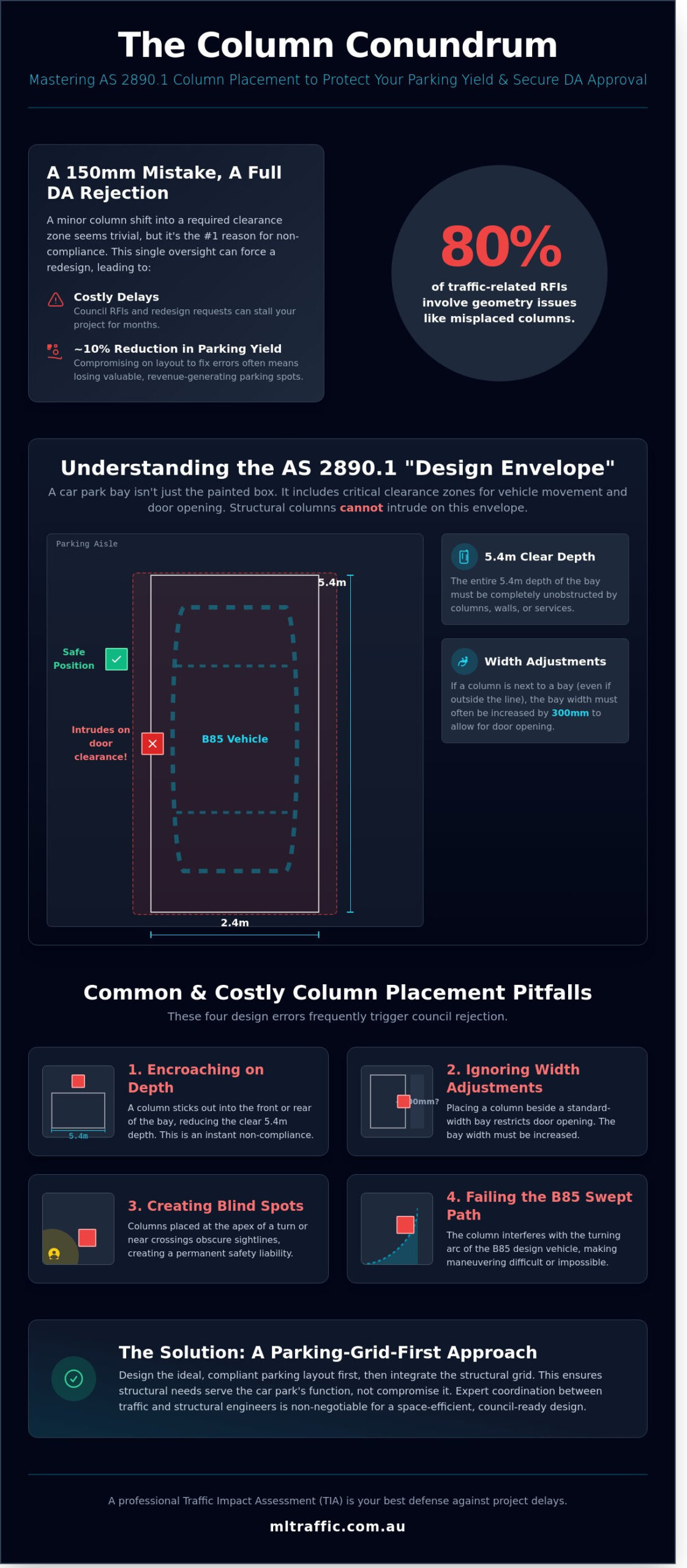
- Encroaching on the 5.4m depth: The standard requires a clear 5.4m depth for a standard bay. If a column sticks out into this zone, the bay is non-compliant.
- Ignoring width adjustments: When a column is located within the "clearance zone" beside a space, you must often increase the bay width by 300mm. Many designers miss this, resulting in doors that can’t open.
- Creating blind spots: Columns placed at the apex of a turn or near a pedestrian crossing point can obscure sightlines. This creates a permanent liability for the building owner.
- Failing the B85 test: The B85 vehicle is a 4.9m long template representing the 85th percentile of cars on Australian roads. If your column interferes with its turning arc, the design fails.
Precision matters. We’ve seen projects where a 150mm shift in a structural grid saved three parking spaces and shaved four weeks off the approval timeline. Don’t let a concrete pillar kill your ROI. Professional assessment ensures your structural grid works with the traffic flow, not against it. It’s the difference between a functional asset and a compliance nightmare.
Understanding the Design Envelope: Where Columns Can and Cannot Sit
Designing a functional car park requires more than just marking out rectangles on a basement plan. It involves managing the three-dimensional space a vehicle occupies while moving and stationary. AS 2890.1 Clause 2.5.2 defines this as the ‘Design Envelope.’ This envelope is the absolute minimum clear space required for a car to park and for the occupants to exit safely. If a structural element intrudes into this space, you’ve created a non-compliant hazard that leads to scraped paint and frustrated tenants.
The relationship between the parking space, the aisle, and your structural columns is governed by Figure 2.2 of the Standard. This diagram acts as the primary template for every project we handle. It outlines exactly where structural supports can reside without interfering with the vehicle. The core rule is that columns must sit outside the area where doors swing open. According to Standards Australia, failing to respect these boundaries often results in costly retrofits or rejected development applications.
For a standard 5.4m deep parking bay, the ‘safe zone’ for AS 2890.1 column placement in car parks is generally located between 0.75m and 3.5m from the aisle line. This specific window allows the front doors of most vehicles to open wide enough for a driver to step out. If you place a column closer than 0.75m to the aisle, you’re blocking the door’s primary arc. If you place it further back than 3.5m, you risk hitting the rear quarter or preventing access to the back doors and boot.
The B85 Vehicle and Door Opening Clearances
The Australian Standard is built around the B85 vehicle. This represents the 85th percentile car, measuring roughly 4.9m long and 1.9m wide. We use this as the benchmark because it covers the vast majority of cars on Australian roads today. Protecting the door opening zone is the priority here. If a column is placed incorrectly, the driver cannot fully open their door, which leads to vehicle damage or makes the spot unusable for anyone with limited mobility. For high-end residential developments or specialized commercial sites, we often recommend designing for the B99 vehicle (the 99th percentile) to provide a more premium, accessible experience.
The ‘No-Go’ Zones for Structural Support
There are strict ‘no-go’ zones where columns are prohibited. Within the standard 2.4m width of a bay, the first 0.75m from the aisle must remain entirely clear of vertical obstructions. This ensures the vehicle has a clear ‘mouth’ to enter the space. We often see designers try to put a column right at the entrance of a bay to save floor space. This is a mistake. A column at the entry line forces the driver to take a wider turn, which means you must increase the aisle width to compensate. For instance, a standard 5.8m aisle might need to expand to 6.2m if columns are poorly positioned. We can help you avoid these spatial traps with a professional swept path analysis during the early design phase.
Column width also plays a major role. A column that is 300mm wide is standard, but if your structural engineer requires a 600mm blade column, the AS 2890.1 column placement in car parks rules change. Any column wider than 450mm that sits near the ‘safe zone’ can significantly restrict the perceived room in a bay, often requiring the entire parking space to be widened by 100mm to 200mm to maintain compliance and usability.
Solving the Conflict Between Structural Integrity and Parking Compliance
Structural engineers and traffic engineers often approach a basement design from opposite ends of the spectrum. The structural team focuses on the vertical load and the most efficient grid to support 20 storeys of concrete. This usually results in bulky, square columns. We focus on the horizontal movement of vehicles. When these two priorities clash, the result is often a design that technically supports the building but fails a council audit. Getting AS 2890.1 column placement in car parks right requires a compromise that doesn’t sacrifice safety or the number of available spots.
The biggest issue we see is the ‘Blind Spot’ problem. This happens when a column sits exactly where a driver needs to begin their turn. If a column interferes with the required clearance zones, it doesn’t just make parking difficult; it makes the spot non-compliant. We use technical data to show structural teams exactly where a column creates a pinch point. By identifying these conflicts early, we avoid the costly exercise of redesigning a basement after the slab has been poured.
Negotiating with Structural Requirements
Successful negotiation requires hard data. We don’t just ask for a column to move; we provide a traffic overlay that justifies the shift. One of the most effective strategies is switching from square to rectangular columns. A 400mm x 800mm rectangular column often provides the same load-bearing capacity as a 600mm square one but offers a much slimmer profile within the parking envelope. This choice is vital for AS 2890.1 column placement in car parks because it maximizes the usable width of the parking bay.
In a 2021 project for a Sydney basement, the original structural grid caused a major conflict with the aisle width. By presenting a data-backed case for a 200mm shift in column position, we saved four parking spots that would have otherwise been deleted to meet clearance requirements. This shift ensured the project met the strict requirements of the City of Parramatta Development Control Plan, which mandates strict adherence to Australian Standards for all new developments. Using offset columns is another reliable tactic. Offsetting a column away from the aisle by just 300mm can be the difference between a compliant 5.8m aisle and a failed 5.5m one.
When Swept Path Analysis Trumps the Standard
Sometimes, a design looks tight on paper but works perfectly in practice. We use Vehicle Swept Path Analysis to prove a column is safe even when clearances seem marginal. While the Standard provides a prescriptive guide, software like AutoTURN allows us to simulate the exact movement of a B85 or B99 vehicle. This digital validation is often the only way to convince council planners that a specific column placement won’t result in scraped fenders or blocked aisles.
It’s also about managing the ‘perception of space.’ A driver feels more comfortable entering a spot where the column is set back from the aisle. Even if the geometric clearance is technically sufficient, a poorly placed column creates a psychological barrier that slows down traffic flow. We use our experience to balance these geometric realities with the practical needs of daily users. We ensure the car park is functional, not just a theoretical success on a blueprint.
Practical Coordination: Integrating Columns into Your Car Park Layout
Don’t treat columns as an afterthought in your design process. Successful car park design requires you to start with the parking grid first, then overlay the structural grid. If you lead with the structure, you’ll likely end up with "dead" spaces or bays that are impossible to maneuver into. This sequence ensures that AS 2890.1 column placement in car parks supports the traffic flow rather than obstructing it.
Standardizing your column spacing is the most effective way to maintain efficiency. In most Australian developments, we recommend spacing that spans 3 parking bays. A span between 7.5m and 8.4m is the recognized sweet spot. This range provides enough width for the vehicles and the columns themselves without requiring massive structural transfers. If you drop below a 7.5m span, you’ll likely struggle to fit three compliant bays, forcing you to revert to a less efficient 2-bay configuration.
You must also account for the physical footprint of column protection. A 400mm concrete column isn’t just 400mm in the eyes of a traffic engineer. When you add bollards or structural curbs to prevent vehicle strikes, that footprint can grow by another 200mm to 300mm. If this isn’t factored into your initial CAD drawings, your drive aisles might end up narrower than the 5.8m minimum required for many Class 1A facilities, leading to a failed compliance check.
Sightlines are another critical coordination point. We often see designs where columns are placed right at the edge of an intersection or a ramp exit. This creates blind spots for drivers. You need to maintain clear sight triangles, typically 5 meters by 5 meters at key internal intersections. Roughly 15% of the projects we review require significant structural redesigns because these sightlines weren’t checked until the end of the project. Engaging a traffic engineer during the schematic design phase, rather than the construction documentation phase, prevents these costly late-stage changes.
The Ideal Column Grid for Residential vs. Commercial
Residential car parks often utilize 2.4m wide bays (User Class 1A), making a 7.5m clear span between columns ideal for three spaces. Commercial sites, however, require wider bays of 2.5m or 2.6m (User Class 2 or 3) to accommodate higher turnover. This pushes the required span toward 8.4m. When integrating disability parking under AS 2890.6, remember that the 2.4m wide shared area must remain completely clear of columns. You can’t simply "tuck" a column into the corner of a disabled bay’s shared zone without violating the standard.
Integrating Services and Pipework
Hidden non-compliance often stems from services rather than the columns themselves. Drainage pipes, fire sprinklers, and cable trays are frequently mounted to columns or the soffit above. AS 2890.1 requires a minimum clear height of 2.2m throughout the car park. If a 150mm drainage pipe is installed under a beam near a column, it can easily drop the clearance to 2.05m. This creates a hazard and a breach of standards. You must ensure that all pipework stays outside the vehicle clearance envelope, especially in high-traffic areas near ramps and entries.
Ensuring your columns meet Australian Standards doesn’t have to be a headache. You can contact our senior engineers today to review your layout and ensure every bay is fully compliant before you break ground.
How Professional Traffic Engineering Streamlines Your Council Approval
Council delays are the primary enemy of any development timeline. A certified Traffic Impact Assessment (TIA) serves as your strongest defense against these setbacks. Since 2005, we’ve provided technical reports for over 10,000 sites across Australia, ensuring that every design element meets the strict criteria of local authorities. Correct AS 2890.1 column placement in car parks is not just about meeting a minimum requirement; it’s about ensuring the functional integrity of the entire development. If your plans don’t demonstrate this compliance clearly, a council assessor will likely issue a Request for Further Information (RFI), which can stall your project for weeks or even months.
We’ve spent 20+ years building a reputation with local councils for accuracy and reliability. This history means that when an assessment from our firm lands on a planner’s desk, it carries the weight of established expertise. We understand the specific nuances and local variations in how different councils interpret the Australian Standards. Our engineers don’t just provide a report; we provide a strategy to clear the regulatory hurdles that often trip up less experienced consultants. We focus on getting the technical details right the first time so your project moves forward without friction.
Technical compliance requires more than just reading a manual; it demands an understanding of how assessors view your site. At ML Traffic Engineers Pty Ltd, we navigate these complex interpretations by applying decades of hands-on experience to every project. We’ve seen how a single poorly positioned pillar can compromise an entire basement layout. By addressing these issues during the design phase, we prevent the need for expensive, late-stage structural changes that could cost your project thousands in A$ redesign fees.
Our Hands-On Approach to Car Park Design
We don’t believe in passing work down to junior staff who lack the experience to spot subtle design flaws. Our "no-gatekeepers" philosophy ensures you speak directly to the senior principal working on your project, such as Michael Lee or Benny Chen. We review your architectural plans with a forensic eye, specifically looking for AS 2890.1 column placement in car parks that might infringe on the required "Design Envelope" or "B-85" vehicle clearance zones. This direct access allows for rapid responses to urgent design queries, keeping your project on track. We’ve found that this personal accountability leads to higher approval rates and better design outcomes for our clients.
Ready to Secure Your DA Approval?
Don’t let a misplaced column stall your development application or force a total basement redesign. A small error in the early stages can lead to a A$10,000+ headache later if the council demands a resubmission. We provide a preliminary review of your car park layout to identify potential compliance issues before they become permanent problems. This proactive approach saves time, reduces stress, and provides the peace of mind that comes from working with seasoned professionals. Contact us to ensure your project meets every regulatory standard from the start. Get a quote for your Traffic Impact Assessment today and take the first step toward a successful council approval.
Secure Your Council Approval with Compliant Column Design
Designing a car park that works for both structural engineers and council planners is a delicate balancing act. You’ve seen how precise AS 2890.1 column placement in car parks must be to maintain the required design envelope. Misplacing a single pillar by a few centimeters can lead to expensive redesigns or a rejection from the council. It’s better to address these technicalities now rather than facing delays during construction. We know the pressure of getting these details right the first time.
At ML Traffic Engineers, we’ve completed over 10,000 successful site assessments across Australia since 2005. You won’t be handed off to a junior staff member; senior engineers Michael Lee and Benny Chen handle every project personally. They bring over 30 years of specialized traffic engineering experience to your development to ensure your layout is both functional and fully compliant. Contact ML Traffic Engineers for an AS 2890.1 Compliance Check and let’s get your project approved. We’re ready to help you navigate the standards and keep your development moving forward.
Frequently Asked Questions
What is the minimum clearance between a column and a parking space?
You must maintain a minimum clearance of 250mm to 300mm from the edge of the parking space to the face of a column to prevent vehicle damage. AS 2890.1 defines a specific design envelope where columns shouldn’t sit to ensure car doors can open freely. If your column is within the 0.75m to 3.5m zone measured from the aisle, it’s usually compliant. We’ve seen projects where even a 50mm error led to costly structural retrofits during the construction phase.
Can a structural column encroach into the 5.4m depth of a parking bay?
Structural columns can encroach into the 5.4m depth of a parking bay provided they stay within the permitted zones defined in Figure 5.2 of the standard. These zones are typically located between 0.75m and 3.5m from the aisle side of the bay. AS 2890.1 column placement in car parks is strictly regulated because columns outside these coordinates obstruct car doors. Our team has reviewed over 10,000 sites where improper encroachment caused an immediate DA rejection from the council.
Does AS 2890.1 allow columns to be placed at the very front of a parking space?
You can’t place columns at the very front of a parking space because they obstruct the swept path of a vehicle entering the bay. AS 2890.1 requires the first 0.75m from the aisle to remain completely clear of any physical obstructions. Placing a column here narrows the effective entry width, making it impossible for a B85 vehicle to park in a single maneuver. We recommend checking your architectural plans against the 2004 standard requirements before you finalize any basement layouts.
How do columns affect the required aisle width in a car park?
AS 2890.1 column placement in car parks directly dictates your required aisle width; if columns are placed at the aisle edge, you’ll often need wider aisles to maintain a compliant swept path. A standard 5.8m aisle works for 2.4m wide spaces, but obstructions can force this width to 6.2m or more. We use Vehicle Swept Path Assessment software to prove that your specific layout allows for safe 2-way traffic flow without hitting structural elements or requiring multi-point turns.
What happens if my columns are non-compliant but the building is already designed?
If your building is already designed with non-compliant columns, you’ll likely need a formal Traffic Impact Statement (TIS) or a performance-based assessment from an RPEQ engineer. We’ve helped developers save A$50,000 in redesign costs by providing expert evidence that the layout still functions safely despite minor deviations. It’s often possible to justify these issues if the overall car park circulation remains efficient and safe for all users. We provide the expert report you need to satisfy the consent authority.
Is there a difference in column rules for residential vs. commercial car parks?
Residential car parks often have more lenient space width requirements than commercial sites, which changes where columns can safely sit. A residential bay (Class 1A) might only need to be 2.4m wide, while a high-turnover retail space (Class 3) requires 2.6m or 2.7m. These 200mm differences change the clear zone for columns significantly. Since 2005, we’ve navigated these distinctions for everything from small apartment blocks to massive shopping centers to ensure full compliance with Australian Standards.
How does AS 2890.1 column placement interact with disability parking standards (AS 2890.6)?
AS 2890.6 is far more restrictive than AS 2890.1; columns cannot encroach into the 2.4m wide shared area adjacent to a disabled space. This shared zone must remain clear from ground level to a height of 2.2m to allow for wheelchair ramps and passenger movement. If a structural column sits within this 2.4m by 5.4m space, the bay is non-compliant and will fail inspection. We ensure your accessible parking meets these 2009 standards to avoid legal liability and access issues.
Can I use wheel stops to mitigate column placement issues?
You can’t use wheel stops to fix a column that’s in a non-compliant location according to the standard. While wheel stops prevent a car from hitting a wall, they don’t resolve the door-opening or swept-path issues caused by poorly placed structural elements. AS 2890.1 is clear that the design envelope must be respected regardless of secondary safety measures like stops or bollards. We’ve seen 15% of DIY designs fail because they relied on wheel stops instead of proper structural spacing.
Which areas do you service?
We are traffic engineers covering Melbourne, Sydney, Brisbane, Gold Coast, Hobart, Perth, Adelaide, Darwin and surrounding areas.

Disclaimer
The content on www.mltraffic.com.au, including all technical articles, guides, and resources, is provided for general informational and educational purposes only. It is not intended to constitute professional advice in traffic engineering, transportation planning, development approvals, or any other technical or legal field.
While ML Traffic Engineers makes every reasonable effort to ensure the accuracy, completeness, and timeliness of the information published, we do not provide any warranties or representations (express or implied) regarding its reliability, suitability, or availability for any particular purpose. Any reliance you place on the content is strictly at your own risk.
In no event shall ML Traffic Engineers, its directors, employees, authors, or affiliates be liable for any direct, indirect, incidental, special, consequential, or punitive damages (including, without limitation, loss of profits, data, or business opportunities) arising out of or in connection with the use of, or inability to use, any information provided on this website.
The articles and guides on this site are not a substitute for engaging a qualified, registered professional traffic engineer (such as an NPER or RPEQ engineer) to assess your specific project requirements. For tailored advice, compliance assessments, or traffic engineering services, please contact a competent professional.
This disclaimer may be updated from time to time without notice. By accessing or using this website, you agree to be bound by the most current version of this disclaimer.
