

A single design oversight in your basement ramp can cost your project A$45,000 in structural rework before the first slab is even poured. You likely already know that Council planners are becoming increasingly meticulous with off-street parking requirements, often using minor technicalities to trigger a Request for Information (RFI) that stalls your Development Application for months. It’s frustrating to watch your project timeline slip because of a 1% grade error or a tight swept path that doesn’t meet the latest benchmarks. This guide provides the definitive AS 2890.1 compliance checklist 2026 to help you secure DA approval on your first submission while maximising every square metre of Gross Floor Area.
We understand that every millimetre of GFA counts toward your bottom line; inefficient layouts are simply wasted profit. By mastering the essential 2026 Australian Standards for off-street parking, you’ll avoid the fear of vehicle scraping complaints and the threat of future litigation. We’ll walk you through the critical updates for ramp grades, aisle widths, and clearance heights that ensure your car park is both functional and legally compliant. This roadmap is designed to move your project from the drawing board to construction without the headache of costly design revisions.
Key Takeaways
-
Understand why AS 2890.1 is the essential "technical bible" for securing Council DA approval for Australian off-street parking facilities.
-
Master mandatory bay and aisle dimensions using an AS 2890.1 compliance checklist 2026 to prevent fundamental design errors.
-
Identify critical driveway and ramp gradient requirements to ensure your site access passes the most scrutinized stage of the approval process.
-
Discover why Swept Path Analysis is now the mandatory "proof" required by Council to validate maneuverability in complex layouts.
-
Follow a professional roadmap to move from initial design to a certified traffic report, avoiding expensive architectural revisions and project delays.
Table of Contents
What is AS 2890.1 and Why is Compliance Critical in 2026?
AS 2890.1 serves as the mandatory technical foundation for every off-street car parking facility in Australia. It functions as the primary benchmark for Council Development Application (DA) approvals from Sydney to Perth. For developers, this standard isn’t a suggestion; it’s a rigid legal requirement. Ignoring these technical specifications leads to rejected applications or, in extreme cases, expensive demolition orders. By 2026, the margin for error has vanished. Modern vehicle fleets now include wider SUVs and heavier Electric Vehicles (EVs) that demand absolute precision in ramp grades and turning circles.
To better understand the fundamentals of this standard, watch this technical breakdown:
Relying on an outdated AS 2890.1 compliance checklist 2026 can sink a project before the first slab is poured. A single error in a driveway gradient or a blind spot in a sight-line assessment can trigger a Land and Environment Court appeal costing upwards of A$35,000. We’ve seen projects stalled for months because a basement layout failed to account for the parking space dimensions required by the B85 design vehicle. Precision is the only way to protect your investment and ensure public safety.
The Core Objectives of the Standard
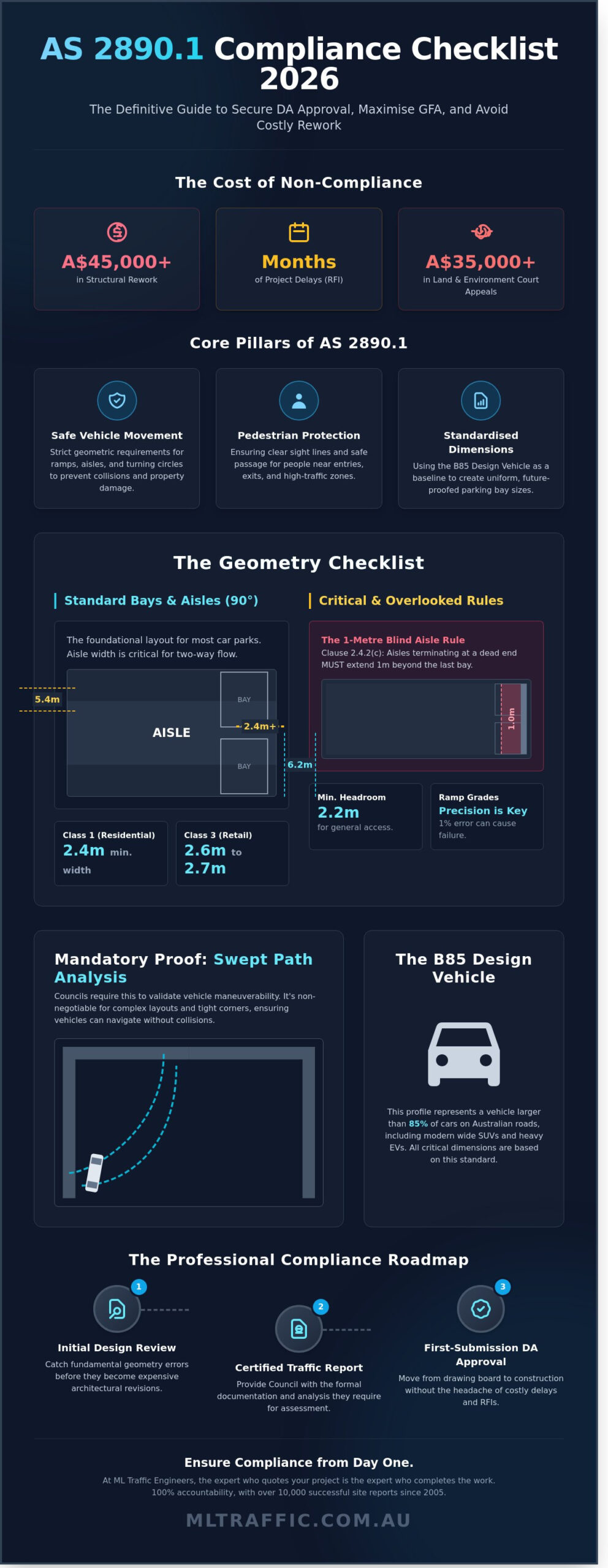
The standard exists to prevent property damage and protect lives. It focuses on three main pillars. First, it ensures safe vehicle movement through strict geometric requirements. Second, it prioritises pedestrian protection near entry points and high-traffic zones. Third, it standardises bay sizes based on the B85 design vehicle. This vehicle profile represents a car larger than 85% of those currently on Australian roads. This creates a uniform framework that every local government authority uses to judge your project’s viability and safety liabilities.
Who Needs to Follow This Checklist?
-
Property Developers: You must use this guide to ensure residential or commercial builds remain profitable and legally compliant.
-
Architects: You need these metrics when drafting initial site layouts and basement levels to avoid "impossible" turns or scraped undercarriages.
-
Town Planners: You rely on this data to review project feasibility against specific Council requirements before submission.
At ML Traffic Engineers, we provide the expert oversight needed to clear these regulatory hurdles. We’ve been trading since 2005 and have worked on over 10,000 sites. The traffic consultant who provides your quote is the same person who does the work. This ensures your AS 2890.1 compliance checklist 2026 is handled with 100% accountability from day one.
The 2026 Geometry Checklist: Bays, Aisles, and Headroom
Getting your car park geometry right isn’t just about fitting more cars into a basement. It’s about ensuring your development application doesn’t get stalled by a Council Request for Information (RFI). Using a detailed AS 2890.1 compliance checklist 2026 helps you catch these errors during the design phase rather than during construction when changes cost ten times more.
Standard Bay and Aisle Dimensions
The 2.4m by 5.4m footprint remains the gold standard for a 90-degree bay, but your specific User Class dictates the actual width. If you’re designing for a residential flat building (Class 1), 2.4m works. For high-turnover retail (Class 3), you’ll likely need 2.6m or even 2.7m to allow for comfortable door opening. Aisle widths are tied directly to these angles. A standard 90-degree layout requires a 6.2m aisle for two-way traffic. You can find the full technical breakdown in the Australian Standard AS 2890.1. If you’re working with tighter angles like 45 or 60 degrees, your aisle width can decrease, but your total bay length will increase. It’s a trade-off that requires careful calculation.
The 1-Metre Blind Aisle Extension Rule
Clause 2.4.2(c) is often the most overlooked requirement in modern basement design. If your aisle terminates at a wall or a dead end, you must extend that aisle 1 metre beyond the last parking space. This extra metre provides the necessary space for a driver to turn the steering wheel and reverse out in a single maneuver. We’ve seen dozens of projects face delays because a designer tried to squeeze one extra bay into a corner, forgetting this rule. Validating these turnaround areas early is a non-negotiable part of any AS 2890.1 compliance checklist 2026. Learn more about our Car Park Design services to see how we optimize these tight spaces.
Headroom and Vertical Clearances
Vertical clearance is where many developers get caught out by overhead services. While 2.2m is the minimum height for standard parking areas, this must be clear of all obstructions. Fire sprinklers, drainage pipes, and cable trays often hang lower than the structural slab, effectively voiding your compliance. Accessible (disabled) parking zones are even stricter, requiring a minimum 2.5m height. This 2.5m clearance must also extend along the entire travel path from the entrance to the bay. If your basement has a 2.3m entry height, your disabled bays are technically non-compliant, even if the bays themselves have 3m of clearance. Our team can help you review your basement sections and levels to ensure every pipe and duct is accounted for before the concrete is poured.
Driveway and Ramp Grade Compliance for Site Access
Driveway crossovers are the most scrutinized element of any Development Application. Council engineers prioritize these because they represent the critical interface between private property and public infrastructure. If your ramp design fails the "scrape test," your project won’t move forward. Using a professional AS 2890.1 compliance checklist 2026 ensures your project accounts for the tighter tolerances required by modern vehicle profiles and avoids expensive redesigns during the construction phase.
Maximum Gradients and Transition Zones
For private residential ramps, the absolute maximum gradient permitted is 1 in 4 (25%). However, a sudden shift from a flat road to a 25% incline will cause vehicle damage. AS 2890.1 requires 2-metre transition zones at every significant grade change. These transitions are typically set at half the main ramp grade to prevent the vehicle’s chassis from hitting the pavement. In 2026, designers must be more conservative with these calculations. Modern electric vehicles often feature longer wheelbases and lower battery packs, making them highly susceptible to "grounding out" on poorly designed crests or sags. If you’re unsure about your levels, contact our team for a driveway grade assessment to avoid costly post-construction rectifications.
Sight Distance and Safety at the Property Boundary
Safety at the pedestrian interface is a non-negotiable requirement for council planners across Australia. Drivers exiting a site must have clear visibility of the footpath. This is managed through "sight triangles," which usually extend 2.5 metres along the property boundary and 2.0 metres into the site from the driveway edge. Fences, landscaping, and even signage can void compliance if they obstruct these zones.
Use this checklist to ensure clear sight lines at the boundary:
-
Ensure no solid fences, walls, or vegetation exceed a height of 0.9 metres within the 2.0m x 2.5m sight triangle.
-
Verify that letterboxes and utility meters are positioned outside the restricted visibility zone.
-
Confirm that structural columns or basement supports don’t obscure the driver’s view of approaching pedestrians.
-
Check that any proposed business signage doesn’t create a visual blind spot for exiting vehicles.
Failing to meet these sight-line requirements is one of the fastest ways to receive a Request for Further Information (RFI) from Council. Integrating these specific safety specs into your AS 2890.1 compliance checklist 2026 from the initial design phase keeps your project on track for approval.
Advanced Validation: Swept Path Analysis and Maneuverability
Swept Path Analysis serves as the empirical proof Council requires for your car park layout. Static 2D drawings are no longer sufficient for 2026 DA submissions. These drawings fail to account for the dynamic "swing" of a vehicle as it moves through a turn. To secure approval, you need a digital simulation that tracks the vehicle’s footprint, including body overhang and wheel paths, as part of your AS 2890.1 compliance checklist 2026.
We utilize AutoTURN software to run these simulations using the B85 and B99 vehicle templates. The B99 template represents the 99th percentile vehicle. It ensures that even the largest passenger cars can navigate your facility safely. A qualified Traffic Engineer must certify these simulations to provide the accountability Council demands. This isn’t just a technicality; it’s about verifying that your design works in the real world before a single slab is poured.
When is Swept Path Analysis Mandatory?
Council planners view swept paths as non-negotiable insurance for your development. You’ll find this analysis is mandatory for any site involving basement entries, tight ramp turns, or heavy vehicle access governed by AS 2890.2. If your design features a driveway with a gradient change or a confined loading dock, a static plan won’t suffice. Since 2005, we’ve seen Councils increase their demands for these simulations to prevent post-construction traffic congestion and safety hazards.
Common Maneuverability Failures to Avoid
Many developers encounter delays because of basic maneuverability errors that could’ve been caught during the design phase. Common failures include:
-
Encroachment: Vehicles overhanging curbs or crossing into opposing traffic lanes during a turn.
-
Multi-point turns: Requiring a three-point turn where the standard mandates a single, continuous movement.
-
Structural Obstructions: Positioning columns or walls within the "swing" zone of a turning B99 vehicle.
Avoiding these issues early saves thousands in redesign costs. Our team has reviewed over 10,000 sites, identifying these bottlenecks before they reach the Council’s desk. Ensuring these movements are verified is a critical step in your AS 2890.1 compliance checklist 2026.
Ensure your layout meets every technical requirement by booking a Vehicle Swept Path Assessment with our senior engineers today.
Securing Your DA: The Professional Compliance Roadmap
Moving from a concept to a Council-approved car park requires more than just drawing lines on a plan. It’s about building a technical bridge between architectural vision and strict regulatory reality. Engaging a traffic specialist during the design phase prevents the "back-and-forth" that often kills project timelines and budgets. We focus on getting the parking layout right the first time, ensuring your AS 2890.1 compliance checklist 2026 is fully addressed before the concrete is poured.
Step-by-Step Approval Process
The path to a successful Development Application (DA) follows a logical progression of technical validation. Our process ensures that your design is functional, safe, and legally compliant.
-
Step 1: Initial site survey and architectural drafting. Your architect provides the base layout. We look for immediate red flags in ramp locations, driveway widths, or bay configurations that won’t meet Australian Standards.
-
Step 2: Preliminary compliance review. We cross-reference the draft against the latest AS 2890.1 compliance checklist 2026. This identifies issues like insufficient aisle widths or "blind" corners while they are still easy to fix on paper.
-
Step 3: Technical reporting and swept path validation. We use specialized software to simulate vehicle movements. This proves to Council that a B99 vehicle can enter, turn, and exit the site in a single maneuver without hitting structural columns.
Why Professional Certification is Your Best Insurance
A certified traffic report is your protection against Council RFIs (Requests for Further Information). When a report is "RFI-proof," you avoid the 4 to 8 week delays that occur when planners question your parking layout. Professional oversight also prevents massive financial hits later. Remedying a non-compliant concrete ramp after construction can easily cost A$15,000 or more in demolition and re-pouring fees. It’s much cheaper to move a line on a CAD drawing than it is to move a structural wall.
We operate on a principal-led model. This means the traffic consultant who provides your quote is the same engineer who performs the assessment. There are no junior hand-offs here; you get direct access to experts with decades of experience. Read about the ML Traffic Engineers team and our 15+ years of experience to see how this accountability secures your project’s future.
Final 2026 Compliance Checklist:
-
Does the driveway ramp grade meet the 1:20 transition rule for the first 2 metres?
-
Is there a minimum 2.2m headroom for standard bays and 2.5m for accessible spaces?
-
Have sight-line assessments been performed for both pedestrians and oncoming traffic at the property boundary?
-
Is the parking demand assessment based on the latest 2026 local council rates and land-use definitions?
Secure Your Development Approval with Technical Precision
Navigating the complexities of car park design requires more than just meeting minimum standards. It’s about ensuring every bay, aisle, and ramp grade aligns perfectly with the updated AS 2890.1 compliance checklist 2026. Council planners don’t overlook minor geometric errors. Even a 1% deviation in driveway grade or a slight oversight in swept path analysis can lead to costly DA delays. Accuracy isn’t optional; it’s the foundation of your site’s approval.
At ML Traffic Engineers, we bring the expertise of over 10,000 sites assessed across Australia directly to your project. You’ll work with senior engineers who possess between 30 and 40 years of experience. We operate on a simple, accountable principle: the traffic consultant who provides your quote is the one who does the work. This hands-on approach eliminates bureaucracy and ensures your car park design is technically sound from the start.
Don’t leave your project’s success to chance. Get a Compliant Traffic Report for Your DA Today and move your development forward with absolute confidence.
Frequently Asked Questions
How wide does a standard Australian car park bay need to be in 2026?
A standard car park bay for residential use (User Class 1A) must be 2.4 metres wide according to the AS 2890.1 compliance checklist 2026. For shopping centres or short-term parking (User Class 3), this width increases to 2.6 or 2.7 metres to allow for easier door opening. We ensure your plans use these precise dimensions from the start so you don’t face expensive redesigns during the Council approval phase.
What is the maximum ramp grade allowed under AS 2890.1?
The maximum ramp grade for private residential driveways is 1 in 4 (25 percent) for lengths under 20 metres. Commercial car parks or longer ramps are restricted to a 1 in 5 (20 percent) gradient. You must also include transition sections at a 1 in 8 grade (12.5 percent) for at least 2 metres at each end. This prevents vehicles from scraping their undercarriage as they enter or exit the facility.
Is a Swept Path Analysis required for all residential developments?
Most local Councils demand a Swept Path Analysis for any multi-unit residential development or sites with restricted access. We use specialized software to simulate vehicle movements for B85 and B99 cars to prove your design works. This documentation is a critical part of the AS 2890.1 compliance checklist 2026 because it shows residents can safely navigate the property without hitting walls or other vehicles.
What happens if my car park design doesn’t meet Australian Standards?
Non-compliant designs usually lead to the immediate refusal of your Development Application by the Council. Beyond the planning stage, failing to meet these standards creates massive legal liability for developers if an accident occurs on your property. Rectifying a built basement that lacks proper clearance is 10 times more expensive than getting the engineering right during the design phase. We provide the qualified assessments you need to avoid these financial disasters.
How much headroom is required for a basement car park?
You need a minimum vertical clearance of 2.2 metres for standard basement parking areas. This requirement increases to 2.5 metres for any areas designated for accessible parking under AS 2890.6. It’s vital to account for overhead pipes, ducts, and fire sprinklers, as these often reduce the actual usable headroom. We recommend designing for 2.4 metres of clear space to provide a safety buffer for construction tolerances.
Can I use ‘small car’ spaces to meet my Council parking requirements?
Most local Councils don’t allow ‘small car’ spaces to count toward your mandatory minimum parking numbers. These spaces are typically 2.3 metres wide and are often treated as surplus parking rather than compliant spots. If your DA relies on these to meet the quota, you’ll likely face a request for more information or a flat rejection. We help you maximize your site yield without relying on these risky design shortcuts.
What is the difference between AS 2890.1 and AS 2890.6?
AS 2890.1 governs general off-street car parking requirements, while AS 2890.6 focuses exclusively on parking facilities for people with disabilities. You must follow both standards for any commercial or multi-residential project in Australia. AS 2890.6 mandates specific shared zones and bollard placements that aren’t required in standard bays. Our team ensures your site plan integrates both sets of rules seamlessly to pass every inspection.
How often are the AS 2890 standards updated?
Standards Australia doesn’t follow a strict calendar, but major revisions typically happen every 10 to 20 years. The current version of AS 2890.1 has been the primary reference since 2004, with various amendments added to address modern vehicle sizes. Because the 2026 regulatory environment is becoming stricter, staying current with the latest interpretations is vital. We keep our technical knowledge updated so your projects remain compliant with the most recent industry shifts.
Which areas do you cover?
We are traffic engineers servicing Melbourne, Sydney, Brisbane, Gold Coast, Hobart, Perth, Adelaide, Darwin, Canberra and surrounding areas.
Disclaimer
The content on www.mltraffic.com.au, including all technical articles, guides, and resources, is provided for general informational and educational purposes only. It is not intended to constitute professional advice in traffic engineering, transportation planning, development approvals, or any other technical or legal field.
While ML Traffic Engineers makes every reasonable effort to ensure the accuracy, completeness, and timeliness of the information published, we do not provide any warranties or representations (express or implied) regarding its reliability, suitability, or availability for any particular purpose. Any reliance you place on the content is strictly at your own risk.
In no event shall ML Traffic Engineers, its directors, employees, authors, or affiliates be liable for any direct, indirect, incidental, special, consequential, or punitive damages (including, without limitation, loss of profits, data, or business opportunities) arising out of or in connection with the use of, or inability to use, any information provided on this website.
The articles and guides on this site are not a substitute for engaging a qualified, registered professional traffic engineer (such as an NPER or RPEQ engineer) to assess your specific project requirements. For tailored advice, compliance assessments, or traffic engineering services, please contact a competent professional.
This disclaimer may be updated from time to time without notice. By accessing or using this website, you agree to be bound by the most current version of this disclaimer.
