

For any development in Australia, achieving a compliant car park design is not an option-it is a mandatory requirement for Development Application (DA) approval. Yet, the official standard is a dense, technical document that can be challenging to interpret correctly. A single miscalculation or overlooked clause can result in council rejection, forcing costly redesigns and significant project delays. A professional understanding of Australian Standard 2890.1, or as2890.1, is the only way to mitigate this risk.
This comprehensive guide eliminates the guesswork. We translate the complexities of the standard into clear, actionable advice for developers, architects, and project managers. Inside, you will find direct explanations of the critical clauses governing everything from parking space dimensions and ramp grades to sight lines and circulation. By the end, you will be equipped to design a safe, efficient, and fully compliant car park, justify your plans to stakeholders, and confidently navigate the DA process without traffic-related setbacks.
What is AS 2890.1 and Why Is It Critical for Your Project?
AS 2890.1 is the foundational Australian Standard that governs the design and layout of off-street car parking facilities. Its primary objective is to ensure all parking areas are safe, efficient, and accessible for light vehicles. For property developers, architects, and builders, understanding and applying this standard is not optional-it is the definitive benchmark used by council planners across Australia to assess and approve Development Applications (DAs).
To better understand the core principles of compliant car park design, the following video provides a helpful visual overview.
The current governing version is AS/NZS 2890.1:2004, though it is important to note that the standards are subject to periodic review and updates to reflect changes in vehicle dimensions and design practices.
The Purpose and Scope of the Standard
The scope of as2890.1 is specific and detailed. It provides the technical requirements for parking facilities intended for light vehicles, such as cars, small vans, and motorcycles. Key specifications include:
-
Minimum dimensions for parking spaces, aisles, and circulation roadways.
-
Geometric design for ramps, including compliant grades and transitions.
-
Requirements for sight lines, signage, and line-marking.
-
Layouts for various parking angles (e.g., 90-degree, 60-degree, parallel).
It is crucial to recognise what the standard does not cover. It excludes requirements for on-street parking, heavy vehicles like trucks and buses, or specific parking space standards for facilities with unique operational needs, which are addressed in other parts of the AS 2890 series.
Why Compliance is Non-Negotiable for DA Approval
Local councils throughout Australia embed the requirements of AS 2890.1 directly into their Development Control Plans (DCPs) or planning schemes. Non-compliance with these geometric standards is one of the most common reasons for a DA to be rejected or delayed with a costly Request for Information (RFI). Demonstrating full compliance from the initial design phase shows due diligence and professionalism, streamlining the approval process and preventing expensive redesigns later in the project lifecycle.
The AS 2890 Series: Understanding the Full Context
AS 2890.1 is the most frequently cited standard, but it is part of a broader series designed to cover all aspects of vehicle parking. Understanding the complete series is essential for complex projects. Other critical parts include:
-
AS 2890.2: Specifies requirements for off-street commercial vehicle facilities, such as loading docks for trucks and buses.
-
AS 2890.6: Details the minimum requirements for parking facilities for people with disabilities, a mandatory consideration for all public and commercial developments.
Correctly identifying and applying the relevant standard is the first step towards a compliant and successful development.
Core Design Elements: Key Dimensions and Geometrics
Compliance with AS2890.1 hinges on a precise understanding of its core geometric requirements. These dimensions are not guidelines; they are minimum standards that dictate the safety, efficiency, and functionality of a car park. This section details the critical measurements for spaces, aisles, and ramps that form the foundation of any compliant car park design.
Parking Space Dimensions and Clearances
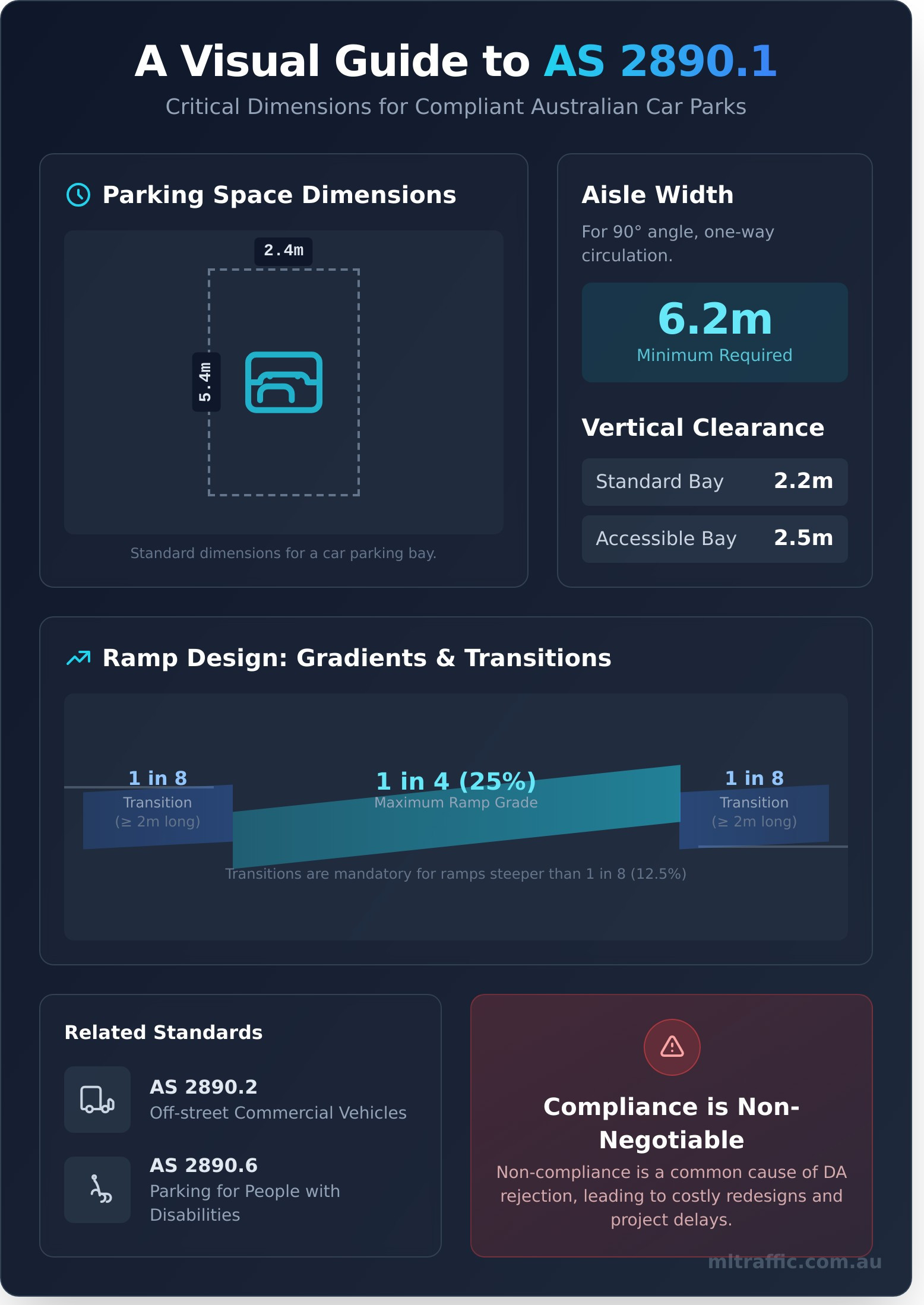
The standard car parking bay dimension specified in the standard is 2.4m wide by 5.4m long. However, the standard also defines different user classes, which can influence dimensions. For instance, Class 1 spaces (for public and shopping centres) often require greater widths for higher turnover, while Class 2 and 3 spaces (for employees and residents) can adhere to the minimums. Vertical clearance is equally critical, with a minimum headroom of 2.2m required for standard vehicles. This increases to 2.5m for accessible parking spaces and their adjacent shared areas. It is also important to note that industry discussions are ongoing regarding updates to accommodate the increasing prevalence of larger SUVs.
Aisle Widths and Circulation Roadways
Aisle width is directly dependent on the angle of the parking spaces. A 90-degree parking layout requires the widest aisle to allow for effective entry and exit manoeuvres, whereas angled parking (e.g., 45° or 60°) permits narrower aisles. The requirements for one-way and two-way circulation also differ significantly. For example, a one-way aisle for 90-degree parking requires a minimum width of 6.2m. These minimums are strictly enforced, with state-level interpretations like the VicRoads guidelines providing further context for local compliance. A professional traffic assessment ensures the most efficient layout is achieved while meeting these strict rules.
Ramp Design: Gradients and Transitions
Ramp design is a frequent point of failure in non-compliant car parks. The maximum allowable gradient for a straight ramp under as2890.1 is 1 in 4 (25%). However, connecting a steep ramp directly to a flat surface will cause most vehicles to scrape their front or rear overhangs. To prevent this, transition gradients are mandatory at the top and bottom of any ramp steeper than 1 in 8 (12.5%). These transitions must be at least 2m long and have a gradient that is half of the main ramp’s grade. For a 1 in 4 ramp, this mandates 1 in 8 transitions, ensuring smooth and damage-free vehicle passage. Ramp width and headroom must also comply with minimum standards to accommodate vehicle swept paths and clearance.
Navigating Common Challenges and Misinterpretations
While AS 2890.1 provides a detailed framework, its practical application often reveals common sticking points that can lead to non-compliance and costly redesigns. Understanding these frequent challenges is crucial for a successful development application. Our experience shows that architects, developers, and builders most often encounter issues with vehicle selection, wheel stop installation, and structural intrusions.
B85 vs. B99 Design Vehicles: Which to Use?
These terms refer to the standard vehicle templates used for swept path analysis to ensure cars can safely navigate a car park. The B85 template represents the 85th percentile vehicle-the typical default for most standard car spaces. However, many local councils now mandate the use of the larger B99 (99th percentile) vehicle template for all or part of a development to accommodate the growing size of popular SUVs and utes. Failing to confirm this specific council requirement early in the design phase is a frequent and avoidable error.
Wheel Stops: Requirements and Correct Installation
A common misinterpretation is that wheel stops are mandatory for every parking space. In reality, as2890.1 only requires them in specific situations, primarily to prevent a vehicle from encroaching into a pedestrian area or striking a wall or barrier. When required, correct placement is critical for compliance and function. Key dimensions include:
-
Height: Between 90mm and 100mm.
-
Placement: Positioned so the front of the vehicle does not overhang into a walkway. For a typical front-in parking bay, this is 0.9m from the front of the space.
Column Placement and Structural Intrusion
One of the most critical and frequently overlooked issues is the impact of columns and walls next to parking spaces. A standard 2.4m wide bay is insufficient when adjacent to a solid object. The standard requires additional width, often called a ‘shy distance’ or ‘door opening clearance,’ to allow occupants to open their car doors. For example, a space next to a column may need to be widened to 2.7m. Ignoring this rule results in unusable, non-compliant parking spaces that will be rejected by council certifiers.
Beyond the Basics: Safety, Accessibility and Future-Proofing
Compliance with AS 2890.1 provides the essential geometric foundation for a car park, but a truly functional and safe facility requires a more holistic design approach. A car park that meets the minimum dimensions but fails on visibility, user guidance, or future planning can become a significant operational liability. This section details the critical safety and forward-thinking elements that define a high-quality car park design.
Sight Lines and Pedestrian Safety
Clear visibility is paramount for preventing accidents. The standard mandates specific sight triangles at driveway exits to ensure drivers can see pedestrians on the public footpath before crossing. This is a non-negotiable safety requirement for any development. Within the car park, best practice involves creating dedicated, physically separated pedestrian walkways where possible. For unavoidable blind corners, such as on sharp ramp turns, the installation of convex mirrors and appropriate warning signage is a critical treatment to mitigate vehicle-to-vehicle collision risk.
Lighting, Signage, and Line Marking
Effective communication with the driver is essential for efficient and safe circulation. While as2890.1 provides guidance, a comprehensive lighting plan should also reference the AS/NZS 1158 series for specific illumination levels, which enhance personal security and visibility. This technical foundation must be supported by a clear and logical system of wayfinding. Key elements include:
-
Directional Signage: Clear, well-placed signs for entries, exits, and different parking levels.
-
Pavement Markings: Precisely painted lines for parking bays, directional arrows, and pedestrian crossings that comply with Australian standards.
-
Statutory Signage: Correctly installed signs for accessible parking spaces as required by AS 2890.6.
This system works in concert to reduce driver hesitation, unpredictable manoeuvres, and potential conflicts.
Integrating EV Charging and Future Trends
The 2004 version of the standard does not specifically address Electric Vehicle (EV) charging. However, its core principles of space and access remain fully applicable. When designing for EV charging, it is crucial to remember that an EV bay is still a parking space. It must meet all minimum dimensional and manoeuvring requirements of the standard. For practical implementation, locate charging bays in areas that minimise cabling costs (e.g., near main switchboards) but avoid placing them in the most convenient "front-door" spaces, which can cause frustration for non-EV users and inefficient turnover.
Ensuring your design considers these factors is key to long-term success. For an expert assessment of your car park plans, contact ML Traffic Engineers for professional guidance.
The Compliance Process: How a Traffic Engineer Ensures Approval
Understanding the principles of car park design is the first step; demonstrating compliance to council is the critical final hurdle. Navigating the Development Application (DA) process requires more than just compliant plans-it requires formal certification from a qualified professional. An experienced traffic engineer provides the necessary analysis and documentation to ensure your project meets all regulatory requirements without costly delays.
The Role of a Traffic Consultant
A professional traffic consultant translates the technical requirements of as2890.1 into a practical, compliant design for your specific site. Their role is to provide objective, expert verification that satisfies council assessors. This is achieved by:
-
Expert Interpretation: Applying the standard’s complex clauses to the unique constraints of your development, ensuring every ramp grade, bay dimension, and circulation aisle is correct.
-
Precise Analysis: Using industry-standard software like AutoTURN to conduct detailed vehicle swept path analysis, proving that design vehicles can safely and efficiently navigate the car park.
-
Formal Reporting: Preparing a comprehensive report and certification that formally attests to the design’s compliance, ready for direct submission to council.
What is a Car Park Design Assessment Report?
The primary deliverable from a traffic engineer is a Car Park Design Assessment Report. This professional document provides a systematic review of your architectural plans against every relevant clause in the Australian Standard. It typically includes a detailed compliance checklist identifying any areas of non-conformance and offering solutions, alongside clear swept path diagrams that visually demonstrate functionality for critical vehicle movements like entering and exiting parking bays or navigating ramps.
Achieve Certainty with Expert Certification
Submitting a DA with a traffic engineer’s report provides council with the confidence needed to grant approval. This formal certification minimises the likelihood of receiving a Request for Information (RFI), which can add significant delays and costs to your project timeline. By verifying compliance upfront, you streamline the assessment process and move towards construction with certainty. Ensure your design is compliant. Contact our experts for a quote.
Mastering AS 2890.1: From Blueprint to Approval
Navigating the complexities of Australian Standard 2890.1 is fundamental to delivering a car park that is safe, efficient, and functional. From precise bay dimensions and aisle widths to compliant ramp grades and clear sight lines, every detail matters. A minor misinterpretation of the as2890.1 standard can result in significant project delays and costly rectification works, making expert oversight essential from the outset.
To ensure your Development Application is approved without issue, partner with a specialist. ML Traffic Engineers provides authoritative traffic reports backed by over 15 years of dedicated experience. Our process gives you direct access to senior, registered traffic engineers who will meticulously assess your design against all council and Australian Standard requirements, safeguarding your project against compliance risks.
Take the critical step towards a successful build. Get a professional review of your car park design to ensure AS 2890.1 compliance and submit your plans with the confidence that comes from expert validation.
Frequently Asked Questions About AS 2890.1
What is the standard car park size in Australia according to AS 2890.1?
The standard car parking space dimension specified in AS 2890.1 is 2.4 metres wide by 5.4 metres long. However, this can vary based on the user class. For example, spaces for employees (Class 1) may have different requirements compared to spaces for shoppers (Class 3). The standard also specifies minimum aisle widths, which depend on the parking angle and user class, to ensure adequate vehicle manoeuvrability within the facility.
Is compliance with AS 2890.1 a legal requirement for all developments?
While AS 2890.1 is an Australian Standard and not legislation itself, it is referenced by the National Construction Code (NCC) and most local council planning instruments like Development Control Plans (DCPs). Therefore, compliance becomes a mandatory condition for securing a Development Application (DA) approval. Non-compliant designs are routinely rejected by councils, making adherence to the standard a practical necessity for any developer or builder in Australia.
What is the difference between AS 2890.1 and AS 2890.6 (disabled parking)?
AS 2890.1 provides the technical requirements for general off-street car parking facilities. In contrast, AS 2890.6 is the specific standard for parking facilities for people with disabilities. AS 2890.6 mandates wider parking spaces to accommodate vehicle-mounted ramps, adjacent shared zones for safe access, specific line-marking and signage, and minimum vertical clearances. It is used in conjunction with AS 2890.1 to ensure overall car park compliance.
How does AS 2890.1 specify driveway ramp grades and transitions?
AS 2890.1 sets strict limits on ramp grades to prevent vehicle scraping. The maximum allowable grade is 1 in 4 (25%) for single-dwelling private residences and 1 in 5 (20%) for all other developments. Critically, the standard requires transition sections at the top and bottom of the ramp, typically at half the main grade (e.g., 1 in 8). These transitions, usually 2 metres long, are essential for smooth vertical travel and avoiding damage to vehicles.
Are the proposed 2024/2025 changes to AS 2890.1 in effect yet?
No, the proposed changes to the Australian Standard for parking facilities are not yet in effect. The current published version of AS 2890.1 remains the legally enforceable document for council assessments. While a draft has been circulated for public comment, indicating future adjustments for larger vehicles, developers must design to the current standard. It is critical to consult with a traffic engineer who is aware of the pending changes for future-proofing designs where possible.
Do I need a traffic engineer to certify my car park design for council?
Yes, for most development applications, local councils require a formal assessment and certification from a qualified traffic engineer. This process verifies that the car park layout, ramp grades, sight lines, and vehicle access arrangements comply with the technical requirements of as2890.1 and relevant council codes. Submitting a professionally certified design significantly reduces the risk of council rejection and costly delays during the approval process.
What is a ‘B85 design vehicle’ mentioned in the standard?
The B85 design vehicle is a key technical benchmark within AS 2890.1. It represents the 85th percentile vehicle in the Australian fleet, meaning its dimensions are larger than 85% of cars on the road. All geometric elements of a car park, including stall dimensions, aisle widths, and ramp turning paths, must be designed to safely accommodate the swept path of this B85 vehicle. This ensures the car park is functional for the vast majority of potential users.
Which areas do you service?
We are traffic engineers covering Melbourne, Sydney, Brisbane, Gold Coast, Hobart, Perth, Adelaide, Darwin and surrounding areas.
