
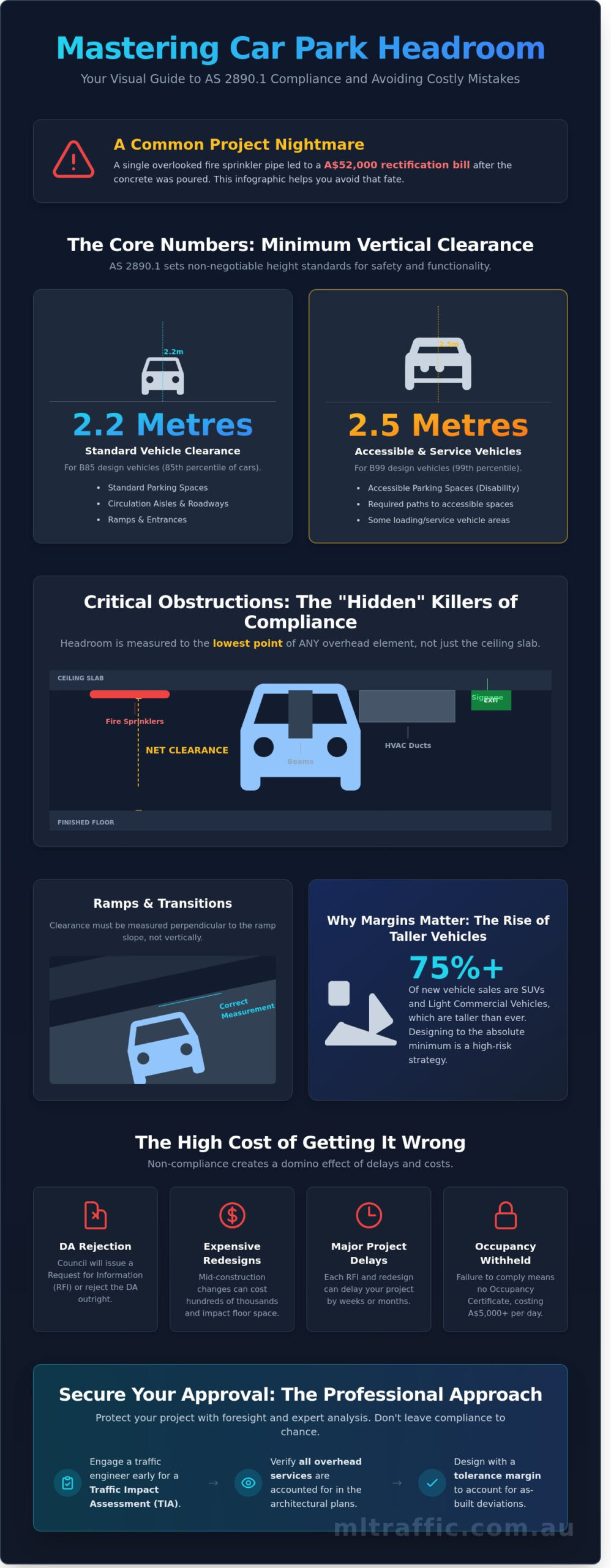
A developer recently faced a A$52,000 rectification bill because a single fire sprinkler pipe infringed on the 2.2-metre clearance zone after the concrete was already poured. It’s a common nightmare that stalls projects and drains budgets. You likely agree that every millimetre of vertical space in a modern car park is high-value real estate. Balancing the need for saleable floor area with the rigid AS 2890.1 headroom requirements is often the difference between a profitable project and a compliance headache. No one wants to lose saleable floor space to excessive margins, but failing to account for overhead services is a recipe for disaster.
This guide provides the technical clarity you need to master these height standards, ensuring your car park design is safe, functional, and ready for council approval. We’ll provide the exact numerical requirements for various vehicle types, explain the critical method for measuring clearance over ramps, and share the professional insights needed to secure a first-time pass on your DA. By the end of this article, you’ll have the data to protect your design from expensive structural changes and technical rejections. Our goal is to ensure your project remains compliant without sacrificing your commercial objectives.
Key Takeaways
-
Learn how to correctly measure vertical distance to prevent vehicle damage and ensure your car park meets safety standards for pedestrian egress.
-
Identify the specific height benchmarks you need, including the 2.2-metre baseline and the 2.5-metre rule for accessible spaces under AS 2890.1 headroom requirements.
-
Avoid costly design errors by identifying "hidden" obstructions like HVAC ducts and fire services that often compromise your net clearance.
-
Master the geometry of ramps and transitions to ensure your design accounts for vertical curves and vehicle clearance at every angle.
-
Find out how a professional Traffic Impact Assessment (TIA) can streamline your council approval process and resolve complex vertical height conflicts.
Table of Contents
-
The Core Numbers: Minimum Height Requirements by Vehicle Type
-
Securing Approval: How Traffic Engineers Solve Headroom Conflicts
Defining AS 2890.1 Headroom: Why "Just Enough" is a Risk
Headroom in a parking facility is the clear vertical distance measured from the finished floor surface to the lowest point of any overhead obstruction. This isn’t limited to the ceiling slab itself. It encompasses fire sprinklers, structural beams, suspended ductwork, cable trays, and even hanging signage. In our experience as traffic engineers, we’ve seen many projects stall because a designer overlooked a single 100mm pipe that breached the minimum clearance zone. Adhering to AS 2890.1 headroom requirements is a fundamental safety and operational necessity that prevents vehicle impact damage and ensures pedestrians have a clear path for egress during emergencies.
In 2026, the margin for error has disappeared. Modern vehicle trends show that Australians are increasingly choosing larger, taller vehicles. Data from the Federal Chamber of Automotive Industries indicates that SUVs and light commercial vehicles now account for over 75% of new car sales. If you design a basement to the absolute minimum 2.2-metre standard without accounting for construction tolerances, you’re inviting a compliance failure. We advocate for a "design for reality" approach. This means distinguishing between the theoretical design height on a blueprint and the actual as-built height. A 20mm deviation in a concrete pour or a slightly misaligned HVAC duct can turn a compliant space into a legal and financial liability.
The Legal Weight of AS 2890.1 in Australia
Local councils across Australia treat AS 2890.1 as a mandatory checklist during the Development Application (DA) process. It’s not a set of friendly suggestions. If your plans show a headroom deficiency, your DA will likely be knocked back or hit with a Request for Further Information (RFI), delaying your project by months. For existing buildings, "grandfathered" heights are a myth when it comes to new modifications. If you’re upgrading a site or changing its use in 2026, you must meet current standards. Non-compliance often leads to the withholding of an Occupancy Certificate, which can cost developers upwards of A$5,000 per day in holding costs and lost revenue. We ensure the car park design principles applied to your site meet every regulatory hurdle before the first brick is laid.
B85 and B99 Design Vehicles: Who are we building for?
The standard uses two primary vehicle templates to determine clearances. The B85 vehicle represents the 85th percentile of cars on Australian roads. For most standard parking areas, the AS 2890.1 headroom requirements are built around this 2.2-metre height. However, the B99 vehicle, representing the 99th percentile, is the benchmark for accessible parking spaces and specific entrance points. These areas typically require a 2.5-metre clearance. Designing for the B85 when the B99 is required is a common mistake that leads to expensive retrofitting. As vehicles grow in size, the 2026 market demands that engineers look beyond the bare minimums to ensure long-term site viability. We don’t just guess; we use precise swept path analysis and height checks to confirm your site works for the vehicles people actually drive.
The traffic consultant who provides your quote should be the one doing the work. This hands-on accountability is why we focus on precision from the start. We’ve assessed over 10,000 sites, and the most common failure point is a lack of foresight regarding vertical clearances. Don’t risk a six-figure redesign during the construction phase. Meticulous planning around vertical obstructions is the only way to guarantee a smooth handover and a safe, functional environment for every driver and pedestrian.
The Core Numbers: Minimum Height Requirements by Vehicle Type
Compliance with Australian Standards isn’t a suggestion; it’s a mandatory requirement for any development application. When we assess AS 2890.1 headroom requirements, we look at the absolute minimum vertical clearance needed for a vehicle to move safely through a facility. This isn’t just about the parking space itself. It includes the entire entrance, the ramps, and the circulation aisles. If a single structural beam or fire sprinkler drops below the limit, the entire path is non-compliant.
The 2.2m rule is the non-negotiable floor-to-ceiling minimum for standard light vehicles. This baseline ensures that typical passenger cars, including many modern SUVs, can enter and exit without structural contact. However, this number changes the moment you introduce specific vehicle classes or accessibility needs. For example, accessible (disabled) parking spaces require a minimum height of 2.5 metres. This extra 300mm allows for the operation of rear-loading ramps and hoists used by modified vans. If your design doesn’t maintain this 2500mm clearance from the site entry all the way to the designated space, the bay is effectively useless and legally non-compliant.
Standard Residential and Commercial Clearances
In most residential apartment basements and commercial office parks, the 2200mm requirement is the standard for general circulation. While some private residential garages might occasionally see a reduction to 2100mm under very specific council relaxations, we always recommend 2200mm to avoid future-proofing issues. Public parking hubs must strictly adhere to these clearances to accommodate the high turnover of diverse vehicle types. Mixed-use developments often face challenges here, as they must balance the lower height needs of residential floors with the higher demands of retail delivery zones.
Service and Delivery Vehicle Overlap
The "loading dock trap" occurs when developers forget where AS 2890.1 ends and AS 2890.2 begins. While light vehicles are fine with 2.2m, Small Requirement Vehicles (SRVs) and Medium Requirement Vehicles (MRVs) often need 3.5 metres or more. We’ve seen projects where the car park entry is 2.2m, but the loading dock is located inside the same basement. If an SRV can’t clear the entrance, your waste collection and delivery strategy will fail. Designing for these overlaps requires a clear understanding of vehicle swept paths and vertical transitions. If you’re unsure about your specific site constraints, our traffic engineering consultants can provide a detailed assessment.
The 2026 Perspective on SUV and EV Clearances
By 2026, the vehicle mix in Australian car parks will look significantly different. While there’s a common myth that Electric Vehicles (EVs) are taller due to battery-pack floors, most maintain standard exterior heights. The real pressure comes from the continued popularity of large SUVs and the addition of aftermarket accessories.
-
Roof Pods: These can add 300mm to 500mm to a vehicle’s height.
-
Bike Racks: Vertical racks on SUVs often exceed the standard 2.2m clearance.
-
EV Infrastructure: Overhead charging cables and cable trays can encroach on headroom if not integrated into the initial structural design.
Modern developers are increasingly opting for 2.3m or 2.4m clearances in "standard" areas to provide a better user experience and reduce the risk of insurance claims from roof strikes.
Critical Obstructions: The "Hidden" Killers of Compliance
Compliance isn’t about the distance between the floor and the concrete ceiling slab. It’s about the clear space between the floor and the absolute lowest point of any fixture. We’ve seen projects fail inspection because a single fire sprinkler head sat 20mm too low. When calculating AS 2890.1 headroom requirements, you’re looking for the net clearance. This includes everything from cable trays to the exit signs hanging above the drive aisle. If it hangs lower than the slab, it becomes the new ceiling height for compliance purposes.
Most Development Application (DA) setbacks happen because the design team treats services as an afterthought. Fire services, HVAC ducting, and electrical conduits aren’t just details; they’re structural constraints. A standard HVAC duct can easily drop 300mm from the slab. If your floor-to-slab height is 2500mm, that duct brings your clearance down to 2200mm instantly. You’ve lost your safety margin before the first car even enters the basement. It’s a common oversight that leads to expensive retrofitting or, worse, a rejected occupation certificate.
Services and Infrastructure Management
You need to coordinate with hydraulic and mechanical engineers during the initial 1:100 design phase. We call the area where pipes cross vehicle travel paths the "zone of conflict." If you don’t manage this early, you’ll end up with a basement that looks like a maze of low-hanging pipes. Smart designers use "nesting" strategies. This involves tucking services into the void between structural beams rather than running them underneath. This simple coordination step can save 200mm of vertical space across the entire floor plate.
Structural Beams and Bulkheads
Deep beams are the primary cause of height failures in modern car parks. A 450mm transfer beam is common in multi-storey residential builds where the apartment layout doesn’t align with the parking grid. These beams effectively lower your ceiling to a point where SUVs or service vehicles can’t pass. You can’t just guess if a vehicle will clear these points. A professional swept path analysis is vital for checking beam clearance. It maps the vehicle’s movement in 3D to ensure the roofline doesn’t clip a bulkhead during a turn or ramp transition.
Don’t forget the final 100mm. Lighting fixtures and wayfinding signage are often the last things installed, and they’re frequently the reason a building surveyor refuses to sign off. A standard LED batten light might only be 80mm deep, but if it’s placed at the lowest point of a ramp, it breaks the AS 2890.1 headroom requirements immediately. We recommend a 150mm "buffer zone" in your initial sections to account for these finishing touches. It’s much cheaper to add a layer of bricks to the basement wall height during design than it is to relocate an entire fire drenching system after the concrete is poured.
-
Fire Services: Sprinkler heads and main pipe runs often drop 150-200mm.
-
Electrical Trays: Cable management for EV chargers is a growing cause of height obstructions.
-
Signage: Exit signs must be positioned outside the vehicle swept path or higher than the minimum clearance.
-
Drainage: P-traps for floor wastes from levels above can protrude into the headroom zone.
Ramps and Transitions: Where Geometry Meets Headroom
Designing a functional car park involves more than measuring flat surfaces. When a vehicle moves from a level floor onto a ramp, its orientation changes. This pitch creates what engineers call the vertical curve problem. If you only measure the height from the floor to the ceiling vertically, you’ll likely fail to meet AS 2890.1 headroom requirements. A vehicle’s "effective height" increases as it tilts, meaning a ceiling height that works on a flat slab won’t necessarily work on a 1:4 grade.
The Australian Standard is specific about how you must measure these clearances. You don’t just measure straight up and down. You must calculate the clearance perpendicular to the ramp surface. On steep grades, the vehicle’s front or rear ends are often higher relative to the ramp than they are on flat ground. If the ceiling doesn’t follow the ramp’s angle exactly, the gap closes quickly. This is why many basement car parks feature scraped overhead pipes or damaged ductwork. Designers often forget that the vehicle doesn’t stay parallel to the floor during the transition.
-
1:4 Grade (25%): The steepest allowable grade for private car parks, requiring significant transition zones.
-
1:5 Grade (20%): A standard ramp grade that still requires careful vertical clearance checks.
-
1:8 Grade (12.5%): Often used for transitions to prevent the vehicle undercarriage from scraping the floor.
Calculating Clearance on Grades
The mathematical reality of a slope is that the vertical distance between the car and the ceiling shrinks as the ramp gets steeper. We visualize this as an "envelope" that follows the vehicle’s path. Long-wheelbase vehicles are at the highest risk here. When a long vehicle like a Toyota HiAce or a large SUV reaches a ramp crest, the front wheels are on the flat while the rear wheels are still on the slope. This "peaks" the vehicle, pushing the highest point of the roof closer to the ceiling than a shorter car would ever reach. You need to account for this pitching motion in every design phase.
Driveway Ramp Grade Compliance
Ensuring compliance means managing the "crest" and the "sag" transitions. A crest is the top of the ramp, while a sag is the bottom where the ramp levels out. If these transitions are too abrupt, the vehicle’s suspension compresses, or the body pitches in a way that strikes overhead obstructions. We use AutoTURN software to model these movements. This tool allows us to simulate the exact vertical path of a B99 vehicle to ensure it won’t hit a structural beam.
Common mistakes in multi-level ramp design usually involve service installations. Plumbers and electricians often run pipes across the "sag" of a ramp because it looks like there’s plenty of room. However, as a vehicle enters that sag, its nose pitches upward. A 100mm pipe installed in the wrong spot can turn a compliant 2.2 metre clearance into a 2.1 metre hazard. Always verify that AS 2890.1 headroom requirements are met at the lowest point of any overhead obstruction, especially within the first 2 metres of a ramp transition.
Don't risk expensive retrofits or non-compliance. [Contact ML Traffic Engineers today](https://www.mltraffic.com.au/) to ensure your ramp designs meet all Australian Standards.
Securing Approval: How Traffic Engineers Solve Headroom Conflicts
The transition from a draft blueprint to a council-approved development depends on technical certification. A traffic engineer doesn’t just review your plans; they certify that the design is functional and compliant with Australian law. When you submit a Development Application (DA), council planners require a Traffic Impact Assessment (TIA) that specifically addresses vertical constraints. This document serves as a legal assurance that vehicles won’t sustain damage from low-hanging beams or services.
At ML Traffic Engineers Pty Ltd, we follow a principal-led approach. This means the senior consultant who provides your initial quote is the same expert performing the technical calculations and signing the certification. We’ve seen projects stall because a junior staff member at a large firm missed a 50mm service pipe clearance. By maintaining direct principal involvement, we eliminate those communication gaps. We take your architectural drawings and transform them into a council-ready certified plan by ensuring strict adherence to AS 2890.1 headroom requirements.
The DA Submission Process
Council planners specifically look for "pinch points" in your parking section drawings. They aren’t satisfied with a general note saying the ceiling is 2.2 metres high. They require detailed cross-sections at the most critical points, such as where a ramp meets a floor slab or where fire sprinklers sit lowest. ML Traffic Engineers Pty Ltd bridges the gap between your architect’s vision and the council’s rigid safety standards. We identify these conflict zones early, providing the exact data points planners need to tick the box for compliance.
-
Detailed ramp grade analysis to prevent "bottoming out" or roof strikes.
-
Identification of "dead zones" where overhead services can be tucked away without impacting clearance.
-
Certification of B85 and B99 vehicle paths to ensure all user groups are accommodated.
-
Direct negotiation with council engineers to justify design variations when site constraints are extreme.
Case Study: Solving a 100mm Deficit
In 2023, a mixed-use development in Western Sydney faced a potential disaster during the post-approval stage. The architectural plans showed a 2.2-metre clearance, but the mechanical ducting for the basement ventilation required an extra 100mm of space, dropping the effective headroom to 2.1 metres. This violated the AS 2890.1 headroom requirements for the required van access. It was a 100mm deficit that threatened to halt the entire construction phase.
We intervened by redesigning the service layout and calculating the precise swept path of the vehicles. By shifting the ducting 1.5 metres to the left, outside the primary travel lane, we maintained the required clearance without needing to excavate deeper into the bedrock. This early intervention saved the client an estimated A$65,000 in additional excavation and structural costs. It’s a clear example of how professional traffic engineering provides a massive return on investment. We don’t just find problems; we provide the geometric solutions that keep your project moving toward a final Occupation Certificate. Our goal is to verify that every ramp and parking bay meets AS 2890.1 headroom requirements before the first brick is laid, preventing the construction nightmares that arise from low ceilings and uncertified designs.
Secure Your DA Approval with Compliant Headroom Design
Achieving full compliance with AS 2890.1 headroom requirements involves more than just measuring from the floor to the ceiling. You’ve got to account for every fire sprinkler, drainage pipe, and structural beam that hangs into the clearance zone. Since 2005, we’ve helped developers avoid the trap of "just enough" height, which often leads to failed inspections and costly redesigns. It’s vital to remember that ramp transitions and vertical curves change the effective clearance for longer vehicles. Getting these geometric details right during the design phase is the only way to protect your investment and avoid building a car park that’s legally unusable.
ML Traffic Engineers offers over 15 years of specialized experience in securing DA approvals across Australia. We take a hands-on approach where the traffic consultant who provides your quote is the same senior expert who performs the assessment. Our team maintains exhaustive knowledge of AS 2890.1, 2890.2, and 2890.6 to identify potential conflicts before they become expensive problems. We’ve assessed over 10,000 sites, so we know exactly what councils look for in a compliant car park layout. Let’s ensure your project meets every technical standard from the very start.
Get a Professional Traffic Assessment for Your Project
Frequently Asked Questions
What is the absolute minimum headroom for a residential car park in Australia?
The absolute minimum headroom for a residential car park under AS 2890.1 is 2.1 metres. This clearance must be maintained at every point above the floor surface to ensure safe vehicle passage. While 2.1 metres is the floor, most developers target 2.2 metres to provide a safety margin for larger vehicles. ML Traffic Engineers has assessed over 10,000 sites where these precise measurements were vital for securing council approval.
Does AS 2890.1 headroom include fire sprinklers and pipes?
Yes, the AS 2890.1 headroom requirements refer to the clear height between the floor and the lowest overhead obstruction. This includes fire sprinklers, drainage pipes, cable trays, and structural beams. If a pipe hangs at 2.0 metres in a 2.2 metre tall room, your effective headroom is 2.0 metres. We often see projects fail building inspections because service contractors ignore these specific vertical clearance limits during the installation phase.
How much extra height is needed for disabled (accessible) parking spaces?
Accessible parking spaces require a minimum headroom of 2.5 metres as specified in AS 2890.6. This extra height allows for the operation of rear-loading or side-loading wheelchair lifts without obstruction. This 2.5 metre requirement applies to the parking space itself and the entire vehicular path of travel to and from the space. Designers must account for this 400mm difference compared to standard bays early in the schematic design phase.
Is headroom measured differently on a steep ramp?
Headroom on a ramp is measured vertically from the floor, but you must account for the vehicle’s wheelbase and overhangs. On a 1 in 4 (25%) grade, the effective clearance changes because the front or rear of a vehicle might be higher or lower than the wheels. AS 2890.1 requires a minimum of 2.1 metres perpendicular to the ramp surface. We use Vehicle Swept Path Assessment software to verify that no part of the car strikes the ceiling.
What happens if my car park doesn’t meet AS 2890.1 height requirements?
Non-compliant car parks face significant legal and financial risks, including the refusal of an Occupation Certificate (OC) by a private certifier. If a vehicle sustains damage in a low-clearance area that doesn’t meet the 2.1 metre standard, the building owner is typically liable for repairs. Rectifying a finished basement can cost over A$50,000 in structural modifications or service relocations. It’s much cheaper to get the traffic engineering right during the DA stage.
Can I get a council waiver for a low-clearance basement?
You can’t get a simple waiver for low clearance, but you might apply for a Performance Solution through a registered engineer. This process requires proving that a 2.05 metre height doesn’t compromise safety for the specific vehicles using the site. Councils in Sydney and Melbourne rarely approve these unless the site has extreme heritage or structural constraints. Most 2024 development applications are rejected if they don’t strictly adhere to the 2.2 metre height standard.
How does AS 2890.1 differ from AS 2890.6 regarding height?
AS 2890.1 covers general off-street car parking with a 2.1 to 2.2 metre clearance, while AS 2890.6 specifically governs accessible parking with a 2.5 metre requirement. The 2890.6 standard is more stringent because it accommodates high-roof conversion vans used by people with disabilities. Mixing these up is a common error. Our consultants ensure your plans differentiate between these two standards to avoid a costly 400mm height deficit in your basement design.
Why is 2.2 metres the standard height for car parks?
The 2.2 metre standard exists to safely accommodate 99% of the Australian passenger vehicle fleet, including large 4WDs with roof racks. While the absolute minimum is often 2.1 metres, the 2.2 metre benchmark provides a safety buffer for bouncing suspension or uneven floor finishes. Since 2005, we’ve found that 2.2 metres is the sweet spot that balances excavation costs with functional vehicle access for modern SUVs and light commercial vans.
Which areas do you cover?
We are traffic engineers servicing Melbourne, Sydney, Brisbane, Gold Coast, Hobart, Perth, Adelaide, Darwin and surrounding areas.
