

A Development Application rejection due to a non-compliant loading dock or inadequate service vehicle access can result in costly project delays and redesigns. For developers and architects, navigating the specific requirements for heavy rigid vehicles, semi-trailers, and waste collection trucks is critical. The distinction between general car parking (AS 2890.1) and facilities for commercial vehicles is where many designs fail, often due to a misapplication of Australian Standard AS2890.2.
This guide provides a professional, plain-English breakdown of AS 2890.2. We will detail the essential requirements for designing compliant loading docks, circulation roadways, and service bays. You will gain a clear understanding of the necessary dimensions, swept paths, and clearance heights to ensure your facility is both safe and functional. Our objective is to equip you with the technical knowledge to avoid common design flaws, secure a smooth DA approval, and deliver a successful project.
Key Takeaways
- Selecting the correct ‘design vehicle’ at the project’s outset is the most critical decision, as it dictates all subsequent dimensions for access, circulation, and loading areas.
- Understanding the specific requirements for driveway grades, widths, and vertical clearances is essential for preventing common design flaws that lead to council rejection.
- A compliant loading dock design under AS2890.2 requires careful planning of the bay, the vehicle apron, and the access driveway to function as an integrated system.
- Proactively addressing common errors like inadequate swept paths or non-compliant sight lines is fundamental to achieving a smooth and efficient Development Application (DA) approval.
What is AS 2890.2 and Why is it Critical for Your DA?
Australian Standard AS 2890.2:2002, Off-street parking – Commercial vehicle facilities, is the definitive technical document governing the design of parking and access for heavy and commercial vehicles. This standard, informed by the foundational Austroads guidelines, provides the precise geometric specifications required for loading docks, service bays, and circulation roadways. For any developer or architect, understanding and correctly applying AS2890.2 is not optional-it is a fundamental requirement for securing a Development Application (DA) approval from local councils.
The primary goal of the standard is to ensure that commercial vehicles can access and manoeuvre within a site safely and efficiently. This involves detailed criteria for everything from ramp grades and vertical clearances to the turning radii required for a semi-trailer to navigate a corner. Proper implementation prevents operational bottlenecks and hazardous interactions between large trucks, light vehicles, and pedestrians.
Compliance is mandatory for a wide range of developments. Any project that relies on regular service or delivery from commercial vehicles must demonstrate adherence. Typical projects include:
- Warehouses and distribution centres
- Industrial parks and manufacturing facilities
- Large-format retail centres and supermarkets
- Hospitals and institutional buildings with service docks
- High-density residential buildings with dedicated loading bays
AS 2890.2 vs. AS 2890.1: Understanding the Key Differences
While often referenced together, these two standards serve distinct purposes. AS 2890.1 deals exclusively with off-street parking for cars and other light vehicles. In contrast, AS 2890.2 focuses on the unique and far more demanding spatial requirements of commercial vehicles, from small rigid trucks to 19-metre semi-trailers. Many large-scale industrial or mixed-use developments must demonstrate compliance with both standards to satisfy council requirements for all vehicle types.
The Purpose of the Standard: Safety, Efficiency, and Compliance
The standard is not simply a set of rules; it is a framework built on three critical objectives:
- Safety: By dictating appropriate sight lines, clearances, and swept path allowances, the standard minimises the risk of collisions between heavy vehicles, cars, and pedestrians on-site.
- Efficiency: A correctly designed facility allows service vehicles to enter, load or unload, and exit without causing disruption to other site operations or public road traffic. This prevents queuing and operational delays.
- Compliance: For councils, adherence to AS 2890.2 is the primary benchmark for assessing the traffic and access component of a DA. Failure to meet these requirements is a common reason for DA rejection, leading to costly redesigns and significant project delays.
Key Design Vehicles: Selecting the Right Vehicle for Your Site
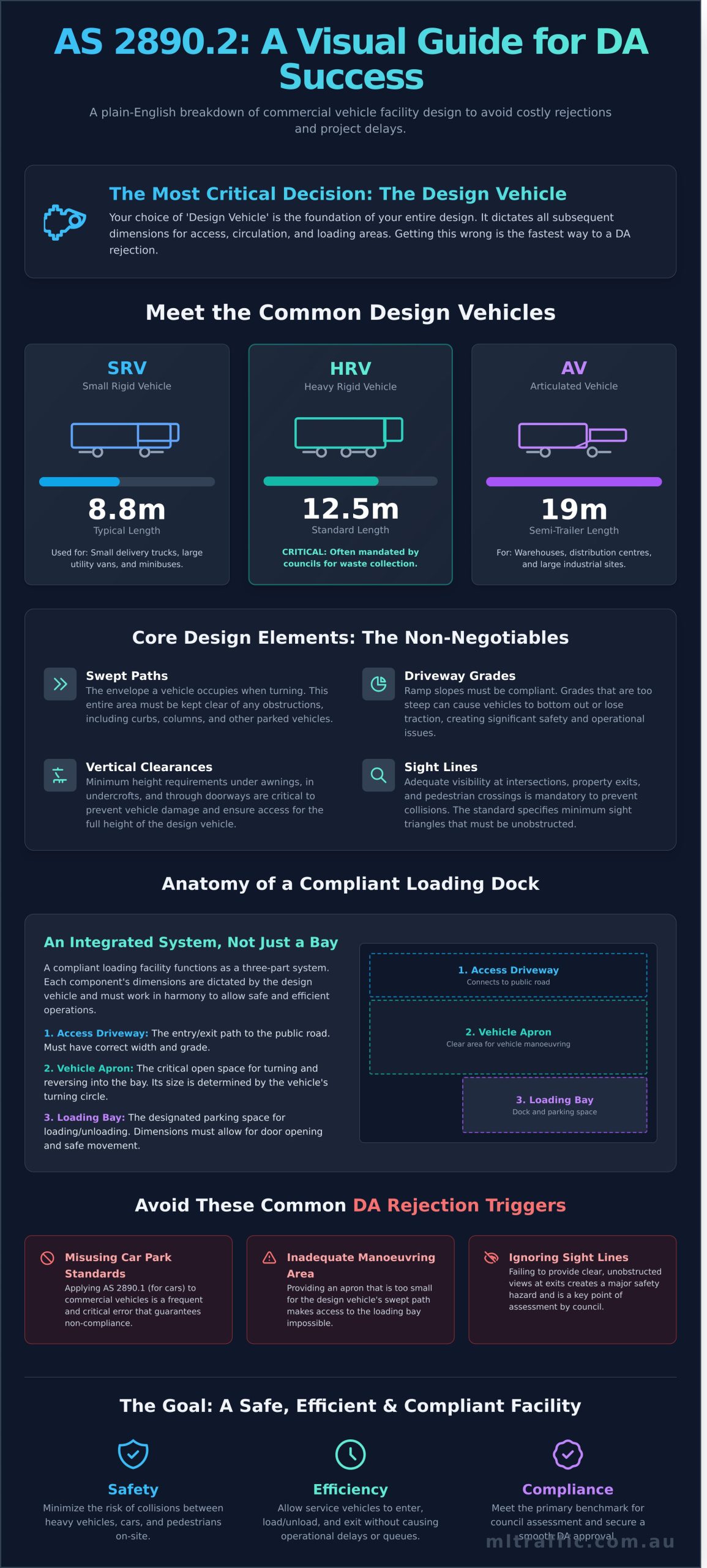
In commercial parking facility design, every critical dimension is derived from a single, fundamental choice: the ‘design vehicle’. This selection dictates everything from circulation roadway widths and ramp grades to vertical clearances and vehicle swept paths. The entire framework for these calculations is detailed in Australian Standard AS2890.2, a document maintained and published by Standards Australia. Selecting an inappropriate vehicle at the outset can render a site inefficient, non-compliant, or entirely non-functional for its intended purpose.
Common Design Vehicle Classes
The standard outlines several vehicle classes to model the different types of vehicles that service commercial and industrial sites. Understanding these classes is essential for matching the design to the site’s operational needs. The most common classes include:
- Small Rigid Vehicle (SRV): This class represents vehicles such as small delivery trucks, large utility vans, and minibuses, typically up to 8.8m in length.
- Heavy Rigid Vehicle (HRV): This covers larger, single-body trucks like council garbage trucks, concrete agitators, and removalist vehicles, with a standard length of 12.5m. Many local councils mandate that developments must accommodate an HRV for waste collection.
- Articulated Vehicle (AV): This class includes prime movers with trailers, such as semi-trailers and B-doubles. The 19m semi-trailer is a common design vehicle for warehouses, distribution centres, and large-scale industrial facilities.
The basic dimensions for these common design vehicles are summarised below:
| Vehicle Class | Example | Overall Length (m) | Minimum Turning Radius (m) |
|---|---|---|---|
| SRV | Delivery Van / Minibus | 8.8 | 10.0 |
| HRV | Garbage / Removalist Truck | 12.5 | 13.0 |
| AV (19m) | Semi-Trailer | 19.0 | 13.0 |
How to Choose the Correct Design Vehicle
Selecting the correct design vehicle is a critical strategic decision that must be made at the very start of a project. This choice should be based on a realistic assessment of the site’s long-term operational requirements.
- Analyse the End-Use: The primary function of the development dictates vehicle choice. A logistics warehouse requires design for AVs, while a fast-food outlet may only need to accommodate SRVs.
- Consult with Tenants: Where possible, consult with future or likely tenants to confirm the specific vehicles used in their delivery and operational fleets.
- Future-Proof the Design: When in doubt, it is prudent to design for the largest vehicle that could conceivably service the site. Retrofitting a facility to accommodate larger vehicles is often prohibitively expensive or impossible.
This initial decision has significant and lasting consequences on a project’s viability. Engaging a qualified traffic engineer is essential to perform a thorough assessment and nominate the appropriate AS2890.2 design vehicle for your development, ensuring both compliance and long-term functionality.
Core Design Elements: Access Driveways and Circulation
Effective commercial parking design hinges on the ability of vehicles to enter, circulate, and exit a site safely and efficiently. This section details the fundamental requirements for access driveways and internal roadways, focusing on the most common areas of non-compliance: widths, gradients, and clearances. It is critical to understand that the dimensions specified in the Australian Standard are minimums; site-specific conditions often necessitate more generous provisions. Ultimately, a compliant design must be proven, and a professional Swept Path Analysis is the definitive method for demonstrating that the intended vehicles can manoeuvre successfully.
Access Driveway Widths and Gradients
The width of an access driveway is dictated by the expected traffic volume and direction. While requirements can vary, AS2890.2 generally stipulates minimum widths for one-way and two-way vehicle movements to prevent conflicts. Gradients are equally critical; ramps must not exceed maximum permissible grades (typically 1 in 4 or 25%), and must incorporate properly designed transitions at the top and bottom to prevent vehicles from scraping. Furthermore, adequate sight lines for drivers entering or exiting the property are a non-negotiable safety requirement to ensure clear visibility of pedestrians and other traffic.
Circulation Roadways and Vertical Clearances
Once inside the site, internal circulation roadways must allow for safe passage. This includes sufficient width for vehicles to pass each other where two-way movement is expected, or the provision of designated passing bays. A critical and often overlooked element is vertical clearance. For facilities accommodating heavy rigid vehicles, AS2890.2 mandates an absolute minimum vertical clearance, which is typically 4.5 metres. Designers must account for all potential overhead obstructions, including:
- Fire sprinkler systems and pipes
- Ventilation ducts
- Low-hanging signage
- Roller doors and structural beams
Failure to maintain this clearance throughout the vehicle’s entire path can lead to costly damage and operational failure.
Verifying Design with Swept Path Diagrams
Theoretical compliance on a drawing is not enough. A swept path diagram is a technical analysis that models the turning path of a specific design vehicle, showing the envelope it occupies while manoeuvring. These diagrams provide indisputable proof that a truck or other large vehicle can successfully navigate tight corners, loading docks, and parking aisles without colliding with kerbs, columns, or other vehicles. Most local councils now mandate swept path diagrams as a standard component of Development Applications (DAs) to verify design functionality. Engaging professional consultants for these assessments ensures accuracy and council approval. Contact us for expert services in swept path analysis.
Designing Compliant Loading Docks and Service Bays
An efficient and safe loading dock is fundamental to the operational success of any commercial or industrial development. Inadequate design is a primary cause of logistical bottlenecks, property damage, and safety incidents. The Australian Standard AS2890.2 provides specific, detailed requirements for these areas, focusing on three core components: the loading bay itself, the manoeuvring apron, and the vehicle access ways. A critical principle is the strict segregation of commercial vehicle traffic from public and staff parking areas to prevent conflict.
Loading Bay Types and Dimensions
The physical design of the loading bay must accommodate the largest vehicle expected to service the site, known as the design vehicle. The standard outlines several configurations, with the most common being flush docks (integrated into the building) and sawtooth docks (angled to reduce apron space requirements). Key dimensional requirements include:
- Bay Width: A minimum width of 3.5 metres is generally required, often increased to 4.0 metres for larger vehicles to allow for door opening and operational clearance.
- Bay Length: Must be sufficient to contain the entire length of the design vehicle, from a Small Rigid Vehicle (SRV) to a 19-metre semi-trailer.
Protective elements such as concrete wheel stops and steel bollards are mandatory to prevent accidental impact with the building structure during reversing manoeuvres.
The Apron Space: Critical for Manoeuvring
The apron is the clear, unobstructed space directly in front of the loading bay. Its sole function is to provide sufficient room for a truck to approach and reverse into the bay in a single, efficient manoeuvre. The required depth of the apron is directly dependent on the length of the design vehicle and the width of the access driveway. A 19-metre semi-trailer will require a substantially larger apron than a 12.5-metre Heavy Rigid Vehicle (HRV). A professional swept path assessment is essential to verify that the proposed apron space is compliant and functional.
Safety and Pedestrian Management
Managing the interaction between heavy vehicles and people is a non-negotiable safety priority. The design must provide clear and unambiguous separation between truck routes and any pedestrian paths. This is often achieved through physical barriers, dedicated raised footpaths, and clear line-marking for exclusion zones. Furthermore, a compliant design must include:
- Clear Signage: Directional signs, warnings for turning trucks, and speed limits must be installed.
- Adequate Lighting: Illumination must be sufficient for safe 24-hour operations, eliminating shadows around the dock and apron.
Ensuring these elements meet the stringent requirements of AS2890.2 is a core component of any development application. For expert assessment and compliant design solutions, contact the professionals at ML Traffic Engineers Pty Ltd.
Avoiding Common Mistakes and Ensuring Council Approval
A development application (DA) can be delayed for months due to avoidable design errors. Non-compliance with Australian Standards is a primary reason for council rejection, leading to expensive redesigns and significant project setbacks. Before submitting your plans, it is critical to verify that every element of your commercial vehicle facility is compliant and functional.
Use the following points as a final checklist to identify common design flaws that frequently cause DA issues. The cost of early, expert advice is minimal compared to the cost of redesign and project delays.
Top 5 Design Flaws to Avoid
Failure to adhere to the strict geometric requirements of AS2890.2 is the most common source of problems. Scrutinise your design against these five critical failure points:
- Insufficient Vertical or Horizontal Clearance: Failing to provide the required clearances for the specified design vehicle at entry points, on ramps, or within service bays and parking modules.
- Unworkable Turning Paths: Designs where the design vehicle cannot physically navigate aisles, ramps, or loading areas. This is often discovered late in the process through a swept path analysis.
- Non-compliant Ramp Grades or Transitions: Exceeding maximum gradients (e.g., 1:4) or providing inadequate transitions between grades, which causes large vehicles to “bottom out” or scrape.
- Inadequate Apron Space at Loading Docks: Not providing enough room for a heavy vehicle to safely approach and depart the dock, often forcing dangerous or multi-point manoeuvres.
- Poor Sight Lines at Access Points: Overlooking the requirement for clear sight lines for pedestrians and vehicles at the property boundary, creating a major safety hazard and a clear point of council objection.
The Role of a Traffic Engineering Consultant
Engaging a qualified traffic engineering consultant is the most effective way to mitigate these risks. A specialist provides the formal compliance certificates and reports that planning authorities require. We use industry-standard software to conduct detailed swept path analyses and grade assessments, verifying every aspect of your design against council and Australian Standards. This process demonstrates professional due diligence and strengthens your DA submission. Learn more about our experienced team and our rigorous approach to compliance.
Get Expert Certification for Your Project
A finding of non-compliance can halt your project indefinitely. ML Traffic Engineers provides detailed reports and certifications for AS 2890.2, ensuring your design is functional, safe, and ready for council assessment. We identify and resolve potential issues before they become costly problems. Ensure your project moves forward without traffic-related delays.
Contact us today for a quote on a comprehensive review and certification of your project plans.
Secure Your Development Approval with Expert AS 2890.2 Guidance
Mastering the technical requirements of Australian Standard 2890.2 is fundamental to the success of any commercial development. As we’ve detailed, correctly selecting the design vehicle, engineering compliant access driveways, and designing functional service bays are not just best practices-they are essential for gaining council approval and ensuring long-term operational viability. An error in applying the principles of AS2890.2 can result in significant delays and costly post-construction modifications.
Don’t leave your Development Application to chance. The professional team at ML Traffic Engineers provides the specialised expertise required to navigate these complex standards. With over 15 years of proven experience in DA approvals and a dedicated focus on AS 2890.2 compliance certification, we ensure your project is planned correctly from day one. Every client benefits from our commitment to direct access to senior traffic engineers, guaranteeing your plans receive the meticulous, expert review they require to move forward with confidence.
Ensure Your Design is Compliant. Contact ML Traffic Engineers for an Expert Assessment.
Frequently Asked Questions About AS 2890.2
What is the current version of Australian Standard 2890.2?
The current and active version is AS 2890.2:2018, titled “Parking facilities, Part 2: Off-street commercial vehicle facilities.” This version was published in 2018 and supersedes the previous AS 2890.2-2002 edition. It is essential for developers, architects, and engineers to reference the 2018 version to ensure all new commercial developments are compliant with the latest geometric design requirements for service vehicles, loading docks, and associated accessways across Australia.
Does AS 2890.2 apply to waste collection vehicles?
Yes, AS 2890.2 provides specific design templates and geometric requirements for waste collection vehicles, typically categorised under Heavy Rigid Vehicles (HRV). The standard outlines the minimum widths, heights, and swept paths needed to ensure these vehicles can safely access and service a site. However, it is critical to also consult the local council’s specific requirements, as they may mandate a larger or different design vehicle for waste collection in their jurisdiction.
Do I need a separate Swept Path Analysis report to prove AS 2890.2 compliance?
Yes, a formal Swept Path Analysis report is almost always required by local councils to demonstrate compliance. While architectural plans may show dimensions that meet the standard, the analysis provides definitive proof that the specified design vehicle can manoeuvre safely through the site. This assessment, conducted using specialised software, is a critical component of a Traffic Impact Assessment and is necessary to secure development approval for projects with commercial vehicle access.
Can our project architect self-certify compliance with AS 2890.2?
While an architect designs the layout, certifying compliance with Australian Standards for traffic and parking requires specialist expertise. Councils typically mandate that Swept Path Analyses and Traffic Impact Assessments be prepared and certified by a qualified and experienced traffic engineering consultant. Attempting to self-certify without the requisite qualifications and experience is not recommended and will likely lead to requests for further information or rejection of the development application by the assessing authority.
How does AS 2890.2 relate to other standards like AS 2890.6 for off-street parking for people with disabilities?
These standards are complementary and govern different aspects of a car park design. The AS2890.2 standard specifically details the requirements for commercial and service vehicles, such as delivery trucks and waste collection vehicles. In contrast, AS 2890.6:2022 focuses exclusively on the design and layout of parking spaces for people with disabilities. A comprehensive commercial or mixed-use development must correctly apply the requirements of both standards to ensure full compliance.
Where can I purchase the official AS 2890.2:2018 document?
The official AS 2890.2:2018 document is a copyrighted publication and must be purchased from an authorised distributor. The primary source in Australia is the Standards Australia Webstore, which is operated by their distribution partner, Techstreet. The document can be purchased as a PDF download or in hardcopy format. It is not legally available for free, and using the correct, official version is essential for ensuring accurate and compliant design work.
