
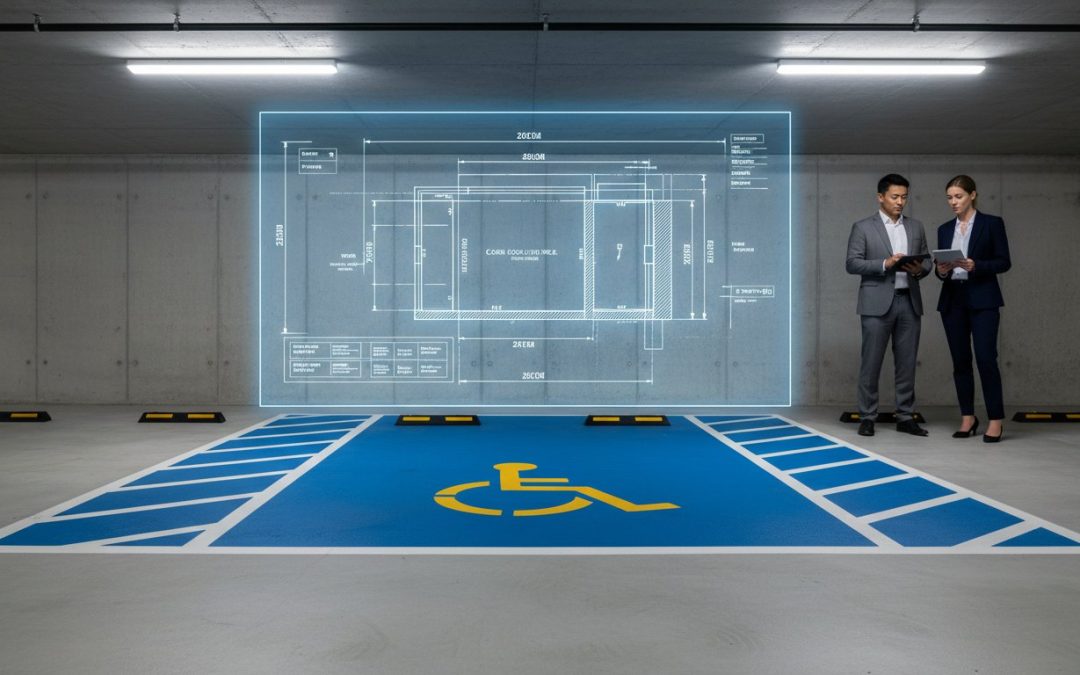
A non-compliant accessible parking bay can halt a development application in its tracks, leading to costly redesigns and significant project delays. For developers, architects, and project managers, the key to avoiding these issues lies in the precise application of Australian Standard as2890.6. Misinterpreting the specific requirements for dimensions, clearances, and gradients is a common cause of DA rejection, creating a risk that can compromise project timelines and budgets. Navigating the dense technical language of the standard is a critical, yet often challenging, step toward achieving full compliance.
This guide provides a direct, professional breakdown of the essential components of AS 2890.6 (2022). We translate the complexities into clear, actionable information, focusing on the critical details you need to design accessible parking correctly the first time. By understanding these requirements, you can eliminate uncertainty, avoid costly rework, and feel confident submitting development plans to council. Our objective is to ensure your project’s accessible parking is fully compliant from the outset, safeguarding your DA from unnecessary delays.
What is AS 2890.6 and Why is it Critical for Your Development?
AS 2890.6 is the Australian Standard that provides the definitive requirements for the design and layout of off-street parking facilities for people with disabilities. Its primary purpose is to ensure that parking areas provide equitable, safe, and dignified access for all individuals, including those who use mobility aids. For any development project in Australia, understanding and correctly applying these requirements is not just best practice—it is a mandatory step for gaining council approval. This guide focuses on the latest version, AS 2890.6:2022, to ensure your project meets current compliance benchmarks.
To better understand the practical application of these standards, the following video provides a helpful overview:
The Scope of the Standard
The standard’s requirements extend to all off-street parking areas and are a critical reference for professionals involved in the planning and construction phases. Its application is essential across a wide range of developments, including:
- Commercial and office buildings
- Retail centres and shopping complexes
- Multi-unit residential apartments
- Hospitals and medical facilities
- Public venues and community centres
Architects, developers, builders, and private certifiers must all demonstrate adherence to AS 2890.6 to ensure a project proceeds without issue.
Why Compliance Isn’t Optional
Compliance with as2890.6 is not a discretionary guideline; it is a legal and regulatory necessity. The National Construction Code (NCC) references this standard as a ‘Deemed-to-Satisfy’ solution for providing accessible car parking spaces. Failure to adhere to these specifications will result in Development Application (DA) rejections or costly Requests for Information (RFIs) from council, leading to significant project delays.
Furthermore, these standards are a practical application of the legal obligations set out in the Disability Discrimination Act (DDA) 1992, which mandates non-discriminatory access to premises. The provisions in the standard align with the operational framework of schemes like the Australian Disability Parking Scheme, ensuring that the built environment is consistent with national accessibility objectives.
Key Design & Dimensional Requirements of AS 2890.6:2022
For designers and traffic engineers, achieving compliance is a matter of precision. The dimensional requirements outlined in the Australian Standard AS 2890.6:2022 are not guidelines; they are mandatory minimums for accessible car parking spaces. This section serves as a core technical checklist to ensure every element of your design meets these non-negotiable criteria, forming the foundation of a compliant and functional parking facility.
Adherence to these specific dimensions ensures that parking facilities provide safe, equitable access for people with disabilities, including sufficient space for vehicle access and manoeuvring.
Parking Space Dimensions
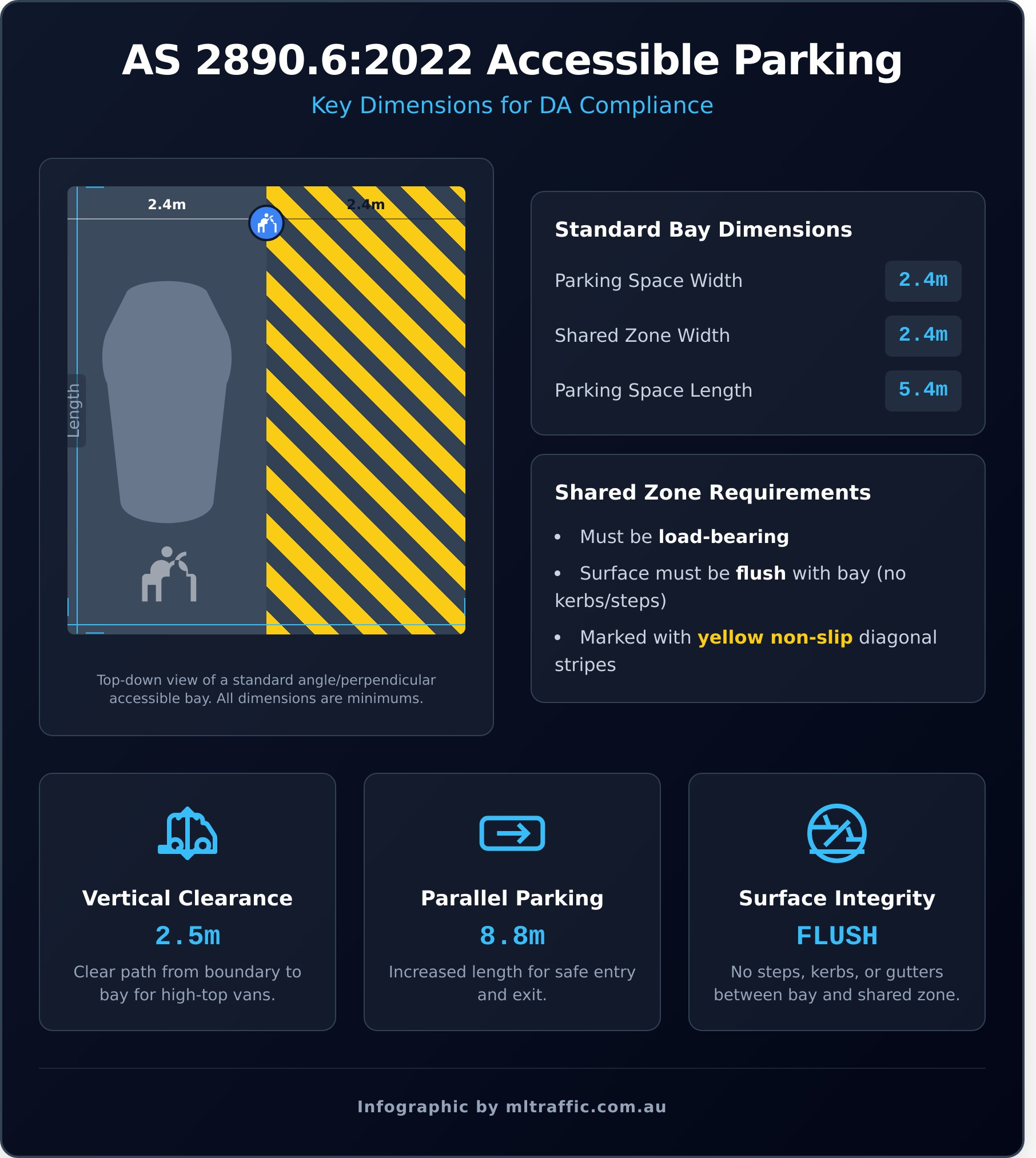
The standard car parking space for people with disabilities must be designed to accommodate a range of vehicles and user needs. The critical minimum dimensions are:
- Width: A minimum of 2.4 metres.
- Length: A minimum of 5.4 metres.
For parallel parking spaces, the required length increases significantly to 8.8 metres to allow for safe entry and exit. While angle parking (e.g., 90, 60, or 45 degrees) uses the standard 2.4m x 5.4m space, it requires an adjacent shared zone, which is a critical component of the overall design stipulated by as2890.6.
The Shared Zone: A Critical Component
The shared zone is an essential, load-bearing area adjacent to the parking space that allows a person to safely get in and out of their vehicle with mobility aids. It must be marked with diagonal yellow non-slip paint. Key requirements include:
- Width: A minimum of 2.4 metres.
- Length: A minimum of 5.4 metres, matching the length of the parking space it serves.
- Surface: The surface must be flush with the parking bay, with no steps, kerbs, or gutters.
Headroom and Vertical Clearances
A compliant design must provide adequate vertical clearance along the entire path of travel, from the property boundary to the parking space itself. The minimum required headroom is 2.5 metres. Designers must be vigilant in identifying potential overhead obstructions such as low-hanging pipes, ventilation ducts, fire sprinkler systems, or signage that could impede high-top conversion vans.
| Element | Minimum Dimension | Notes |
|---|---|---|
| Standard Parking Space Width | 2.4 metres | Excludes the shared zone. |
| Standard Parking Space Length | 5.4 metres | Applies to angle and perpendicular bays. |
| Parallel Parking Space Length | 8.8 metres | Increased length for parallel manoeuvring. |
| Shared Zone (Width & Length) | 2.4m x 5.4m | Must be adjacent to the parking space and flush. |
| Vertical Clearance / Headroom | 2.5 metres | Clear of all obstructions along the access path. |
Essential Requirements Beyond Dimensions: Signage, Markings & Bollards
Achieving compliance with as2890.6 extends beyond the geometric measurements of the bay itself. The correct application of signage, pavement markings, and protective bollards is equally critical for a compliant outcome. These visual and physical identifiers work in unison to ensure the space is unambiguously reserved, protected from misuse, and safe for all users. Overlooking these details is a frequent source of non-compliance in development applications, yet they are often the simplest issues to rectify when properly specified.
Pavement Markings and Surface
The surface and its markings provide the foundational visual guidance for an accessible bay. Getting these details right is a straightforward but essential step. Key requirements include:
- Line Markings: The perimeter of the parking space and the adjacent shared zone must be defined by a continuous, unbroken yellow line of non-slip, durable material.
- Shared Zone Hatching: The dedicated shared zone must be clearly marked with yellow diagonal hatching, striped at a 45-degree angle, to indicate it is not a parking or stopping area.
- Surface Integrity: The entire surface must be firm, level, and possess slip-resistant properties. Critically, the gradient must not exceed 1:40 (a 2.5% slope) in any direction to ensure stability for wheelchairs and people with mobility aids.
Mandatory Signage Specifications
Clear and correctly placed signage is non-negotiable for identifying and enforcing the use of accessible parking spaces. The standard mandates a sign featuring the white on blue International Symbol of Access. This sign must be positioned at the head of the parking bay, either on a wall or a dedicated post, where it is clearly visible to approaching drivers. The precise height requirements and symbol dimensions are detailed within the official AS 2890.6:2022 documentation. Supplementary text, such as ‘Permit Holders Only’, is also required to clarify usage restrictions and support enforcement.
Bollard Placement and Purpose
Bollards serve a crucial protective function, preventing other vehicles from obstructing the shared zone. This area is essential for users who need side-access for wheelchair lifts or other mobility devices. The as2890.6 standard specifies that a single bollard must be installed centrally at the head of the shared zone. This bollard must be blue and have a minimum height of 1300mm to ensure it is visible to drivers of all vehicle types, including large SUVs and vans. Its correct placement provides a robust physical barrier against accidental or deliberate encroachment.
Common AS 2890.6 Compliance Mistakes and How to Avoid Them
As experienced traffic engineering consultants, we review countless development plans and consistently identify the same critical errors. These mistakes can lead to costly council rejections, construction delays, and the need for expensive rectification works. By understanding these common pitfalls, you can ensure your design for accessible parking is compliant from the outset.
Below are the three most frequent compliance issues we encounter and our professional advice on how to avoid them.
Mistake 1: Incorrect Location and Path of Travel
An accessible parking space is ineffective if it cannot be easily and safely reached. The Australian Standard requires that these spaces be located as close as possible to the nearest accessible building entrance or lift lobby. A common design flaw is failing to provide a continuous, accessible path of travel from the parking space to the destination. This path must be free of all obstructions, including:
- Kerbs or steps
- Bollards or wheel stops that impede wheelchair movement
- Garden beds or other landscaping features
Expert Tip: Always map the complete user journey from the car door to the building entrance on your plans to verify a compliant, barrier-free route.
Mistake 2: Insufficient or Obstructed Vertical Clearance
The standard mandates a minimum vertical clearance of 2.5 metres for accessible parking spaces and their adjacent access ways. This height requirement must also be maintained along the entire vehicular route to and from the space. We often see designs that fail to account for low-hanging services, such as fire sprinkler heads, HVAC ducting, pipework, or the garage door mechanism in its open position. A space is non-compliant if a high-top conversion van cannot safely access and use it.
Expert Tip: Verify the 2.5m clearance along the entire path of vehicle travel, not just the static parking bay. Coordinate with mechanical and fire service engineers early in the design process.
Mistake 3: Non-Compliant Gradients and Surfaces
This is one of the most stringent and frequently overlooked requirements of as2890.6. The surface of the parking space and any adjacent shared area must be firm, stable, and have a maximum gradient of 1:40 (or 2.5%) in any direction. Even a minor slope intended for surface drainage can easily exceed this limit, rendering the space non-compliant and unsafe for users. Additionally, the surface material itself is critical; loose materials like gravel, grass, or unstabilised pavers are unacceptable.
Expert Tip: Specify the 1:40 maximum gradient directly on your civil and structural drawings. A small oversight here can lead to major compliance failure. Ensure your design is compliant. Get an expert review.
Integrating AS 2890.6 with Other Key Building Codes
Achieving compliance in driveway and car park design requires more than focusing on a single standard. Australian Standard AS 2890.6 is a critical component, but it operates within a broader framework of building codes and accessibility legislation. At ML Traffic, our professional consultants provide a comprehensive assessment that considers the full regulatory landscape, ensuring your development application is robust and free from compliance gaps.
Understanding how these documents interact is essential for architects, developers, and builders. A failure to see the complete picture can lead to costly redesigns and project delays. The following sections clarify the relationship between AS 2890.6 and other key Australian regulations.
Relationship with AS 2890.1 (General Parking Facilities)
While AS 2890.6 provides detailed specifications for accessible parking spaces, it is designed to be used in conjunction with AS 2890.1, which covers the design of general off-street parking facilities. Think of it as a hierarchy:
- AS 2890.1 sets the baseline requirements for all parking, including layouts, dimensions for standard spaces, and general ramp grades.
- AS 2890.6 provides specific, and often overriding, requirements for parking spaces designated for people with disabilities, including stricter ramp grades and dimensions.
For a car park to be fully compliant, both standards must be consulted. The specific requirements for accessible paths of travel and parking spaces in as2890.6 take precedence over the general clauses in AS 2890.1 where they apply.
The National Construction Code (NCC) and Premises Standards
The National Construction Code (NCC) is Australia’s primary set of technical design and construction provisions. The NCC directly references and mandates compliance with Australian Standards, including AS 2890.6, as a “Deemed-to-Satisfy” solution for providing required accessible car parking.
Furthermore, this requirement is legally reinforced by the Disability (Access to Premises – Buildings) Standards 2010 (Premises Standards). These standards aim to provide equitable and dignified access to buildings for people with disabilities. By designing driveway ramps and accessible parking in accordance with AS 2890.6, you are directly addressing your legal obligations under the Premises Standards and the broader Disability Discrimination Act 1992 (DDA).
Navigating these interconnected standards requires specialist expertise. To ensure your project satisfies every technical and legislative requirement, contact the experienced consultants at ML Traffic.
Secure Your Development’s Approval with Expert AS 2890.6 Compliance
Compliance with Australian Standard 2890.6 is a critical, non-negotiable component for any modern development in Australia. As this guide has detailed, achieving full compliance extends far beyond basic bay dimensions. It demands a meticulous approach to shared zones, gradients, signage, and line marking to ensure genuine accessibility. Overlooking these critical details is a common pitfall that leads directly to council rejections, expensive rework, and significant project delays.
Protect your investment and timeline by engaging a seasoned expert. ML Traffic Engineers brings over 15 years of specialised experience in traffic engineering, with a deep understanding of all Australian Standards for parking and access. Our proven track record in securing Development Application approvals for clients is built on precise, compliant designs that navigate the complexities of as2890.6 and other building codes. Avoid costly delays. Contact us for a professional AS 2890.6 compliance assessment.
Partner with us to ensure your accessible parking design is correct from the outset, securing a smooth path to approval for your compliant and inclusive project.
Frequently Asked Questions
How many accessible parking spaces do I need to provide for my development?
The required number of accessible parking spaces is determined by the National Construction Code (NCC), formerly the Building Code of Australia (BCA), not by AS 2890.6 itself. The provision rate is calculated based on the total number of car spaces and the building’s classification (e.g., retail, residential, commercial). For precise requirements, a detailed assessment against the NCC is necessary, as the ratio varies significantly between different types of land use and development scales.
Does AS 2890.6 apply to existing buildings or only new constructions?
Australian Standard AS 2890.6 primarily applies to new constructions and significant redevelopments where a Development Application is required. However, it can be triggered for existing buildings during major alterations, additions, or a change of use. Local councils may also mandate upgrades to meet current standards as a condition of consent for any works, ensuring that accessibility is improved wherever feasible. It is not typically applied retrospectively without a development trigger.
What is the difference in requirements for outdoor vs. indoor accessible parking bays?
The primary difference relates to vertical clearance. Indoor and undercover accessible parking bays require a minimum vertical clearance of 2500mm from the car park entrance to the bay itself. This accommodates vehicles often fitted with rooftop equipment or wheelchair hoists. Outdoor bays do not have this specific overhead height requirement but must still comply with all other dimensional, shared zone, gradient, and signage specifications outlined in the standard to ensure full accessibility and compliance.
Can a single shared zone be used between two accessible parking spaces?
Yes, a single shared zone can be used between two adjacent accessible parking spaces. This is an efficient and compliant design configuration. The shared zone must have a minimum width of 2400mm and be clearly marked with diagonal yellow stripes to delineate it as a non-parking, transitional area. This design allows occupants of either vehicle to safely deploy ramps or manoeuvre wheelchairs, optimising the use of space while maintaining full accessibility.
Are the requirements for accessible parking the same in every state and territory in Australia?
While Australian Standards like AS 2890.6 establish a national benchmark for design, specific requirements can vary. State and local government planning policies, such as a council’s Development Control Plan (DCP), may impose additional or more stringent conditions. Therefore, achieving compliance requires a thorough assessment of both the overarching Australian Standards and the specific planning instruments applicable to the development’s location. A professional traffic consultant can navigate these multi-layered regulatory requirements.
What happens if my design doesn’t comply with AS 2890.6?
Non-compliance with AS 2890.6 can lead to significant project setbacks and financial penalties. A local council is likely to reject a Development Application (DA) or issue a Request for Further Information (RFI), causing costly delays. If a non-compliant facility is constructed, the Certifier may refuse to issue an Occupation Certificate until the defects are rectified. Furthermore, non-compliance can expose developers and owners to legal action under the Disability Discrimination Act 1992.