
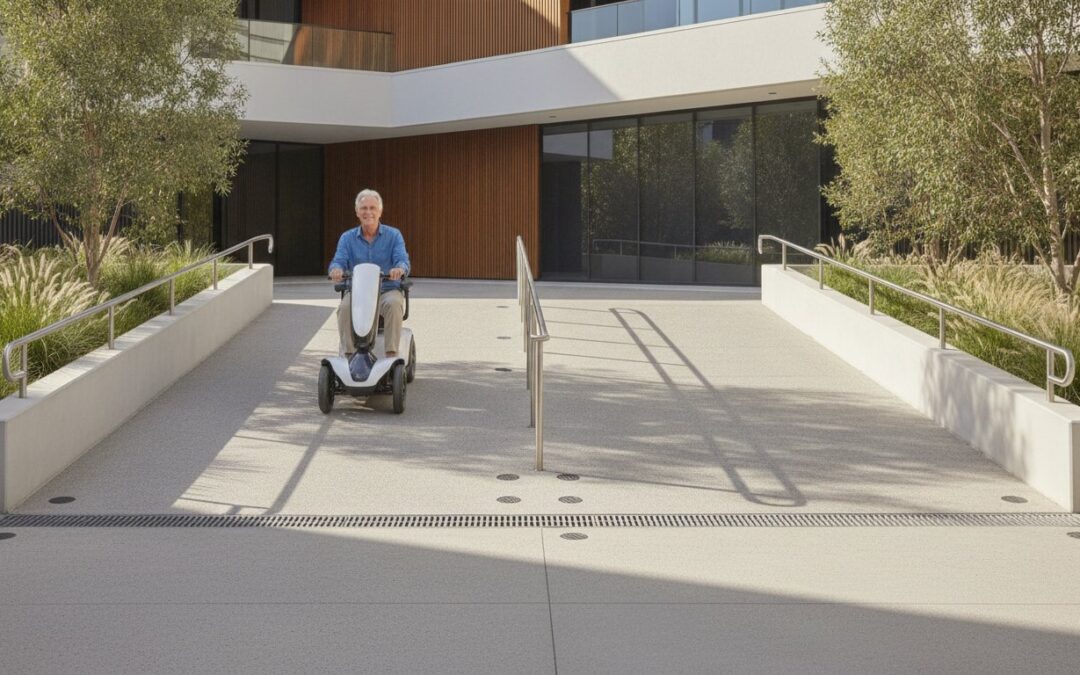
Did you know that approximately 35% of initial site plans involving shared access receive a council Request for Further Information (RFI) due to grade conflicts? It is a common technical setback that can delay your project by up to 45 business days. You likely understand the complexity of balancing tight site constraints with the rigid demands of AS 2890 driveway ramp grade compliance, only to find that a design suitable for a passenger vehicle creates a significant rollover hazard for a mobility scooter.
ML Traffic Engineers Australia recognises that navigating the intersection of AS 2890.1 and the accessibility standards of AS 1428.1 is a technical challenge requiring absolute precision. This article provides the expert clarity needed to master these requirements, ensuring seamless mobility scooter access and a faster path to council approval. We will examine the essential checklist for ramp grades, mandatory transition zones, and landing intervals. This guide delivers the technical foundation to build a site that is safe, inclusive, and fully compliant with current national regulatory standards.
Key Takeaways
- Differentiate between AS 2890.1 vehicular slopes and AS 1428.1 accessibility requirements to ensure a continuous accessible path of travel.
- Master the technical requirements for AS 2890 driveway ramp grade compliance, including the mandatory 2.0-metre transition sections for grade changes exceeding 12.5%.
- Utilise digital swept path analysis to simulate mobility scooter movements, ensuring adequate clearance around corners and through building entry thresholds.
- Minimise the risk of council RFIs and project delays by synchronising vehicle ramp grades with strict accessibility landing intervals and crossfall limits.
Understanding Driveway Ramp Grade Compliance in Australia
Driveway ramp grade defines the vertical shift across a horizontal distance between the public road and the site boundary. It determines whether a vehicle clears the pavement and whether a mobility device remains stable during the transition. Achieving AS 2890 driveway ramp grade compliance is a technical necessity for any Development Application (DA) in Australia. Designers must account for the physical interface where the private driveway meets the public footpath to ensure safety for all users.
Councils require technical validation that designs meet safety standards. If a driveway acts as the primary access route, it must satisfy the “continuous accessible path of travel” requirement. A standard driveway might work for a sedan, but the same slope can be a barrier for a scooter. Non-compliance leads to legal liabilities and expensive site remediation if errors aren’t caught early. This is especially true when a scooter footplate risks “beaching” on a poorly designed crest or sag.
The Role of the Traffic Engineer in Access Design
Engineers calculate these grades using percentage gradients or ratios such as 1:14. These aren’t just numbers; they represent physical safety limits. Professional certification ensures the driveway is functional and legally sound. ML Traffic Engineers Australia integrates these assessments into a comprehensive Traffic Impact Assessment to verify AS 2890 driveway ramp grade compliance. We use digital modelling to ensure that theoretical ratios translate into buildable, safe transitions on site.
Technical reports must clearly differentiate between vehicular requirements and pedestrian safety. While a car can handle a 1:4 slope, a scooter requires much more gradual changes. ML Traffic Engineers Australia provides the certification required to prove that these two distinct needs have been synchronised. This level of detail is what prevents engineering delays during the Council review process and ensures the site is safe for diverse user groups.
Regulatory Framework: National Standards
The Disability Discrimination Act (DDA) sets the baseline for site access. Local Council Development Control Plans (DCPs) enforce these through national standards like AS 1428.1 and general wheelchair ramp gradient guidelines. Universal design is now standard in Australian infrastructure projects. We plan for the 80th-percentile mobility scooter, which needs more space and shallower slopes than a manual wheelchair. This foresight prevents the common clashes found in standard site plans that only consider basic vehicle clearance.
Australian Standards: Navigating AS 2890.1 vs. AS 1428.1
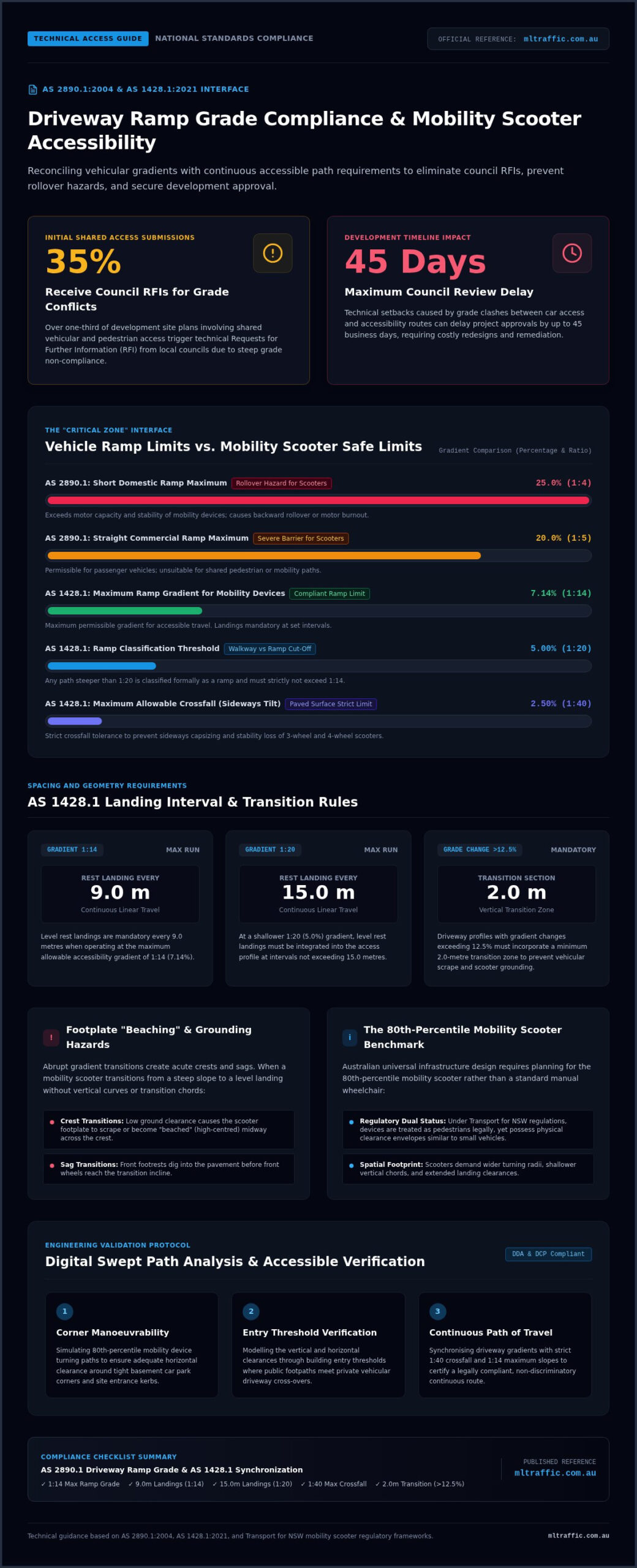
AS 2890.1:2004 focuses on motor vehicles, allowing gradients up to 25% (1:4) for short domestic ramps or 20% (1:5) for straight commercial ramps. In contrast, AS 1428.1:2021 governs the design for access and mobility. The “Critical Zone” occurs where these two standards overlap, typically at a site entrance or within a basement car park. A ramp that’s perfectly compliant for a car is often a significant safety hazard for a mobility scooter. A 1:4 grade exceeds the motor capacity and stability limits of most motorised devices, risking motor burnout or a backward rollover. Achieving AS 2890 driveway ramp grade compliance requires reconciling these two vastly different sets of requirements within the same physical footprint. For developers or managers of senior living facilities, you can visit Aged Care Made Easy to find aged care providers who prioritise these standards of accessibility.
Maximum Allowable Grades for Scooters
To accommodate mobility devices, designers must adhere to much shallower limits than those allowed for cars. Any path steeper than 1:20 is classified as a ramp and must not exceed a 1:14 (7.14%) gradient. For a 1:20 slope, level rest landings are required every 15.0 metres. If the gradient reaches 1:14, these landings must occur every 9.0 metres. Designers must also strictly control the cross-fall. Sideways tilts must not exceed 1:40 (2.5%) for paved surfaces. This level of precision is why developers often seek a professional Driveway Ramp Grade Assessment during the initial design phase to avoid Council refusal.
Transition Geometry and Ground Clearance
Abrupt changes in gradient pose a high “grounding” risk. When a scooter transitions from a steep ramp to a level landing, its footplate can scrape or become “beached” if the change is too sharp. To prevent this, engineers calculate vertical curves or transition chords. Under Transport for NSW mobility scooter regulations, these devices are treated as pedestrians, yet they have physical clearance envelopes similar to small vehicles. We design for the “worst-case” scenario, typically a four-wheel class-3 scooter. This involves verifying a minimum 2.0-metre transition chord where grade changes exceed 12.5% for crests. Ensuring the transition geometry accommodates a scooter’s wheelbase prevents the costly site remediation that follows a failed final inspection.
The Essential Driveway Grade Compliance Checklist
Achieving AS 2890 driveway ramp grade compliance requires a systematic verification of physical site characteristics. Engineers must ensure the design accounts for both the AS/NZS 2890.1:2004 standard for vehicles and the accessibility mandates of AS 1428.1. Use the following checklist to verify site readiness during the design phase:
- Longitudinal Grade: Confirm that no section of the continuous accessible path exceeds a 1:14 gradient.
- Transition Zones: Verify that all changes in grade exceeding 12.5% (1 in 8) include a minimum 2.0-metre transition section to prevent scooter grounding or “beaching”.
- Clear Width: Provide a minimum unobstructed width of 1000 mm. We recommend 1200 mm to accommodate the wider clearance envelopes required by class-3 mobility scooters.
- Visibility: Ensure the ramp is illuminated to meet AS/NZS 1158 requirements for safe night-time navigation.
- Passing Spaces: Include 1800 mm wide passing zones if the ramp length exceeds 6.0 metres and a clear line of sight is not maintained.
Surface and Tactile Requirements
The physical finish of the ramp determines its safety for mobility devices. Outdoor ramps must achieve a slip-resistance rating of at least P4 or P5 as per AS 4586. This prevents wheel slippage during wet weather. Tactile Ground Surface Indicators (TGSIs) are mandatory at the top and bottom of the ramp to alert vision-impaired users to the change in level. The surface must be smooth and free of significant joints. Large gaps between pavers or deep expansion joints can trap the small front wheels of a mobility scooter, causing sudden stops or instability.
Drainage and Weather Considerations
Managing water runoff is a technical balance between drainage efficiency and user stability. Surface cross-fall must not exceed 1:40 (2.5%) for paved areas. Excessive cross-fall causes a mobility scooter to drift sideways, which requires constant steering correction and increases the risk of tipping. Grate placement is equally critical. All drainage grates must be installed with slots perpendicular to the direction of travel. Ensure grate openings don’t exceed 13 mm to prevent tyre entrapment. Designing for the Australian climate means ensuring these systems can handle high-intensity rainfall without compromising the accessible path.
Swept Path Analysis: Verifying Mobility Scooter Manoeuvrability
While vertical AS 2890 driveway ramp grade compliance ensures that a device can climb a slope, swept path analysis verifies that it can actually negotiate the turns. This process involves the digital simulation of a vehicle’s footprint as it moves through a specific path of travel. A standard four-wheel mobility scooter often requires a turning space between 1800 mm and 2200 mm. This footprint significantly exceeds the 1500 mm turning circle typically used for manual wheelchairs. Mapping the movement of these devices ensures that driveway entries and basement layouts don’t include horizontal “pinch points” that render a site inaccessible for motorised devices. This focus on universal access is particularly important for NDIS participants supported by Mighty Mentors WA, as it ensures they can navigate their local communities without barriers.
Using AutoTURN for Accessibility Verification
ML Traffic Engineers Australia utilises AutoTURN software to provide rigorous technical proof of compliance for every project. This allows our team to visualise the exact path of travel from the public property boundary to the final building entry point. Digital simulation identifies physical constraints, such as inadequate clearance around structural columns or tight corridor corners, before construction begins. This data-driven approach provides planning officers with the assurance they need to approve a DA. It’s a reliable method for reducing project risk and ensuring the site is genuinely functional for all users.
Common Design Pitfalls to Avoid
Blind corners represent a significant safety risk in shared access environments. If a driveway entry lacks clear sight lines, a vehicle exiting a steep ramp may not detect a mobility scooter navigating the same path. Kerb ramps at the driveway-road interface are another frequent failure point. If these ramps are too narrow or lack proper vertical transitions, a scooter cannot safely exit the roadway. Understanding why Swept Path Analysis is vital for DA approval helps developers avoid these fundamental errors. We model the clearance envelopes for class-3 scooters to ensure that every turn and entry point is safely navigable under real-world conditions.
Contact ML Traffic Engineers Australia today for a professional Vehicle Swept Path Analysis that includes dedicated mobility device modelling for your next development.
Ensuring DA Approval with ML Traffic Engineers
ML Traffic Engineers provides a specialised consultancy service that bridges the gap between civil design and regulatory approval. We bring over 15 years of experience to every project. Our primary focus is ensuring that every driveway ramp and car park entry satisfies the rigorous demands of local government authorities. Achieving AS 2890 driveway ramp grade compliance is not just about meeting a number on a page. It requires technical precision and a deep understanding of how local planning authorities interpret national standards. We have conducted assessments for more than 10,000 project sites across Australia, giving us the expertise required to navigate even the most constrained developments.
Every technical report we produce involves senior principal involvement from start to finish. Clients have direct access to our leadership team, ensuring accountability and technical accuracy throughout the life of the project. This “no-gatekeepers” approach allows for faster communication and more reliable outcomes. We understand the nuances of the DA process and have a proven track record in successful Council negotiations. Our registered traffic engineers (NPER & RPEQ) provide the professional certification necessary to satisfy building certifiers and planning officers alike.
Our Technical Assessment Process
Our process begins with a meticulous review of your initial site plans. We identify potential clashes between vehicular gradients and accessibility paths before they become costly problems. We provide clear, authoritative reports that Councils trust. These documents provide the engineering evidence required to support your application and reduce the risk of an RFI. Our team handles everything from initial site plan reviews to final car park certifications. You can explore our full range of Traffic Engineering Services to see how we assist developers with broader transport and access requirements.
Contact Our Experts Today
Getting a quote for a Driveway Ramp Grade Assessment is a straightforward process. The ML Traffic promise ensures that the expert who initiates your project is the same professional who performs the technical work. This personnel continuity eliminates the communication gaps often found in larger, impersonal firms. We provide a dependable, results-oriented service that prioritises your project deadlines and compliance needs. Contact ML Traffic Engineers today to discuss your specific project requirements and ensure your development is compliant, safe, and ready for approval.
Secure Your DA with Compliant Access Design
Balancing vehicular gradients with accessibility requirements is a technical imperative for modern Australian developments. You’ve seen that standard car ramps often exceed the safety limits for mobility scooters, requiring precise transition chords and shallower longitudinal grades to prevent grounding. Navigating the friction between AS 2890.1 and AS 1428.1 is essential to avoid the 35% RFI rate associated with non-compliant access paths. Achieving AS 2890 driveway ramp grade compliance requires more than a basic site plan; it demands digital verification through swept path analysis to prevent dangerous rollover hazards and costly site remediation.
ML Traffic Engineers has assessed over 10,000 sites since 2005, providing the technical certainty that only registered NPER and RPEQ engineers can offer. Our specialist knowledge in AS 2890.1 and AS 1428.1 ensures your design is both buildable and compliant from the first submission. We provide the authoritative reports Councils trust to fast-track approvals and deliver safe, universal access for all users. Don’t let engineering delays stall your project.
Get a Professional Driveway Compliance Assessment from ML Traffic Engineers and move forward with confidence.
Frequently Asked Questions
What is the maximum grade for a driveway ramp to be mobility scooter compliant?
The maximum allowable gradient for a mobility scooter ramp is 1:14 (7.14%), while walkways must not exceed 1:20 (5.0%). Any slope steeper than 1:20 is technically classified as a ramp and requires rest landings at specific intervals. For a 1:14 ramp, level landings are mandatory every 9.0 metres. Ensuring AS 2890 driveway ramp grade compliance also involves maintaining a maximum crossfall of 1:40 (2.5%) to prevent the device from drifting or tipping sideways.
Does AS 2890.1 cover mobility scooter access or just cars?
AS 2890.1 specifically governs off-street car parking and vehicular ramp grades for motor vehicles like cars and vans. It doesn’t provide technical standards for mobility scooters. Instead, these devices fall under the jurisdiction of AS 1428.1, which focuses on design for access and mobility. Compliance clashes often occur because AS 2890.1 allows gradients up to 25%, which are unsafe and illegal for the continuous accessible paths of travel required by accessibility standards.
When does a Council require a Driveway Ramp Grade Assessment?
Local Councils typically mandate a Driveway Ramp Grade Assessment during the Development Application (DA) stage for sites with significant elevation changes or shared access points. This report is essential whenever a driveway serves as the primary accessible entry for a building. Planning officers use these assessments to verify that the proposed gradients won’t cause vehicle grounding or create barriers for mobility scooter users. Providing this technical evidence early helps prevent a formal Request for Further Information.
Can a mobility scooter use a standard vehicle driveway?
A mobility scooter can only use a vehicle driveway if the gradients satisfy the strict requirements of AS 1428.1. Standard domestic driveways often reach slopes of 1:4 (25%), which are far too steep for safe scooter operation. Attempting to navigate these grades risks motor failure or backward rollovers. If a driveway is the only path of travel, it must be engineered to the shallower accessibility limits rather than the steeper vehicular limits allowed under AS 2890.1.
What is a transition zone in driveway design and why is it important?
A transition zone is a dedicated section, typically 2.0 metres in length, that smooths the change between two different gradients. It’s vital for AS 2890 driveway ramp grade compliance because it prevents mobility scooters and vehicles from bottoming out or “beaching”. Without these vertical curves, the footplate of a scooter or the undercarriage of a car will scrape the pavement at the crest or sag of a ramp. This geometry is a mandatory requirement for all compliant driveway designs.
How do I know if my site needs a Swept Path Analysis for scooters?
Your site requires a Swept Path Analysis for scooters if the design includes tight turning circles, basement airlocks, or narrow corridors. While standard wheelchairs need about 1500 mm for a turn, class-3 mobility scooters often require between 1800 mm and 2200 mm. We use AutoTURN software to simulate these movements digitally. This process identifies horizontal “pinch points” that could lead to Council refusal if the path of travel isn’t wide enough for a scooter to navigate safely.
What happens if my driveway is found to be non-compliant after construction?
Non-compliant driveways discovered after construction can lead to severe consequences, including the refusal of an Occupation Certificate. Building certifiers must verify that the “as-built” gradients match the approved plans and national standards. If the grades are too steep, you may face expensive site remediation, such as ripping up and re-pouring concrete. Additionally, owners face legal liability under the Disability Discrimination Act if the site doesn’t provide the required equitable access for all users.
Do I need a traffic engineer for a residential driveway compliance report?
Yes, engaging a registered traffic engineer is the most reliable way to secure Council approval for a residential driveway report. Our engineers hold NPER and RPEQ certifications, which provide the professional authority Councils require for technical assessments. We use specialised software to verify vertical and horizontal clearances that general designers might overlook. Professional involvement ensures the report is accurate and buildable, reducing the risk of engineering delays or post-construction compliance issues during the final certification process.

Disclaimer
The content on www.mltraffic.com.au, including all technical articles, guides, and resources, is provided for general informational and educational purposes only. It is not intended to constitute professional advice in traffic engineering, transportation planning, development approvals, or any other technical or legal field.
While ML Traffic Engineers makes every reasonable effort to ensure the accuracy, completeness, and timeliness of the information published, we do not provide any warranties or representations (express or implied) regarding its reliability, suitability, or availability for any particular purpose. Any reliance you place on the content is strictly at your own risk.
In no event shall ML Traffic Engineers, its directors, employees, authors, or affiliates be liable for any direct, indirect, incidental, special, consequential, or punitive damages (including, without limitation, loss of profits, data, or business opportunities) arising out of or in connection with the use of, or inability to use, any information provided on this website.
The articles and guides on this site are not a substitute for engaging a qualified, registered professional traffic engineer (such as an NPER or RPEQ engineer) to assess your specific project requirements. For tailored advice, compliance assessments, or traffic engineering services, please contact a competent professional.
This disclaimer may be updated from time to time without notice. By accessing or using this website, you agree to be bound by the most current version of this disclaimer.
