
While extending your trading window seems like a straightforward path to increased revenue, it often triggers a level of council scrutiny that can stall a development application for months. You likely understand that more hours mean more customers, but for a consent authority, the focus is on how those additional vehicle movements affect local residents at 11:00 PM or during the morning commuter peak. Assessing traffic impact of increased operating hours isn’t just about total volume; it’s about managing temporal shifts and late-night amenity.
We recognise the frustration of facing unexpected costs for additional surveys or hitting a wall with council delays due to insufficient data on late-night noise and parking. This technical guide provides the clarity you need to navigate these complexities. You’ll learn how to leverage the latest standards, such as the NSW Guide to Transport Impact Assessment (TS 00085) and the ITE Trip Generation Manual 12th Edition, to secure a successful DA approval. We’ll preview the essential components of a cost-effective TIA, from SIDRA intersection modelling to parking accumulation profiles and noise mitigation strategies that satisfy strict regulatory requirements.
Key Takeaways
- Identify the specific thresholds where extending trading hours constitutes a material change in intensity, triggering the requirement for a specialised Traffic Impact Assessment.
- Learn the technical methodology for assessing traffic impact of increased operating hours, including how to develop trip generation rates when standard industry data is unavailable.
- Understand the shift from network capacity to the “amenity peak,” focusing on how late-night vehicle movements affect residential peace and local acoustic baselines.
- Explore operational mitigation strategies and Green Travel Plans that can reduce vehicle dependency and facilitate council approval for extended trading windows.
- Discover how direct access to senior principals provides a streamlined, expert-led approach to navigating complex regulatory requirements and DA conditions.
Why Increased Operating Hours Require a Traffic Impact Assessment
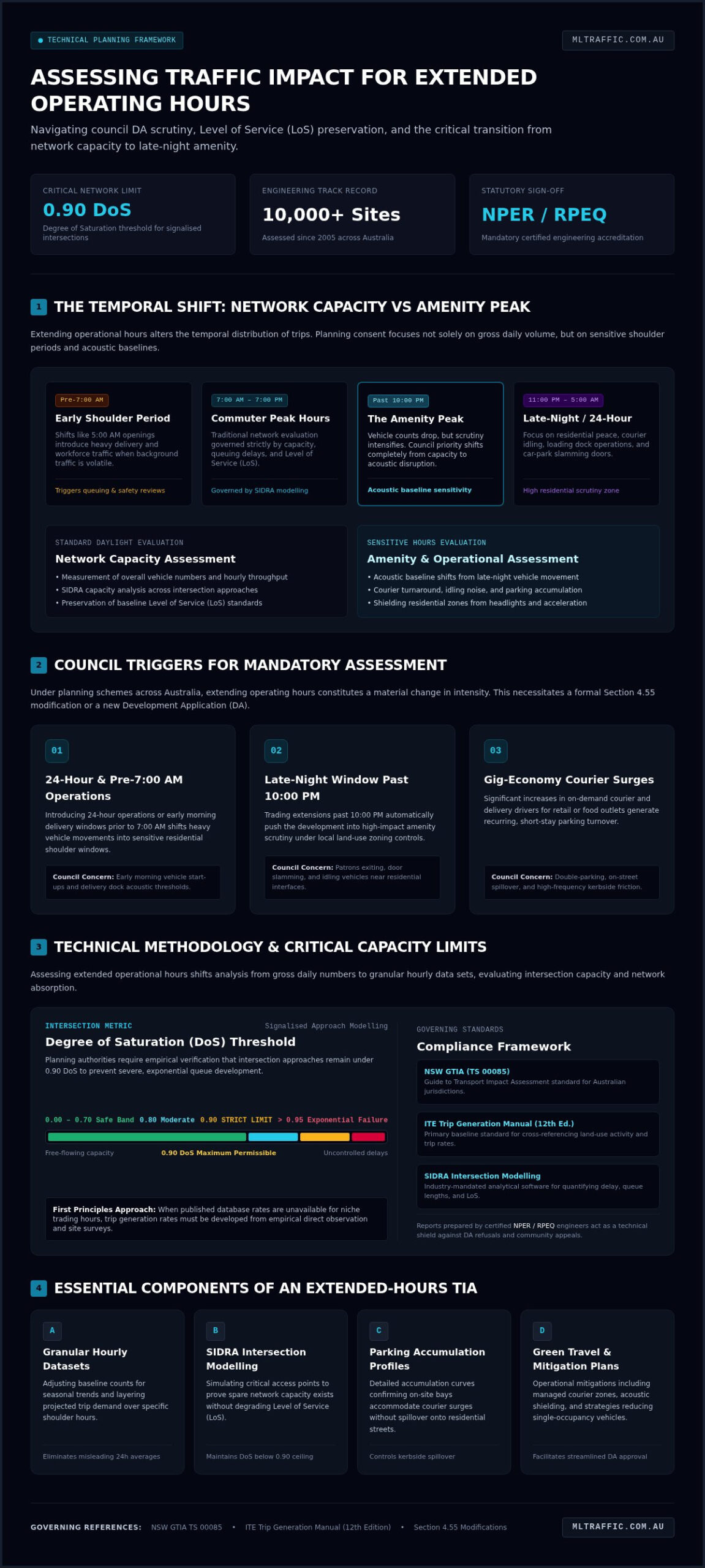
Local councils view an extension of operating hours as a material change in the intensity of use. While the physical footprint of a site may remain unchanged, the operational demand on the surrounding road network shifts. Planning authorities evaluate these changes via a Section 4.55 modification or a new Development Application (DA). The primary concern is whether additional vehicle movements will degrade existing Level of Service (LOS) standards at nearby intersections or create unacceptable noise for residents during sensitive periods.
In many cases, the total daily traffic volume is less critical than the temporal distribution of those trips. For instance, a facility opening at 5:00 AM instead of 7:00 AM introduces new demand during the early morning shoulder period. Councils require a formal process for assessing traffic impact of increased operating hours to ensure these shifts don’t cause queuing issues or safety hazards when background traffic is at its most volatile. This scrutiny is particularly high for businesses seeking to operate past 10:00 PM, where the “amenity peak” takes precedence over raw network capacity.
To better understand how transportation engineers quantify these changes and evaluate network impacts, watch this technical overview:
Council Triggers for Extended Trading Hours
Planning schemes across Australia contain specific hour restrictions based on land-use zoning. If an extension moves a business into a high-impact category, a TIA becomes a mandatory component of the application. Common triggers include:
- Introduction of 24-hour operations or early morning delivery windows (pre-7:00 AM).
- Extension of trading hours into late-night periods, typically past 10:00 PM.
- Significant increases in gig-economy courier traffic for retail or food outlets.
A professional Traffic Impact Assessment (TIA) Report provides the empirical evidence needed to prove that these triggers won’t result in adverse local impacts. Checking local planning schemes for specific hour restrictions early in the process is essential to avoid unexpected survey costs later.
The Legal Requirement for Professional Engineering Reports
Planning authorities rarely accept self-assessments or anecdotal evidence regarding traffic flow. Reports must be prepared by registered traffic engineers, such as those with NPER or RPEQ certification, to hold weight during the DA process. ML Traffic Engineers Australia has assessed over 10,000 sites since 2005, ensuring every report complies with current standards like the NSW GTIA TS 00085. A certified TIA serves as a technical shield. It protects developers from future community complaints or litigation by demonstrating that all potential impacts were rigorously quantified and mitigated. This meticulous approach is the most reliable way to secure a successful DA approval without unnecessary bureaucracy.
Key Metrics in Assessing Traffic Impact for Extended Operations
Assessing traffic impact of increased operating hours requires a shift from gross daily figures to granular, hourly data sets. Planning authorities require empirical evidence that the local network possesses sufficient spare capacity to absorb new demand without degrading the existing Level of Service (LoS). This involves adjusting baseline traffic counts to account for seasonal variations and then layering the projected development traffic onto these figures. We focus on the Degree of Saturation (DoS), specifically ensuring that signalised intersections remain below the 0.90 threshold to prevent exponential queuing delays.
When standard databases, such as the ITE Trip Generation Manual (12th Edition), lack specific data for niche late-night operations, engineers must employ a “first principles” approach. This method involves conducting surveys at similar sites to establish a reliable trip rate. These rates are then adjusted according to multimodal transportation impact analysis guidelines to ensure all travel modes are considered, including gig-economy delivery couriers and staff movements.
Trip Generation and Distribution Modelling
Trip generation in the context of temporal shifts is the quantification of site-specific vehicle movements during non-standard operational windows to identify potential conflicts with background traffic. We analyse historical data to predict arrival patterns. For example, a 24-hour gym or distribution centre often draws from a wider catchment area during late-night hours because fewer competitors are open. This geographic expansion changes how traffic is distributed across the local road network compared to standard daytime operations.
Intersection and Network Capacity Analysis
We utilise SIDRA INTERSECTION 11 to model how new traffic loads interact with existing infrastructure. This software allows us to test “what-if” scenarios, such as the impact of a 10% increase in right-turn movements at 11:00 PM. The analysis identifies if an intersection will fail or if the 95th percentile queue lengths will block adjacent driveways. For developments involving logistics, we also perform Intersection Analysis to evaluate the impact of heavy vehicle delivery schedules. This is critical for ensuring that early morning deliveries do not coincide with the start of the commuter peak, which could lead to unstable traffic flow. Our meticulous modelling ensures that the proposed hours are technically viable and defensible during council review.
Comparing Peak Period vs. Late-Night Traffic Impacts
Standard engineering assessments often prioritise the morning and afternoon commuter peaks. However, when assessing traffic impact of increased operating hours, the most critical data points frequently emerge during off-peak or late-night windows. During these times, background traffic volumes are significantly lower. This means development-generated trips represent a higher proportion of total road usage, making individual vehicle movements, such as engine starts, door slams, and braking, far more perceptible to the local community.
Councils must balance the economic benefits of extended trading against the potential for local disruption. While a road might have the physical capacity to handle hundreds of additional vehicles, its environmental capacity is often much lower. We use established traffic impact assessment guidelines to evaluate these temporal shifts. This ensures that a business opening earlier or closing later doesn’t degrade the safety of pedestrians or the availability of on-street parking for residents who return home after work.
The Concept of Environmental Capacity
Environmental capacity defines the maximum number of vehicles a residential street can accommodate before the quality of life for residents is compromised. Unlike technical road capacity, which focuses on flow and congestion, this metric prioritises acoustic amenity and safety. We quantify “peace and enjoyment” by analysing volume metrics against suburban noise baselines. At 3:00 AM, even a minor increase in heavy vehicle movements can exceed local thresholds, even if the road remains technically under-saturated. Our reports provide the technical justification needed to prove that your extended hours won’t breach these sensitive social limits.
Safety and Sight Distance at Night
Operating in low-light conditions introduces specific safety requirements that aren’t present during standard business hours. Sight lines and visibility for vehicles exiting a site must be rigorously assessed to prevent collisions with cyclists or pedestrians who are less visible at night. We evaluate the adequacy of existing street lighting and on-site signage to ensure safe navigation. All night-time access designs must maintain strict compliance with AS 2890.1 for off-street car parking. This includes checking ramp grades and aisle widths to ensure that late-night patrons can enter and exit the facility without causing unnecessary noise or safety hazards. Meticulous attention to these details reduces the likelihood of council imposing restrictive conditions on your DA approval.
Mitigating Traffic and Parking Issues from Increased Hours
Effective mitigation for extended trading often relies on operational management rather than costly physical infrastructure. While state agencies might focus on road widening, these upgrades are usually disproportionate for a simple change in hours. We focus on developing robust Management Plans that use empirical data to justify “staged” hour increases. This approach allows a business to demonstrate compliance during a 12-month trial period, building council confidence through proven results.
A Green Travel Plan is a vital component of this strategy. By implementing measures to reduce vehicle dependency, such as carpooling incentives or secure bicycle storage, we can lower the total trip generation of the site. This is essential when assessing traffic impact of increased operating hours in locations with limited road capacity or high residential density. Our engineers focus on practical solutions that satisfy planners without compromising your operational efficiency.
Acoustic and Amenity Mitigation
Council scrutiny often centres on the noise generated within car parks during late-night hours. We mitigate these impacts through specific design recommendations, including the use of low-noise surface materials and strategically placed speed humps to control vehicle speeds. Delivery windows should be restricted to avoid the most sensitive sleep periods, typically between 10:00 PM and 7:00 AM. To ensure these operations remain quiet, we integrate our findings with swept path analysis. This technical verification ensures that heavy vehicles can enter and exit the site in a single forward motion, eliminating the need for reversing beepers or excessive engine idling near residential boundaries.
Parking Demand and Car Park Design
Extended operations frequently lead to a parking “clash” during shift changes. We recalculate parking requirements by analysing the overlap between outgoing daytime staff and incoming night-shift employees. This prevents staff from saturating local street parking, which is a frequent trigger for community objections. Compliance with AS 2890.1 is mandatory for all off-street facilities. Our designs prioritise safe pedestrian movement through dedicated, well-lit walkways that don’t cause light spill into neighbouring properties. If your project requires a technical solution to complex parking issues, you can request a specialised Car Parking Demand Assessment to support your application.
Professional Traffic Engineering Support for Your DA
Securing planning approval for extended trading requires a strategic interpretation of traffic data that satisfies both planning officers and local community concerns. ML Traffic Engineers Australia provides the professional oversight needed to translate technical modelling into a defensible narrative for council. We navigate the specific requirements of local government across all Australian jurisdictions, ensuring that every Traffic Impact Assessment (TIA) report is prepared to a standard that withstands rigorous regulatory scrutiny.
A primary benefit of our consultancy is the seamless integration of specialised technical services. When assessing traffic impact of increased operating hours, we combine Intersection Analysis with Vehicle Swept Path Analysis and Car Parking Demand Assessments to provide a holistic view of the development’s performance. This comprehensive approach is designed to eliminate the need for councils to issue multiple Requests for Further Information (RFIs), which frequently cause project delays and unexpected costs.
The ML Traffic Advantage: 15+ Years of Expertise
Our experience with over 10,000 sites since 2005 provides a significant advantage when managing complex hour-extension applications. ML Traffic Engineers Australia operates with a “no-gatekeepers” approach, providing direct access to senior principals Michael Lee and Benny Chen. This ensures that the same expert who initiates your project is the same expert performing the technical work and signing the final certification. This continuity promise is a core signature of our firm, distinguishing us from larger, more impersonal consultancies. You can contact us for a Traffic Impact Assessment tailored to your specific land-use category and operational goals.
Streamlining the Planning Approval Process
Proactively addressing technical hurdles during the initial drafting phase is essential for maintaining development timelines. Our national expertise in urban transport planning allows us to anticipate potential objections regarding night-time amenity or parking saturation before they are raised by council. The workflow follows a structured path from initial consultation to the delivery of a certified traffic report. By providing a clear, evidence-based assessment that incorporates the latest industry standards, we facilitate a smoother approval process. This results-oriented approach ensures that the technical burden of assessing traffic impact of increased operating hours is managed professionally, allowing your business to expand its operations with confidence.
Securing Approval for Your Extended Trading Window
Successfully navigating the complexities of council approval for extended trading requires a transition from raw traffic volume analysis to the management of sensitive temporal impacts. The key to a favourable DA outcome lies in a rigorous, evidence-based approach that addresses both network capacity and residential amenity during non-standard operational windows. By prioritising the “amenity peak” and implementing the specific mitigation strategies discussed in this guide, you can effectively manage the risks associated with assessing traffic impact of increased operating hours.
ML Traffic Engineers Australia provides the technical certainty required for complex applications, backed by over 10,000 successful site assessments since 2005. Our national footprint ensures compliance with all Australian regulatory frameworks, while our commitment to principal-led involvement guarantees that senior expertise is applied to every project from inception to delivery. We provide the meticulous documentation needed to avoid restrictive trial periods and ensure long-term operational success. Contact our senior traffic engineers today for a TIA quote to discuss your specific operational goals. We look forward to supporting your business as it moves into its next phase of growth.
Frequently Asked Questions
Do I really need a traffic report if my business is only open an extra two hours?
Yes, most local councils require a professional report because extending trading hours constitutes a material change in the intensity of land use. Assessing traffic impact of increased operating hours is essential even for a two-hour extension, as it can shift vehicle movements into sensitive periods or commuter peaks. Planning authorities use these reports to verify that additional traffic won’t degrade local safety or residential peace, helping to prevent project delays.
What is the difference between a Traffic Impact Statement and a full Assessment?
A Traffic Impact Statement is a concise document typically used for low-impact developments where the traffic increase is minimal. In contrast, a full Traffic Impact Assessment (TIA) is a comprehensive technical report required for larger or more complex projects. TIAs involve detailed intersection modelling and network analysis. The scale of the extension and the zoning of the surrounding area determine which report type council will mandate for your specific development application.
How does a traffic engineer calculate trip generation for a 24-hour gym or cafe?
Engineers calculate trip generation using a combination of first principles and industry-standard databases like the ITE Trip Generation Manual 12th Edition. For 24-hour facilities, we often conduct surveys at comparable sites to establish realistic arrival and departure rates during late-night windows. We then adjust these figures based on local catchment data and multimodal factors. This ensures the projected demand reflects actual operational patterns rather than generic daytime averages.
Will I need to upgrade the road if my increased hours cause more traffic?
Physical road upgrades are rarely required for an extension of operating hours alone. Instead, councils usually prefer operational mitigation strategies, such as restricted delivery windows or designated staff parking areas. If the assessment identifies a significant degradation in the Level of Service at a nearby intersection, small-scale modifications to signage or line marking might be requested. We focus on providing technical justifications that favour management plans over expensive infrastructure works.
Can Council refuse my hours extension based solely on traffic noise?
Yes, planning authorities can refuse an application if the traffic noise generated during extended hours exceeds residential amenity thresholds. This is common when businesses seek to operate past 10:00 PM in suburban areas. A professional TIA addresses this by quantifying vehicle movements and proposing mitigation measures like low-noise car park surfaces or acoustic fencing. We integrate traffic data with acoustic requirements to prove the development remains compatible with its surroundings.
How much does a Traffic Impact Assessment for increased operating hours cost?
The cost of a Traffic Impact Assessment varies based on the complexity of the site and the specific requirements of the local council. Factors influencing the fee include the number of intersections requiring SIDRA modelling and whether new traffic counts are needed for the proposed hours. We provide tailored quotes that reflect the exact scope of work required for your DA. Every project is handled directly by our senior principals to ensure a cost-effective outcome.
What software is used to assess traffic impact for extended hours?
We utilise industry-standard software to ensure technical accuracy and council compliance. SIDRA INTERSECTION 11 is used for micro-analytical network modelling to evaluate intersection capacity and delays. For sites involving delivery vehicles or complex car park layouts, we use AutoTURN for Vehicle Swept Path Analysis. This software allows us to demonstrate that vehicles can safely manoeuvre within the site during all operational hours without causing safety hazards or unnecessary noise.
How long does it take to prepare a traffic report for a DA submission?
Preparation times typically range from one to two weeks, depending on the availability of current traffic data. If the council requires fresh intersection turning counts or automatic tube counts for the new operational window, this can add time to the schedule. We prioritise a streamlined workflow to meet your DA submission deadlines. Having the same engineer manage your project from start to finish ensures technical continuity and a faster delivery of the final certified report.

Disclaimer
The content on www.mltraffic.com.au, including all technical articles, guides, and resources, is provided for general informational and educational purposes only. It is not intended to constitute professional advice in traffic engineering, transportation planning, development approvals, or any other technical or legal field.
While ML Traffic Engineers makes every reasonable effort to ensure the accuracy, completeness, and timeliness of the information published, we do not provide any warranties or representations (express or implied) regarding its reliability, suitability, or availability for any particular purpose. Any reliance you place on the content is strictly at your own risk.
In no event shall ML Traffic Engineers, its directors, employees, authors, or affiliates be liable for any direct, indirect, incidental, special, consequential, or punitive damages (including, without limitation, loss of profits, data, or business opportunities) arising out of or in connection with the use of, or inability to use, any information provided on this website.
The articles and guides on this site are not a substitute for engaging a qualified, registered professional traffic engineer (such as an NPER or RPEQ engineer) to assess your specific project requirements. For tailored advice, compliance assessments, or traffic engineering services, please contact a competent professional.
This disclaimer may be updated from time to time without notice. By accessing or using this website, you agree to be bound by the most current version of this disclaimer.
