
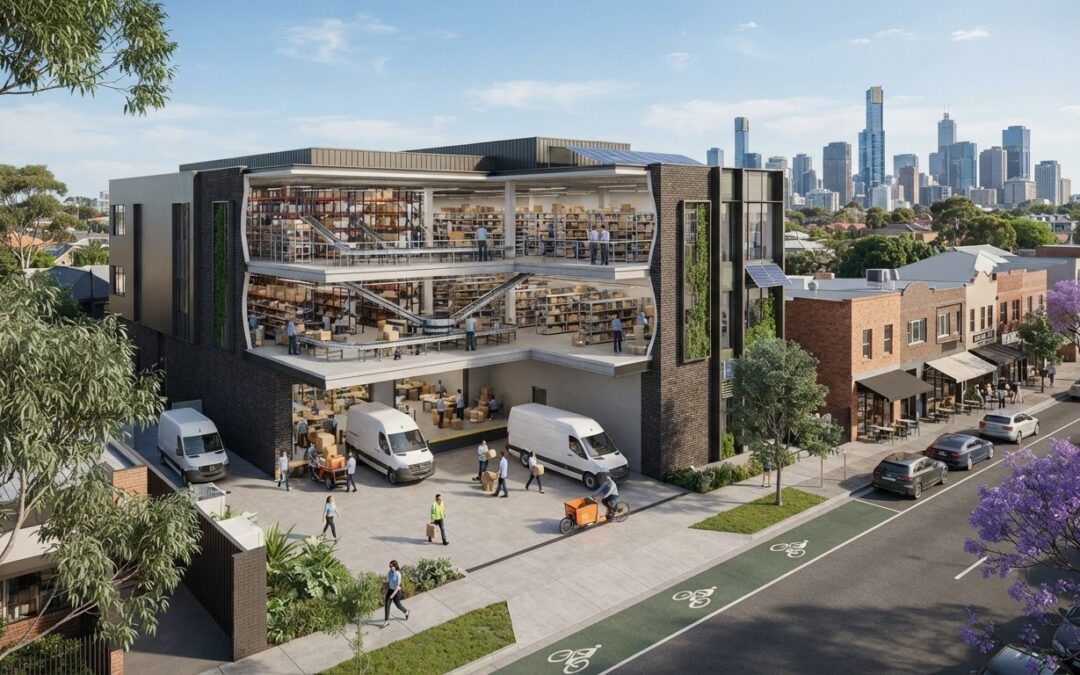
Fast delivery can reduce the distance to customers, but it concentrates vehicle activity at the fulfilment site. A dark store is dedicated solely to fulfilling online orders, and dark stores can support delivery models of 10-30 minutes. Assessing traffic needs for dark stores and micro-fulfilment means considering how orders translate into staff travel, replenishment vehicles, courier movements, loading activity and queues at site access points.
That’s why building size alone cannot show whether a site will work. The surrounding street network, delivery catchment, operating patterns and space for vehicles to load and turn all shape traffic effects, particularly in established urban areas across Australia.
This article explains how dark stores, grocery fulfilment, micro-hubs and vertical fulfilment models affect urban traffic. It outlines the movements to consider, how site layout and delivery operations influence demand, and what a traffic assessment can evaluate when a new fulfilment use is proposed.
Key Takeaways
- Assess a fulfilment site by how orders, replenishment, couriers and staff generate vehicle movements, not by floor area alone.
- Separate delivery activity by vehicle type, operating period and access point to identify where demand may affect the surrounding street network.
- Compare micro-hub and vertical fulfilment layouts by considering loading space, vehicle access and how goods move through the building.
- Use order patterns and delivery methods to build a project-specific estimate of daily trips rather than relying on a generic dark-store figure.
- A Traffic Impact Assessment can examine network effects, while swept path analysis and parking demand assessment address specific site-access and parking questions.
Traffic and last-mile delivery challenges
Dark stores bring picking and dispatch into urban areas, so traffic effects depend on delivery timing, vehicle mix and site access. Rapid fulfilment can shorten customer journeys while concentrating loading and courier movements near homes and shops.
Rapid delivery and hyper-local placement
Rapid delivery relies on placing fulfilment close to customers so orders can be picked and dispatched within a short window. Dark store services can offer delivery in 15-60 minutes, making the location and operation closely linked. A site near customers can reduce delivery distance, but frequent dispatches may increase vehicle movements at the property. The traffic assessment should consider when couriers arrive, where they wait and how they enter and leave without obstructing streets or footpaths.
Delivery speed also affects environmental impacts. Shorter routes can reduce distance travelled, while separate trips for individual orders can increase vehicle activity. Consolidating orders and planning efficient routes can balance speed with fewer repeated journeys.
Delivery radius and population density
A dark store is described as serving a 2-5 mile delivery radius, and its potential order base depends on how many people live within that catchment. A dense urban area can bring more customers within a short travel distance than a lower-density location. One market estimate says a small-footprint site may struggle to generate viable order volumes if it cannot reach 50,000 to 100,000 people within a 2- to 5-mile radius.
For an Australian proposal, map the delivery catchment against nearby housing, street connections and competing land uses. A river, rail corridor or limited crossing points can make practical routes longer than the radius suggests, affecting courier routes and delivery times.
Traffic across delivery models
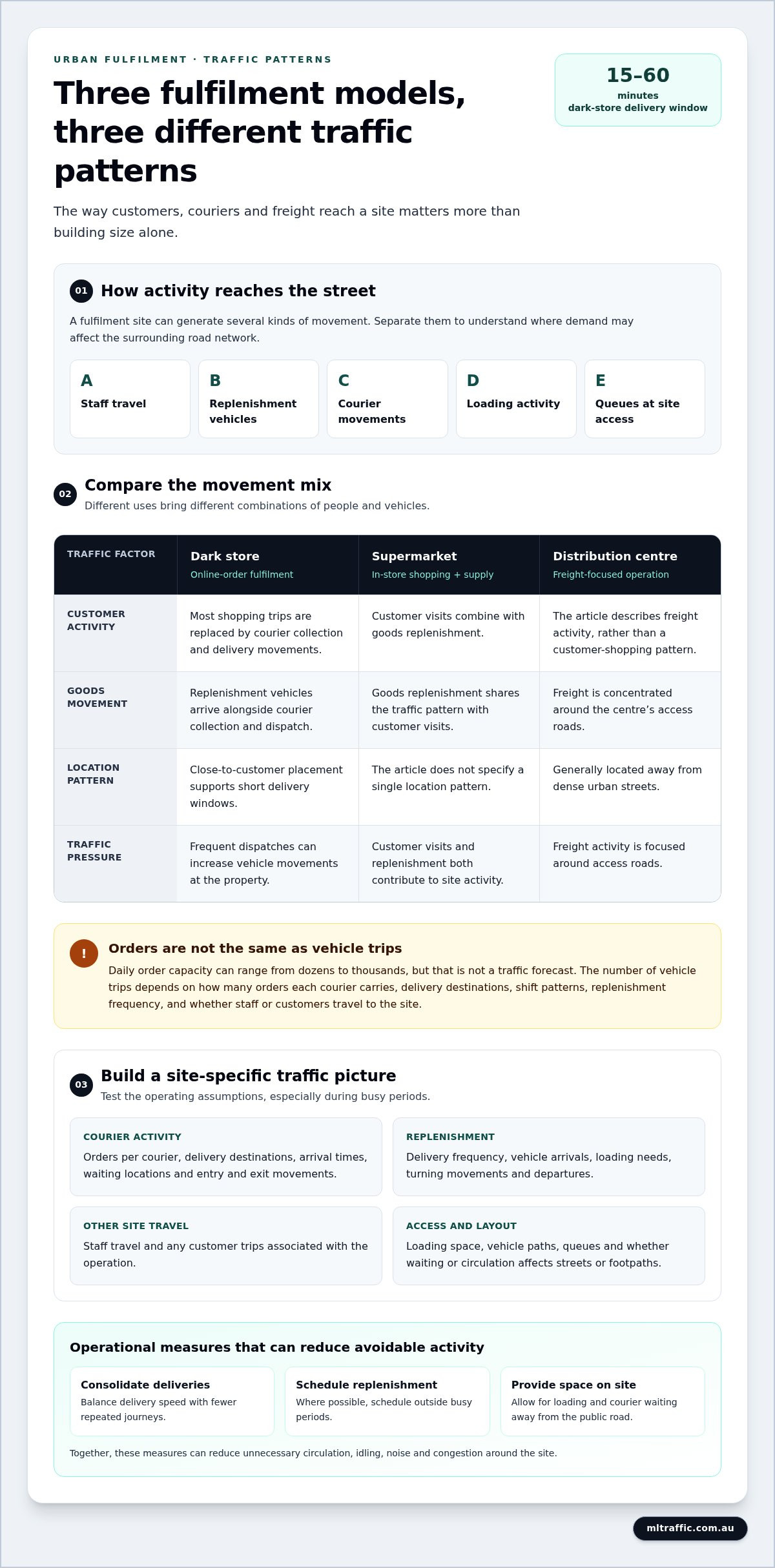
Dark stores, supermarkets and traditional distribution centres generate different traffic patterns because customers, workers and freight arrive in different ways. A supermarket combines customer visits with goods replenishment. A dark store replaces most shopping trips with courier collection and delivery movements. A traditional distribution centre is generally located away from dense urban streets, with freight concentrated around its access roads.
Operators can reduce avoidable traffic, noise and congestion by consolidating deliveries, scheduling replenishment outside busy periods, providing suitable on-site loading space and keeping courier waiting areas off the public road. These measures can reduce unnecessary circulation and idling around the site.
Delivery expectations add pressure: 41% of consumers worldwide expect delivery within 24 hours, while 24% would like orders in less than two hours. These expectations can increase demand for close-in fulfilment and prompt more frequent dispatches.
Expected orders and vehicle trips
Daily orders at an Australian dark store cannot be represented by one standard figure. Picking systems may be designed to handle anything from dozens to thousands of orders a day. This broad range reflects different operating scales, not a traffic forecast for a specific site.
Orders do not translate directly into the same number of vehicle trips. The total depends on how many orders each courier carries, delivery destinations, shift patterns, replenishment frequency and whether staff or customers also travel to the site. Assess traffic by testing these operating assumptions during busy periods, then account for vehicle arrivals, loading, turning and departures.
Grocery and quick-commerce fulfilment
Online grocery fulfilment combines picking, storage, replenishment and dispatch at one site. For Australian proposals, the land-use fit and the way vehicles access the property shape planning approval and effects on surrounding streets.
Parking and loading standards
Assess parking, loading bays and bicycle parking against applicable planning controls and the site’s operational demands. No single figure applies to every Australian dark store or micro-fulfilment centre. Requirements depend on the proposal, its location and the relevant planning framework.
Separate staff parking, courier waiting and freight loading in the site layout. For example, a grocery warehouse receiving frequent small deliveries needs space for goods vehicles as well as delivery couriers. If couriers queue across a loading area, dispatch can obstruct incoming freight and create conflicts at the driveway. A Car Parking Demand Assessment can compare parking provision with the operation’s expected demand.
Planning and road-access risks
Planning and road-access risks arise when the proposed use, vehicle activity or site layout conflicts with local controls or the surrounding street network. Commercial or mixed-use zoning alone does not explain how a particular fulfilment use will operate. Approval considerations may include the activity’s fit with the site, loading arrangements, driveway access, traffic effects and potential impacts on nearby homes.
Access constraints matter in practice. A narrow frontage, limited sight lines or a loading area that requires vehicles to reverse across a pedestrian route can complicate operations. Map intended vehicle paths and loading processes against the property layout and nearby roads. This helps decision-makers understand how vans, couriers and replenishment vehicles will enter, circulate and leave.
Fulfilment models also change the logistics profile of retail property. A dark store is dedicated to online orders, while a supermarket may combine in-person shopping with online picking and dispatch. In a mixed-use building, goods handling and customer-facing activity may share access, circulation or loading space, adding complexity when several uses depend on the same loading area.
Vacant retail premises can present opportunities for reuse, but a closed shop is not automatically suitable for fulfilment. Its existing layout may not support secure storage, picking routes or efficient vehicle access. Before assuming conversion will be straightforward, assess how the proposed product range, replenishment frequency and dispatch pattern fit the building.
Logistics costs help explain the focus on efficient picking and site operations. McKinsey research estimates e-commerce logistics costs could reach 15-25% of revenue; e-commerce order picking-up costs are estimated at 5-7% of costs. These figures show why operators may consider small fulfilment centers closer to customers, but location decisions still need to account for loading and road access. For brands scaling online sales, partnering with third-party logistics specialists like Silicon Valley Direct highlights how integrated fulfilment systems can help manage these operational pressures.
Micro-hubs and vertical dark stores
Micro-hubs bring inventory closer to customers, while vertical dark stores use building height to store and pick goods. Their compact footprints can suit constrained urban areas, but delivery vehicles still need practical access, loading and circulation space. Consider the physical site and its operating model together.
Footprints vary by model. Micro-fulfilment centres typically occupy 3,000-20,000 square feet, while some compact centres can be as small as 500 to 5,000 square feet. Dark stores are also described as typically under 10,000 square feet. These figures illustrate a range, not a universal design standard. A grocery site’s storage method, online order volume and product assortment all influence its space requirements.
Vertical storage can increase capacity without expanding the building’s ground footprint. In many automated micro-fulfilment configurations, picking systems need 16-24 feet of clear height. That requirement can affect which existing buildings are suitable. A site with limited internal height may require a different storage arrangement, while a taller building may need careful planning for goods movement between storage, picking and dispatch areas.
Automation can change the internal flow of an order. A system may bring goods to a picking station, reducing the need for staff to move through every storage aisle. Semi-automated operations can also support throughput with a limited product range. For example, a grocery hub could place high-demand goods near picking areas and keep slower-moving products in separate storage.
Internal efficiency does not eliminate external traffic demands. A compact hub still receives replenishment vehicles and dispatches delivery vehicles or couriers. The site layout needs to accommodate loading and manoeuvres without blocking access or creating conflicts with pedestrians. In a multi-storey building, the route from storage to dispatch matters too. Goods lifts, shared corridors and loading areas can all affect how efficiently orders leave the site.
Choose a location by matching the building’s physical capacity to its surrounding street network. A centre in a dense urban area may reduce the distance between fulfilment and customers, but narrow streets or limited loading space can constrain operations. Compare candidate sites by reviewing access points, loading arrangements, vehicle paths and nearby land uses. These details show whether vertical capacity can support practical fulfilment.
Forecast growth also makes the site model relevant. According to Interact Analysis, the number of micro-fulfilment centres will reach 7,300 by 2030. That projected expansion highlights the importance of evaluating each location’s building constraints and traffic operation. A smaller footprint can support urban fulfilment, but the overall design still depends on how inventory, staff and vehicles move through the site.
What delivery order volumes and vehicle trips should be expected per day for an Australian dark store?
There is no single daily order or vehicle-trip figure for every Australian dark store. Order volumes can range from dozens to thousands per day, depending on the catchment, product range, trading pattern and fulfilment capacity. Base a traffic estimate on the proposed operation, not a generic store benchmark.
Translate orders into vehicle movements by examining how deliveries are grouped. If couriers carry several orders on one route, dispatch activity will differ from an operation where each order leaves separately. Record the delivery method, typical route pattern and dispatch timing, then estimate outbound journeys and corresponding returns. This shows how order demand becomes activity at the site driveway.
Keep delivery dispatches separate from other site trips. A dark store may also generate staff travel, stock replenishment and service vehicle movements. For example, a grocery operation receiving frequent small deliveries has a different vehicle profile from one receiving consolidated loads. Include each movement type in the daily estimate, then identify when it overlaps with courier dispatches.
Daily totals alone can hide pressure during busy periods. Break the forecast down by operating period and identify when orders, courier arrivals or replenishment activity peak. A store with steady activity throughout the day may operate differently from one with concentrated online demand. The peak period helps test whether loading space, driveway access and on-site circulation can handle simultaneous arrivals.
Use clear, documented operating assumptions. Record the expected order range, delivery methods, vehicle types, staffing pattern and replenishment approach, then test how changes affect trips. A wider product range or more individual deliveries may increase courier movements; combining orders on routes may change the number of separate departures. These scenarios make the traffic forecast easier to follow.
Vehicle trips also depend on the physical layout. A delivery van that cannot turn within the site may need extra manoeuvres or affect driveway operation. Vehicle Swept Path Analysis tests whether the design accommodates the vehicles expected to use the property. Assess entry, loading, turning and exit, not just daily order numbers.
For a useful Australian assessment, connect the daily forecast to the access arrangement and surrounding roads. Explain how movement estimates were derived and distinguish delivery trips from staff and replenishment traffic. This lets planners understand the assumptions and assess whether the proposed operation can function without relying on an unexplained daily total.
How should delivery vans, couriers, staff and customer trips be included in a traffic assessment?
A traffic assessment should account for every group using the site and show how their movements affect access and nearby roads. For a dark store, distinguish delivery vans, couriers, staff, customers and replenishment vehicles. This prevents online orders from obscuring other traffic sources and clarifies whether the site is a closed fulfilment facility or also offers customer collection.
A consistent method for assessing traffic needs for dark stores and micro-fulfilment starts with the operating profile. Record delivery methods, vehicle types, staff travel patterns, customer access and stock replenishment arrangements, then identify when each activity occurs. For example, morning goods deliveries may overlap with staff arrivals, while courier dispatches may cluster later. Separate daily activity from busy periods to show overall demand and potential peak pressure.
Count vehicle movements consistently. A vehicle entering and later leaving creates separate movements on the adjoining road, while a courier collecting several orders makes one departure from the site for that route. Show arrivals and departures separately, and explain the assumptions behind each estimate. Include return trips, repeat replenishment visits and any customer collection included in the proposal.
Make separate assumptions for staff trips. Consider shift start and finish times, travel modes, parking demand and whether workers arrive together or over a period. For example, a fulfilment shift changeover can create a short peak of arrivals and departures. Include customer trips only if the operation invites customers on-site, such as for click-and-collect. A fully online operation has a different trip profile.
Assess how movements interact at the property. Check driveway capacity, sight lines, ramp grades, loading areas and internal circulation. A delivery van reversing through a courier waiting area can create conflict even when the daily traffic total appears manageable. A Traffic Guidance Scheme (TGS) can address traffic arrangements where work affects access or movement around a site. A Traffic Impact Assessment (TIA) Report can present expected movements and their effects on the surrounding network.
When assessing traffic needs for dark stores and micro-fulfilment, document vehicle classes, trip purposes, operating periods and the basis for each estimate. Test the busiest combination, such as a staff changeover alongside replenishment and courier departures. This can reveal whether loading, parking or access arrangements need adjustment. Keep proposed and existing activity distinct so decision-makers can see the additional traffic from the dark store.
For a project involving several trip types, a Traffic Impact Assessment service can help assess site movements and network effects.
ML Traffic Engineers Australia: Traffic Impact Assessment (TIA) Report
ML Traffic Engineers Australia prepares Traffic Impact Assessment (TIA) Reports for proposals such as dark stores and micro-fulfilment centres. The report can assess projected vehicle movements, site access and effects on the surrounding road network, helping inform planning decisions.
Where vehicle access is a key design issue, Vehicle Swept Path Analysis can assess whether delivery vehicles can manoeuvre through the site. A Car Parking Demand Assessment can consider parking requirements for staff and other site users. These services address specific traffic and parking questions alongside the broader impact assessment.
Turn to a TIA when a proposed fulfilment use needs its traffic generation and access arrangements assessed. Contact ML Traffic Engineers Australia to discuss your project.
Turn the operating model into a clear project brief
A useful next step is to turn the fulfilment model into a practical site brief. Set out how orders will be picked and dispatched, how replenishment will work and which vehicles need access. This gives the design and planning process a consistent basis. It also helps assess proposed operational changes, such as adding customer collection or changing delivery patterns, before they affect site access.
When assessing traffic needs for dark stores and micro-fulfilment, keep operating assumptions visible alongside the site layout. Record proposed loading arrangements, staff access and vehicle routes. Use this information to guide project discussions and identify which traffic questions need further assessment. A clear brief connects day-to-day operations with the physical design.
ML Traffic Engineers Australia can prepare a Traffic Impact Assessment (TIA) Report, Vehicle Swept Path Analysis or Car Parking Demand Assessment to address relevant project requirements. Contact ML Traffic Engineers Australia to discuss your project and take the next step with a clear traffic brief.
Frequently Asked Questions
What Are Dark Stores and Their Role in Urban Logistics?
Dark stores are retail premises organised around online order fulfilment rather than walk-in shopping. Their urban logistics role is to connect stored and picked inventory with local delivery routes. This changes how a retail site interacts with nearby streets: couriers and goods vehicles may matter more than customer parking turnover. For planning, the key question is how the operation fits the building, access points and surrounding land uses.
How much vehicle traffic do dark stores and micro-fulfilment centres generate in Australia?
No single daily vehicle figure applies to every Australian dark store or micro-fulfilment centre. The forecast depends on the delivery model, order profile, staff attendance, replenishment arrangements and whether customers collect orders. A useful estimate separates each trip purpose and vehicle type, then tests the busiest operating period. This gives a more meaningful view of access demand than applying a generic traffic rate to floor area.
How do site size, operating hours and delivery radius affect traffic demand?
Site size can affect storage capacity, picking activity and the space available for loading, but it does not determine traffic by itself. Longer operating hours may spread movements across more periods, while concentrated dispatch windows can create sharper peaks. Delivery radius affects route distance and how orders are grouped. For example, a compact catchment with clustered destinations may produce different courier movements from dispersed deliveries, even with similar order demand.
What traffic impact assessment requirements apply to dark stores in Australian states and local councils?
Assessment scope depends on the development application pathway and the relevant state and local planning framework. A proposal may need to explain its operational use, expected traffic, vehicle access, parking and loading arrangements. Assessment material should address the site setting and issues raised during planning review. Clearly describe vehicle types, operating patterns and access design so the traffic analysis reflects the proposal, not generic retail use.
How should peak-hour traffic, queuing and access impacts be modelled for a proposed site?
Model periods when site arrivals and departures overlap with busy conditions on surrounding roads. Set out expected movements by vehicle type and trip purpose, then examine driveway operation, turning movements and nearby intersections. Queue analysis should test where vehicles wait and whether queues can be contained on-site. Compare the proposed layout with realistic scenarios, including overlapping courier dispatches, staff changes and goods deliveries.
What transport data and surveys are needed to assess a dark store site?
Useful inputs include classified traffic counts, intersection turning movements, parking occupancy, site plans and access dimensions. Operational information should describe delivery schedules, vehicle types, staffing patterns, customer collection and courier dispatch arrangements. A traffic volume survey can establish surrounding road activity, while a parking occupancy survey can show how nearby parking is used. The right evidence depends on the assessment questions and the site’s access and transport context.
What parking, loading bay and bicycle parking standards apply to dark stores and micro-fulfilment centres?
There is no single standard for every Australian dark store or micro-fulfilment centre. Assess provision against applicable local planning controls and the site’s operational needs, including separate space for staff parking, courier waiting and freight loading.

Disclaimer
The content on www.mltraffic.com.au, including all technical articles, guides, and resources, is provided for general informational and educational purposes only. It is not intended to constitute professional advice in traffic engineering, transportation planning, development approvals, or any other technical or legal field.
While ML Traffic Engineers makes every reasonable effort to ensure the accuracy, completeness, and timeliness of the information published, we do not provide any warranties or representations (express or implied) regarding its reliability, suitability, or availability for any particular purpose. Any reliance you place on the content is strictly at your own risk.
In no event shall ML Traffic Engineers, its directors, employees, authors, or affiliates be liable for any direct, indirect, incidental, special, consequential, or punitive damages (including, without limitation, loss of profits, data, or business opportunities) arising out of or in connection with the use of, or inability to use, any information provided on this website.
The articles and guides on this site are not a substitute for engaging a qualified, registered professional traffic engineer (such as an NPER or RPEQ engineer) to assess your specific project requirements. For tailored advice, compliance assessments, or traffic engineering services, please contact a competent professional.
This disclaimer may be updated from time to time without notice. By accessing or using this website, you agree to be bound by the most current version of this disclaimer.
