

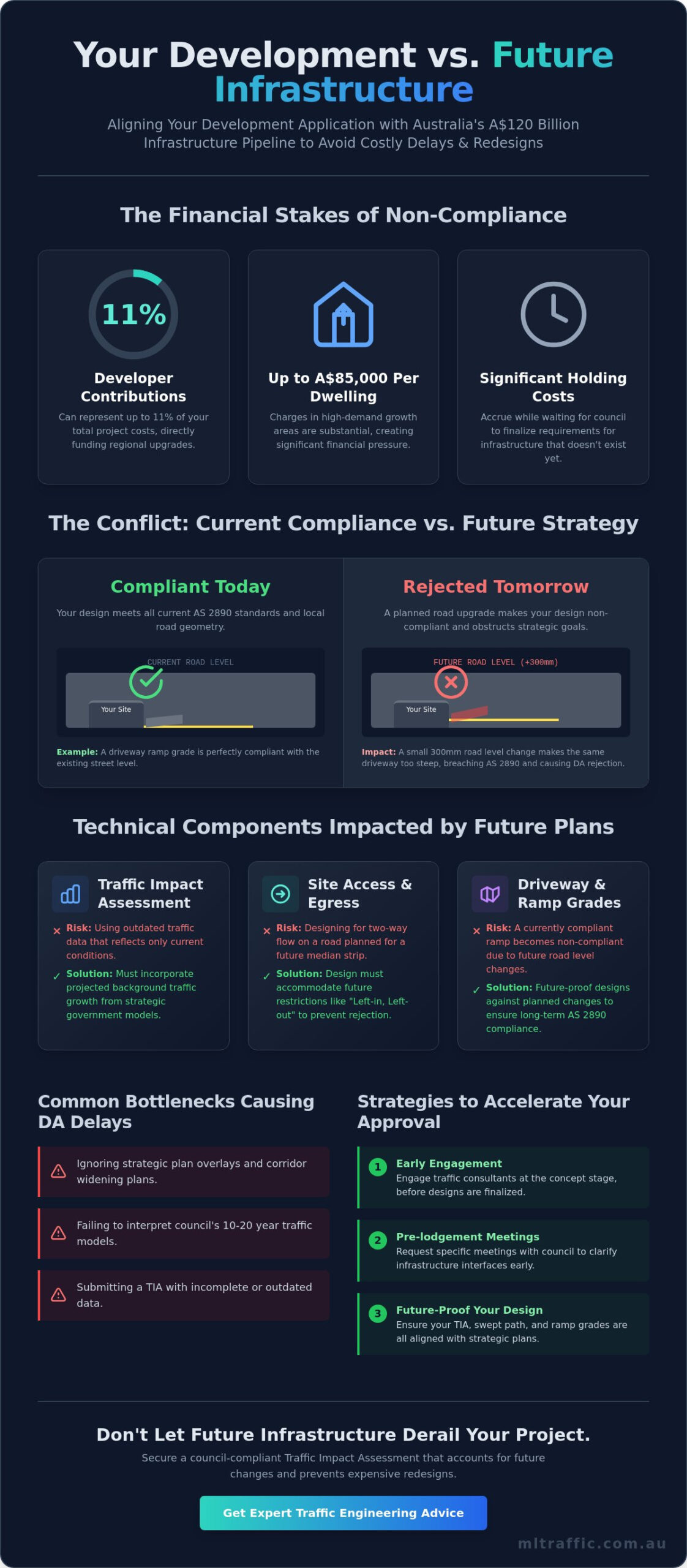
Developer contributions now represent up to 11% of total project costs, with charges in high-demand growth areas across the country reaching as high as A$85,000 per dwelling. This financial pressure is compounded by the uncertainty of how future infrastructure projects affect your development application, especially when current site conditions conflict with long-term strategic plans. You’re likely managing significant project holding costs while waiting for council to finalize requirements for road levels or access points that haven’t been built yet.
ML Traffic Engineers Australia recognizes that bridging the gap between current site conditions and future transport upgrades is a complex technical requirement. This article explains how to align your project with the A$120 billion federal infrastructure pipeline and the differing priorities of the Labor, Liberal-National, and One Nation parties. You’ll discover how to secure a council-compliant Traffic Impact Assessment (TIA) that accounts for future changes, adheres to AS 2890 standards, and prevents expensive redesigns during construction. We’ll examine the specific infrastructure funding models and developer contribution schemes that will dictate your site’s viability through 2027.
Key Takeaways
- Understand why planned transport upgrades are a critical path factor for modern development applications and how to distinguish between current capacity and strategic growth.
- Learn how future infrastructure projects affect your development application by requiring adjustments to Traffic Impact Assessments and Vehicle Swept Path Analysis to accommodate future road geometry.
- Identify common bottlenecks, such as using outdated traffic data or failing to interpret strategic plan overlays, which often lead to costly council delays.
- Discover strategies to accelerate your DA approval, including early engagement with traffic consultants and requesting specific pre-lodgement meetings to address infrastructure interfaces.
The Intersection of Future Infrastructure and DA Timelines
Planning authorities view future infrastructure as a non-negotiable constraint rather than a distant possibility. For developers, the primary way how future infrastructure projects affect your development application is through the "critical path" logic used by council assessors. A project that complies with today’s road geometry but obstructs a planned 2028 corridor widening will face immediate rejection. Councils don’t just look at what’s on the ground; they use sophisticated traffic modelling to project network demand 10 to 20 years into the future. If your site access interferes with these strategic goals, you risk entering a cycle of Request for Information (RFI) letters and expensive redesign loops.
The financial risk of ignoring these upgrades is substantial. Developer contributions now represent 8% to 11% of total project costs in many regions. In Greater Sydney, the Housing and Productivity Contribution (HPC) for residential subdivisions is A$12,000 per new lot as of July 2025. These funds are specifically earmarked for regional upgrades. If your Traffic Impact Assessment (TIA) Report fails to account for the strategic growth these levies fund, your application is technically incomplete from day one.
To better understand this concept, watch this helpful video:
Why Councils Prioritise Future Network Capacity
Councils act as custodians of the long-term transport network. They must protect the integrity of planned transport corridors and public transport links to ensure scalability. A major concern for assessors is preventing new developments from "choking" future road widening projects. Given the complexity of Transport in Australia, which involves a mix of federal funding and state execution, councils rely on developer contributions to bridge the gap. They prioritize projects that demonstrate a clear understanding of regional infrastructure plans, ensuring your site doesn’t become a bottleneck as the population grows.
Strategic Alignment vs. Current Compliance
Meeting today’s standards isn’t enough for a 2026 approval. You must navigate a hierarchy of local and state infrastructure plans that often conflict with current site conditions. A common technical failure occurs with driveway ramp grades. If a future road upgrade involves raising or lowering the street level by even 300mm, a currently compliant driveway may become unusable or breach AS 2890 standards. This is a primary example of how future infrastructure projects affect your development application at a granular level. We focus on ensuring your Driveway Ramp Grade Assessment and site levels are future-proofed against these inevitable strategic changes.
Technical Traffic Components Impacted by Planned Projects
Technical compliance requires more than observing current conditions. A professional Traffic Impact Assessment (TIA) Report must incorporate projected background traffic growth derived from strategic government models. When the 2026-27 federal budget allocates A$10.3 billion specifically for transport infrastructure, it signals high-growth corridors where traffic volumes will increase significantly. Failing to model these future volumes results in a report that fails council scrutiny immediately. This data gap is a primary reason how future infrastructure projects affect your development application during the assessment phase.
Site access and egress are equally sensitive to planned network changes. A developer might design a site based on current two-way flow, only to find that Infrastructure Australia has prioritized a median strip or a major intersection upgrade for that specific segment. These modifications can restrict movements to "left-in, left-out" only, fundamentally altering the site’s operational efficiency. We ensure your Intersection Analysis accounts for these gazetted changes to prevent your site from becoming functionally obsolete before construction finishes.
Future-Proofing Swept Path Analysis
We use AutoTURN to model vehicle movements against future kerb alignments. Planned lane reconfigurations often narrow existing carriage-ways or introduce new bicycle lanes, as seen with the A$500 million Active Transport Fund expansion. If your loading dock design doesn’t account for these shifts, you risk creating a "land-locked" facility where heavy vehicles cannot legally maneuver. Our Swept Path Analysis accounts for these planned road narrowings. This proactive approach ensures that your Car Park Design remains functional despite external network modifications.
Impact on Parking and Traffic Generation
Proximity to future transport hubs, such as the A$30 billion Suburban Rail Loop or Sydney Metro West, provides a technical basis for justifying parking shortfalls. However, this requires a meticulous Car Parking Demand Assessment that proves future public transport will offset vehicle use. You must model peak hour impacts on intersections that haven’t been built yet to satisfy council requirements. Maintaining strict AS 2890 compliance is the only way to ensure your internal circulation remains viable when external road levels are modified. If you are unsure about future road levels near your site, you should contact our senior principals for a direct technical consultation.
Common Bottlenecks: When Infrastructure Uncertainty Delays DAs
Using outdated traffic count data remains a primary cause of DA refusal. Many consultants rely on counts taken during atypical periods or fail to adjust for imminent network changes. This oversight directly illustrates how future infrastructure projects affect your development application by creating a mismatch between your proposal and council’s future-year models. If your Traffic Impact Assessment (TIA) Report doesn’t account for the A$12.1 billion in new transport investments announced in the 2026-27 federal budget, your assumptions about background traffic growth will be fundamentally flawed. Council assessors will identify these gaps quickly, leading to immediate Requests for Information (RFIs) that stall your project.
The "Junior Engineer" trap is another significant bottleneck. Junior staff often lack the technical experience to interpret complex strategic plan overlays, such as those found in the 2021 Australian Infrastructure Plan. They might assume current road levels and access points are permanent, failing to recognize that a gazetted road widening project could render a new basement ramp unusable. These inconsistent assumptions regarding future delivery and service vehicle access create unbuildable designs that require expensive, late-stage revisions. Avoiding these errors requires a deep understanding of how future infrastructure projects affect your development application across both local and state jurisdictions.
The Risk of Seniority Gaps in Traffic Consulting
Complex infrastructure contexts demand a professional traffic engineer with at least 15 years of experience. Junior-led reports frequently result in over-conservative designs that waste valuable site area or, conversely, designs that fail to meet future AS 2890 requirements. We provide principal-led continuity from the initial brief through to council submission. Our senior leadership personally handles all technical work, ensuring that your Intersection Analysis and swept path models are based on expert interpretation of strategic network growth rather than simple data entry.
Communication Failures Between Consultants
Delays often stem from a lack of alignment between the architect, civil engineer, and traffic engineer. If the civil engineer’s road levels don’t match the traffic engineer’s future-year assumptions, the entire basement layout may need to be redesigned. This is particularly critical when road widening projects are imminent. We establish a single source of truth for future infrastructure assumptions at the project’s start. This prevents the need for late-stage changes to car park layouts, ensuring that your Car Park Design remains compliant with both current standards and future strategic requirements.
How to Accelerate Your DA in an Infrastructure Growth Area
Accelerating a development application in a growth corridor requires a shift from reactive compliance to proactive technical alignment. Engaging a traffic consultant during the concept phase is the most effective way to identify potential ‘deal-breakers’ before architectural plans are finalized. This early intervention allows for the identification of how future infrastructure projects affect your development application, specifically regarding site access points that may conflict with future road widening or median installations. When you consider that developer contributions can represent up to 11% of total project costs, avoiding design errors in the initial phase is a financial necessity.
Developers must request a pre-lodgement meeting with council specifically to discuss future infrastructure interfaces. You should provide your traffic engineer with the most recent CAD files, including future road boundaries and gazetted alignments, to ensure all technical modelling is accurate from the outset. Defining operational details such as delivery schedules and staff numbers early minimizes ‘worst-case scenario’ modelling that often leads to excessive infrastructure requirements. Selecting a consultant with a national track record of handling complex infrastructure is critical; they understand the nuances of the A$120 billion federal transport pipeline and how it translates to local council requirements.
The Power of Early Concept Reviews
Identifying unworkable driveway locations early prevents them from being ‘locked in’ by the architect. This avoids costly redesigns during the formal assessment. By correctly applying a Car Parking Demand Assessment during the initial design phase, you can optimize the net lettable area while maintaining compliance with both current and future standards. This proactive approach significantly reduces the likelihood of major redesigns triggered by council RFIs regarding future network capacity. It ensures that your site remains viable as the surrounding infrastructure matures.
Streamlining the Data Briefing Process
Developers can assist in fast-tracking the assessment by providing concrete delivery schedules and accurate staff projections. This data allows the engineer to use historical trends and validated future growth rates rather than relying on generic, conservative estimates. Ensuring your Traffic Impact Assessment is based on these specific operational realities ensures a more favorable review by transport authorities. Using validated growth rates is essential, especially in states like Victoria where standardized contribution systems are being implemented through 2027. For expert assistance in navigating these complex growth areas, you should contact our senior principals for a direct project review.
ML Traffic Engineers Australia: Expertise in Complex Infrastructure Contexts
ML Traffic Engineers Australia brings over 15 years of professional experience to the civil engineering and urban planning sectors. We specialize in navigating high-stakes infrastructure projects for private developers who require technical certainty. Our firm understands the intricacies of the national transport pipeline and how these investments translate to local site constraints. This specialized knowledge is essential for determining how future infrastructure projects affect your development application. We ensure your documentation meets the rigorous standards of both local councils and state transport authorities from the initial submission.
Our senior principals personally handle all technical work. We do not use junior gatekeepers or inexperienced staff to draft reports. This hands-on approach allows ML Traffic Engineers Australia to minimize council RFIs through meticulous, data-driven reporting that anticipates assessor concerns. We provide a comprehensive suite of services designed for technical compliance and operational efficiency:
- Traffic Impact Assessment (TIA) Reports
- Vehicle Swept Path Analysis
- Car Parking Demand Assessment
- Traffic Guidance Scheme (TGS)
- Driveway Ramp Grade Assessment
- Intersection Analysis
- Sight Distance Assessment
- Car Park Design
Our Senior-Led Efficiency Model
Direct access to our senior leadership ensures a rapid turnaround for your project. Our ‘right-first-time’ philosophy eliminates unnecessary redesign cycles that often stall development timelines. ML Traffic Engineers Australia maintains a deep understanding of how Traffic Engineering interacts with future strategic planning. This perspective is vital for projects located in high-growth corridors where network changes are imminent. By accounting for future road levels and planned intersections early, we protect your project from the financial risks of late-stage redesigns.
Secure Your DA Approval with Confidence
We maintain a proven track record across residential, commercial, industrial, and retail sectors nationwide. Our expertise extends to complex project environments where current site conditions conflict with future strategic plans. ML Traffic Engineers Australia ensures full AS 2890 compliance and provides precise Car Park Design that maximizes your site’s potential. Our reports provide the technical evidence required to justify parking shortfalls or complex access arrangements. Contact ML Traffic Engineers Australia today to discuss your project’s specific infrastructure needs with a senior principal.
Future-Proof Your Development Against Strategic Network Growth
Successful DA approval in growth corridors requires a technical strategy that treats future infrastructure as a current constraint. You’ve seen how the A$120 billion federal transport pipeline and shifting state contribution schemes create a complex regulatory environment. Failing to address how future infrastructure projects affect your development application leads to costly redesigns and prolonged council delays. Your traffic documentation must account for future background traffic growth, gazetted road widenings, and evolving AS 2890 requirements to ensure long-term site viability.
ML Traffic Engineers Australia provides the technical authority needed to navigate these infrastructure interfaces. With 15+ years of Australian traffic engineering experience, our senior principals personally handle every assessment. This ensures direct access to experts who understand the nuances of national compliance and strategic network modelling. We eliminate the junior gatekeeper bottleneck and deliver reports designed to withstand rigorous council scrutiny from the first submission. Get an expert-led traffic report for your DA project today and secure your project’s future with confidence.
Frequently Asked Questions
How do planned road widening projects affect my site access?
Planned road widening projects often shift existing kerb lines, which can fundamentally change your site’s entry and exit conditions. A previously compliant two-way driveway might be restricted to a left-in, left-out only arrangement due to a new central median. This is a primary way how future infrastructure projects affect your development application, as it requires a total reconfiguration of your internal circulation and driveway placement to ensure long-term road safety compliance.
Can a future public transport project reduce my required parking spaces?
Yes, proximity to future high-capacity transport hubs, such as the Sydney Metro West or Melbourne’s Suburban Rail Loop, can justify significant parking reductions. You must provide a meticulous Car Parking Demand Assessment that proves future public transport and active transport links will sufficiently offset private vehicle use. This justification relies on state-specific guidelines, such as the NSW Guide to Transport Impact Assessment, to prove the development won’t create local overspill.
What happens if council changes their infrastructure plan after I lodge my DA?
Council typically assesses applications against the strategic plans in force at the time of determination rather than lodgement. If a new Infrastructure Contributions Plan or road alignment is gazetted during the assessment phase, you may receive a Request for Information requiring a technical redesign. This uncertainty highlights why our senior principals emphasize identifying strategic transport corridors during the concept phase to maintain project continuity and avoid expensive late-stage changes.
Do I need a Traffic Impact Assessment if the road upgrade is years away?
You still require a Traffic Impact Assessment because councils evaluate sites based on a 10 to 20-year network horizon. Even if an upgrade is years away, your development must not obstruct the future capacity or safety of that corridor. Assessors verify that your site’s trip generation remains compatible with projected background traffic volumes to ensure the regional network can handle the cumulative impact of growth.
How do I find out about future infrastructure projects near my development site?
You should consult state transport authority websites, local environmental plans, and Infrastructure Australia’s Priority List for gazetted road widenings and transport corridors. These strategic documents outline the long-term vision for the region. Our senior principals also utilize specialized spatial viewers to identify strategic overlays and planned intersection upgrades that often don’t appear on standard site surveys or basic planning certificates.
Will council accept a traffic report that uses current traffic counts only?
Council will likely reject a report that relies solely on current traffic counts in an infrastructure growth area. A compliant report must apply specific growth factors to account for regional development and planned network upgrades. This is essential for understanding how future infrastructure projects affect your development application, as reports using outdated or static data fail to reflect the technical reality of the 2026 or 2027 transport network.
How does future road geometry affect my Swept Path Analysis requirements?
Future road geometry changes, such as new bicycle lanes or narrowed carriage-ways, directly reduce the available turning area for heavy vehicles. Your Vehicle Swept Path Analysis must be modelled against these future kerb alignments to ensure delivery trucks can enter and exit the site legally. This proactive modelling prevents you from building a loading dock that becomes functionally land-locked once the planned road modifications are physically implemented.
Can a traffic engineer help me negotiate with council regarding future road levels?
A traffic engineer provides the technical evidence required to negotiate driveway grades and site levels when future road heights are uncertain. We perform a Driveway Ramp Grade Assessment to prove your site remains accessible under both current conditions and future street levels. This technical proof is vital for securing council approval while avoiding unbuildable designs that would otherwise require a complete basement and ramp redesign during construction.

Disclaimer
The content on www.mltraffic.com.au, including all technical articles, guides, and resources, is provided for general informational and educational purposes only. It is not intended to constitute professional advice in traffic engineering, transportation planning, development approvals, or any other technical or legal field.
While ML Traffic Engineers makes every reasonable effort to ensure the accuracy, completeness, and timeliness of the information published, we do not provide any warranties or representations (express or implied) regarding its reliability, suitability, or availability for any particular purpose. Any reliance you place on the content is strictly at your own risk.
In no event shall ML Traffic Engineers, its directors, employees, authors, or affiliates be liable for any direct, indirect, incidental, special, consequential, or punitive damages (including, without limitation, loss of profits, data, or business opportunities) arising out of or in connection with the use of, or inability to use, any information provided on this website.
The articles and guides on this site are not a substitute for engaging a qualified, registered professional traffic engineer (such as an NPER or RPEQ engineer) to assess your specific project requirements. For tailored advice, compliance assessments, or traffic engineering services, please contact a competent professional.
This disclaimer may be updated from time to time without notice. By accessing or using this website, you agree to be bound by the most current version of this disclaimer.
