

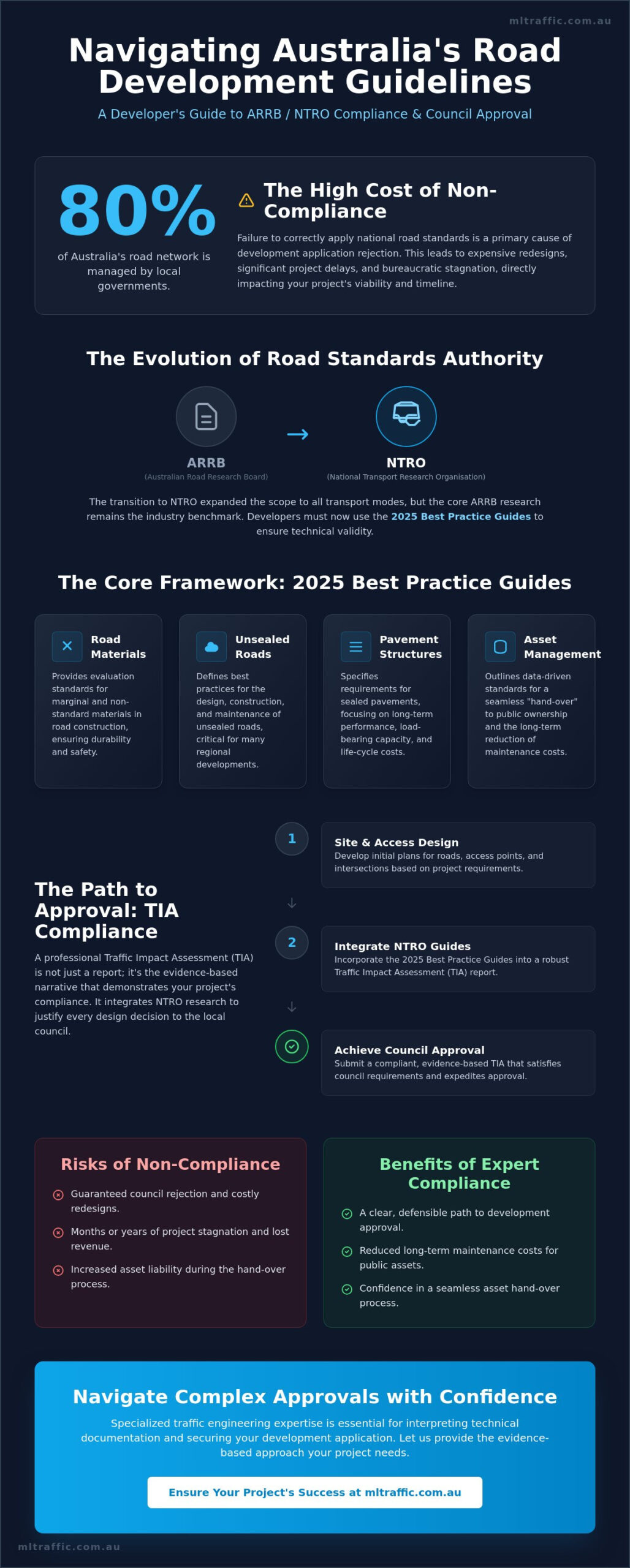
Local governments manage over 80% of Australia’s road network, which places the burden of technical compliance directly on the developer. Correctly applying the australian road research board (ARRB) guidelines for developers is the only way to ensure a site meets the rigorous standards required for local authority approval. We understand that interpreting these evolving documents can be difficult. Failure to comply often results in expensive redesigns and project stagnation. You need a reliable, evidence-based approach to secure your development application.
This article provides a detailed technical overview of these guidelines, now managed by the National Transport Research Organisation (NTRO). You’ll learn which 2025 Best Practice Guides apply to your specific infrastructure assets and how to achieve full Traffic Impact Assessment (TIA) compliance. We’ll preview the essential standards for road materials, unsealed roads, and pavement structures that satisfy council requirements. This guide ensures you have the technical knowledge to avoid bureaucracy and move your project toward a successful approval.
Key Takeaways
- Understand the transition from ARRB to the National Transport Research Organisation (NTRO) and how the 2025 Best Practice Guides dictate current infrastructure standards.
- Learn how to apply the australian road research board (ARRB) guidelines for developers to ensure road materials and site access designs meet national regulatory requirements.
- Discover how to leverage ARRB research data within a Traffic Impact Assessment (TIA) to justify intersection configurations and roundabout designs to local councils.
- Master the asset management standards necessary for a seamless “hand-over” process and the long-term reduction of maintenance costs for dedicated public assets.
- Identify why specialized traffic engineering expertise is essential for interpreting technical documentation and navigating complex bureaucratic approval pathways.
Introduction to ARRB (NTRO) Guidelines for Australian Developers
The National Transport Research Organisation (NTRO), formerly known as the Australian Road Research Board, is the central authority for transport research and infrastructure standards in Australia. For those in the property sector, the australian road research board (ARRB) guidelines for developers represent the technical foundation for all road-related infrastructure. These standards ensure that new developments integrate safely and sustainably with existing public networks. They aren’t just suggestions; they’re the benchmarks used by authorities to measure project viability.
Local councils use these guidelines to mitigate long-term maintenance risks and ensure public safety. Because local governments manage over 80% of the Australian road network, they demand strict adherence to these research-backed methods before granting project approvals. If you don’t reference the correct technical standards, your site access designs and intersection layouts will likely face rejection. This leads to costly delays and expensive redesigns that can stall a project for months.
To better understand the practical application of these standards, watch this overview of the Best Practice Guides workshop:
The Evolution of ARRB into NTRO
The 2022 transition to NTRO expanded the organisation’s scope beyond roads to encompass all transport modes. However, the original ARRB research remains the industry benchmark for road design and pavement engineering. Developers must now access the 2025 Best Practice Guides to ensure they’re using current specifications. For example, NT-G01.00-01:2025 provides the evaluation standards for marginal and non-standard materials in road construction. Using legacy documents instead of these updated versions can compromise your project’s technical validity during the assessment phase.
Regulatory Weight of ARRB Standards in DAs
Compliance is mandatory for large-scale commercial and residential developments. Councils use NTRO research to assess how a project impacts traffic flow and road durability. Applying the australian road research board (ARRB) guidelines for developers allows you to rely on a national framework rather than subjective local preferences. This alignment is critical for reducing asset liability during the hand-over to public ownership. It’s the most effective way to justify non-standard material usage or complex intersection designs. Recent trends also show an increased focus on sustainability, such as the NT-R01.00-01:2025 reference for embodied carbon in pavement structures, which many councils now monitor closely.
The Four Best Practice Guides Essential for Site Development
The technical framework for Australian road infrastructure relies on four core pillars. These are detailed in NTRO’s Best Practice Guides. For developers, these documents serve as the definitive reference for site design and material selection. Using the australian road research board (ARRB) guidelines for developers ensures that every asset, from the primary access road to internal culverts, meets the scrutiny of local government assessors. These guides provide a harmonized framework that replaces fragmented local standards with consistent, research-backed methods.
Adherence to these standards is critical during the design phase. Local authorities will not accept road assets that deviate from these best practices without substantial technical justification. The 2025 updates specifically address modern challenges like sustainability and data-driven asset management. A professional Traffic Impact Assessment will incorporate these specific guides to ensure your pavement designs and site access points are council-ready.
Guide 1 & 3: Road Materials and Sealed Pavements
Guide 1 (NT-G01.00-01:2025) focuses on the evaluation of marginal and non-standard materials. This is vital for developers looking to utilize cost-effective or recycled materials without compromising structural integrity. Guide 3 details the requirements for sealed roads. It provides the necessary formulas for determining pavement thickness based on projected traffic volumes and heavy vehicle use. You must ensure your internal road networks meet these national durability benchmarks to avoid premature failure. These guides also now include references like NT-R01.00-01:2025, which helps practitioners determine the embodied carbon for pavement structures, a metric increasingly requested by modern planning authorities.
Guide 2 & 4: Unsealed Surfaces and Infrastructure Management
Guide 2 (NT-G04.00-01:2025) is essential for regional developments or managing unsealed access roads during construction phases. It provides a standardized method for evaluating road conditions, ensuring that temporary surfaces remain safe and functional under heavy load. Guide 4 covers bridge management and culvert design. If your site includes internal drainage crossings or small-scale bridges, they must meet the structural integrity requirements outlined here. This guide emphasizes lifecycle management principles. It ensures that any infrastructure you contribute to the public network is designed for longevity and low maintenance. Councils rely on these ARRB standards to ensure that developer-contributed assets don’t become a financial liability for the community.
Integrating ARRB Standards into Traffic Impact Assessments (TIA)
A Traffic Impact Assessment is a technical defense of your project’s viability. It’s not just a checklist. By integrating the australian road research board (ARRB) guidelines for developers, we provide evidence-based justifications for site-specific infrastructure. This research provides the data necessary to justify complex intersection designs and roundabout configurations that local councils might otherwise question. It allows for a design that balances traffic throughput with the safety of all road users. We use this data to prove that your development won’t negatively impact the surrounding network.
ARRB research also plays a critical role in mitigating traffic-related environmental impacts. Standards for noise reduction and emissions management are derived from national transport data. When these are applied to internal site circulation, the result is a more efficient layout that minimizes idling and congestion. Safety research regarding pedestrian interfaces ensures that high-traffic commercial zones remain safe for vulnerable road users. This meticulous approach reduces the likelihood of costly redesigns during the council review phase.
Evidence-Based Design in TIA Reports
Council assessors often default to conservative, standard design solutions. However, site constraints frequently require a more nuanced approach. Citing ARRB research allows us to support non-standard designs, such as compact roundabouts for urban infill projects. We use national crash data and safety research to validate proposed access points. This demonstrates that the design meets safety benchmarks despite physical site limitations. This authoritative backing is essential for securing approvals for innovative or complex site layouts.
Future-Proofing for Electric and Autonomous Vehicles
Modern developments must account for the shift toward Electric Vehicles (EVs) and Connected and Automated Vehicles (CAVs). Current australian road research board (ARRB) guidelines for developers include research on EV charging infrastructure impacts on local grids and traffic flow. Site designs must now incorporate spatial requirements for CAVs. These technologies may eventually alter lane widths and parking configurations. By applying this research today, we ensure your development remains functional and compliant for decades. This forward-looking approach prevents the need for expensive structural retrofitting as transport technology evolves.
Achieving Council Compliance through Asset Management Standards
The hand-over process is the most critical phase of a development’s infrastructure lifecycle. This is the point where road assets are formally dedicated to public ownership. Local councils are notoriously risk-averse. They refuse to accept any infrastructure that doesn’t strictly adhere to the australian road research board (ARRB) guidelines for developers. By following these standards, you provide the technical evidence that your road network meets the structural and safety requirements demanded by local authorities. This adherence is the only way to avoid the significant financial burden of post-construction rectification.
We utilize the principles of the Strategic Local Government Asset Assessment Project (SLGAAP) to streamline this transition. This initiative focuses on creating a consistent framework for asset assessment across all Australian jurisdictions. Applying SLGAAP principles allows for a data-driven justification of road strength and capacity. It gives councils the necessary assurance that your infrastructure can handle projected heavy vehicle loads without immediate degradation. This technical alignment reduces long-term maintenance costs and facilitates a smoother approval process.
Longevity and Material Sustainability
Modern local authorities now prioritize environmental impact benchmarks alongside structural integrity. The 2025 Best Practice Guides provide the technical framework for using recycled crushed glass and crumb rubber in pavement construction. These materials must meet rigorous national durability benchmarks to satisfy the 20 to 50 year service life requirements typical of local government assets. We use these guidelines to prove that sustainable material choices don’t compromise the road’s lifespan. This ensures your project meets modern environmental targets while maintaining full technical compliance.
Risk Mitigation and Road Safety Audits
There is a direct technical relationship between ARRB research and the Road Safety Audit process. We use ARRB best practice checklists to identify design deficiencies during the initial planning stages. This proactive method ensures that sight distances, intersection layouts, and pedestrian interfaces are validated against national safety data before construction begins. Adhering to these standards significantly reduces developer liability. It minimizes the risk of council-mandated redesigns after the infrastructure is already in place. It’s a meticulous approach that ensures every asset is safe, compliant, and ready for public dedication.
For expert assistance with your project’s compliance requirements, speak directly with our engineering leadership.
Navigating Technical Requirements with Expert Traffic Consultancy
Interpreting the australian road research board (ARRB) guidelines for developers requires technical depth that goes beyond basic planning. A specialist Traffic Engineer provides the filter needed to apply these national standards to specific site constraints. Without this expertise, developers often face costly delays due to technical misalignments in their submission. ML Traffic Engineers Australia brings over 15 years of experience in national regulatory compliance to every project. We don’t just cite the guides; we apply the underlying data to secure approvals for complex commercial and residential developments.
The value of senior-level involvement can’t be overstated. Technical precision in the early stages prevents the bureaucratic friction that often stalls large-scale projects. We understand the nuances of how local authorities interpret NTRO research. This allows us to streamline the approval process by providing the evidence-based reporting councils require. It’s about delivering a submission that is technically unassailable from the first draft.
Our Approach to Technical Compliance
ML Traffic Engineers Australia provides direct access to senior principals. This ensures that the same expert who begins the assessment is the one performing the technical work. This continuity is vital for maintaining accountability throughout the DA process. We apply this senior-level scrutiny to every technical service, including:
- Traffic Impact Assessment (TIA) Report
- Vehicle Swept Path Analysis
- Car Parking Demand Assessment
- Traffic Guidance Scheme (TGS)
- Driveway Ramp Grade Assessment
- Intersection Analysis
- Sight Distance Assessment
- Car Park Design
- Waste Management Plan
Securing Your Development Approval
Securing approval requires translating complex road research into actionable site design. We provide the rigorous technical reporting needed for modern civil projects. Every Swept Path Analysis we conduct meets the current national standards. This precision minimizes the risk of council-mandated redesigns. Our role is to ensure your project meets every regulatory benchmark with absolute accuracy. For expert guidance on the australian road research board (ARRB) guidelines for developers on your next project, contact ML Traffic Engineers Australia to speak directly with our leadership team.
Secure Your Development Approval with Technical Precision
Adherence to the australian road research board (ARRB) guidelines for developers is the determining factor in project success and effective asset hand-over. These 2025 standards provide the objective evidence required to satisfy local government scrutiny and mitigate long-term infrastructure liability. By integrating research-backed pavement designs and safety-first intersection configurations, you ensure your development integrates seamlessly with the national transport network. This technical rigour is essential for avoiding the bureaucratic delays that compromise project timelines.
ML Traffic Engineers Australia provides the seasoned expertise necessary to navigate these complex regulatory requirements. With over 15 years of specialist traffic engineering experience and national coverage across all Australian jurisdictions, we deliver precise, compliant technical reporting. Our commitment to direct access to senior principals ensures that your project benefits from expert oversight and personnel continuity from inception to final council approval. This results-oriented approach provides the reliability needed for large-scale commercial and residential developments.
Contact our senior traffic engineers for a compliant TIA report to secure your project’s technical foundation. We look forward to facilitating your next development approval.
Frequently Asked Questions
What is the difference between ARRB and NTRO for developers?
The National Transport Research Organisation (NTRO) is the successor to the Australian Road Research Board (ARRB). For developers, this means the technical standards and best practice guides previously branded as ARRB are now published and updated by NTRO. While the legacy ARRB name remains common in industry documentation, the 2025 Best Practice Guides are the current versions you must reference for project approvals.
Are ARRB guidelines legally binding for private developments?
ARRB guidelines aren’t legislation themselves, but they become legally binding when mandated by local council planning schemes or development conditions. Councils use these standards as the technical benchmark to evaluate the compliance of road infrastructure before public dedication. Failure to adhere to these research-backed standards usually results in the rejection of your development application or the refusal of asset hand-over.
Which ARRB guide is most important for residential subdivisions?
The Best Practice Guide for Sealed Roads is typically the most critical document for residential subdivisions. It dictates the technical requirements for pavement thickness, material selection, and design life that satisfy council asset management standards. Correctly applying the australian road research board (ARRB) guidelines for developers in this category ensures that internal road networks can handle projected residential traffic volumes without premature failure.
How does ARRB research affect car park design and AS 2890 compliance?
ARRB research provides the evidence-based data used to refine Australian Standards like AS 2890. While AS 2890 sets the mandatory dimensions for parking modules and ramps, ARRB guidelines offer technical insights into pavement durability and drainage for high-turnover environments. Integrating both ensures your car park design is structurally sound and meets the operational requirements of local authorities and private operators alike.
Can developers use recycled materials in roads according to ARRB?
Yes, the 2025 Best Practice Guide for Road Materials (NT-G01.00-01:2025) explicitly covers the evaluation of marginal and non-standard materials. This includes the use of recycled crushed glass and crumb rubber in pavement structures. Developers can use these materials to meet sustainability targets, provided the technical assessment proves they meet the durability benchmarks required for the specific road hierarchy and traffic load.
How often are the ARRB Best Practice Guides updated?
Updates occur periodically as new transport research and material technologies emerge. The most recent major release of Best Practice Guides occurred in 2025. It’s critical to ensure your technical reports reference the current versions, as local councils often update their requirements immediately following a new NTRO release. Using outdated research can lead to technical deficiencies in your Traffic Impact Assessment.
Do I need a traffic engineer to interpret ARRB guidelines for my DA?
Yes, a specialist traffic engineer is required to translate these complex technical documents into actionable site designs. An engineer ensures the australian road research board (ARRB) guidelines for developers are correctly applied to your specific site constraints. This professional oversight is essential for producing the rigorous technical reporting and Swept Path Analysis that councils demand before granting a project approval.
What is the SLGAAP and does it apply to my project?
The Strategic Local Government Asset Assessment Project (SLGAAP) is a framework designed to create consistent asset assessment across Australian jurisdictions. It applies to any development project involving the hand-over of road infrastructure to local councils. SLGAAP principles help developers justify the structural capacity of their road assets, providing councils with the data-driven assurance they need to accept the infrastructure into the public network.

Disclaimer
The content on www.mltraffic.com.au, including all technical articles, guides, and resources, is provided for general informational and educational purposes only. It is not intended to constitute professional advice in traffic engineering, transportation planning, development approvals, or any other technical or legal field.
While ML Traffic Engineers makes every reasonable effort to ensure the accuracy, completeness, and timeliness of the information published, we do not provide any warranties or representations (express or implied) regarding its reliability, suitability, or availability for any particular purpose. Any reliance you place on the content is strictly at your own risk.
In no event shall ML Traffic Engineers, its directors, employees, authors, or affiliates be liable for any direct, indirect, incidental, special, consequential, or punitive damages (including, without limitation, loss of profits, data, or business opportunities) arising out of or in connection with the use of, or inability to use, any information provided on this website.
The articles and guides on this site are not a substitute for engaging a qualified, registered professional traffic engineer (such as an NPER or RPEQ engineer) to assess your specific project requirements. For tailored advice, compliance assessments, or traffic engineering services, please contact a competent professional.
This disclaimer may be updated from time to time without notice. By accessing or using this website, you agree to be bound by the most current version of this disclaimer.
