

A non-compliant site entry is often the single most expensive reason for a council planning rejection. You likely recognize the frustration of seeing a development stalled because of a technical mismatch between site plans and local authority expectations. Many developers face significant confusion when trying to navigate the overlap between Austroads standards for property development and the mandatory requirements of AS 2890.1:2004. Misinterpreting these technical frameworks leads to costly redesigns and delays that erode project margins.
This guide provides the technical clarity needed to master the Austroads framework. It ensures your access design meets national transport and safety requirements for successful planning approval. We will examine the latest updates to the Guide to Road Design (AGRD) Edition 5.2, published in March 2025, and clarify how to apply engineering judgment to constrained environments. You will learn how to communicate effectively with traffic engineers to achieve defensible design choices that satisfy council requirements from the first submission.
Key Takeaways
- Identify the specific sections of the Guide to Road Design (AGRD) that dictate site entry and road widening requirements for new developments.
- Navigate the technical boundary between Austroads standards for property development and AS 2890 parking standards to ensure compliance across the property line.
- Apply context-sensitive design principles and engineering judgment to move beyond minimum baselines and satisfy rigorous council approval criteria.
- Leverage specialized assessments, including Vehicle Swept Path Analysis and Intersection Analysis, to prove design viability in constrained urban environments.
- Gain direct access to senior engineering expertise to interpret complex regulatory frameworks and avoid the high costs of late-stage redesigns.
What are Austroads Standards in the Context of Property Development?
Austroads is the collective organization of Australian and New Zealand transport agencies. It serves as the primary source of technical expertise for the design, management, and operation of road networks. For developers, Austroads standards for property development represent the technical criteria that local councils use to assess planning applications. These standards ensure that any new site access or road frontage work maintains national infrastructure consistency and safety. Compliance isn’t optional; it’s a fundamental requirement for securing planning approval.
To better understand the fundamentals of this field, watch this helpful video:
The Guide to Road Design (AGRD) is the central pillar of this framework. It provides a standardized approach to geometric design, drainage, and pavement requirements. While councils often mandate compliance with these guides, the industry is moving away from rigid design limits. The current Edition 5.2 of the AGRD, updated in March 2025, emphasizes “context-sensitive design.” This approach allows designers to use engineering judgment to solve complex site constraints rather than following a one-size-fits-all rulebook. This flexibility is critical for high-density urban infill projects where space is limited and traditional design limits can’t be met.
The Legal and Regulatory Weight of Austroads
Austroads guides don’t exist in isolation. Most state transport authorities, such as Transport for NSW or Victoria’s Department of Transport and Planning, publish their own supplements that modify or add to the national guides. Compliance is typically a condition of your Development Application (DA). These standards form the technical foundation for a Traffic Impact Assessment (TIA) Report. If your design deviates from these standards without professional engineering justification, you face significant legal liability and a high probability of council rejection. Councils rely on these standards to ensure that private developments don’t negatively impact the safety or efficiency of the public road reserve.
Core Objectives: Safety, Economy, and Efficiency
Modern road design follows the “Safe System” approach. This philosophy aims to eliminate fatal and serious injuries by designing infrastructure that accounts for human error. In a property development context, this means ensuring sight distances are clear and vehicle movements don’t conflict with pedestrian paths. Developers must balance maximum project yield with these safety requirements. This balance requires meticulous planning and specialized assessments, such as Intersection Analysis or Sight Distance Assessments, to prove the site is functional. The AGRD functions as a framework for defensible engineering judgment in 2026, providing the technical evidence needed to support your design choices during the planning phase.
Key Sections of the Guide to Road Design (AGRD) for Developers
Navigating the full library of the Austroads Guide to Road Design is impractical for most developers. The complete set includes over 15 parts covering everything from drainage to bridge design. For property development, you must filter these down to the sections that govern site access, frontage upgrades, and internal road networks. Mastery of these specific volumes is essential to ensure Austroads standards for property development are met before council submission. Focus your technical review on Parts 3, 4, and 6 to address the most common reasons for planning delays.
AGRD Part 3: Geometric Design Essentials
Part 3 is the technical foundation for any development requiring road widening or new internal streets. It dictates the horizontal and vertical alignment of roads to ensure safety at designated speeds. A critical factor here is Safe Intersection Sight Distance (SISD). If your site boundary layout doesn’t account for SISD, you may lose significant developable area to achieve compliance later. Designers must also distinguish between the “Design Vehicle,” which is the largest vehicle navigating the site regularly, and the “Check Vehicle,” such as a fire truck, that must pass with limited clearances. Professional Intersection Analysis ensures these alignments are optimized for both safety and yield.
AGRD Part 4: Intersections and Driveway Access
Part 4 and its sub-parts (4A and 4B) govern how your development connects to the existing network. This section determines the functional hierarchy of your entry point. Councils use this to mandate specific turn treatments. For example, a high-volume commercial site on an arterial road might require a dedicated left-turn deceleration lane. Conversely, a smaller residential project might only need a simple left-in/left-out arrangement. For high-density developments, Part 4 provides the criteria to determine if a signalised entry is necessary or if a roundabout, governed by Part 4B and updated August 12, 2025, is a more efficient solution.
Part 6 focuses on the “Clear Zone” concept. This is the traversable area beyond the edge of the road that allows a driver to regain control of a vehicle. If your development places structures, steep batters, or landscaping within this zone, you must provide safety barriers. Ignoring these requirements late in the design phase leads to significant cost blowouts when expensive guardrails or impact attenuators become a council requirement for approval. Ensuring your Car Park Design integrates correctly with these roadside requirements is vital for a seamless planning process.
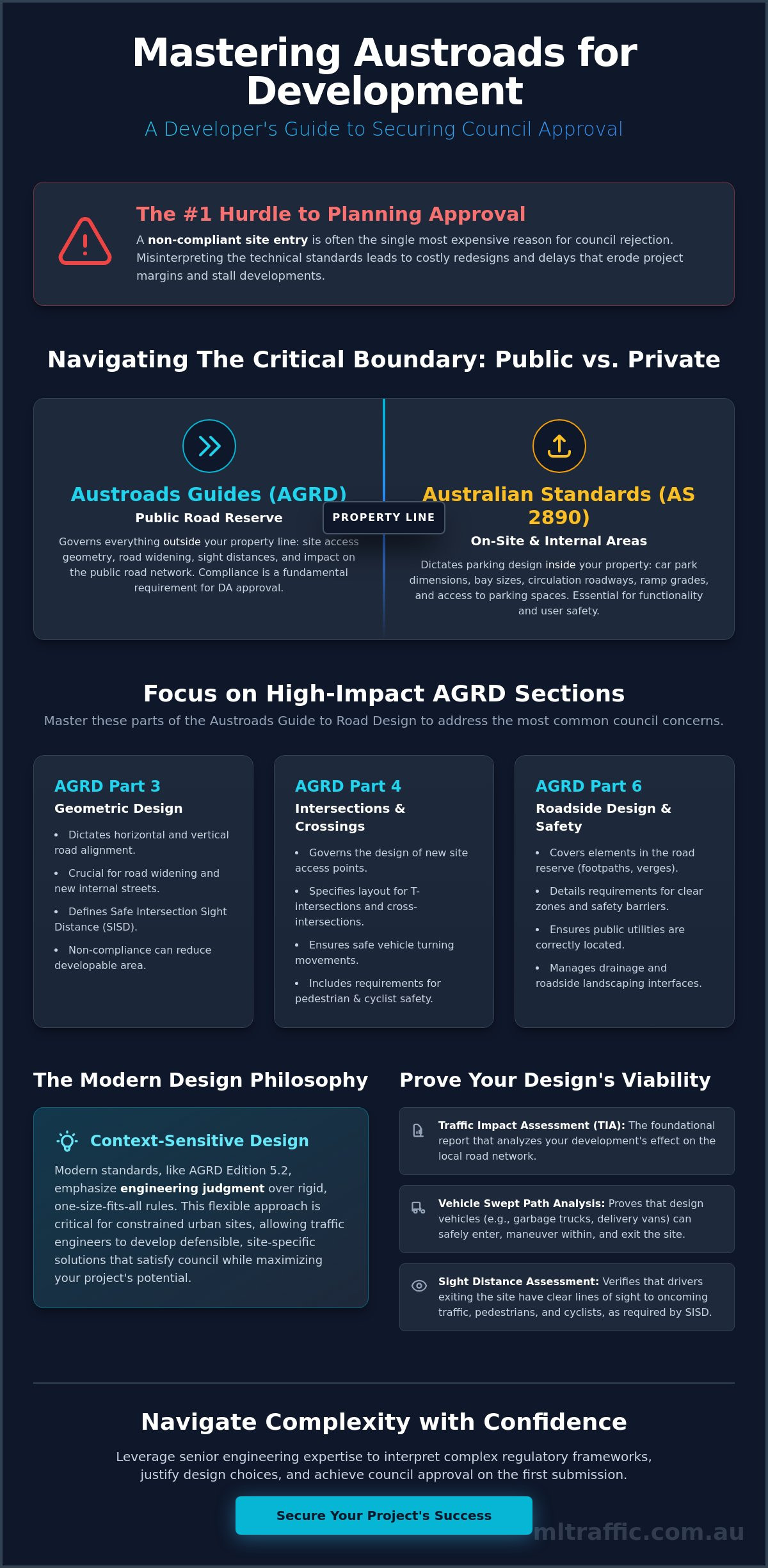
Austroads vs. Australian Standards (AS 2890): Navigating the Differences
Understanding where one regulatory framework ends and the other begins is vital for project compliance. The property line serves as the primary jurisdictional boundary. Inside the property line, Australian Standards (AS 2890) dictate the layout. Outside that line, within the public road reserve, Austroads standards for property development take precedence. It’s a common mistake to assume AS 2890 applies to the entire site entry. Misunderstanding this transition frequently leads to site access designs that councils reject because they fail to meet the performance requirements of the external road network.
The Scope of AS 2890 for Off-Street Parking
AS 2890 focuses exclusively on off-street parking facilities. It covers internal circulation, specific bay dimensions, and aisle widths. As of early 2026, AS/NZS 2890.1:2004 remains the primary reference for off-street car parking, though an updated version is expected within the year. This update will likely address the trend of increasing vehicle sizes by proposing longer standard parking bays. For commercial developments, AS 2890.2 governs the requirements for heavy vehicle loading areas. Additionally, AS 2890.6:2022 provides the mandatory standards for people with disabilities. Developers should consult the AS 2890.1 Explained Guide to ensure internal layouts maximize efficiency while remaining compliant.
The Scope of Austroads for Road Interface
While AS 2890 manages the “lot,” Austroads manages the “link.” This means the interface between your private driveway and the public kerb must adhere to the Guide to Road Design. This includes managing the transition of vehicle speeds and types from the high-speed road network into the low-speed environment of a car park. In many cases, Austroads requirements for driveway ramp grades and sight distances are more stringent than AS 2890. This is especially true when the development connects to an arterial road where safety risks are higher. You can’t rely on parking standards alone to justify a site entry design that impacts public traffic flow.
Successful planning approval requires seamless coordination between internal Car Park Design and external infrastructure. Conflicts often arise when local council-specific codes impose additional layers of regulation on top of national standards. For example, a council might demand a specific driveway width that contradicts the geometric requirements of AGRD Part 4. These discrepancies require professional engineering justification to resolve. Using a Driveway Ramp Grade Assessment ensures that the transition between the property and the road reserve is technically sound. This assessment proves that the ramp design meets the expectations of both the Australian Standards and the local road authority simultaneously.
Applying Context-Sensitive Design to Achieve Council Approval
Councils frequently demand designs that exceed baseline minimums to ensure long-term network safety and amenity. Adhering strictly to the lowest possible Austroads standards for property development might satisfy a basic checklist, but it often fails the merit-based assessment during the planning phase. Context-sensitive design allows for flexibility by prioritizing the specific environment over rigid numerical limits. This approach is particularly effective for urban infill projects where existing infrastructure or heritage constraints make standard alignments impossible. You must demonstrate that the proposed design is the most appropriate solution for the site’s unique constraints.
Achieving approval for a non-standard design requires more than just a well-drawn plan. It requires a technical argument supported by rigorous data. Councils are increasingly risk-averse. They need to see that every design choice is backed by a professional assessment of vehicle behavior and pedestrian safety. If your site is oddly shaped or features significant grade changes, standard templates won’t work. In these cases, you must provide defensible evidence that the design maintains the safety objectives of the Austroads framework while accommodating the site’s physical limitations.
Justifying Deviations from Standard Limits
When site topography or existing property boundaries prevent a designer from meeting “normally accepted limits,” engineering judgment becomes the primary tool for approval. You must document the specific risks associated with a non-standard design. This includes providing a detailed risk assessment that proves the proposed variation maintains a comparable level of safety to a standard design. A Traffic Impact Assessment serves as the formal vehicle for these justifications. It presents the technical evidence councils need to approve a design exception without compromising their own legal liability. This report must clearly outline why the standard cannot be met and how the alternative design achieves the same functional outcome.
The Role of Vehicle Swept Path Analysis
Proving that a tight turn or unconventional entry works in practice requires visual evidence. Swept Path Analysis is the industry standard for this task. By using AutoTURN simulations, designers can visualize the exact path of a design vehicle as it navigates the site. This is critical for ensuring that waste collection trucks and emergency vehicles meet national access standards. Councils rarely accept a design for a high-density development without seeing these simulations. They provide the technical certainty that a vehicle won’t clip a kerb or cross into opposing traffic lanes. Integrating these simulations into your final design package shows a level of meticulous planning that builds council confidence.
Effective communication with council traffic engineers is the final step in securing approval. When you present a design that uses context-sensitive principles, you’re inviting a discussion based on performance rather than just compliance. This requires a deep understanding of how different vehicle types interact with your site frontage. If you need assistance in preparing these technical justifications, you can contact our senior principals to discuss your specific project requirements.
Strategic Traffic Engineering: Navigating Austroads with ML Traffic
Interpreting Austroads standards for property development requires more than a cursory reading of the technical guides. In 2026, the increasing complexity of urban transport networks and the shift toward context-sensitive design demand a level of expertise that only comes from multi-decade professional longevity. ML Traffic Engineers Australia provides this through over 15 years of specialized experience in civil engineering and urban planning. We understand that a successful planning approval depends on technical accuracy and the ability to defend design choices against rigorous council scrutiny. By engaging experts who’ve navigated thousands of diverse project environments, you minimize the risk of technical errors that lead to costly redesigns.
Our firm operates on a “No Gatekeepers” philosophy. This means you have direct access to senior principals for every project. We don’t hand your technical work off to junior staff once the relationship is established. ML Traffic Engineers Australia ensures that the senior expert who initiates your project performs the technical analysis and remains your point of contact through to council approval. This personnel continuity promise ensures that the technical nuances of your Traffic Impact Assessment (TIA) are maintained throughout the entire planning process. It’s a hands-on, accountable approach that distinguishes our consultancy from larger, more impersonal firms.
Comprehensive Assessment Services
We provide an exhaustive range of technical services designed to address every aspect of the road-property interface. Whether your project requires a Driveway Ramp Grade Assessment or a complex Intersection Analysis, our team ensures full compliance with both AS 2890 and the relevant AGRD parts. Our expertise covers a vast range of practical experience across diverse land-use categories, including residential flat buildings, commercial warehouses, child care centers, medical clinics, and mixed-use developments. View our full range of Traffic Engineering Services to see how we can support your specific project environment.
Ready to Secure Your Planning Approval?
Proactive traffic engineering during the concept design phase is the most effective way to streamline the DA process. By identifying potential access issues early, we significantly reduce the likelihood of receiving a Request for Information (RFI) from the council. These delays are often expensive and avoidable with compliant, expert-led reporting. ML Traffic Engineers Australia ensures that your design is functional, safe, and defensible from the first submission. Contact our senior engineers today at the ML Traffic Contact Page to ensure your property development meets all national transport and safety requirements.
Securing Planning Approval Through Technical Excellence
Consolidating the technical requirements of the road-property interface is the final step toward a successful development application. You’ve seen how the jurisdictional boundary dictates the application of either internal parking standards or national road design guides. Successfully navigating Austroads standards for property development requires a balance of rigid compliance and defensible engineering judgment. Utilizing advanced technical assessments like Vehicle Swept Path Analysis provides the evidence councils need to approve designs in constrained urban environments where standard limits cannot be met.
ML Traffic Engineers Australia offers the depth of expertise needed to interpret these frameworks with precision. With over 15 years of experience and a commitment to direct access to senior leadership, we ensure your project moves through the planning phase without unnecessary friction. Our national coverage ensures that regardless of your development type, your reporting is robust and compliant with current national transport requirements. Expert oversight during the concept phase remains the most effective strategy to avoid costly RFI delays and redesigns.
While this technical guide focuses on Australian infrastructure, the principle of rigorous oversight extends to the operational phase of any real estate investment. Even for those operating in different markets, firms like TBM Property Management demonstrate how professional oversight ensures that a property continues to meet high standards and remains compliant long after the initial planning phase is complete.
Get expert advice on Austroads compliance for your development today to streamline your approval process and secure your project’s future. We’re ready to help you achieve a successful outcome for your next project.
Frequently Asked Questions
Are Austroads standards legally binding for all property developments?
Austroads guides become legally binding when a local council or state transport authority incorporates them into their planning codes or development consent conditions. While they are technical guides rather than legislation, non-compliance typically results in the rejection of a Development Application (DA). Developers must adhere to these standards to ensure the safety and efficiency of the public road interface. Compliance is a fundamental requirement for securing planning approval in every Australian jurisdiction.
What is the difference between Austroads Guide to Road Design and Australian Standards?
The primary difference lies in the jurisdictional boundary of the project. Australian Standards, specifically AS 2890, govern off-street parking facilities and internal circulation within the property line. The Austroads Guide to Road Design (AGRD) applies to the public road reserve and the interface between the private driveway and the street. Coordinating Austroads standards for property development with AS 2890 is essential for a compliant site entry and functional internal layout.
Do I need a traffic engineer to prove Austroads compliance for my DA?
Councils generally require a qualified traffic engineer to certify that a proposed design meets national standards. Professional engineering involvement is necessary to prepare technical documents such as a Traffic Impact Assessment (TIA) Report or a Vehicle Swept Path Analysis. These experts provide the defensible evidence needed to justify design choices and navigate complex regulatory requirements during the planning phase. Most councils won’t accept self-certified designs for complex access arrangements.
How does Austroads Part 3 impact my site boundary and set-backs?
AGRD Part 3 governs the geometric design of roads, which directly influences the required sight lines at a site entry. If a project requires road widening or specific intersection treatments, this can force building set-backs further into the lot. Failing to account for these horizontal and vertical alignment requirements early can lead to a significant loss of developable area once the council mandates compliance. Meticulous planning is required to balance building yield with these geometric constraints.
What is SISD and why is it critical for my development entry?
Safe Intersection Sight Distance (SISD) is the minimum distance a driver needs to see approaching traffic to safely enter or cross a road. It is a critical safety metric in Austroads standards for property development because it prevents high-speed collisions at access points. If a proposed driveway can’t achieve the required SISD due to landscaping, topography, or existing structures, the council will likely refuse the application on safety grounds. This distance is calculated based on the road’s operating speed.
Can I use a design that falls outside of Austroads normally accepted limits?
You can use a design that falls outside standard limits if you provide a rigorous technical justification. This process, known as context-sensitive design, requires a professional risk assessment to prove the alternative maintains an acceptable level of safety. You must document why the standard can’t be met and how the proposed variation functions within the specific constraints of the site. Councils require this documentation to be prepared by a senior traffic engineer to limit their own liability.
Does Austroads cover pedestrian and cyclist path design within a development?
Austroads provides specific guidance for active transport through Part 6A: Paths for Walking and Cycling. This section dictates the width, gradient, and surface requirements for shared paths and cycleways that interface with the development. Councils often mandate compliance with these parts to ensure that new developments integrate safely with the existing local pedestrian and bicycle networks. This is particularly important for high-density residential and commercial projects where pedestrian volumes are high.
How often are Austroads standards updated and which version should I use in 2026?
Austroads standards are updated periodically to reflect new research and safety trends. For projects in 2026, you should use the Guide to Road Design Part 1 Edition 5.2, which was published on March 21, 2025. Always check for recent supplements from state authorities, as they may have specific transition arrangements or additional requirements that override the national guide for certain project types. Using an outdated version can lead to an immediate Request for Information (RFI) delay.

Disclaimer
The content on www.mltraffic.com.au, including all technical articles, guides, and resources, is provided for general informational and educational purposes only. It is not intended to constitute professional advice in traffic engineering, transportation planning, development approvals, or any other technical or legal field.
While ML Traffic Engineers makes every reasonable effort to ensure the accuracy, completeness, and timeliness of the information published, we do not provide any warranties or representations (express or implied) regarding its reliability, suitability, or availability for any particular purpose. Any reliance you place on the content is strictly at your own risk.
In no event shall ML Traffic Engineers, its directors, employees, authors, or affiliates be liable for any direct, indirect, incidental, special, consequential, or punitive damages (including, without limitation, loss of profits, data, or business opportunities) arising out of or in connection with the use of, or inability to use, any information provided on this website.
The articles and guides on this site are not a substitute for engaging a qualified, registered professional traffic engineer (such as an NPER or RPEQ engineer) to assess your specific project requirements. For tailored advice, compliance assessments, or traffic engineering services, please contact a competent professional.
This disclaimer may be updated from time to time without notice. By accessing or using this website, you agree to be bound by the most current version of this disclaimer.
