
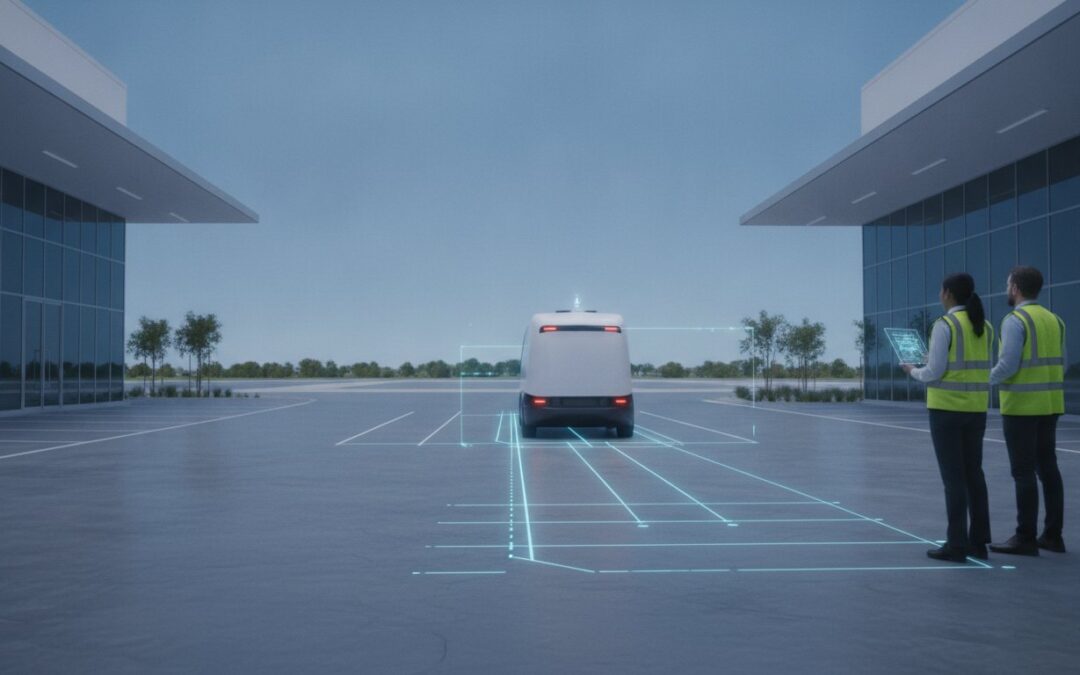
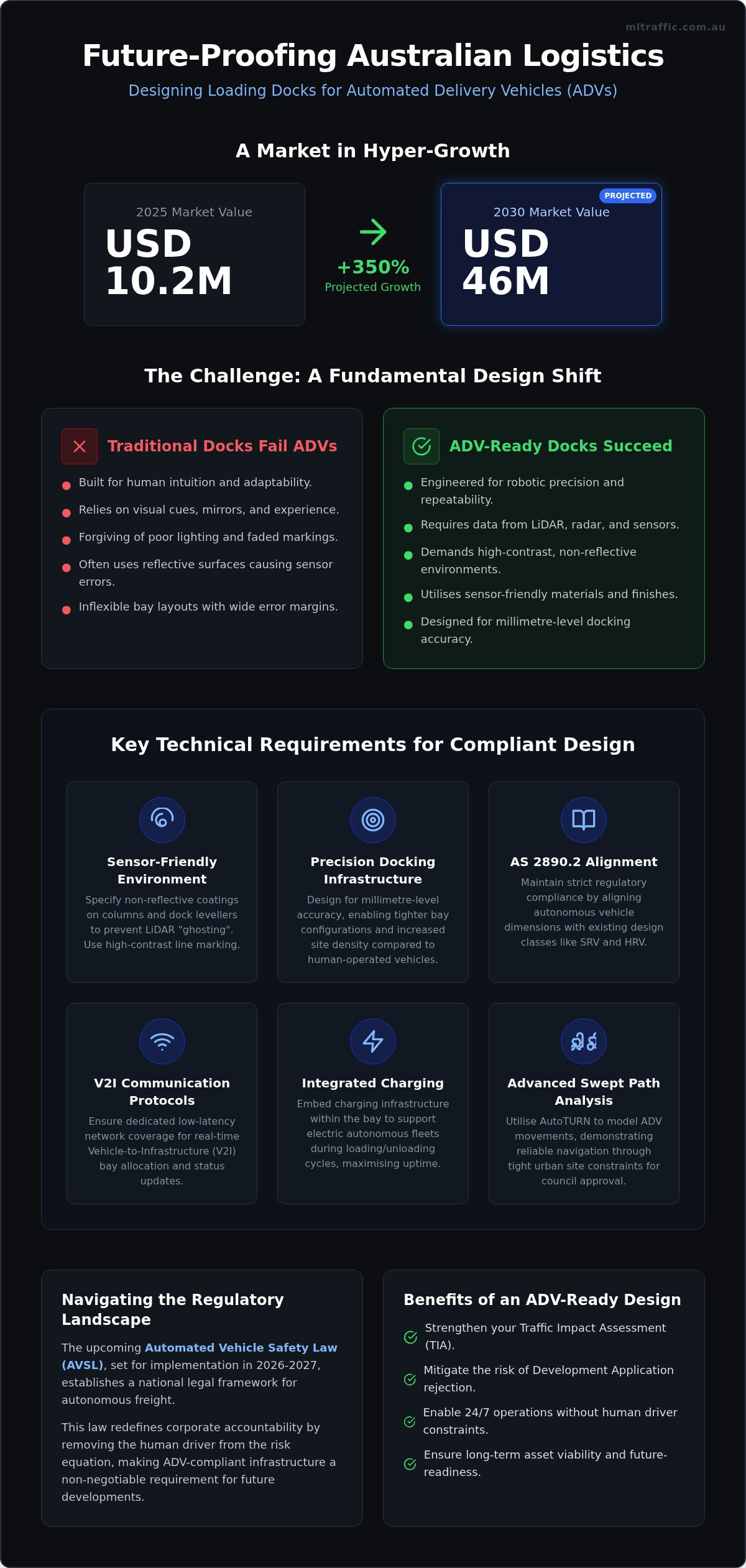
With the Australian delivery robot market projected to surge from USD 10.2 million in 2025 to nearly USD 46 million by 2030, your next commercial development cannot afford to ignore the rapid shift toward autonomous logistics. You probably recognise that traditional layouts are no longer sufficient, yet the uncertainty regarding how these vehicles interact with physical infrastructure creates a significant risk of DA rejection. Balancing human-operated machinery with robotic precision is a technical hurdle that requires more than just extra space.
This guide will show you how to future-proof your development’s logistics hub by integrating specific ADV requirements with strict Australian Standards. We’ll demonstrate how a compliant loading dock design for automated delivery vehicles relies on technical precision rather than guesswork. You’ll discover the importance of advanced swept path analysis using AutoTURN, the impact of the upcoming Automated Vehicle Safety Law (AVSL), and how to organise sensor-friendly environments that satisfy council scrutiny. By the end of this article, you’ll understand how to bridge the gap between innovative technology and the rigorous demands of AS 2890.2 compliance.
Key Takeaways
- Understand how the 2026-2027 implementation of the Automated Vehicle Safety Law (AVSL) will redefine operational requirements for autonomous freight across Australia.
- Optimise your loading dock design for automated delivery vehicles by selecting sensor-friendly materials and non-reflective finishes to ensure high-precision docking performance.
- Align autonomous vehicle dimensions with existing AS 2890.2:2018 design vehicle classes, such as SRV and HRV, to maintain strict regulatory compliance.
- Utilise AutoTURN for precise vehicle swept path analysis to demonstrate how ADVs navigate tight urban site constraints more reliably than human-operated trucks.
- Strengthen your Traffic Impact Assessment (TIA) by documenting ADV-ready infrastructure to mitigate the risk of DA rejection and ensure long-term asset viability.
The Evolution of Automated Delivery Vehicles (ADVs) in Australian Logistics
Australia is currently witnessing a transition from trial-based autonomous operations to a regulated commercial landscape. The introduction of the Automated Vehicle Safety Law (AVSL) in 2026-2027 provides the necessary legal framework for corporate accountability; it’s a shift that removes the human driver from the risk equation. This transition accelerates the demand for specialised loading dock design for automated delivery vehicles, as these assets must now operate within environments that facilitate robotic precision. With the broader autonomous vehicle market valued at USD 1.7 billion in 2025, the pressure on physical infrastructure to keep pace with software capabilities has never been higher.
Automation fundamentally alters loading frequency and ‘just-in-time’ delivery cycles. Without the constraints of human driver fatigue and mandatory rest periods, autonomous fleets can operate 24/7. This increases the rotation rate at the bay, requiring a logistics hub that can handle rapid, repeatable arrivals. Integrating Automated Truck Loading Systems (ATLS) with ADV arrival protocols ensures that the efficiency gained on the road is maintained at the facility. Our team at ML Traffic Engineers Australia focuses on ensuring these high-frequency movements don’t create internal site congestion or safety conflicts through our traffic engineering services.
Types of Automated Vehicles Entering the Supply Chain
The supply chain now accommodates a diverse range of autonomous hardware. Autonomous Light Commercial Vehicles (ALCVs) are becoming the standard for urban distribution, while heavy-duty autonomous prime movers are being deployed for interstate freight between major hubs. Micro-mobility robots represent a different challenge; these smaller units require specific kerbside access points and dedicated charging zones that differ from traditional heavy vehicle bays. Each category requires a distinct loading dock design for automated delivery vehicles to ensure the physical interface matches the vehicle’s technical steering and braking profile.
Why Traditional Loading Docks Fail Automated Drivers
Traditional docks fail because they are built for human intuition. Human drivers can compensate for poor lighting, faded line marking, or slightly non-compliant gradients. Automated systems cannot. Sensors and LiDAR require high-contrast, non-reflective environments to operate at peak safety. Inflexible bay configurations often lack the precision docking tolerances required by AI, which operates with a much smaller margin of error than a person. Without sensor-readable signage and clear lines of sight, an ADV may fail to dock entirely, leading to operational delays and potential DA compliance issues during council assessment.
Technical Requirements for Automated Loading Dock Design
Precision docking is the foundation of autonomous logistics. Unlike human drivers who rely on visual cues and mirrors, ADVs utilise LiDAR, radar, and ultrasonic sensors to navigate. This requires a loading dock design for automated delivery vehicles that prioritises millimetre-level accuracy. AI algorithms significantly reduce the margin of error, which allows for narrower bay widths and increased site density if the infrastructure supports it. This transition from human-centric to machine-centric design is further explored in this comprehensive loading dock design guide, which highlights the necessity for integrated restraint systems.
Material selection is critical to prevent sensor interference or signal absorption. Engineers must specify non-reflective coatings on structural columns, bollards, and dock levellers to avoid “ghosting” in LiDAR point clouds. Communication protocols, specifically Vehicle-to-Infrastructure (V2I), are also mandatory. The dock area requires dedicated low-latency network coverage to facilitate real-time bay allocation and status updates between the vehicle and the warehouse management system. Additionally, integrated charging infrastructure must be embedded within the bay to support electric autonomous fleets during the loading cycle.
Spatial Optimisation and Bay Configuration
Precision steering profiles allow for tighter spatial tolerances. You can maximise the number of bays by reducing the traditional buffer zones required to accommodate human steering variance. However, vertical clearance requirements often increase. Many ADVs feature roof-mounted sensor arrays that extend beyond the height of a standard truck cab. Automated levellers and vehicle restraints must interface directly with the vehicle’s onboard computer to confirm a safe lock before any freight movement begins. This level of integration ensures that the dock operates as a single, synchronised unit.
Sensor-Friendly Environments
Computer vision systems require different environmental conditions than human sight. High-contrast ground markings and embedded RFID tags provide essential redundant positioning data for the vehicle’s AI. Lighting must remain consistent across the apron to avoid deep shadows or glare that can confuse optical sensors. Since heavy rain or extreme weather can lead to sensor degradation, covered dock designs are no longer optional; they’re a requirement for maintaining 24/7 operational reliability. If you’re currently in the planning phase, our team can provide a specialised car park design assessment to ensure your facility meets these evolving technical benchmarks.
Navigating AS 2890.2 and ADV Compliance in Australia
Compliance in the Australian market currently rests on AS 2890.2:2018. This standard governs off-street commercial vehicle facilities and provides the geometric requirements for Small (SRV), Medium (MRV), and Heavy Rigid Vehicles (HRV). While the physical dimensions of most autonomous fleets align with these existing categories, the loading dock design for automated delivery vehicles must account for technical nuances that the current standard doesn’t yet address. Professional certification is mandatory to ensure that high-tech logistics hubs remain compliant while pushing the boundaries of traditional site layouts.
Local council regulations often lag behind the rapid adoption of ADV technology. Many planning schemes still mandate human-centric infrastructure, such as specific pedestrian sightlines or manual signal controls, which may be redundant or even obstructive for AI-driven systems. A Whole Building Design Guide on Loading Dock Design emphasises that while foundational safety remains constant, the integration of technology requires a flexible approach to standard codes. Relying on outdated interpretations can lead to DA rejections or costly retrofitting once the Automated Vehicle Safety Law (AVSL) becomes fully operational across Australia in 2026-2027.
Compliance Challenges for Autonomous Fleets
Manoeuvring space is one of the most contentious areas in modern dock design. Because automation allows for repeatable, centimetre-perfect turning circles, there’s a technical argument for reducing apron space to maximise site yield. However, mixed-use environments where robots and humans co-exist require robust safety barriers and clear physical separation. Standardised bay widths might also conflict with the specific needs of robotic loaders or side-loading ADVs. Engineers must balance these technical efficiencies with the safety mandates of AS 2890.2 to satisfy both operational goals and regulatory requirements.
The Role of the Traffic Engineer in Compliance
Experienced traffic engineers act as the bridge between innovation and regulation. We interpret council planning schemes to find opportunities for forward-thinking developments that won’t be obsolete in five years. This often involves justifying deviations from standard codes by providing data-driven evidence of technological precision. If a site can demonstrate superior safety through AI-controlled movements, councils are more likely to approve non-standard configurations. Learn more about our Car Park Design services to see how we integrate these requirements into your next project submission.
Optimising Site Access and Swept Path Analysis for ADVs
Accessing a site autonomously requires more than just meeting the minimum widths prescribed in AS 2890.2. It demands a sophisticated understanding of how AI interprets the physical environment. While human drivers exhibit high variance in their approach angles and braking distances, ADVs provide predictable, repeatable steering profiles. This consistency allows engineers to refine loading dock design for automated delivery vehicles by narrowing the margin of error. However, this precision is only achievable if the site access points are designed to accommodate the specific sensor limitations and communication needs of the vehicle.
The transition period between 2026 and 2034 will involve mixed traffic environments where human-driven trucks and autonomous robots share the same driveway. This creates a complex risk profile that traditional traffic reports often overlook. Designs must prioritise physical separation or advanced signalisation to prevent conflict. Entry and exit points need to be optimised to minimise dwell time on public road networks, ensuring that autonomous queueing doesn’t impact local traffic flow or trigger council complaints regarding site congestion.
Precision Manoeuvring with AutoTURN
We utilise AutoTURN software to simulate the exact turn-in requirements for automated prime movers. Unlike standard swept path assessments that assume a human driver’s steering behaviour, autonomous simulations focus on the vehicle’s specific algorithmic pathing. This allows us to reduce ‘dead space’ in the yard, potentially increasing the land available for storage or additional bays. For a deeper look at how these assessments facilitate development approval, see A Developer’s Guide to Swept Path Analysis. Our team ensures that every loading dock design for automated delivery vehicles is validated against these high-accuracy steering profiles.
Access Control and Gate Integration
Unmanned vehicles require automated gate triggers that interface with the vehicle’s onboard communication system. Standard proximity cards or manual intercoms are insufficient. Access control must be integrated into the site’s digital twin or warehouse management system to facilitate seamless entry. Queue management and holding areas are also vital for high-volume sites to prevent sensor ‘blindness’ caused by vehicle bunching. We also conduct rigorous sight distance assessments at site egress to ensure autonomous sensors have an unobstructed view of oncoming traffic, satisfying both safety requirements and council standards. Our senior principals provide a direct Vehicle Swept Path Analysis to validate these critical access points during the design phase.
Securing Council Approval with a Future-Proof Traffic Report
The Development Application (DA) process is the final hurdle for any innovative logistics project. While the technicalities of loading dock design for automated delivery vehicles are essential for operational success, those innovations are only valuable if they pass council scrutiny. A Traffic Impact Assessment (TIA) Report is the primary document used to bridge the gap between your development’s operational goals and the local government’s regulatory requirements. ML Traffic Engineers Australia provides meticulous, results-oriented documentation that addresses the specific concerns of planning authorities, ensuring your project isn’t stalled by bureaucratic uncertainty.
Presenting ADV-ready designs to councils requires a shift in how you communicate risk and safety. Councils often harbour concerns regarding the unknown impacts of autonomous freight, particularly regarding noise, safety, and traffic volume. Our reports mitigate these concerns by providing data-driven evidence of robotic precision. Senior principal involvement is vital for these complex projects; having an expert with over 15 years of experience directly handling your assessment adds a layer of authority that smaller, less experienced firms cannot replicate. It’s about demonstrating that the precision discussed in previous sections translates into a safer, quieter environment for the community.
The Components of a Modern TIA Report
A modern TIA must analyse the impact of 24/7 autonomous operations on local traffic flow. Since ADVs can operate outside of peak hours, we demonstrate how this actually reduces the burden on the local road network during high-congestion periods. We use rigorous swept path and sight distance data to prove that an autonomous fleet can navigate the site more safely than human drivers. If you require professional documentation for your project, you can Contact our senior engineers for a TIA quote. This direct access to leadership ensures that the expert who starts your project is the one who completes the technical work.
Future-Proofing Your Development Application
Building flexibility into your design is the most effective way to accommodate evolving vehicle types. As the market grows toward the USD 45.9 million projection for 2030, your site must remain functional for both current and future autonomous hardware. A professional Traffic Engineer acts as your advocate during council negotiations, justifying deviations from standard codes based on the demonstrated precision of your loading dock design for automated delivery vehicles. Early-stage traffic engineering doesn’t just ensure compliance; it saves significant costs by preventing expensive retrofits. Engaging with our senior principals early in the design phase ensures your logistics hub is dependable, compliant, and ready for the next decade of Australian freight.
Future-Proofing Your Logistics Hub for Autonomous Freight
The transition toward autonomous delivery systems is no longer a theoretical concept; it’s a technical requirement for modern Australian developments. Operational success depends on moving beyond human-centric layouts and adopting a machine-readable approach to infrastructure. This involves precise material selection to prevent sensor interference and rigorous adherence to AS 2890.2:2018 standards. A compliant loading dock design for automated delivery vehicles ensures that your facility remains functional as the industry moves toward the projected 2030 market growth.
By integrating expert AutoTURN analysis for precise ADV pathing and leveraging over 15 years of successful council approvals, you can mitigate the risk of DA rejection. Our senior traffic engineering principals provide direct oversight on every project to guarantee technical accuracy and personnel continuity. Secure your project’s future with a professional Traffic Impact Assessment from ML Traffic Engineers Australia. Your development is ready to lead the next generation of Australian logistics.
Frequently Asked Questions
Does AS 2890.2 specifically cover automated delivery vehicles?
AS 2890.2:2018 does not currently contain specific provisions for automated delivery vehicles. It was developed for human-operated commercial vehicles. While the standard provides the geometric baseline for Small, Medium, and Heavy Rigid Vehicles, designers must apply additional technical layers to accommodate robotic sensors. We ensure your facility meets the minimum legal requirements while integrating the precision tolerances required for autonomous operations.
Can automated vehicles use smaller loading bays than standard trucks?
While ADVs offer higher precision, you must still adhere to the bay dimensions specified in AS 2890.2 for regulatory compliance. Robotic systems reduce the margin of steering error, which might allow for tighter spatial configurations in private yards. However, councils generally require standard bay widths to ensure the site remains accessible to non-autonomous fleets. We help you balance these technical efficiencies with strict planning requirements.
How does swept path analysis change for autonomous vehicles?
Swept path analysis for autonomous vehicles moves away from assuming human steering variance. We use AutoTURN to simulate the exact, repeatable steering profiles programmed into the vehicle’s AI. This high-accuracy pathing is a fundamental component of loading dock design for automated delivery vehicles. It allows us to identify where dead space can be reduced while ensuring the vehicle never makes contact with structural columns or bollards.
What are the main safety concerns for mixed human and robot loading docks?
Safety in mixed-use environments centres on the interaction between unpredictable human behaviour and robotic logic. Key measures include physical separation through safety barriers and high-contrast ground markings that sensors can easily detect. You must also consider V2I communication to manage bay allocation. Ensuring that optical sensors aren’t blinded by glare or deep shadows is vital for maintaining a safe environment for everyone on the site.
Do I need a special traffic report for a site using autonomous vehicles?
You require a specialised Traffic Impact Assessment (TIA) Report that specifically addresses autonomous logistics. Standard reports often fail to account for 24/7 delivery cycles or the unique communication requirements of ADVs. Our senior principals prepare detailed assessments that document how your site manages robotic traffic. This professional documentation is essential for securing council approval and demonstrating that the development meets all Australian safety standards.
Can automated delivery vehicles improve the traffic impact on surrounding roads?
ADVs can significantly improve traffic impact by shifting delivery schedules to off-peak periods. Because these vehicles don’t require human drivers, they can operate overnight or during mid-day lulls when road capacity is highest. This reduces the development’s contribution to peak-hour congestion. Documenting this shift in your TIA provides a compelling argument for council approval, showing a net benefit to the surrounding road network.
How do I ensure my loading dock sensors don’t experience interference?
Preventing interference requires careful material selection during the design phase. You should specify non-reflective coatings for all structural elements, including bollards and dock levellers, to avoid LiDAR ghosting. Consistent, high-contrast lighting is also necessary for optical sensors. A loading dock design for automated delivery vehicles should also include covered aprons to protect sensors from rain or extreme weather, which can lead to signal degradation.
Will councils approve a design that deviates from standard dimensions if I use ADVs?
Councils may approve deviations if you provide data-driven evidence that safety isn’t compromised. You must use precise swept path analysis to prove that the autonomous system can navigate tighter dimensions more reliably than a human driver. This justification requires a high level of professional expertise. Our senior principals have 15 years of experience in council negotiations, helping developers secure approvals for innovative designs that push beyond traditional standards.

Disclaimer
The content on www.mltraffic.com.au, including all technical articles, guides, and resources, is provided for general informational and educational purposes only. It is not intended to constitute professional advice in traffic engineering, transportation planning, development approvals, or any other technical or legal field.
While ML Traffic Engineers makes every reasonable effort to ensure the accuracy, completeness, and timeliness of the information published, we do not provide any warranties or representations (express or implied) regarding its reliability, suitability, or availability for any particular purpose. Any reliance you place on the content is strictly at your own risk.
In no event shall ML Traffic Engineers, its directors, employees, authors, or affiliates be liable for any direct, indirect, incidental, special, consequential, or punitive damages (including, without limitation, loss of profits, data, or business opportunities) arising out of or in connection with the use of, or inability to use, any information provided on this website.
The articles and guides on this site are not a substitute for engaging a qualified, registered professional traffic engineer (such as an NPER or RPEQ engineer) to assess your specific project requirements. For tailored advice, compliance assessments, or traffic engineering services, please contact a competent professional.
This disclaimer may be updated from time to time without notice. By accessing or using this website, you agree to be bound by the most current version of this disclaimer.
