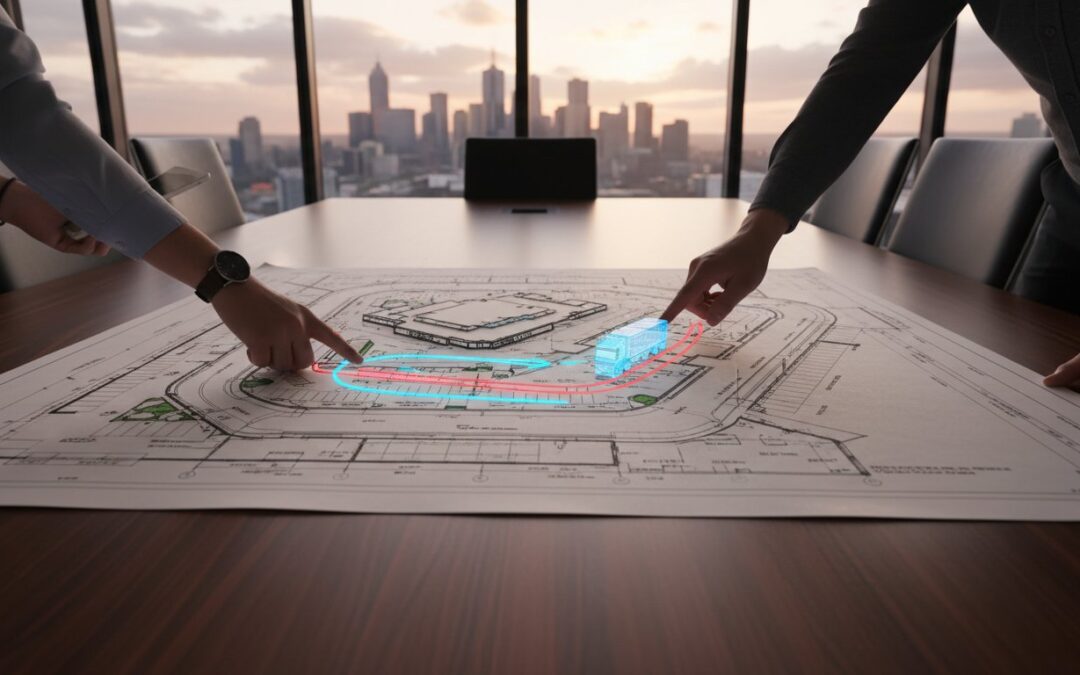
A single miscalculation in your vehicle turning paths can trigger a total council rejection, forcing expensive redesigns after you’ve already committed to a site layout. You likely understand that meeting the rigid requirements of AS 2890.1 and AS 2890.2 is the most technical hurdle in the development application process. Utilizing a professional AutoTurn swept path Sydney assessment ensures your project meets these benchmarks. Since 2005, ML Traffic Engineers has assessed over 10,000 sites to ensure they pass council review without delay.
Our goal is to help you master these technical requirements and secure council approval on your first attempt. Our senior engineers personally handle every assessment to guarantee accuracy. This article provides the technical clarity needed to ensure your site design is functional and compliant from the start. We will examine how to provide clear evidence of safe heavy vehicle maneuvering and ensure your design remains fully compliant with national parking and access standards to avoid costly post-construction modifications.
Key Takeaways
-
Learn why professional AutoTurn swept path Sydney simulations are the industry standard for securing council approval and ensuring your site layout accommodates specific vehicle movements.
-
Understand the critical technical differences between AS 2890.1 for light vehicles and AS 2890.2 for commercial heavy vehicles to maintain full regulatory compliance.
-
Identify high-risk site plan scenarios early in the design phase to prevent expensive architectural revisions and technical objections from local authorities.
-
Discover how professional engineering certification eliminates the risk of "Requests for Further Information" (RFI) delays and provides the legal weight required for successful development applications.
Table of Contents
-
The Role of AutoTurn Swept Path Analysis in Modern Development Applications
-
Technical Capabilities: How AutoTurn Models Real-World Vehicle Maneuvers
-
Critical Scenarios Requiring Professional Turning Path Assessments
-
Why Professional Engineering Certification is Non-Negotiable
The Role of AutoTurn Swept Path Analysis in Modern Development Applications
Swept path analysis is the technical calculation of the horizontal and vertical space a vehicle requires while performing a turn. It maps the envelope created by the vehicle’s body, wheels, and any specific overhangs. In the context of AutoTurn swept path Sydney requirements, this analysis ensures that proposed driveways, loading docks, and car parks are functional and safe. Traffic engineering consultants rely on swept path analysis software to replace the manual, less accurate methods used in previous decades.
ML Traffic Engineers has provided these technical assessments since 2005, supporting over 10,000 sites across Australia. This digital modeling is a critical part of the Traffic Impact Assessment process. It provides developers and architects with immediate feedback on whether a design complies with Australian Standard AS 2890.1 or specific Council requirements for heavy vehicle access.
To better understand how these simulations work in practice, watch this technical demonstration:
Why Councils Demand Professional Swept Path Simulations
NSW Councils require rigorous verification that service vehicles, such as 12.5m heavy rigid trucks or 9.6m waste collection vehicles, can operate without obstructing public roads. These simulations confirm that a vehicle can enter and exit a site in a forward direction, which is a standard safety mandate. Professional analysis also identifies potential conflict points between vehicles and pedestrians, reducing the risk of accidents within high-traffic developments like mixed-use towers or child care centres.
The Limitations of Static Turning Templates
Traditional 2D paper templates are static and fail to account for the dynamic nature of vehicle movement. They don’t reflect how steering lock angles change at different speeds or how a driver manages a three-point turn in a confined basement. An AutoTurn swept path Sydney assessment provides a 3D perspective that accounts for vehicle overhangs and chassis ground clearance. This is vital for developments with steep driveway ramps, where a simulation can predict if a car will scrape its undercarriage before a single cubic metre of concrete is poured.
Technical Capabilities: How AutoTurn Models Real-World Vehicle Maneuvers
AutoTurn utilizes a robust library of vehicle profiles defined by Australian Standards AS 2890.1 and AS 2890.2. This database allows us to simulate exact movements for everything from a standard B99 passenger car to a 19m semi-trailer. The difference in space requirements is stark. A B99 car, measuring roughly 5.2m in length, requires a significantly tighter turning circle than an 8.8m Medium Rigid Vehicle (MRV). The MRV is the benchmark for most Sydney waste collection and delivery zones, and its larger wheelbase necessitates a much wider swept path to avoid mounting kerbs or striking structures.
Our modeling accounts for lock-to-lock steering time. This is the time a driver takes to turn the steering wheel from one limit to the other. For an MRV, we typically assume a 6-second steering time. If this isn’t factored in, the simulation produces an unrealistic, sharp turn that a real driver couldn’t replicate. This oversight often leads to designs that fail in practice. We also integrate 3D clearance analysis. This is vital for Sydney basement car parks where low-hanging pipes, sprinkler heads, or structural beams often create clearance issues for vehicles exceeding 2.2m in height. Professional AutoTurn swept path Sydney assessments ensure these vertical constraints are identified before construction begins.
Simulating Heavy and Multi-Part Vehicles
Articulated Vehicles (AV) present unique challenges due to off-tracking. This occurs when the trailer wheels follow a shorter path than the tractor unit during a turn. AutoTurn models this complexity for industrial loading docks and freight terminals. We customize dimensions for specialized vehicles, including fire trucks and heavy rescue units, to ensure emergency access complies with specific council requirements. Our engineers use these simulations to verify that heavy vehicles can enter and exit a site in a forward direction, a common requirement for high-traffic developments.
Visualizing Clearance Zones and Safety Margins
There’s a critical distinction between the wheel path and the body swept path. The vehicle body often overhangs the wheels by several hundred millimeters. Most Sydney councils require a 300mm safety margin outside the body swept path to account for operational variances and driver error. This buffer ensures designs are practical and safe. Our AutoTurn swept path Sydney services identify these margins early to prevent costly redesigns. We also use the software to identify blind spots in driveway and intersection designs, ensuring that sight-lines meet the safety criteria specified in AS 2890.1.
By simulating these real-world variables, we provide developers with the certainty that their designs are both compliant and functional. If you need to verify your site’s accessibility, contact our senior engineers for a detailed assessment.
Achieving Compliance with AS 2890.1 and AS 2890.2 Standards
Compliance with Australian Standards is the mandatory baseline for any development application in New South Wales. AS 2890.1 governs off-street car parking for light vehicles, establishing the minimum requirements for bay widths, aisle dimensions, and blind aisle extensions. For commercial or industrial sites, AS 2890.2 sets the criteria for commercial vehicle facilities, ensuring heavy vehicles can navigate the site safely. An AutoTurn swept path Sydney assessment provides the technical evidence that a proposed design meets these rigid standards before construction begins.
Swept path analysis proves that a vehicle’s body and wheels won’t encroach on restricted areas or strike physical obstructions like structural columns. We use these simulations to verify that aisle widths are sufficient for the turning circles required by the specific vehicle classes assigned to the project. For a deeper look at these requirements, refer to our AS 2890.1 guide, which details how to integrate these standards into your initial design phase.
-
Verification of B85 and B99 vehicle maneuvers for residential and commercial car parks.
-
Assessment of aisle widths against the minimums specified in AS 2890.1 Table 1.1.
-
Confirmation of clearance for Medium Rigid Vehicles (MRV) and Heavy Rigid Vehicles (HRV) in service areas.
Driveway Ramp Grades and Access Transitions
It’s common for vehicles to bottom out when moving from a level street onto a steep driveway ramp. AS 2890.1 mandates specific gradients and transition zones to prevent damage to vehicle undercarriages. Our engineers combine AutoTurn swept path Sydney data with detailed longitudinal sections to certify these transitions. Councils expect to see these sections alongside turning path diagrams to ensure the ramp profile accommodates the design vehicle’s wheelbase and front or rear overhangs without conflict.
Loading Dock and Service Area Functionality
AS 2890.2 dictates that heavy vehicles must enter and exit a site in a forward direction. Reversing maneuvers should occur entirely within the private property boundaries to maintain road safety. We use software simulations to prove that a vehicle can perform its required turns without crossing into oncoming lanes or hitting loading docks. A traffic engineer’s certification confirms that these service areas are functional and meet the operational demands of the specific land use, whether it’s a warehouse or a retail center.
Critical Scenarios Requiring Professional Turning Path Assessments
Sydney councils scrutinize site plans for "tight spots" that hinder vehicle movement. High-risk areas like steep driveway ramps and narrow street frontages are primary targets for RFI (Request for Further Information) letters. Conducting an AutoTurn swept path Sydney assessment during the initial design phase prevents costly architectural redesigns. You can view our full list of traffic services to understand how swept path analysis integrates with broader Traffic Impact Statements.
Basement Car Parks and Tight Urban Sites
Basement car parks in high-density residential developments present the greatest risk of non-compliance. We verify B99 and B85 vehicle accessibility for every designated parking space, ensuring columns, ramps, and narrow aisles don’t create dead zones. Our engineers optimize parking layouts to maximize yield without compromising the maneuverability required by AS 2890.1. This technical validation is essential for sites with limited footprints where every centimeter of clearance matters.
Mixed-Use Developments and Shared Access
Shared access zones in mixed-use developments create safety risks between residents and commercial operators. We use AutoTurn to model different vehicle classes, ensuring delivery routes don’t overlap dangerously with pedestrian or residential paths. Waste collection points are a major focus; councils require proof that waste trucks can enter and exit in a forward direction without multiple-point turns that block traffic. We model Small Rigid Vehicles (SRV) and Medium Rigid Vehicles (MRV) to confirm these routes are functional and safe.
How to Prepare for Your Swept Path Analysis
Efficient assessments require clean data to meet strict council deadlines. Follow these steps to prepare your project for our traffic engineering team:
-
Step 1: Provide accurate CAD site plans in DWG format. These must show clear boundary lines, structural columns, and any proposed landscaping.
-
Step 2: Identify the largest vehicle expected to access the site. This might be an 8.8m MRV for waste or a 12.5m HRV for industrial loading docks.
-
Step 3: Define the specific maneuvers required for the site. Common requirements include parallel parking, loading dock entry, and 180-degree turnarounds.
-
Step 4: Review the draft assessment against your specific local council Development Control Plan (DCP) requirements to ensure all local standards are met.
Our principals have over 30 years of experience managing these technical requirements. We don’t just provide the software output; we provide the expert interpretation that councils demand.
Contact us today to request a quote for your swept path assessment.
Why Professional Engineering Certification is Non-Negotiable
A certified report carries legal weight that a standard CAD drawing lacks. When a qualified traffic engineer signs off on an AutoTurn swept path Sydney assessment, they assume professional liability for the design’s functionality and safety. Many developers attempt to submit "self-made" diagrams to save on initial costs. This strategy frequently backfires. Local councils in New South Wales regularly issue Requests for Further Information (RFI) when they detect non-compliance with Australian Standard AS 2890.1. These administrative delays can stall a project for 4 to 8 weeks, costing thousands in holding charges and site overheads.
ML Traffic Engineers operates on a principal-led model. The consultant who provides your quote is the same senior expert who performs the technical analysis. We don’t outsource to junior staff or offshore drafting pools. Since 2005, we’ve completed over 10,000 site assessments across Australia. This deep experience allows us to solve complex access issues, such as tight basement turns or steep driveway gradients, that less experienced firms might deem impossible.
The Consequences of Design Errors
Errors in vehicle clearance or ramp grades lead to permanent structural failures. Modifying a misplaced structural column or a non-compliant concrete ramp post-construction can exceed A$100,000 in remedial works. Beyond the physical cost, non-compliant access voids professional indemnity insurance and creates long-term liability for the building owner. In one 2022 project, our professional analysis identified a 300mm clearance error in a basement design. Correcting this on paper saved the developer from a total redesign of the lower basement levels after the slab was poured.
Securing Your DA Approval with Confidence
Professional reports preempt council objections by addressing potential traffic conflicts before they’re flagged. By providing technical authority rooted in AS 2890.1 and local DCP requirements, we streamline the approval timeline. Our senior consultants have extensive experience in Land and Environment Court proceedings, providing the rigorous data needed for legal defense. You get direct access to Michael Lee or Benny Chen for rapid design advice and revisions. This hands-on approach ensures your AutoTurn swept path Sydney assessment is accurate, compliant, and ready for submission.
Contact ML Traffic Engineers today for a professional swept path assessment of your project.
Secure Approval for Your Development Application
Accurate vehicle movement modeling is mandatory for Sydney developments. It ensures your site layout functions safely and meets strict regulatory requirements. Using AutoTurn swept path Sydney assessments removes guesswork from the design phase. This technical process guarantees your project aligns with AS 2890.1 and AS 2890.2 standards. It prevents costly redesigns or council rejections during the DA process.
ML Traffic Engineers brings deep technical expertise to every project. We’ve assessed over 10,000 sites across Australia since 2005. You get direct access to our senior traffic engineering principals who handle your work personally. This hands-on approach ensures every calculation is precise and every report is ready for submission. The traffic consultant who provides your quote is the same expert who performs the work.
Don’t risk your project’s timeline with non-compliant designs. We provide the technical certainty required for complex urban environments. Get a Professional Swept Path Assessment for Your DA to ensure full compliance and a smoother approval process. Your project is in capable hands.
Frequently Asked Questions
What is the difference between a wheel path and a body swept path?
A wheel path tracks the specific trajectory of a vehicle’s tyres across the pavement surface. In contrast, a body swept path accounts for the entire footprint of the vehicle, including front and rear overhangs that swing wider than the wheels during a turn. Sydney councils require the body swept path in all submissions to ensure vehicles don’t strike structural columns, walls, or other site obstructions.
Does every development application require a swept path analysis?
Most development applications involving new driveways, basement car parks, or loading docks require this technical assessment. NSW planning policies and local Development Control Plans (DCPs) typically mandate that vehicles enter and exit a site in a forward direction. An AutoTurn swept path Sydney assessment provides the necessary evidence that your design facilitates these movements safely and complies with AS 2890.1 standards.
Which vehicle templates are used for standard Australian car parks?
We use the B85 and B99 vehicle templates defined in AS 2890.1:2004 for standard residential and commercial car park designs. The B85 represents the 85th percentile vehicle, while the B99 represents the 99.8th percentile car. For industrial sites, we apply the 8.8m Medium Rigid Vehicle (MRV) or 12.5m Heavy Rigid Vehicle (HRV) templates to verify loading dock accessibility.
Can AutoTurn simulate 3D vertical clearances for basement entries?
AutoTurn Pro simulates 3D vertical clearances to identify potential underbody scraping or overhead strikes on steep driveway ramps. This is vital for basement entries where the ramp grade exceeds a 1:20 slope. We check the clearance for the B99 vehicle against the minimum 2.2m height requirement specified in AS 2890.1 to prevent structural issues during the construction phase.
How much clearance is required between a vehicle and a structural column?
AS 2890.1 requires a minimum 300mm clearance between the edge of the swept path and any fixed object, such as a structural column or boundary wall. This safety buffer accounts for operational variations and driver error. In constrained urban sites, we verify these distances to the millimetre to ensure you maximise parking yield while maintaining strict compliance with Australian safety standards.
What file formats do I need to provide for a swept path assessment?
You must provide site plans in DWG or DXF format to allow for accurate digital modelling. These CAD files should be at a 1:1 scale and include all relevant layers such as basement walls, columns, and ramp gradients. We also require a PDF set of the architectural drawings for cross-referencing. This ensures the AutoTurn swept path Sydney analysis is performed on the most current design revision.
How long does it typically take to receive a swept path report?
We deliver a standard swept path assessment within 3 to 5 business days after receiving your final CAD files. Complex projects involving large-scale distribution centres or multiple vehicle types may require up to 7 business days for a full technical report. The traffic consultant who provides your quote performs the actual work, which eliminates delays often found in larger, bureaucratic firms.
Why can’t I just use the turning circles provided in the Australian Standards?
Static turning circles in AS 2890.1 provide a theoretical minimum but don’t account for dynamic steering lock speeds or multi-point turns. AutoTurn simulates realistic vehicle movement within your specific site constraints. Council engineers generally reject static templates for complex layouts because they fail to prove the vehicle can navigate the specific geometry of your proposed driveway or loading area.
Which areas do we service?
We prepare swept path assessments in every suburb of Sydney such as Abbotsbury, Abbotsford, Acacia Gardens, Agnes Banks, Airds, Alexandria, Alfords Point, Allambie Heights, Allawah, Ambarvale, Angus, Annandale, Annangrove, Arcadia, Arncliffe, Arndell Park, Artarmon, Ashbury, Ashcroft, Ashfield, Asquith, Auburn, Austral, Avalon Beach, Badgerys Creek, Balgowlah, Balgowlah Heights, Balmain, Balmain East, Bangor, Banksia, Banksmeadow, Bankstown, Bankstown Aerodrome, Barangaroo, Barden Ridge, Bardia, Bardwell Park, Bardwell Valley, Bass Hill, Baulkham Hills, Bayview, Beacon Hill, Beaconsfield, Beaumont Hills, Beecroft, Belfield, Bella Vista, Bellevue Hill, Belmore, Belrose, Berala, Berkshire Park, Berowra, Berowra Heights, Berowra Waters, Berrilee, Beverley Park, Beverly Hills, Bexley, Bexley North, Bidwill, Bilgola Beach, Bilgola Plateau, Birchgrove, Birrong, Blackett, Blacktown, Blair Athol, Blairmount, Blakehurst, Bligh Park, Bondi, Bondi Beach, Bondi Junction, Bonnet Bay, Bonnyrigg, Bonnyrigg Heights, Bossley Park, Botany, Bow Bowing, Box Hill, Bradbury, Bradfield, Breakfast Point, Brighton-Le-Sands, Bringelly, Bronte, Brooklyn, Brookvale, Bundeena, Bungarribee, Burraneer, Burwood, Burwood Heights, Busby, Cabarita, Cabramatta, Cabramatta West, Caddens, Cambridge Gardens, Cambridge Park, Camellia, Cammeray, Campbelltown, Camperdown, Campsie, Canada Bay, Canley Heights, Canley Vale, Canoelands, Canterbury, Caringbah, Caringbah South, Carlingford, Carlton, Carnes Hill, Carramar, Carss Park, Cartwright, Castle Cove, Castle Hill, Castlecrag, Castlereagh, Casula, Catherine Field, Cattai, Cecil Hills, Cecil Park, Centennial Park, Chatswood, Chatswood West, Cheltenham, Cherrybrook, Chester Hill, Chifley, Chippendale, Chipping Norton, Chiswick, Chullora, Church Point, Claremont Meadows, Clarendon, Clareville, Claymore, Clemton Park, Clontarf, Clovelly, Clyde, Coasters Retreat, Cobbitty, Colebee, Collaroy, Collaroy Plateau, Colyton, Como, Concord, Concord West, Condell Park, Connells Point, Constitution Hill, Coogee, Cottage Point, Cowan, Cranebrook, Cremorne, Cremorne Point, Cromer, Cronulla, Crows Nest, Croydon, Croydon Park, Curl Curl, Currans Hill, Currawong Beach, Daceyville, Dangar Island, Darling Point, Darlinghurst, Darlington, Davidson, Dawes Point, Dean Park, Dee Why, Denham Court, Denistone, Denistone East, Denistone West, Dharruk, Dolans Bay, Dolls Point, Doonside, Double Bay, Dover Heights, Drummoyne, Duffys Forest, Dulwich Hill, Dundas, Dundas Valley, Dural, Eagle Vale, Earlwood, East Hills, East Killara, East Lindfield, East Ryde, Eastern Creek, Eastgardens, Eastlakes, Eastwood, Edensor Park, Edgecliff, Edmondson Park, Elanora Heights, Elderslie, Elizabeth Bay, Elizabeth Hills, Elvina Bay, Emerton, Enfield, Engadine, Englorie Park, Enmore, Epping, Ermington, Erskine Park, Erskineville, Eschol Park, Eveleigh, Fairfield, Fairfield East, Fairfield Heights, Fairfield West, Fairlight, Fiddletown, Five Dock, Forest Glen, Forest Lodge, Forestville, Frenchs Forest, Freshwater, Gables, Galston, Georges Hall, Gilead, Girraween, Gladesville, Glebe, Gledswood Hills, Glen Alpine, Glendenning, Glenfield, Glenhaven, Glenmore Park, Glenorie, Glenwood, Gordon, Grantham Farm, Granville, Grays Point, Great Mackerel Beach, Green Valley, Greenacre, Greendale, Greenfield Park, Greenhills Beach, Greenwich, Gregory Hills, Greystanes, Guildford, Guildford West, Gymea, Gymea Bay, Haberfield, Hammondville, Harrington Park, Harris Park, Hassall Grove, Haymarket, Heathcote, Hebersham, Heckenberg, Henley, Hillsdale, Hinchinbrook, Hobartville, Holroyd, Holsworthy, Homebush, Homebush West, Horningsea Park, Hornsby, Hornsby Heights, Horsley Park, Hoxton Park, Hunters Hill, Huntingwood, Huntleys Cove, Huntleys Point, Hurlstone Park, Hurstville, Hurstville Grove, Illawong, Ingleburn, Ingleside, Jamisontown, Jannali, Jordan Springs, Kangaroo Point, Kareela, Kearns, Kellyville, Kellyville Ridge, Kemps Creek, Kensington, Kenthurst, Kentlyn, Killara, Killarney Heights, Kings Langley, Kings Park, Kingsford, Kingsgrove, Kingswood, Kirkham, Kirrawee, Kirribilli, Kogarah, Kogarah Bay, Ku-ring-gai Chase, Kurnell, Kurraba Point, Kyeemagh, Kyle Bay, La Perouse, Lakemba, Lalor Park, Lane Cove, Lane Cove North, Lane Cove West, Lansdowne, Lansvale, Laughtondale, Lavender Bay, Leets Vale, Leichhardt, Len Waters Estate, Leppington, Lethbridge Park, Leumeah, Lewisham, Liberty Grove, Lidcombe, Lilli Pilli, Lilyfield, Lindfield, Linley Point, Little Bay, Liverpool, Llandilo, Loftus, Londonderry, Long Point, Longueville, Lovett Bay, Lower Portland, Lucas Heights, Luddenham, Lugarno, Lurnea, Macquarie Fields, Macquarie Links, Macquarie Park, Maianbar, Malabar, Manly, Manly Vale, Maraylya, Marayong, Maroota, Maroubra, Marrickville, Marsden Park, Marsfield, Mascot, Matraville, Mays Hill, McCarrs Creek, McGraths Hill, McMahons Point, Meadowbank, Melonba, Melrose Park, Menai, Menangle Park, Merrylands, Merrylands West, Middle Cove, Middle Dural, Middleton Grange, Miller, Millers Point, Milperra, Milsons Passage, Milsons Point, Minchinbury, Minto, Minto Heights, Miranda, Mona Vale, Monterey, Moore Park, Moorebank, Morning Bay, Mortdale, Mortlake, Mosman, Mount Annan, Mount Colah, Mount Druitt, Mount Kuring-Gai, Mount Lewis, Mount Pritchard, Mount Vernon, Mulgoa, Mulgrave, Narellan, Narellan Vale, Naremburn, Narrabeen, Narraweena, Narwee, Nelson, Neutral Bay, Newington, Newport, Newtown, Nirimba Fields, Normanhurst, North Balgowlah, North Bondi, North Curl Curl, North Epping, North Kellyville, North Manly, North Narrabeen, North Parramatta, North Rocks, North Ryde, North St Marys, North Strathfield, North Sydney, North Turramurra, North Wahroonga, North Willoughby, Northbridge, Northmead, Northwood, Norwest, Oakhurst, Oakville, Oatlands, Oatley, Old Guildford, Old Toongabbie, Oran Park, Orchard Hills, Oxford Falls, Oxley Park, Oyster Bay, Paddington, Padstow, Padstow Heights, Pagewood, Palm Beach, Panania, Parklea, Parramatta, Peakhurst, Peakhurst Heights, Pemulwuy, Pendle Hill, Pennant Hills, Penrith, Penshurst, Petersham, Phillip Bay, Picnic Point, Pitt Town, Pleasure Point, Plumpton, Point Piper, Port Botany, Port Hacking, Potts Hill, Potts Point, Prairiewood, Prestons, Prospect, Punchbowl, Putney, Pymble, Pyrmont, Quakers Hill, Queens Park, Queenscliff, Raby, Ramsgate, Ramsgate Beach, Randwick, Redfern, Regents Park, Regentville, Revesby, Revesby Heights, Rhodes, Richards, Richmond, Riverstone, Riverview, Riverwood, Rockdale, Rodd Point, Rookwood, Rooty Hill, Ropes Crossing, Rose Bay, Rosebery, Rosehill, Roselands, Rosemeadow, Roseville, Roseville Chase, Rossmore, Rouse Hill, Rozelle, Ruse, Rushcutters Bay, Russell Lea, Rydalmere, Ryde, Sackville North, Sadleir, Sandringham, Sandy Point, Sans Souci, Schofields, Scotland Island, Seaforth, Sefton, Seven Hills, Shalvey, Shanes Park, Silverwater, Singletons Mill, Smeaton Grange, Smithfield, South Coogee, South Granville, South Hurstville, South Maroota, South Penrith, South Turramurra, South Wentworthville, South Windsor, Spring Farm, St Andrews, St Clair, St Helens Park, St Ives, St Ives Chase, St Johns Park, St Leonards, St Marys, St Peters, Stanhope Gardens, Stanmore, Strathfield, Strathfield South, Summer Hill, Surry Hills, Sutherland, Sydenham, Sydney, Sydney Olympic Park, Sylvania, Sylvania Waters, Tallawong, Tamarama, Taren Point, Telopea, Tempe, Tennyson Point, Terrey Hills, The Ponds, The Rocks, Thornleigh, Toongabbie, Tregear, Turramurra, Turrella, Ultimo, Varroville, Vaucluse, Villawood, Vineyard, Voyager Point, Wahroonga, Waitara, Wakeley, Wareemba, Warrawee, Warriewood, Warwick Farm, Waterfall, Waterloo, Watsons Bay, Wattle Grove, Waverley, Waverton, Wedderburn, Wentworth Point, Wentworthville, Werrington, Werrington County, Werrington Downs, West Hoxton, West Pennant Hills, West Pymble, West Ryde, Westleigh, Westmead, Wetherill Park, Whalan, Whale Beach, Wheeler Heights, Wiley Park, Willmot, Willoughby, Willoughby East, Windsor, Windsor Downs, Winston Hills, Wisemans Ferry, Wolli Creek, Wollstonecraft, Woodbine, Woodcroft, Woodpark, Woollahra, Woolloomooloo, Woolooware, Woolwich, Woronora, Woronora Heights, Yagoona, Yarrawarrah, Yennora, Yowie Bay, Zetland.

Disclaimer
The content on www.mltraffic.com.au, including all technical articles, guides, and resources, is provided for general informational and educational purposes only. It is not intended to constitute professional advice in traffic engineering, transportation planning, development approvals, or any other technical or legal field.
While ML Traffic Engineers makes every reasonable effort to ensure the accuracy, completeness, and timeliness of the information published, we do not provide any warranties or representations (express or implied) regarding its reliability, suitability, or availability for any particular purpose. Any reliance you place on the content is strictly at your own risk.
In no event shall ML Traffic Engineers, its directors, employees, authors, or affiliates be liable for any direct, indirect, incidental, special, consequential, or punitive damages (including, without limitation, loss of profits, data, or business opportunities) arising out of or in connection with the use of, or inability to use, any information provided on this website.
The articles and guides on this site are not a substitute for engaging a qualified, registered professional traffic engineer (such as an NPER or RPEQ engineer) to assess your specific project requirements. For tailored advice, compliance assessments, or traffic engineering services, please contact a competent professional.
This disclaimer may be updated from time to time without notice. By accessing or using this website, you agree to be bound by the most current version of this disclaimer.