
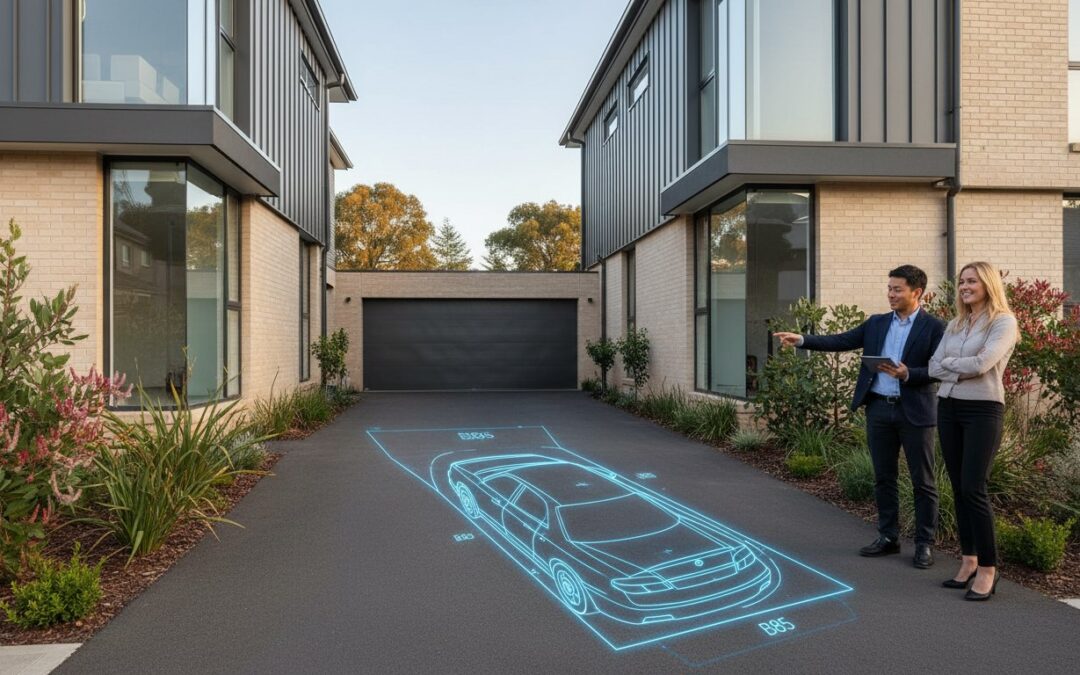
A single Request for Further Information (RFI) regarding vehicle maneuvering can stall a townhouse project for 4 to 12 weeks, accumulating significant holding costs before construction even begins. You understand that maximizing yield on a constrained site is the primary goal, yet Council engineers will not compromise on the rigid requirements of AS 2890.1. Balancing these competing interests requires more than a rough sketch of a driveway; it demands technical precision to prove that a B85 or B99 vehicle can safely navigate the site without striking structures or requiring impossible multi-point turns.
This guide demonstrates how an AutoTurn swept path townhouse assessment provides the evidence-based reporting needed to secure Council approval. You’ll learn how to identify potential pinch points early, ensuring your development meets Australian Standards while maintaining the highest possible dwelling count. We’ll outline the process of generating a professional traffic report that satisfies regulatory authorities and eliminates the risk of costly design revisions during the DA process. With over 10,000 sites assessed by our team since 2005, we provide the technical certainty required to move your project from the drawing board to the construction phase.
Key Takeaways
- Understand how AutoTURN software functions as the industry standard for calculating vehicle maneuvers to ensure your project meets strict Australian Standards.
- Learn why an AutoTurn swept path townhouse assessment is a mandatory requirement for securing Council approval during the Development Application (DA) process.
- Identify the specific technical requirements for B85 and B99 design vehicles, including the necessary 300mm to 600mm clearance margins from fixed structures.
- Discover strategies to overcome common design challenges, such as navigating tight garage entries and managing driveway crossovers near tree protection zones.
- Recognize the value of the “quote to completion” promise, ensuring the senior traffic engineer who assesses your site is the one who delivers the final report.
What is AutoTURN Swept Path Analysis for Townhouses?
Swept path analysis is the technical calculation of the physical space a vehicle occupies while performing a maneuver. For developers, an AutoTurn swept path townhouse assessment is a mandatory component of a Development Application (DA). This process uses vehicle swept path analysis software to simulate how cars move through a site. AutoTURN is the recognized industry standard in Australia, used by traffic engineers to ensure every driveway and parking space complies with Australian Standard AS 2890.1.
Most Australian Local Government Authorities (LGAs) no longer accept manual templates or hand-drawn turning circles. Digital simulations provide a level of accuracy that manual methods cannot replicate. These digital models account for the specific dimensions of the design vehicle, ensuring that the proposed site layout is functional and safe before construction begins. Relying on outdated methods often leads to rejected applications or costly design revisions during the construction phase.
To better understand this concept, watch this helpful video:
The Science of Vehicle Tracking
The path a vehicle follows is dictated by its wheelbase, steering angle, and overall length. In residential townhouse developments, engineers typically use the B85 vehicle, which represents the 85th percentile of cars on Australian roads. The “swept envelope” generated by the software includes the vehicle’s body overhangs and side mirrors, not just the tire tracks. This is critical because the body of the car often extends beyond the wheels during a turn.
Engineers must distinguish between front-wheel tracking and rear-wheel “off-tracking.” On tight residential sites, the rear wheels follow a tighter arc than the front wheels, which often leads to collisions with kerbs or bollards if not properly planned. While 2D simulations are common, 3D modeling is superior for sites with significant gradients. A car’s clearance and swept path change as it moves over a driveway hump or through a dip, and 3D analysis prevents the undercarriage from scraping the pavement.
Why Townhouse Sites Present Unique Challenges
Modern townhouse developments prioritize high density, which frequently results in narrower shared driveways and compact maneuvering areas. These constraints leave little margin for error. An AutoTurn swept path townhouse assessment identifies potential “choke points” where vehicles might struggle to pass each other or enter garages. Property boundaries, retaining walls, and landscaping features act as rigid obstacles that don’t allow for the slight adjustments a driver might make on a wider street.
- Shared Driveways: Verifying that two vehicles can pass or that a single vehicle has enough room to turn without reversing long distances.
- Garages and Carports: Ensuring the “apron” or space in front of the garage allows for a B85 vehicle to enter in a single, fluid motion.
- Service Access: Confirming that waste collection vehicles or emergency services can access the site as required by local council codes.
Our team at ML Traffic Engineers uses these simulations to provide certainty for developers. You can learn more about our specific approach on our about page. Accurate modeling at the start of a project prevents the need for redesigns that shrink the number of units or require expensive structural changes to retaining walls.
Why Australian Councils Mandate Swept Path Assessments
Australian local government authorities require a Vehicle Swept Path Assessment as a mandatory component of a Development Application (DA) or Planning Permit. This requirement isn’t a mere bureaucratic hurdle. It’s a technical verification that the proposed townhouse layout functions safely for all users. Without an AutoTurn swept path townhouse analysis, a developer risks a costly Request for Further Information (RFI) or an outright project refusal. These assessments ensure that the tight constraints of a multi-dwelling site don’t lead to property damage or traffic congestion on public roads.
Compliance with Australian Standard AS 2890.1
AS 2890.1 governs off-street car parking and is the benchmark for residential developments. It dictates the minimum geometry for garages, driveways, and maneuvering areas. For townhouse developments, the standard typically requires that a B85 vehicle, representing the 85th percentile of cars on Australian roads, can enter and exit the site in a forward direction. AutoTURN software allows us to simulate these movements with mathematical precision. We use it to prove that a garage design meets the minimum clearance requirements. If a B85 vehicle cannot make the turn without hitting a structural pillar or encroaching on a neighbor’s property, the design fails to meet AS 2890.1 standards.
Meeting Local Government Authority Expectations
Councils prioritize “one-pass” maneuvers for residential entry and exit points. This means a vehicle should ideally turn into a parking space without needing to reverse and realign. While some authorities allow three-point turns for difficult sites, excessive maneuvering is a common reason for project delays. Detailed diagrams created via an AutoTurn swept path townhouse assessment provide the visual proof Council planners need to approve a design. Professional certification by an experienced traffic consultant carries significant weight. It demonstrates that the design considers intersection design and safety principles within the private property boundary, ensuring the layout is practical for future residents.
Safety is the primary driver for these mandates. Poorly designed driveways lead to pedestrian accidents and vehicle collisions. By integrating professional traffic engineering services early in the design phase, developers prevent future liability issues. If an accident occurs due to a design flaw that contradicts Australian Standards, the developer and designer face significant legal exposure. A certified traffic report acts as a safeguard. It confirms that the site was designed to meet rigorous safety benchmarks and local planning schemes. If you’re currently preparing a planning permit, you can view our full range of traffic engineering services to ensure your project remains compliant and moves through Council without unnecessary friction.
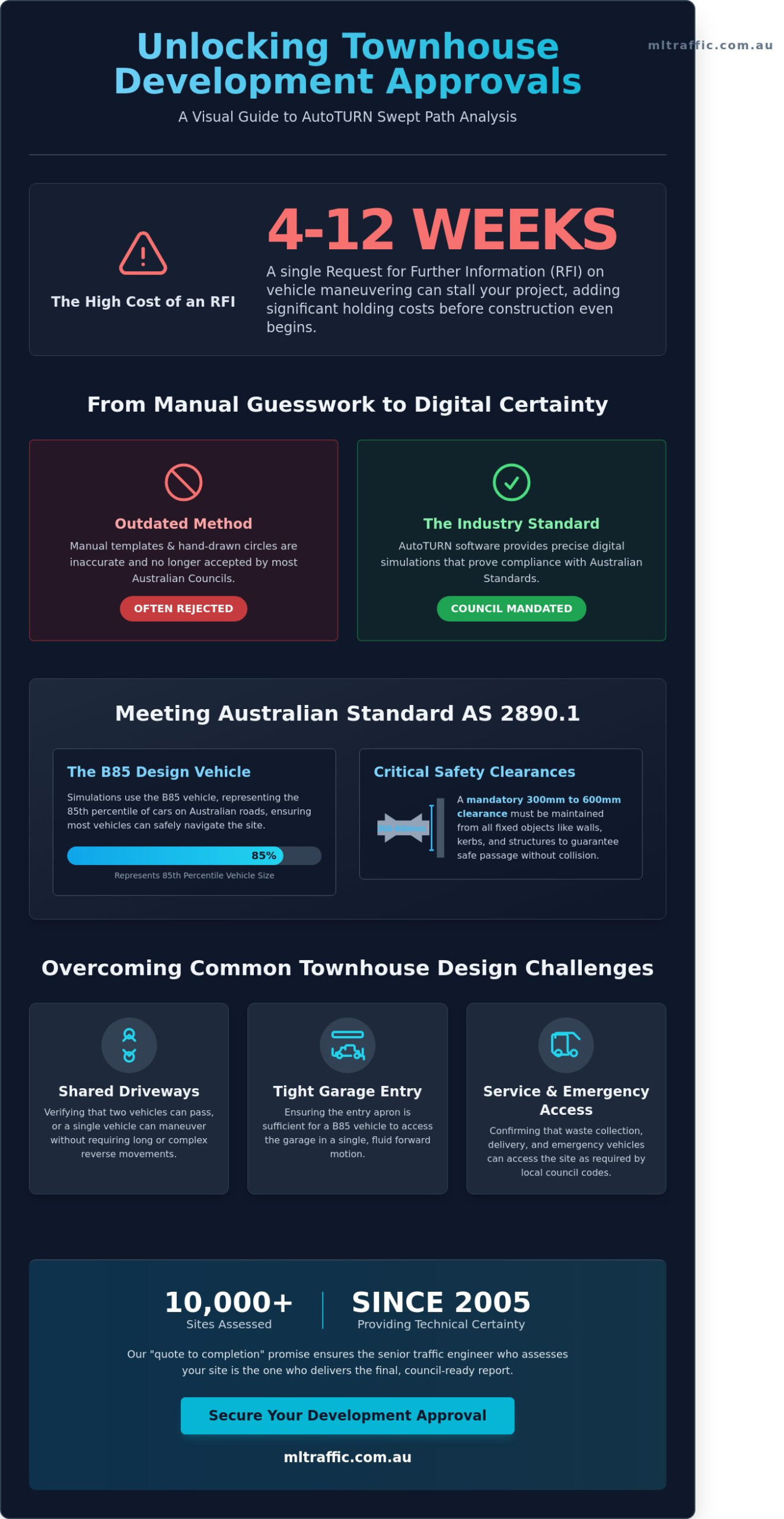
Technical Requirements for Townhouse Swept Path Reports
Compliance with Australian Standard AS 2890.1 is the baseline for any residential development application. An AutoTurn swept path townhouse assessment must prove that vehicles can maneuver safely without striking infrastructure or encroaching on pedestrian zones. Councils require these simulations to be conducted with specific parameters to ensure long-term site functionality. Failure to adhere to these technical standards often results in a Request for Further Information (RFI) or a flat refusal of the planning permit.
The B85 Design Vehicle Explained
The B85 vehicle represents the 85th percentile of the Australian car fleet. It’s the standard design vehicle used for most residential parking assessments. While the B85 is the default, many local government authorities now mandate the B99 vehicle assessment. This larger profile represents 99.8% of the fleet, including large SUVs and 4WDs. We use AutoTURN to model these specific profiles with millimeter precision. This ensures the driveway layout accommodates the physical reality of modern vehicle sizes.
Clearance Margins and Safety Buffers
A report is only valid if it includes appropriate safety buffers. Standard practice requires a minimum 300mm clearance from the vehicle body to kerbs or low-level obstructions. This margin increases to 600mm for vertical structures such as walls, columns, or fences. These buffers account for driver error and limited visibility during complex maneuvers. If your AutoTurn swept path townhouse simulation shows a vehicle clipping these margins, Council won’t approve the driveway design. These buffers directly influence the final width of your driveway and crossover dimensions.
Beyond vehicle dimensions and clearances, our traffic engineering services focus on several critical operational requirements:
- Forward Entry and Exit: Most Australian councils require all vehicles to enter and exit the site in a forward direction. Reverse maneuvers onto a public road are generally prohibited for multi-dwelling developments to maintain road safety.
- Worst-Case Scenarios: We simulate maneuvers while adjacent visitor bays are occupied. This ensures the “worst-case” scenario is functional.
- Three-Point Turns: For townhouse developments, a vehicle must be able to turn around within the site in no more than a three-point turn.
- Sight-Line Compliance: The simulation must demonstrate that the driver has a clear line of sight to pedestrians and oncoming traffic before exiting the property boundary.
The traffic consultant who provides the quote at ML Traffic Engineers is the one who does the work. We ensure every simulation reflects the practical constraints of your specific site. We’ve been trading since 2005 and have completed over 10,000 site assessments. This experience allows us to identify potential design failures before they reach the Council’s desk. Precise technical modeling is the only way to guarantee a townhouse development meets the rigorous safety standards required by Australian law.
Optimising Townhouse Layouts: Common Design Challenges
Townhouse developments often face a direct conflict between maximising land yield and meeting Council requirements for vehicle access. The most frequent issue involves the “tight turn” required to enter garages located at the end of a long, narrow driveway. Without technical verification, developers often allocate too much space to asphalt, reducing the private open space available for residents. Using an AutoTurn swept path townhouse assessment allows designers to minimise driveway widths while ensuring compliance with AS 2890.1.
Engineers use swept path analysis to justify deviations from standard driveway widths. This is particularly effective when dealing with site constraints such as Tree Protection Zones (TPZ) or existing utility infrastructure like power poles and sewer manholes. By simulating the exact wheel path of a B85 or B99 vehicle, we can prove that a narrower driveway still provides safe access without damaging landscaping or structural elements.
- Balancing 25% to 30% permeable surface requirements with functional vehicle tracking.
- Proving that a 3.0m wide driveway is sufficient for straight sections.
- Adjusting building footprints to accommodate the wider “swing” required for the final townhouse in a row.
Garage and Carport Maneuvering
Internal garage dimensions and door widths are critical for successful vehicle entry. While a standard single garage might be 3.0m wide, the “apron” or maneuvering space in front of the door dictates the ease of access. For a standard B85 vehicle, a 5.4m apron is often required to enter a garage in a single turn. In tighter configurations, we use AutoTurn swept path townhouse simulations to determine if a 5.8m or 6.0m apron is necessary to avoid multi-point turns. This is vital for basement car parks where structural columns create fixed obstructions that leave no room for error.
Shared Driveway and Crossover Optimization
The crossover serves as the transition between the public road and private property. It must align perfectly with the internal driveway path to prevent vehicles from mounting kerbs or encroaching on pedestrian footpaths. When designing for curved driveways, the inner radius must be carefully managed to prevent the rear wheels of a vehicle from clipping garden beds. We ensure the crossover design accounts for the 1:4 maximum ramp grade often required by Australian Standards, preventing vehicle scraping on steep sites. This precision ensures the development remains functional without sacrificing valuable square meterage.
For expert assistance with your layout, contact our senior traffic engineers to discuss your site requirements.
Engaging a Traffic Engineer for Your Townhouse Project
Architects and developers often wait until the final design phase to seek traffic engineering input. This delay frequently leads to expensive redesigns when Council identifies non-compliance. Engaging a professional early ensures your site layout accommodates the necessary vehicle movements from the start. An AutoTurn swept path townhouse assessment identifies tight turn radii, narrow access ways, and clearance issues before they become permanent fixtures on your plans.
ML Traffic Engineers operates on a principle of direct accountability. The traffic consultant who provides your quote is the same person who performs the technical work. This “quote to completion” promise eliminates the communication gaps common in larger firms. You deal directly with senior experts who understand the technicalities and bureaucratic requirements of Australian local councils. This hands-on approach ensures that the person defending your design during the DA process is the one who simulated the vehicle movements.
A professional swept path assessment is rarely a standalone document. It integrates directly into the wider Traffic Impact Assessment (TIA) or Traffic Impact Statement (TIS). This comprehensive report justifies your development’s impact on the local road network and confirms that all internal car parking meets AS 2890.1 standards.
Preparing a Professional Report for Council
A standard assessment report includes high-resolution diagrams, technical text, and formal certification. It details the specific vehicle templates used, such as B85 or B99 cars, to prove every townhouse resident can enter and exit the site in a single forward motion. To begin, you must provide your site plans in CAD format to a traffic engineer for analysis. Most assessments are completed within 3 to 5 business days. If Council requires revisions, the process involves refining the driveway geometry or parking bay widths to achieve compliance while maintaining the maximum yield for the developer.
Why Senior Expertise Matters
Senior expertise is the difference between a project approval and a refusal. ML Traffic brings national experience across more than 10,000 sites in Australia. Our principals have between 30 and 40 years of experience each. This level of seniority allows us to spot potential access issues that a junior engineer might overlook. Junior staff often fall into the “trap” of running basic simulations without accounting for vertical clearances or driveway ramp grades. Inaccurate AutoTurn swept path townhouse simulations lead to rejected applications and wasted time. By choosing experienced consultants, you ensure your project is backed by decades of technical knowledge and a proven track record of Council approvals.
- Direct access to Michael Lee and Benny Chen.
- Compliance with AS 2890.1 and local Council DCPs.
- Accurate modeling of waste collection and emergency vehicles.
- Fast turnaround for Development Application deadlines.
Secure Your Townhouse DA Approval with Precision Engineering
Successful townhouse developments depend on technical accuracy and strict adherence to AS 2890.1. An AutoTurn swept path townhouse assessment ensures your site layout accommodates waste collection and resident vehicles without compromising safety or density. Avoiding council RFI requests requires professional reports that address driveway grades and sight-line requirements from the start. Errors in these initial designs often lead to expensive layout revisions and project delays.
ML Traffic Engineers offers over 15 years of experience in the Australian market. We’ve delivered results for more than 10,000 sites nationwide, from small residential subdivisions to complex mixed-use developments. You’ll receive direct access to our senior principals, Michael Lee and Benny Chen, ensuring your project benefits from senior-level oversight. At our firm, the traffic consultant who provides your quote is the expert who does the work. We eliminate unnecessary bureaucracy to deliver reliable, council-ready documentation tailored to your specific site constraints.
Get a professional Swept Path Assessment for your townhouse DA today
We look forward to helping you move your development forward with confidence and technical certainty.
Frequently Asked Questions
What is the difference between a B85 and a B99 vehicle in AutoTURN?
B85 vehicles represent the 85th percentile of cars on Australian roads, measuring 4.91 metres long, while B99 vehicles represent the 99.9th percentile at 5.2 metres long. AS 2890.1 defines these standards to ensure parking facilities accommodate the vast majority of passenger vehicles. Most townhouse designs use the B85 vehicle for internal maneuvers and the B99 for checking access from the street.
Does Council always require forward entry and exit for townhouses?
Most Australian Councils require vehicles to enter and exit a site in a forward direction if the driveway serves more than 3 dwellings or connects to a sub-arterial road. This requirement is a safety measure to prevent drivers from reversing into high-volume traffic. For smaller developments on local roads, reversing might be permitted, but you must check the specific requirements in your Local Environmental Plan.
How much clearance is required between the vehicle path and the garage wall?
AS 2890.1 specifies a minimum lateral clearance of 300mm between the swept path of the vehicle and any fixed object like a garage wall or fence. Some Councils increase this requirement to 500mm for specific difficult maneuvers. Maintaining these margins ensures that real-world drivers can navigate the space safely without the extreme precision of a computer simulation.
Can I use swept path analysis to reduce my driveway width?
You can use an AutoTurn swept path townhouse assessment to justify a narrower driveway if the simulation proves the design vehicle can navigate the space safely. While standard widths are often 3.0 to 5.5 metres, technical evidence from a traffic engineer can support a variation request. This often helps developers maximize the building footprint while still meeting safety standards and Council regulations.
How long does it take to get a swept path assessment report?
A standard swept path assessment report typically takes 3 to 5 business days to complete once final architectural plans are provided. Complex sites with multiple levels or tight constraints might require up to 10 days for detailed analysis and internal reviews. Engaging a traffic consultant early in the design phase prevents delays in your Development Application submission.
What happens if the AutoTURN simulation shows the car hitting a wall?
If the simulation shows a collision, the site layout or driveway geometry must be modified to achieve compliance. Our engineers identify these pinch points early and suggest design changes like widening a curve or relocating a structural column. Council will not approve a Development Application if the AutoTurn swept path townhouse analysis shows any overlap with permanent structures or insufficient clearances.
Do I need a swept path for a single dwelling or just townhouses?
Swept path analysis is mandatory for townhouse developments but is rarely required for a standard single dwelling unless the driveway is exceptionally steep or narrow. If your single dwelling project involves a complex basement or a tight turn-around area, Council may request an assessment to prove functionality. We recommend checking your local Development Control Plan for specific trigger points.
Is AutoTURN the only software Councils accept for swept path analysis?
AutoTURN is the industry standard, but Councils also accept other CAD-based programs like PathPlanner or Vehicle Tracking. The software must accurately model the vehicle dimensions and turning circles defined in Australian Standard AS 2890.1. Most traffic engineers use AutoTURN because its algorithms are widely recognized and trusted by planning authorities across every state in Australia.

Disclaimer
The content on www.mltraffic.com.au, including all technical articles, guides, and resources, is provided for general informational and educational purposes only. It is not intended to constitute professional advice in traffic engineering, transportation planning, development approvals, or any other technical or legal field.
While ML Traffic Engineers makes every reasonable effort to ensure the accuracy, completeness, and timeliness of the information published, we do not provide any warranties or representations (express or implied) regarding its reliability, suitability, or availability for any particular purpose. Any reliance you place on the content is strictly at your own risk.
In no event shall ML Traffic Engineers, its directors, employees, authors, or affiliates be liable for any direct, indirect, incidental, special, consequential, or punitive damages (including, without limitation, loss of profits, data, or business opportunities) arising out of or in connection with the use of, or inability to use, any information provided on this website.
The articles and guides on this site are not a substitute for engaging a qualified, registered professional traffic engineer (such as an NPER or RPEQ engineer) to assess your specific project requirements. For tailored advice, compliance assessments, or traffic engineering services, please contact a competent professional.
This disclaimer may be updated from time to time without notice. By accessing or using this website, you agree to be bound by the most current version of this disclaimer.
