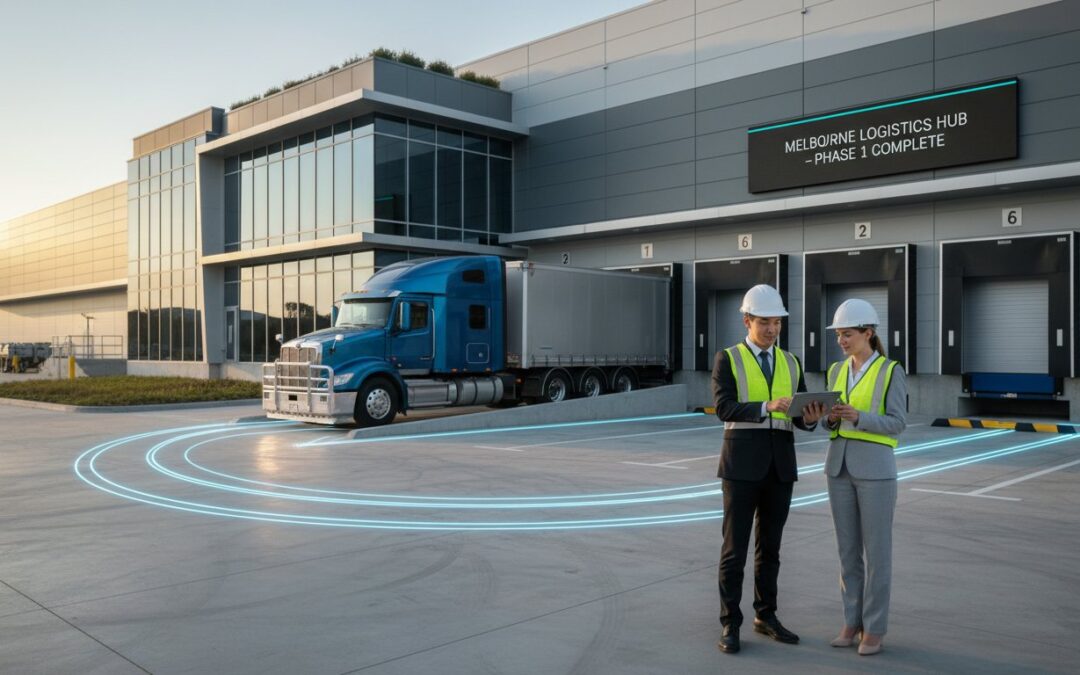
A single miscalculation in heavy vehicle clearance can stall an industrial development for 180 days or lead to a flat refusal from Council. When you’re designing high-stakes logistics hubs, an inaccurate AutoTurn swept path warehouse assessment isn’t just a technical oversight; it’s a financial liability that risks your entire Development Application (DA). You’ve likely experienced the frustration of balancing maximum floor area with the rigid turning circles required for B-doubles, only to have Council request a redesign that eats into your leasable space.
We understand that navigating AS 2890.2 compliance is a difficult balancing act between operational efficiency and strict regulatory demands. This article explains how precise swept path analysis secures first-time Council approval and optimizes your site layout to reclaim valuable square metres that conservative manual designs often waste. We’ll detail the specific technical parameters required for Australian warehouse developments, from driveway crossovers to loading dock maneuvering, ensuring your project moves from submission to construction without the bottleneck of costly Requests for Information.
Key Takeaways
- Understand how to achieve full compliance with AS 2890.2 standards for off-street commercial vehicle facilities in Australian warehouse developments.
- Learn why a professional AutoTurn swept path warehouse assessment is critical for identifying the correct design vehicle, ranging from SRVs to B-Doubles.
- Discover methods to optimize loading dock configurations and internal circulation while strictly adhering to Council limits on reversing maneuvers.
- Gain insight into why engineering expertise is required to account for real-world driver variability and avoid the “Garbage In, Garbage Out” risks of basic software simulations.
- Find out how technical traffic engineering reports accelerate the DA process and provide authoritative responses to Council Requests for Further Information (RFI).
Understanding AutoTurn Swept Path Analysis for Warehouse Developments
AutoTurn swept path analysis is a computer-simulated model that maps the turning arc and footprint of a vehicle as it moves through a specific space. For warehouse developments, this simulation is a critical component of the traffic engineering phase. It allows our consultants to visualize how heavy vehicles, such as 19-metre semi-trailers or B-doubles, interact with the physical constraints of a site. Since 2005, ML Traffic Engineers has utilized these simulations to ensure warehouse designs accommodate the required design vehicles without compromising safety or efficiency.
In the Australian traffic engineering sector, AutoTurn is the recognized industry standard. It aligns with the rigorous requirements of AS 2890.1 and local council guidelines. By using this software, we provide high-fidelity diagrams that demonstrate a vehicle’s ability to enter, circulate, and exit a site in a forward direction. This level of accuracy is essential for securing approval during the Development Application (DA) process, as it removes the guesswork from site layout planning.
To better understand this concept, watch this helpful video:
What is a Swept Path?
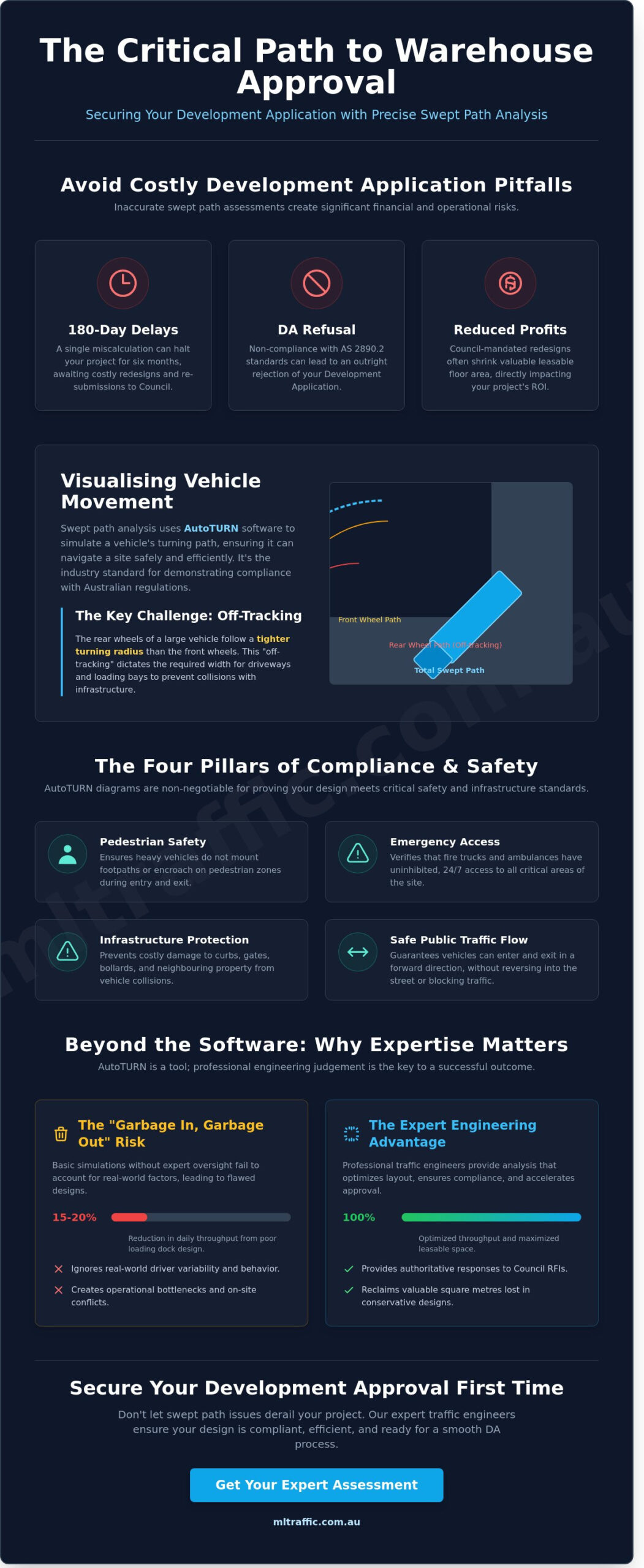
A swept path represents the total area occupied by a vehicle during a turn. There’s a distinct difference between the path of the front wheels and the rear trailer wheels. This phenomenon, known as ‘off-tracking,’ occurs because the rear wheels follow a tighter radius than the front steering wheels. For warehouse designers, off-tracking is the primary concern because it determines the width required for driveways and loading bays. Swept path analysis is the calculation of the envelope swept by a vehicle’s body during a maneuver. Our Traffic Impact Statement (TIS) services include these detailed calculations to verify that even the largest permitted vehicles can navigate the proposed site safely.
Why Councils Demand AutoTurn Diagrams
Local government authorities require an AutoTurn swept path warehouse assessment to protect public infrastructure and ensure safety. These diagrams are vital for several reasons:
- Pedestrian Safety: Ensuring heavy vehicles don’t encroach on footpaths or designated pedestrian zones during entry and exit.
- Emergency Access: Verifying that fire trucks and ambulances have 24/7 access to all critical areas of the warehouse.
- Infrastructure Protection: Preventing damage to curbs, gates, bollards, and neighboring property.
- Traffic Flow: Ensuring vehicles don’t need to reverse into the street or cross into oncoming lanes, which relates to the broader Geometric design of roads and intersections.
Accurate simulation prevents physical site damage that often leads to costly repairs and operational delays. If a loading dock is poorly designed, it can result in a 15% to 20% reduction in daily throughput due to difficult maneuvering. By identifying these issues during the design phase, we help clients avoid the logistical bottlenecks that plague non-compliant developments.
Compliance with Australian Standards for Heavy Vehicle Access
Compliance with AS 2890.2: Off-street commercial vehicle facilities is the foundation of any industrial development application. This standard dictates the geometric requirements for loading docks, service areas, and access driveways. Every AutoTurn swept path warehouse simulation must strictly adhere to these benchmarks to avoid immediate rejection by local councils or Transport for NSW (TfNSW). ML Traffic Engineers focuses on ensuring your site layout accommodates the specific vehicle classes intended for the operation. We verify that all maneuvers, particularly at tight entry points or loading bays, maintain necessary safety margins and operational efficiency.
Navigating AS 2890.2 Requirements
AS 2890.2 specifies minimum turning circles based on the swept path of the vehicle’s body and its wheel tracks. A standard 19m Articulated Vehicle (AV) requires significantly more space than a Heavy Rigid Vehicle (HRV). Our assessments include a minimum 300mm clearance between the vehicle’s swept path and any fixed site structures, such as bollards, structural columns, or walls. Failure to account for this buffer often results in operational damage or failed DA assessments. You can learn more about our traffic engineering services to see how we apply these standards to complex industrial layouts.
- Minimum turning radii for SRV, HRV, and AV classes.
- Vertical clearance requirements for basement or covered loading docks.
- Safety sight distance requirements at the property boundary.
- Dedicated space for driver maneuvering without encroaching on pedestrian zones.
Selecting the Right Design Vehicle
Choosing a design vehicle that’s too small is a common reason for DA failure. If your warehouse is zoned for heavy industrial use, councils expect the site to accommodate at least a 19m AV. Proposing a site that only fits an HRV limits the future utility of the land and triggers a Request for Information (RFI) from planners. For larger logistics hubs, B-double access is often a requirement. A 25m or 26m B-double has a much wider swept path and requires specific turning templates. Local councils, such as the City of Sydney or Penrith City Council, often have variations in their Development Control Plans (DCP) regarding which vehicle must be used as the test case.
Every AutoTurn swept path warehouse diagram we produce ensures vehicles enter and exit the site in a single forward motion. Reversing maneuvers on public roads are generally prohibited under Australian safety regulations. Our senior engineers, who have worked on over 10,000 sites, personally oversee these assessments to ensure every diagram is accurate and compliant. If you need a professional review of your site plan, contact our principals directly for a technical assessment and quote.
Beyond the Software: Why Engineering Expertise is Essential
AutoTurn is an industry-standard tool, but it’s only as reliable as the data entered into it. This is the “Garbage In, Garbage Out” risk. If an operator selects the wrong design vehicle or fails to set the correct lock-to-lock time, the resulting simulation is useless for a Development Application. An AutoTurn swept path warehouse assessment requires precise inputs regarding vehicle width, steering lock angles, and articulation points. Without these, a design that looks functional on a screen will fail in practice.
Experienced engineers don’t just click buttons. They understand the physics of heavy vehicle movement. They know that a simulation showing a 19-metre articulated vehicle clearing a corner by 50mm is a failure, not a success. Real-world variables like tyre scrub, driver fatigue, and poor weather conditions mean that theoretical paths must be tempered with professional caution.
- Correct vehicle selection based on AS 2890.2 standards.
- Accurate lock-to-lock time settings (typically 6 seconds for heavy vehicles).
- Consideration of “body swing” and “rear-axle kick-out.”
- Verification of swept paths against existing site constraints.
Software Accuracy vs. Operational Reality
A 300mm clearance in a digital model often translates to a collision in the real world. Software operates in a frictionless environment, but drivers face blind spots and varying mechanical responses. Compliance with AS 2890.2 is the baseline, but we also factor in driveway gradients and vertical clearances. Professional engineering judgment must dictate that a minimum 500mm safety buffer is maintained beyond the theoretical swept path to account for driver variance, vehicle body swing, and unforeseen operational shifts.
Maximizing Site Efficiency
Traffic engineers do more than just ensure vehicles fit; they optimize the layout to reclaim valuable land. Every square meter of unnecessary asphalt is a square meter of lost warehouse storage or reduced parking capacity. We balance the high parking demand of modern industrial sites with the circulation requirements of heavy vehicles. By tightening paths strategically, we’ve helped clients increase their usable floor area by 5% to 10% in some cases.
Our approach is built on accountability. We believe the traffic consultant who provides the quote should be the one who does the work. This prevents the “junior-designer error” where complex AutoTurn swept path warehouse simulations are delegated to inexperienced staff who lack the field experience to spot operational flaws. You can learn more about our 15+ years of traffic expertise and how our principal-led model ensures your DA submission is technically sound and optimized for maximum site yield.
Optimizing Warehouse Loading Docks and Internal Circulation
Efficient warehouse design relies on the seamless movement of heavy vehicles between the site entry and the loading face. Poorly planned internal circulation leads to operational bottlenecks and safety hazards that can result in DA refusal. Our team uses AutoTurn swept path warehouse simulations to evaluate whether a 90-degree or sawtooth dock configuration best fits the site constraints. While 90-degree docks are standard, they require a larger apron space, often exceeding 35 metres for a 19m semi-trailer. Sawtooth designs reduce the required apron depth but increase the complexity of the swept path, making precise digital verification essential during the design phase.
Loading Dock Design Principles
Calculating apron space isn’t a matter of guesswork. For a standard 19m semi-trailer, the apron must accommodate the vehicle’s turning radius plus a safety margin. We use AutoTurn to verify that maneuvers occur on the driver-side whenever possible. Driver-side reversing allows the operator to maintain direct line-of-sight with the dock, whereas blind-side reversing significantly increases the risk of collisions. If a site layout forces a blind-side maneuver, Council will often require additional safety measures or a redesign. You can find more detail on these requirements in our Swept Path Analysis: A Developer’s Guide to Council Approval.
The ‘reversing maneuver’ rule is a critical factor in Australian warehouse compliance. Most local councils and Australian Standards (AS 2890.2) recommend limiting the distance a heavy vehicle travels in reverse to 20 metres or less. Excessive reversing distances decrease site safety and slow down turnaround times. We model these movements to ensure trucks can enter and exit the site in a forward direction, which is a non-negotiable requirement for most industrial DAs in NSW and QLD.
Safety and Conflict Management
Warehouse sites are high-traffic environments where heavy vehicles, passenger cars, and forklifts often intersect. A compliant AutoTurn swept path warehouse assessment must demonstrate clear separation between these modes. We designate specific waiting areas within the site boundaries to ensure that arriving trucks don’t queue on public roads, which is a major concern for transport authorities. These holding bays must be sized to accommodate the largest vehicle expected on site, such as a 26m B-Double.
- Pedestrian Separation: We map 1.5m wide dedicated walking zones that remain outside the swept paths of heavy machinery.
- Conflict Zones: We use line marking and signage plans to manage the transition points where forklifts cross heavy vehicle paths.
- Sight Distances: Our assessments include a review of sight lines at exit points to ensure drivers can see oncoming traffic and pedestrians before crossing the property boundary.
Since 2005, ML Traffic Engineers has provided meticulous assessments for over 10,000 sites. If you need to verify your site’s internal circulation, contact our senior engineers for a professional swept path assessment.
Securing Council Approval with Professional Traffic Engineering
A professional AutoTurn swept path warehouse assessment provides the technical evidence required to satisfy Council planners. It eliminates guesswork. When a Development Application (DA) includes a certified report, it demonstrates that the site layout is functional and compliant with Australian Standards like AS 2890.2. This proactive approach significantly reduces the likelihood of delays during the assessment phase. A clear, well-documented report makes it easier for the assessing officer to tick the compliance boxes quickly.
The ROI of a Professional Traffic Report
Investing in a detailed traffic report early prevents expensive errors. Redesigning a concrete slab or relocating a gate after construction begins can cost tens of thousands of A$. A professional report offers the technical certainty that planners demand. At ML Traffic Engineers, senior-level involvement is standard. Michael Lee and Benny Chen bring between 30 and 40 years of experience to every project. This expertise ensures that the AutoTurn swept path warehouse analysis is accurate the first time. We avoid the “back and forth” that often plagues poorly prepared applications. Our focus is on providing a results-oriented service that moves your project forward.
Councils often issue a Request for Further Information (RFI) regarding heavy vehicle access, sight-lines, or driveway ramp grades. Responding to these requests requires precise technical data and often a fast turnaround. Our engineers provide detailed responses that address specific Council concerns, often resolving issues that might otherwise lead to a refusal. The RPEQ (Registered Professional Engineer of Queensland) or Chartered status of our engineers is vital. This certification provides the legal and technical weight necessary for Council to accept the findings. It proves the assessment meets the rigorous standards of the National Engineering Register and Australian industry requirements.
Contact ML Traffic Engineers Today
ML Traffic Engineers has completed over 10,000 sites since 2005. We provide national service coverage for warehouse developments across Australia, including projects involving B-doubles, semi-trailers, and heavy rigid vehicles. You get direct access to the principals, Michael Lee and Benny Chen. The traffic consultant who provides your quote is the person who does the work. There are no junior staff or gatekeepers. We focus on private clients and their specific DA requirements. You can contact our engineers for a quote to secure your project’s approval and ensure your AutoTurn swept path warehouse design is fully compliant.
Secure Your Warehouse DA Approval with Professional Swept Path Analysis
Achieving Council approval for a new development requires more than just standard software outputs. Your warehouse must demonstrate strict compliance with AS 2890.1 and accommodate heavy vehicle movements without operational conflict. An accurate AutoTurn swept path warehouse assessment identifies potential pinch points in loading docks and internal circulation before they become expensive construction mistakes. Engineering expertise ensures your site layout is functional and legally compliant from the start.
At ML Traffic Engineers, we bring over 15 years of Australian traffic engineering experience to your project. We’ve assessed more than 10,000 sites across Australia, providing the technical certainty needed for successful Development Applications. You’ll deal directly with our principals, Michael Lee and Benny Chen. We maintain a strict policy where the traffic consultant who provides your quote is the expert who completes the work. This direct accountability ensures your project receives the meticulous attention it deserves, helping you avoid delays during the planning phase.
Get a Swept Path Analysis Quote from Our Senior Engineers
Take the next step toward a compliant and efficient warehouse design today.
Frequently Asked Questions
Is AutoTurn swept path analysis mandatory for all warehouse DAs?
Yes, AutoTurn swept path analysis is mandatory for any warehouse Development Application (DA) where heavy vehicle access is required. Australian Standard AS 2890.2 dictates that designers must prove vehicles can enter and exit the site in a forward direction. Without a digital swept path assessment, councils cannot verify compliance with safety and operational standards. We provide these technical drawings to ensure your application meets the specific requirements of the local planning authority.
What is the difference between a design vehicle and a check vehicle?
A design vehicle represents the standard heavy vehicle expected to use the site daily, such as a 19 metre semi-trailer. The check vehicle is typically a larger or less frequent vehicle, like a 26 metre B-double or a fire truck, used to ensure the infrastructure doesn’t fail under extreme conditions. Designers use the design vehicle to set the primary geometry. The check vehicle ensures that occasional movements are possible with minimal clearances or slower speeds.
Can a warehouse accommodate B-doubles if it was originally designed for semi-trailers?
Accommodating B-doubles on a site designed for 19 metre semi-trailers usually requires a new AutoTurn swept path warehouse assessment. B-doubles have a wider swept path width and require larger turning radii. If your existing hardstand area lacks the 6 metre to 12 metre additional clearance needed for these larger combinations, you’ll face structural or operational conflicts. We evaluate your current site layout against the 25 metre or 26 metre B-double templates to identify necessary modifications.
How much clearance is required around a vehicle’s swept path in Australia?
Australian Standard AS 2890.2 requires a minimum 300mm clearance on both sides of the swept path for vehicles moving at low speeds. For higher speed areas or constrained environments, this margin often increases to 500mm or 1000mm to account for driver error and safety. Maintaining these 300mm buffers prevents damage to warehouse walls, bollards, and parked cars. Our engineers apply these specific tolerances within the software to ensure your site remains functional and safe.
What happens if my site is too small for the required turning circles?
If a site cannot accommodate standard turning circles, you must either redesign the internal layout or restrict the vehicle size allowed on site. Local councils rarely grant waivers for forward-entry requirements. We often resolve these issues by relocating loading docks or widening driveway crossovers by 1 or 2 metres. If the site is physically restricted, we can provide a Traffic Impact Assessment (TIA) to justify the use of smaller, more manageable vehicles for your operations.
How long does it take to complete a swept path analysis for a warehouse?
A standard swept path analysis for a single warehouse site typically takes 3 to 5 business days to complete. This timeframe includes the initial CAD setup, simulation of all required movements, and the final technical report. Complex sites with multiple loading docks or steep gradients might require 7 to 10 days for a comprehensive review. Our senior engineers handle every stage of the process to ensure your DA documentation is ready for immediate submission.
Do I need a separate report for fire truck access?
You must include fire truck access in your swept path assessment to comply with the Building Code of Australia (BCA) and local fire authority requirements. While it’s often part of the main AutoTurn swept path warehouse report, it requires a specific vehicle template, usually a 10.2 metre or 12.5 metre Heavy Rigid Vehicle (HRV). Failure to demonstrate that emergency services can reach within 15 metres of all entry points will result in a DA refusal or costly late-stage redesigns.
Can AutoTurn account for vertical clearances in underground loading docks?
AutoTurn Pro versions account for vertical clearances by simulating the vehicle’s 3D envelope against ramp grades and ceiling heights. This is vital for underground docks where a 4.5 metre clearance is standard for heavy vehicles. We check for grounding at the top of ramps and overhead strikes at the bottom. Our analysis ensures that the 1 in 8 or 1 in 10 ramp transitions don’t cause the vehicle’s chassis or roof to impact the structure.

Disclaimer
The content on www.mltraffic.com.au, including all technical articles, guides, and resources, is provided for general informational and educational purposes only. It is not intended to constitute professional advice in traffic engineering, transportation planning, development approvals, or any other technical or legal field.
While ML Traffic Engineers makes every reasonable effort to ensure the accuracy, completeness, and timeliness of the information published, we do not provide any warranties or representations (express or implied) regarding its reliability, suitability, or availability for any particular purpose. Any reliance you place on the content is strictly at your own risk.
In no event shall ML Traffic Engineers, its directors, employees, authors, or affiliates be liable for any direct, indirect, incidental, special, consequential, or punitive damages (including, without limitation, loss of profits, data, or business opportunities) arising out of or in connection with the use of, or inability to use, any information provided on this website.
The articles and guides on this site are not a substitute for engaging a qualified, registered professional traffic engineer (such as an NPER or RPEQ engineer) to assess your specific project requirements. For tailored advice, compliance assessments, or traffic engineering services, please contact a competent professional.
This disclaimer may be updated from time to time without notice. By accessing or using this website, you agree to be bound by the most current version of this disclaimer.
