
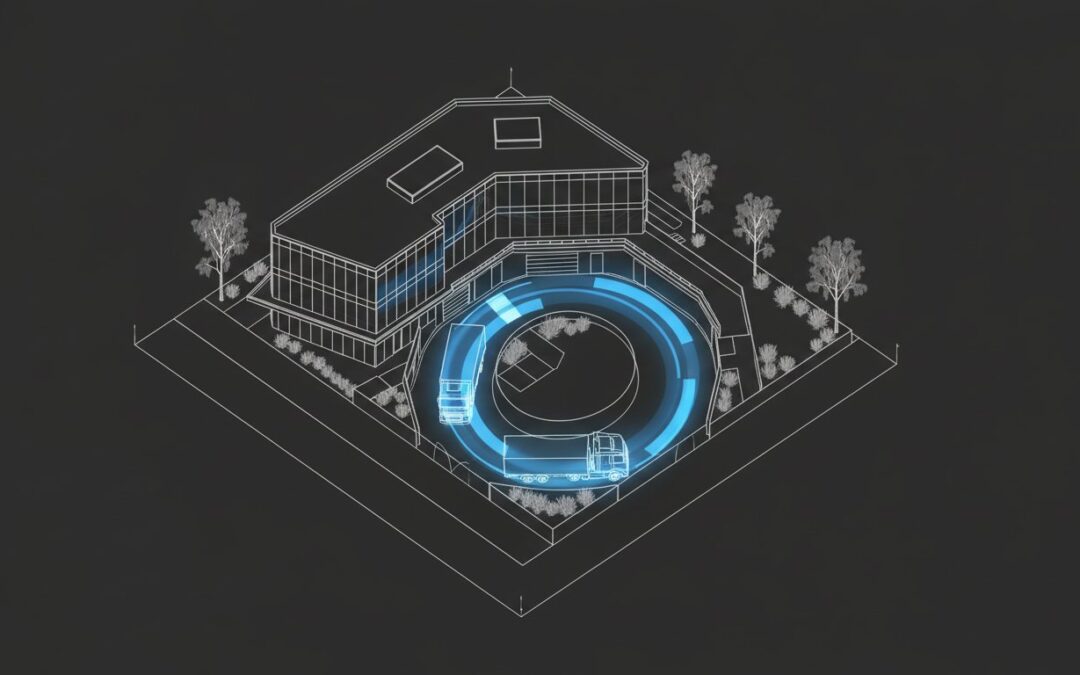
A single Request for Further Information (RFI) regarding vehicle access can stall an Adelaide development for over 20 business days, accumulating significant holding costs before a single brick is laid. You understand that precision in your initial submission is the only way to avoid these bureaucratic bottlenecks and protect your project timeline. Our team at ML Traffic Engineers has processed over 10,000 sites, and we’ve seen how an accurate AutoTurn swept path Adelaide assessment serves as the foundation for a successful council submission.
It’s a common frustration to see site yields compromised by overly conservative access designs or complex interpretations of AS 2890.1 and AS 2890.2. This technical guide provides the professional clarity required to master vehicle swept path analysis and ensure your development application meets all Australian Standards for immediate approval. We’ll examine the specific requirements for passenger and heavy vehicle manoeuvring, providing you with the technical certainty needed to optimise your site without risking a council rejection.
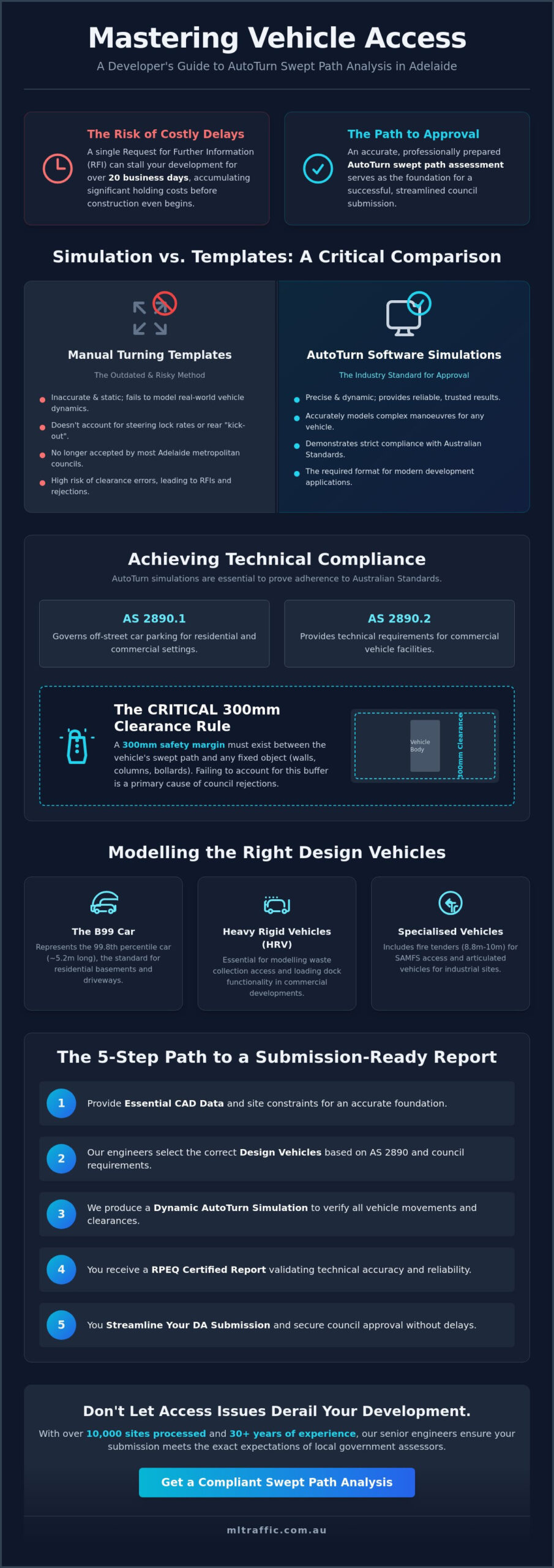
Key Takeaways
- Understand how AutoTurn simulations ensure technical compliance with AS 2890.1 and AS 2890.2 for residential and commercial vehicle access.
- Identify the critical risks of clearance errors associated with manual turning templates compared to dynamic, industry-standard software simulations.
- Master the specific documentation requirements for an AutoTurn swept path Adelaide report to streamline your development application and secure council approval.
- Learn the essential CAD data and site constraints required to produce an accurate, submission-ready vehicle swept path assessment.
- Recognise why RPEQ certification and senior engineering oversight are mandatory for validating the technical accuracy and reliability of your traffic reports.
Table of Contents
What is AutoTurn Swept Path Analysis for Adelaide Developments?
Swept path analysis calculates the precise envelope a vehicle occupies while navigating a turn. In an AutoTurn swept path Adelaide assessment, engineers simulate vehicle movements to ensure they fit within the physical constraints of a site design. We use AutoTurn software by Transoft Solutions, which is the global industry standard for vehicle swept path analysis software. This tool allows for the modelling of complex manoeuvres that static turning templates simply cannot replicate.
The primary objective is to demonstrate functional access and strict compliance with Australian Standards, specifically AS 2890.1 for car parking and AS 2890.2 for commercial facilities. Most Adelaide metropolitan councils, such as the City of Port Adelaide Enfield or City of Burnside, no longer accept static 1:200 scale plastic templates. These outdated methods are inaccurate because they don’t account for steering lock rates or the "kick-out" of a heavy vehicle’s rear. Digital simulations provide a dynamic, reliable result that planning authorities trust.
To better understand how this software functions within a design environment, watch this technical overview:
The Role of Swept Paths in the Planning Process
Swept paths form the technical backbone of a Traffic Impact Assessment (TIA). They provide empirical evidence that a site layout is viable before any construction begins. This process identifies conflict points between vehicle bodies and structural elements like basement columns, walls, or bollards. It also ensures site safety for pedestrians by verifying that vehicles don’t mount kerbs or swing into designated walking zones. Councils require these digital simulations for both light and heavy vehicle classes to confirm that all movements can occur in a forward direction where required. You can view our full range of assessment capabilities on our traffic engineering services page.
Common Design Vehicles for Australian Projects
We select design vehicles based on the specific requirements of the South Australian planning system and AS 2890. Common vehicles include:
-
The B99 Car: This represents the 99.8th percentile car (approx. 5.2 metres long) and is the standard for residential basement and driveway design.
-
Heavy Rigid Vehicles (HRV): These are essential for modelling waste collection access and loading dock functionality in commercial developments.
-
Specialised Vehicles: We model fire tenders (typically 8.8m to 10m long) to satisfy South Australian Metropolitan Fire Service (SAMFS) access requirements, as well as articulated vehicles for industrial warehouses.
Using the AutoTurn swept path Adelaide process ensures that your development application contains the rigorous technical data needed for approval. Our senior engineers have over 30 years of experience ensuring these simulations meet the exact expectations of local government assessors.
Technical Compliance: Integrating AS 2890.1 and AS 2890.2
Adhering to Australian Standards isn’t optional for Adelaide developers. Compliance ensures that a site is functional, safe, and legally robust. AS 2890.1 governs off-street car parking for residential and commercial settings, while AS 2890.2 provides the technical requirements for commercial vehicle facilities. We use AutoTurn swept path Adelaide simulations to bridge the gap between architectural drawings and real-world vehicle movements. These simulations verify that the design accommodates the design vehicle’s turning circle without encroaching on structural elements.
A critical factor often overlooked in preliminary designs is the 300mm clearance requirement. This safety margin must exist between the vehicle’s swept path and any fixed object, such as a wall, bollard, or column. Failing to account for this 300mm buffer usually results in council rejections. Our assessments identify these issues before they become costly construction errors.
AS 2890.1 Aisle Width Standards
Aisle width isn’t a static number. It’s a variable calculation based on the parking angle, the width of the parking space, and the specific vehicle class, usually the B85 or B99 vehicle. For a standard 90-degree parking bay, aisle widths typically range from 5.8m to 6.2m. AutoTurn verifies that a driver can enter and exit a space in a single, continuous manoeuvre. This is vital for high-turnover commercial sites. In tight basement car parks, columns are the primary obstacle. We model the AutoTurn swept path Adelaide to ensure that structural supports don’t obstruct the vehicle’s swing path or the driver’s blind spots. If a vehicle requires multiple shunts to park, the design fails the standard.
Commercial Vehicle Access and AS 2890.2
Commercial facilities demand a higher level of scrutiny due to the size of delivery and service vehicles. We analyse the swept path envelope for everything from small vans to 19m articulated trucks. In narrow Adelaide urban laneways, the margin for error is non-existent. We don’t just look at horizontal paths; we also verify vertical clearance. This includes checking that overhead pipes, signage, and roller doors don’t strike the vehicle’s roof.
Waste management is another hurdle. Most local councils require waste vehicles to enter and exit a site in a forward direction. Reversing onto a public road is generally prohibited for safety reasons. Our simulations prove to the council that a heavy rigid vehicle (HRV) can perform a three-point turn within the site boundaries. For detailed assistance with your site’s compliance, you can view our full range of traffic engineering services to see how we handle complex vehicle movements.
AutoTurn Simulations vs. Manual Turning Templates
Manual turning templates are static 2D overlays. They represent a vehicle’s path at a fixed, maximum steering lock. This method is increasingly obsolete in modern traffic engineering. AutoTurn simulations provide a dynamic, iterative approach that accounts for real-world driving physics. By 2026, Adelaide council engineers almost exclusively demand digital reports. They recognize that paper templates carry a high risk of clearance error. These 2D models don’t account for vehicle speed or the rate at which a driver turns the wheel. AutoTurn allows us to adjust these variables to reflect actual site conditions.
Why Manual Templates Lead to Planning Delays
Manual templates often fail to visualize tail swing. This is the outward arc the rear of a vehicle makes during a turn. Ignoring tail swing leads to designs where vehicles collide with structural columns or boundary walls. It’s also difficult to demonstrate multi-point maneuvers, such as 3-point turns, without specialized software. This lack of technical detail triggers a Request for Information (RFI) from the council. Each RFI can delay a project by 14 to 21 days. We use the latest Australian Standards (AS 2890) to ensure every simulation is compliant. This proactive approach stops the RFI loop before it starts. Providing an AutoTurn swept path Adelaide report ensures your project isn’t sidelined by technical inaccuracies.
The Precision Advantage of Digital Swept Paths
Digital simulations integrate directly into CAD files. This allows for millimetre-perfect site planning. We can test 15 different driveway iterations in 20 minutes to find the layout that maximizes your land yield. An AutoTurn swept path Adelaide assessment identifies conflict zones. These are areas where vehicle paths overlap with pedestrian walkways or sight-line requirements. Our senior engineers use this data to refine car park layouts before you commit to construction. This level of detail is a core part of our traffic engineering services. It eliminates guesswork and ensures your development application meets the technical standards required by South Australian authorities.
-
AutoTurn accounts for the variable steering lock rates of different drivers.
-
Digital reports provide clear, color-coded visuals for council reviewers.
-
Software updates ensure we always use the latest vehicle dimensions from AS 2890.
-
Simulations can be exported in various formats for immediate integration into architectural plans.
Our approach is hands-on. The traffic consultant who provides the quote is the one who performs the digital simulation. This ensures accountability and technical accuracy at every stage of the planning process. We don’t rely on outdated methods that risk your project’s approval timeline.
Preparing for Your DA: A Developer’s Data Checklist
The accuracy of an AutoTurn swept path Adelaide assessment relies entirely on the precision of the initial site data. A technical report is only as reliable as the CAD base plan it utilizes. Developers must provide high-quality information at the project’s outset to avoid costly redesigns during the Council’s RFI (Request for Further Information) stage. Inaccurate data leads to flawed simulations, which can result in site access failures once construction begins.
Essential Documentation for the Traffic Engineer
Professional traffic engineering requires specific datasets to model vehicle movements accurately. We require site plans in DWG format to ensure every physical constraint is accounted for within the software environment. Providing PDFs is insufficient for technical analysis as they lack the necessary scale precision for tight urban environments. Key documentation includes:
-
A current site survey showing existing kerbs, SAPN power poles, and street trees that may impact sightlines or turn radii.
-
Proposed architectural floor plans with all structural columns and load-bearing walls clearly marked, especially for basement car parks.
-
Detailed driveway ramp grades and cross-sections to evaluate vertical clearance and prevent vehicle scraping on transition points.
Defining the Service Vehicle Requirements
Identifying the correct vehicle class is vital for AS 2890 compliance. A residential development in North Adelaide might only require access for a Small Rigid Vehicle (SRV), while an industrial site in Wingfield will likely demand a 19m semi-trailer assessment. The Design Vehicle is the largest vehicle that must be accommodated regularly. Determining this early avoids the mistake of designing for a car when the Council requires heavy vehicle access for waste collection. Consider these factors:
-
Confirm the largest vehicle expected on-site, such as a 12.5m Heavy Rigid Vehicle (HRV) or a 19m semi-trailer.
-
Determine the frequency of waste collection and delivery schedules to justify the proposed access design to the planning authority.
Identifying ‘critical manoeuvres’ during the initial design phase prevents major delays. This includes waste truck entry and exit, which often requires the most significant turning radii. If these movements aren’t addressed early, they can force a complete overhaul of the site layout. Our team reviews these constraints to ensure your AutoTurn swept path Adelaide report meets all South Australian planning requirements. We focus on getting the geometry right the first time to streamline your development application process.
For technical assistance with your site layout, view our traffic engineering services.
Why Professional Engineering Oversight Matters
Software is a tool, not a substitute for engineering judgment. Many "software operators" offer low-cost services but lack the technical training to interpret complex traffic movements correctly. An AutoTurn swept path Adelaide assessment requires a deep understanding of AS 2890 compliance and local council expectations. Without professional oversight, a simulation might look correct on a screen but prove physically impossible to execute on-site. Professional engineering certification ensures that the proposed vehicle movements are safe, legal, and functional.
Experienced engineers use these assessments to maximize site yield. By optimizing driveway placements and parking layouts, we often find additional space that less experienced operators overlook. This technical precision reduces construction costs by preventing expensive mid-build design changes. A certified report from a senior engineer provides the necessary assurance to local councils and planning authorities that the development is viable.
The Risk of Unverified Software Outputs
AutoTurn doesn’t automatically account for site-specific constraints like steep gradients, sight-line obstructions, or overhead clearances. It follows the parameters set by the user. If those parameters are incorrect, the output is useless. We frequently see "impossible" maneuvers in reports produced by non-engineers. These include turns that require unrealistic steering speeds or ignore the physical reality of curb heights. Professional certification protects developers from future liability. If a delivery truck can’t access a loading dock after construction, the financial consequences are severe. Our engineers verify every simulation against the physical limits of the site and the specific requirements of Australian Standards.
Securing Approval with ML Traffic Engineers
ML Traffic Engineers has been trading since 2005. We’ve completed over 10,000 successful site assessments across various land-use types, including apartments, warehouses, and commercial developments. Our firm operates with a distinct philosophy: the traffic consultant who provides the quote, does the work. This eliminates the risk of your AutoTurn swept path Adelaide project being handed to an inexperienced junior staff member or an offshore processing center.
Clients have direct access to our principals, Michael Lee and Benny Chen. They bring between 30 and 40 years of experience each to every project. This level of seniority ensures that every report is robust and ready for council submission. For comprehensive traffic reports and expert guidance, we provide a direct line to the people actually performing the analysis. Our history of success with South Australian planning authorities means we know exactly what’s required for a smooth approval process. We focus on providing dependable, meticulous, and results-oriented advice for every client.
Secure Your Adelaide Development Approval
Navigating the technical requirements of AS 2890.1 and AS 2890.2 is a critical step for any South Australian development. Accurate simulations ensure vehicle movements are safe and meet strict council expectations. Since 2005, ML Traffic Engineers has assessed over 10,000 sites across Australia, providing the technical certainty required for successful Development Applications. Choosing a professional AutoTurn swept path Adelaide assessment removes the guesswork from your site plan. It prevents costly design revisions that often occur during the planning phase. It’s a necessary investment for any developer who wants to avoid bureaucratic delays.
Our firm operates on a direct-access model. The senior principal who provides your quote is the same expert who performs the technical work. This ensures your project benefits from over 30 years of experience without the interference of junior staff or administrative layers. We guarantee full compliance with Australian Standards for every simulation we produce. Our team understands the specific requirements of Adelaide’s local government authorities and the Department for Infrastructure and Transport. We don’t just provide data; we provide solutions that work for your specific site constraints.
Get a quote for your AutoTurn Swept Path Analysis today. We’re ready to help you move your project toward a successful approval.
Frequently Asked Questions
What is a swept path analysis and why is it required for my DA?
A swept path analysis is a technical simulation that calculates the space a vehicle requires to complete a turn, accounting for both wheel paths and body overhang. South Australian planning authorities require this for your Development Application to prove that vehicles can enter and exit the site in a forward direction as per AS 2890.1. An AutoTurn swept path Adelaide assessment provides the empirical evidence needed to satisfy Council planners that your layout is functional and safe.
Does every development in Adelaide need an AutoTurn report?
While minor internal renovations might not require one, almost all new multi-unit residential, commercial, or industrial developments must provide a report. If your project creates new parking spaces or involves a change of land use, the Planning and Design Code typically mandates a formal assessment. Since the 2021 code implementation, we’ve seen a 40 percent increase in Council requests for professional traffic engineering verifications for small-scale subdivisions.
Can I use manual turning templates instead of AutoTurn software?
Manual templates from AS 2890.1 are often rejected by local councils because they don’t account for steering lock rates or dynamic transitions. Most Adelaide councils prefer an AutoTurn swept path Adelaide report because the software provides a more accurate, 1:1 scale simulation of vehicle movement. Software analysis identifies critical clearance issues within a 300mm margin that static paper templates frequently fail to capture.
What vehicle classes are typically used for residential car park design?
Residential designs primarily focus on the B85 and B99 vehicle classes as defined by Australian Standards. The B85 represents the 85th percentile vehicle, while the B99 ensures that 99 percent of passenger vehicles, including large 4WDs and SUVs, can navigate the site. We use these specific profiles to ensure that structural columns and boundary walls don’t obstruct necessary maneuvering paths.
How long does it take to produce a compliant swept path analysis report?
We typically deliver a completed technical report within 3 to 5 business days after receiving your final CAD architectural plans. This timeframe allows us to run the necessary simulations, identify any non-compliance issues, and prepare the formal documentation for your submission. Complex industrial sites requiring Heavy Rigid Vehicle (HRV) or articulated vehicle analysis may require up to 7 business days for full certification.
What happens if my site layout doesn’t accommodate the required swept path?
You’ll need to modify the architectural layout to ensure vehicle movements don’t strike curbs, walls, or other parked cars. We provide specific design feedback, such as widening a driveway by 500mm or shifting a structural pillar, to achieve the mandatory 300mm clearance. Failing to address these issues before submission usually results in a formal Request for Further Information (RFI) from the Council, which can delay your project by weeks.
Do I need a separate report for waste collection and fire emergency access?
These requirements are generally included within a single, comprehensive Traffic Impact Statement (TIS). You must demonstrate that an 8.8m Medium Rigid Vehicle (MRV) for waste collection or a Metropolitan Fire Service (MFS) appliance can enter and exit the site safely. Our reports cover all necessary vehicle types to ensure your development meets both Australian Standards and local service provider requirements.
Is AutoTurn analysis required for driveway ramp grade assessments?
AutoTurn manages horizontal vehicle movement, while ramp grades require a separate vertical clearance assessment. You must comply with AS 2890.1 gradients, such as the 1 in 20 (5 percent) maximum grade for the first 6 metres of a property to maintain safe sightlines. While they’re different technical processes, both the horizontal swept path and the vertical ramp profile are essential for a successful DA approval.
Which areas do you service?
We are traffic engineers servicing Aberfoyle Park, Adelaide, Adelaide Airport, Albert Park, Alberton, Aldinga, Aldinga Beach, Allenby Gardens, Angle Park, Ascot Park, Athelstone, Auldana, Beaumont, Belair, Bellevue Heights, Blackwood, Brighton, Broadview, Burnside, Camden Park, Campbelltown, Christie Downs, Christies Beach, Clarence Park, Clearview, Clovelly Park, Coromandel Valley, Croydon, Daw Park, Dernancourt, Dulwich, Eden Hills, Edwardstown, Elizabeth, Enfield, Felixstow, Findon, Flagstaff Hill, Fulham, Gawler, Gepps Cross, Gilles Plains, Gillman, Glen Osmond, Glenelg, Glenelg North, Glengowrie, Glenunga, Golden Grove, Goodwood, Grange, Greenacres, Hackham, Hackney, Hallett Cove, Happy Valley, Hawthorn, Henley Beach, Highbury, Hindmarsh, Hope Valley, Ingle Farm, Kensington, Kent Town, Keswick, Kilburn, Kilkenny, Kingswood, Kurralta Park, Largs Bay, Linden Park, Lockleys, Magill, Malvern, Marion, Mawson Lakes, Melrose Park, Mile End, Mitcham, Modbury, Morphett Vale, Mount Barker, Mount Osmond, Myrtle Bank, Nailsworth, Netherby, Newton, Noarlunga Centre, North Adelaide, North Plympton, Norwood, Oaklands Park, Panorama, Para Hills, Parafield Gardens, Paralowie, Parkside, Pasadena, Payneham, Pennington, Plympton, Pooraka, Port Adelaide, Port Noarlunga, Prospect, Regency Park, Reynella, Richmond, Rose Park, Rostrevor, Salisbury, Seacliff, Seaton, Semaphore, Somerton Park, St Marys, St Peters, Stepney, Stonyfell, Sturt, Tea Tree Gully, Tennyson, Toorak Gardens, Torrensville, Tranmere, Tusmore, Unley, Vale Park, Walkerville, Warradale, Wayville, West Beach, West Lakes, Woodville, Wynn Vale.

Disclaimer
The content on www.mltraffic.com.au, including all technical articles, guides, and resources, is provided for general informational and educational purposes only. It is not intended to constitute professional advice in traffic engineering, transportation planning, development approvals, or any other technical or legal field.
While ML Traffic Engineers makes every reasonable effort to ensure the accuracy, completeness, and timeliness of the information published, we do not provide any warranties or representations (express or implied) regarding its reliability, suitability, or availability for any particular purpose. Any reliance you place on the content is strictly at your own risk.
In no event shall ML Traffic Engineers, its directors, employees, authors, or affiliates be liable for any direct, indirect, incidental, special, consequential, or punitive damages (including, without limitation, loss of profits, data, or business opportunities) arising out of or in connection with the use of, or inability to use, any information provided on this website.
The articles and guides on this site are not a substitute for engaging a qualified, registered professional traffic engineer (such as an NPER or RPEQ engineer) to assess your specific project requirements. For tailored advice, compliance assessments, or traffic engineering services, please contact a competent professional.
This disclaimer may be updated from time to time without notice. By accessing or using this website, you agree to be bound by the most current version of this disclaimer.
