

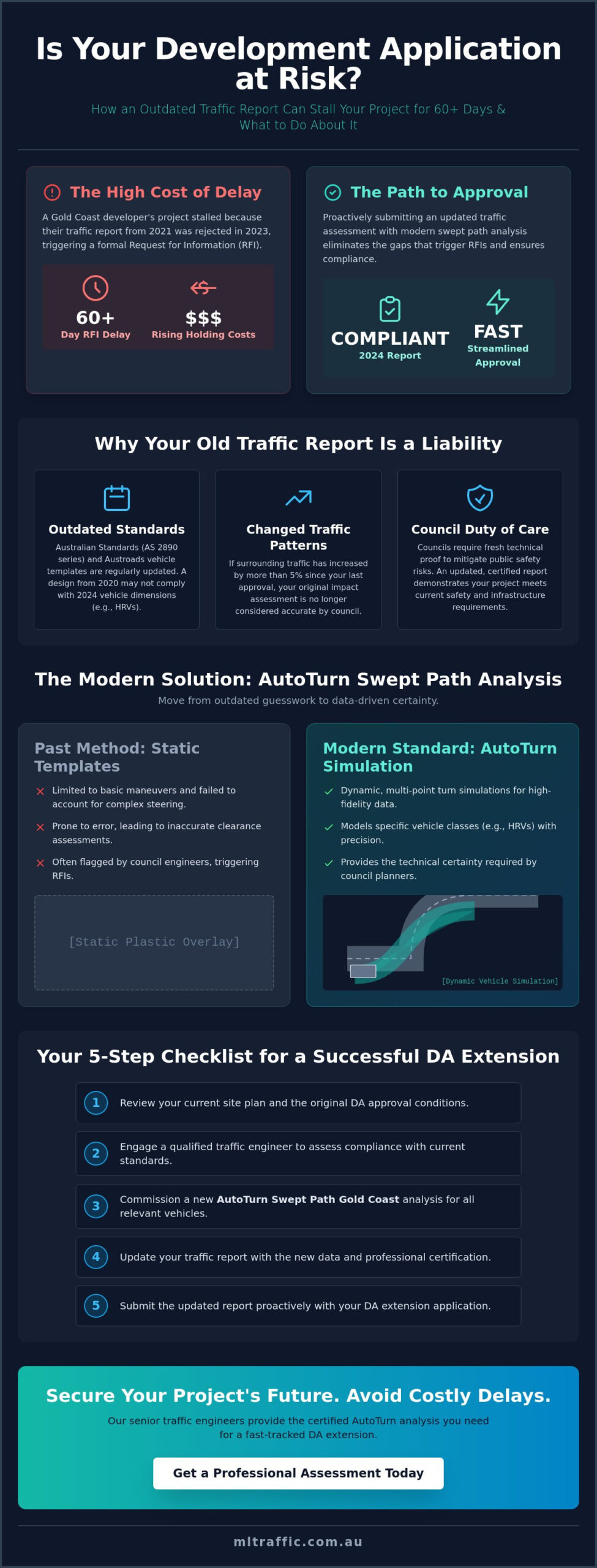
In October 2023, a Gold Coast developer saw their project timeline stall for 60 days because a Development Application extension relied on a traffic report from 2021 that no longer met current standards. You understand that every week of delay adds to your monthly holding costs. It’s a common frustration when outdated site access designs trigger a formal Request for Information (RFI) regarding your AutoTurn swept path Gold Coast requirements. You need a technical solution that moves your application through the system rather than keeping it stuck in a pile of paperwork.
This article explains how to use professional vehicle path analysis to satisfy council requirements and secure your DA extension. We’ll demonstrate how precise maneuvering simulations ensure your site remains compliant with AS 2890.1 and AS 2890.2. You’ll learn the specific steps to update your traffic documentation, resolve access issues, and achieve a functional design that council officers can approve without hesitation. We’ll examine the technical requirements for different vehicle classes and how to integrate these findings into a robust traffic report.
Key Takeaways
- Understand why Australian councils require current traffic reports for DA extensions to mitigate risks associated with outdated site data.
- Discover how a professional AutoTurn Swept Path Gold Coast assessment simulates vehicle movements to prove your site remains functional and compliant.
- Learn how updated swept path diagrams address council safety concerns and duty of care requirements, even when site layouts appear unchanged.
- Access a practical checklist for preparing your documentation and engaging a qualified traffic engineer to review your current site plan.
- Gain insight into how direct access to senior principals ensures technical accuracy and streamlined approval for complex development applications.
Table of Contents
-
Why Council Requires Updated Swept Path Diagrams for Extensions
-
Securing Approval: Professional Traffic Engineering for Your Project
The Critical Role of Traffic Reports in DA Extensions
Applying for a Development Application (DA) extension isn’t a simple administrative formality. Most Australian councils, particularly the City of Gold Coast, require technical proof that a project remains viable under current planning codes. A traffic report for a DA extension serves as this proof. It confirms that the original access, parking, and loading designs still function correctly within the evolved road network. Relying on an approval from three or four years ago is risky. Traffic patterns change, and what worked in 2020 might fail a 2024 assessment.
Professional certification is mandatory for these submissions. Councils expect reports signed by qualified engineers to ensure public safety and infrastructure integrity. We utilize
**AutoTurn Swept Path Gold Coast
**simulations to provide high-fidelity data that satisfies council engineering departments. Without an updated
[traffic engineering assessment
](https://www.mltraffic.com.au/services/), your extension request faces immediate scrutiny.
To better understand the technical precision required for these assessments, watch this video on core software functionality:
Why Original Reports May No Longer Be Compliant
Standards move fast. Even if your site plan hasn’t changed, the rules governing it likely have. The Australian Standards for parking (AS 2890 series) undergo periodic revisions that can render an old layout obsolete. Austroads vehicle templates have also evolved. A design vehicle dimension used in 2015 often differs from the 2024 requirements for a Heavy Rigid Vehicle (HRV).
Using modern
[vehicle swept path analysis software
](https://en.wikipedia.org/wiki/AutoTrack)is the only way to guarantee compliance with current templates. Local council policies regarding trip generation rates and "on-street" parking credits also shift based on new precinct plans. If the surrounding road network traffic volumes have increased by more than 5% since your initial approval, your original report’s impact assessment is technically inaccurate.
Avoiding Costly Project Stalls
The most significant threat to a DA extension is the Request for Further Information (RFI). A single traffic-related RFI can delay a project by 60 days or more. During this time, the project sits in limbo while holding costs accumulate. For a standard multi-residential development, these delays can cost thousands in interest and lost opportunity.
Proactive report preparation is a strategy for fast-tracked renewals. By submitting an updated
**AutoTurn Swept Path Gold Coast
**analysis with your extension application, you eliminate the technical gaps that trigger RFIs. This direct approach demonstrates competence to council officers. It shows the project is "shovel-ready" and compliant with the latest safety standards.
-
Updated reports prevent the 60-day RFI delay cycle.
-
Technical assessments ensure alignment with the latest AS 2890.1:2004 amendments.
-
Accurate swept path data protects development feasibility.
Understanding AutoTurn Swept Path Analysis for Compliance
AutoTurn is the global industry standard for simulating vehicle movements within a digital environment. It allows traffic engineers to model how specific vehicles interact with a site layout before construction begins. By providing a technical proof of concept, swept path analysis demonstrates that a site is functional for its intended use. This is a critical requirement for Development Applications (DA) and extensions across Queensland.
Historically, engineers relied on static 2D plastic templates. These manual overlays were limited and often failed to account for complex steering geometries or varying speeds. Modern software simulations provide dynamic, multi-point turn capabilities. This level of detail is necessary for both high-density residential car parks and industrial loading docks where clearance margins are tight. For developers securing an AutoTurn Swept Path Gold Coast assessment, this software provides the technical certainty required by local council planning schemes.
The Mechanics of Vehicle Turning Simulations
Simulations calculate the precise space a vehicle occupies while moving through a curve. This includes modeling the specific wheel paths, body overhangs, and required safety clearances, typically ranging from 300mm to 600mm depending on the environment. In tight commercial spaces, we simulate complex maneuvers like three-point turns to ensure delivery vehicles can enter and exit in a forward direction. Our assessments verify access for various vehicle classes, including:
-
Small Rigid Vehicles (SRV): Standard for local parcel deliveries and small-scale service access.
-
Medium Rigid Vehicles (MRV): Utilized for waste collection and standard freight requirements.
-
Heavy Rigid Vehicles (HRV): Required for larger industrial sites, warehouses, and major retail loading docks.
Meeting Australian Standards AS 2890.1 and AS 2890.2
Compliance hinges on adhering to the Australian Standards for parking and service facilities. AS 2890.1 governs off-street car parking, utilizing the B85 and B99 vehicle templates. The B85 represents the 85th percentile vehicle, while the B99 template accounts for larger SUVs and 4WDs. AS 2890.2 focuses on commercial vehicle access, ensuring that loading bays and service areas accommodate the turning circles of heavy transport. AutoTurn integrates AS 2890 requirements into a visual diagram that clearly illustrates vehicle swept paths against the proposed site boundaries. If your project requires professional validation, you can view our full range of traffic engineering services to see how we assist with DA compliance and site functionality.
Why Council Requires Updated Swept Path Diagrams for Extensions
Applicants frequently argue that a building extension doesn’t alter the existing driveway or parking layout. This is a common misconception in Development Applications (DA). Council planners require an updated AutoTurn Swept Path Gold Coast assessment because any change to the built form influences site dynamics. Even if the pavement remains untouched, new walls, columns, or landscaping can create physical obstructions or obscure critical sight-lines. Planners don’t just look at the footprint; they evaluate the interaction between the structure and the vehicle.
Local government authorities hold a strict duty of care regarding road safety and traffic efficiency. They cannot rely on historical approvals when evaluating a new extension. Since 2005, we’ve assisted with over 10,000 sites where council requirements have evolved. Planners need technical certainty that the design vehicle can still maneuver safely without striking infrastructure or mounting curbs. Our engineers use precise software simulations to provide this assurance. This data-driven approach removes guesswork for the assessing officer and reduces the likelihood of a Request for Further Information (RFI).
Swept path analysis also verifies that drivers have sufficient visibility at conflict points. We use these diagrams to confirm compliance with AS 2890.1 standards. We ensure the extension doesn’t create blind spots for exiting motorists or hide pedestrians from view. A professional assessment provides the empirical evidence needed to prove the site remains functional and safe under the new configuration.
Verifying Functional Site Access
Ensuring vehicles enter and exit in a forward direction is a non-negotiable safety requirement for most Gold Coast developments. An updated AutoTurn Swept Path Gold Coast report proves that the design vehicle, often a B99 car or a Small Rigid Vehicle (SRV), maintains a minimum 300mm clearance from new structural elements. We check driveway ramp grades against the updated site levels to prevent vehicle scraping. This is vital when extensions change the site’s topography or internal floor levels. Our RPEQ-certified engineers verify that the driveway width remains compliant for the specific design vehicle dictated by the council’s planning scheme.
Addressing Loading and Waste Collection Requirements
Modern DA conditions often include stringent requirements for on-site waste collection and delivery. Councils prioritize the ability of a 12.5m Heavy Rigid Vehicle (HRV) or an 8.8m Medium Rigid Vehicle (MRV) to service the site without blocking through-traffic. If an extension reduces the available turning radius, the development might fail to meet current waste management codes. We demonstrate that service vehicles operate within designated envelopes and don’t impede pedestrian safety zones. For a deeper understanding of these technical requirements, see our Swept Path Analysis: A Complete Guide for Australian Developments. Our reports show exactly how these heavy vehicles circulate without conflicting with parked cars or structural supports.
Preparing Your Traffic Report for DA Extension: A Checklist
Securing a Development Application (DA) extension requires technical precision. Gold Coast Council planners frequently issue Requests for Further Information (RFIs) when original traffic assessments are outdated or no longer reflect current site conditions. You must follow a structured process to ensure your submission meets modern regulatory standards. Use this five-step checklist to prepare your report for a successful extension.
-
Step 1: Collate Documentation. Gather all previous DA approvals and specific council correspondence. Since 2005, we’ve observed projects stall because developers missed a single condition from a prior RFI or failed to account for updated local area plans.
-
Step 2: Engage an Expert. You need a traffic engineer with RPEQ certification to review the current site plan. At ML Traffic Engineers, the consultant who provides your quote is the one who performs the technical work. This ensures accountability throughout the extension process.
-
Step 3: Run Simulations. Conduct an AutoTurn Swept Path Gold Coast assessment for every required design vehicle. This includes 8.8m Medium Rigid Vehicles (MRV) for waste collection or B99 cars for basement parking. We use the latest software to model these movements against the proposed site layout to ensure 100% compliance.
-
Step 4: Formulate the TIS. Your Traffic Impact Statement (TIS) must address operational changes since the original DA was lodged. It needs to account for current traffic volumes and any new intersections or developments nearby. Relying on five-year-old data is a common reason for application refusal.
-
Step 5: Submission. Submit the final, certified report to council. This clears outstanding RFIs and moves the extension toward a final decision.
Essential Components of a Compliant Report
A compliant report includes high-resolution swept path diagrams. These diagrams specify the vehicle’s turning radius, lock-to-lock time, and clearance margins. We provide a formal car parking demand and supply assessment to ensure your project adheres to AS 2890.1:2004 for off-street parking. Every report we issue carries a certification of compliance against relevant Australian Standards. This technical rigor is necessary for all Gold Coast commercial and multi-residential applications.
Working with Your Architect
Our engineers work directly with your architect’s CAD files to streamline the design process. We integrate traffic engineering feedback into the design early. A 300mm shift in a structural column or a 2% change in a driveway ramp grade often solves a major access issue. This collaboration prevents costly redesigns during the construction phase. It’s much cheaper to move a wall on a screen than to remediate a finished driveway. For expert assistance with your site plan, explore our Professional Traffic Engineer Services.
If you need a technical assessment to clear a council RFI, contact our senior engineers today for a direct quote.
Securing Approval: Professional Traffic Engineering for Your Project
ML Traffic Engineers brings technical authority to every project. We’ve completed over 10,000 site assessments since our establishment in 2005. When you require an AutoTurn Swept Path Gold Coast report for a DA extension, experience is the deciding factor. We provide nationwide support for private developers and large-scale civil projects. Our work isn’t just about software; it’s about applying decades of engineering knowledge to ensure your site functions safely and legally.
Our firm operates on a "No Gatekeepers" model. We believe the traffic consultant who provides your quote should be the one doing the work. This direct approach eliminates communication breakdowns often found in larger firms. You deal directly with senior experts who understand the bureaucratic requirements of local councils and state authorities. We’ve assessed a vast range of land uses, including apartments, childcare centres, warehouses, and shopping centres. This breadth of experience ensures we’ve likely solved similar access challenges before.
Reliability and Accountability in Traffic Engineering
Accuracy in a DA extension report is non-negotiable. Every assessment we produce involves direct oversight from our senior principals, Michael Lee and Benny Chen. Each principal brings between 30 and 40 years of specific industry experience to the table. This level of involvement ensures that every AutoTurn Swept Path Gold Coast analysis meets the strict criteria of Australian Standards, specifically AS 2890.1. Our commitment is to provide results-oriented, meticulous assessments that stand up to council scrutiny. You can find more details regarding our firm’s history and qualifications at About ML Traffic Engineers.
Get Started with Your DA Extension Report
Don’t let council deadlines stall your development. We’ve built our reputation on being dependable and responsive to client needs. Requesting a fast, accurate quote for your swept path analysis is straightforward. Because our principals are hands-on, you can contact Michael Lee or Benny Chen directly for urgent project needs. We provide the technical documentation required to secure your DA extension without unnecessary delays. Our reports are designed to be clear, professional, and authoritative. Contact us today to ensure your traffic engineering requirements are handled by seasoned experts who value accountability and precision.
Secure Your DA Extension with Precision Traffic Engineering
Securing a DA extension requires technical precision that meets strict Council standards. An accurate AutoTurn Swept Path Gold Coast assessment ensures your site design accommodates the required design vehicles without compromising safety. Since 2005, ML Traffic Engineers has assessed over 10,000 sites, providing the technical data needed for project compliance and successful approvals.
You’ll get direct access to senior principals Michael Lee and Benny Chen to ensure your traffic report aligns with AS 2890 standards. We don’t use junior staff; the consultant who quotes your project is the professional who completes the work. This hands-on approach eliminates bureaucracy and ensures your submission is meticulous and results-oriented. Professional engineering reports reduce the risk of Council RFIs and keep your development timeline on track.
Contact ML Traffic Engineers for a professional Traffic Report for your DA Extension at mltraffic.com.au to secure your project’s future. We’re ready to help you achieve a seamless approval process.
Frequently Asked Questions
Is a traffic report always required for a DA extension?
A traffic report isn’t mandatory for every DA extension, but it’s required if your proposal increases the gross floor area or alters vehicle access. Gold Coast City Council typically triggers this requirement when a development’s intensity increases by more than 10% or if parking requirements change under the City Plan. Our RPEQ engineers evaluate whether your specific extension triggers these statutory requirements to ensure your application remains compliant with current transport codes.
How long does an AutoTurn swept path analysis take to complete?
A standard AutoTurn swept path Gold Coast assessment typically takes 48 to 72 hours to complete once we receive your CAD files. This timeline includes the technical simulation of vehicle movements and the preparation of the final report by a senior consultant. If your project involves complex heavy vehicle movements or tight 90 degree turns, the analysis might require an additional 24 hours for rigorous quality assurance checks.
What is the difference between a TIA and a TIS for a DA extension?
The primary difference lies in the scale of the development’s impact on the road network. A Traffic Impact Assessment (TIA) is a comprehensive study for large developments generating over 30 vehicle trips per hour. A Traffic Impact Statement (TIS) is a concise report for smaller extensions with lower traffic volumes. Both documents must adhere to AS 2890.1 standards to demonstrate that the proposed changes won’t compromise safety or efficiency.
Can I use manual turning templates instead of AutoTurn software?
Manual templates are no longer the industry standard for DA extensions because they lack the precision required by modern planning authorities. We use AutoTurn software to provide a dynamic simulation that accounts for steering lock, speed, and vehicle overhangs. This digital approach eliminates the 15% margin of error often found in manual templates. It ensures your design meets the exact requirements of the Gold Coast City Council’s transport code.
What happens if the swept path analysis shows my design is non-compliant?
If the simulation identifies a conflict, we provide specific engineering recommendations to rectify the design. This often involves adjusting driveway widths or relocating structural columns to accommodate the B85 or B99 design vehicle. Our consultants work directly on your CAD files to find a solution that meets AS 2890.1 without sacrificing valuable floor space. We’ve successfully resolved non-compliance issues for over 10,000 sites since 2005.
Do I need to update my car park design for a DA extension?
You must update your car park design if the extension changes the building’s use or increases the number of employees or residents. Older designs often fail to meet the current AS 2890.1:2004 standards for parking modules and aisle widths. An updated AutoTurn swept path Gold Coast analysis confirms that modern vehicles can still navigate your existing site safely. This prevents delays during the council’s information request period.
How much does a traffic report for a DA extension cost?
The cost of a traffic report varies based on the project’s complexity and the specific requirements of the local planning scheme. Factors such as the number of intersections analyzed and the type of vehicles simulated influence the final professional fee. We provide a fixed-fee quote after reviewing your site plans. The traffic consultant who provides your quote will be the same senior engineer who performs the technical work on your project.
Which areas do you cover?
We are traffic engineers servicing Advancetown, Alberton, Arundel, Ashmore, Austinville, Beechmont, Benobble, Benowa, Biddaddaba, Biggera Waters, Bilinga, Birnam, Bonogin, Broadbeach, Broadbeach Waters, Bundall, Burleigh Heads, Burleigh Waters, Carrara, Cedar Creek, Clagiraba, Clear Island Waters, Coolangatta, Coombabah, Coomera, Currumbin, Currumbin Valley, Currumbin Waters, Elanora, Gaven, Gilberton, Gilston, Guanaba, Helensvale, Highland Park, Hollywell, Hope Island, Jacobs Well, Kingsholme, Labrador, Lower Beechmont, Luscombe, Main Beach, Maudsland, Mermaid Beach, Mermaid Waters, Merrimac, Miami, Molendinar, Mount Nathan, Mudgeeraba, Natural Bridge, Nerang, Neranwood, Norwell, Numinbah Valley, Ormeau, Ormeau Hills, Oxenford, Pacific Pines, Palm Beach, Paradise Point, Parkwood, Pimpama, Reedy Creek, Robina, Runaway Bay, South Stradbroke, Southport, Southern Moreton Bay Islands, Springbrook, Stapylton, Steiglitz, Surfers Paradise, Tallai, Tallebudgera, Tallebudgera Valley, Tugun, Upper Coomera, Varsity Lakes, Willow Vale, Wongawallan, Woongoolba, Worongary, Yatala

Disclaimer
The content on www.mltraffic.com.au, including all technical articles, guides, and resources, is provided for general informational and educational purposes only. It is not intended to constitute professional advice in traffic engineering, transportation planning, development approvals, or any other technical or legal field.
While ML Traffic Engineers makes every reasonable effort to ensure the accuracy, completeness, and timeliness of the information published, we do not provide any warranties or representations (express or implied) regarding its reliability, suitability, or availability for any particular purpose. Any reliance you place on the content is strictly at your own risk.
In no event shall ML Traffic Engineers, its directors, employees, authors, or affiliates be liable for any direct, indirect, incidental, special, consequential, or punitive damages (including, without limitation, loss of profits, data, or business opportunities) arising out of or in connection with the use of, or inability to use, any information provided on this website.
The articles and guides on this site are not a substitute for engaging a qualified, registered professional traffic engineer (such as an NPER or RPEQ engineer) to assess your specific project requirements. For tailored advice, compliance assessments, or traffic engineering services, please contact a competent professional.
This disclaimer may be updated from time to time without notice. By accessing or using this website, you agree to be bound by the most current version of this disclaimer.
