

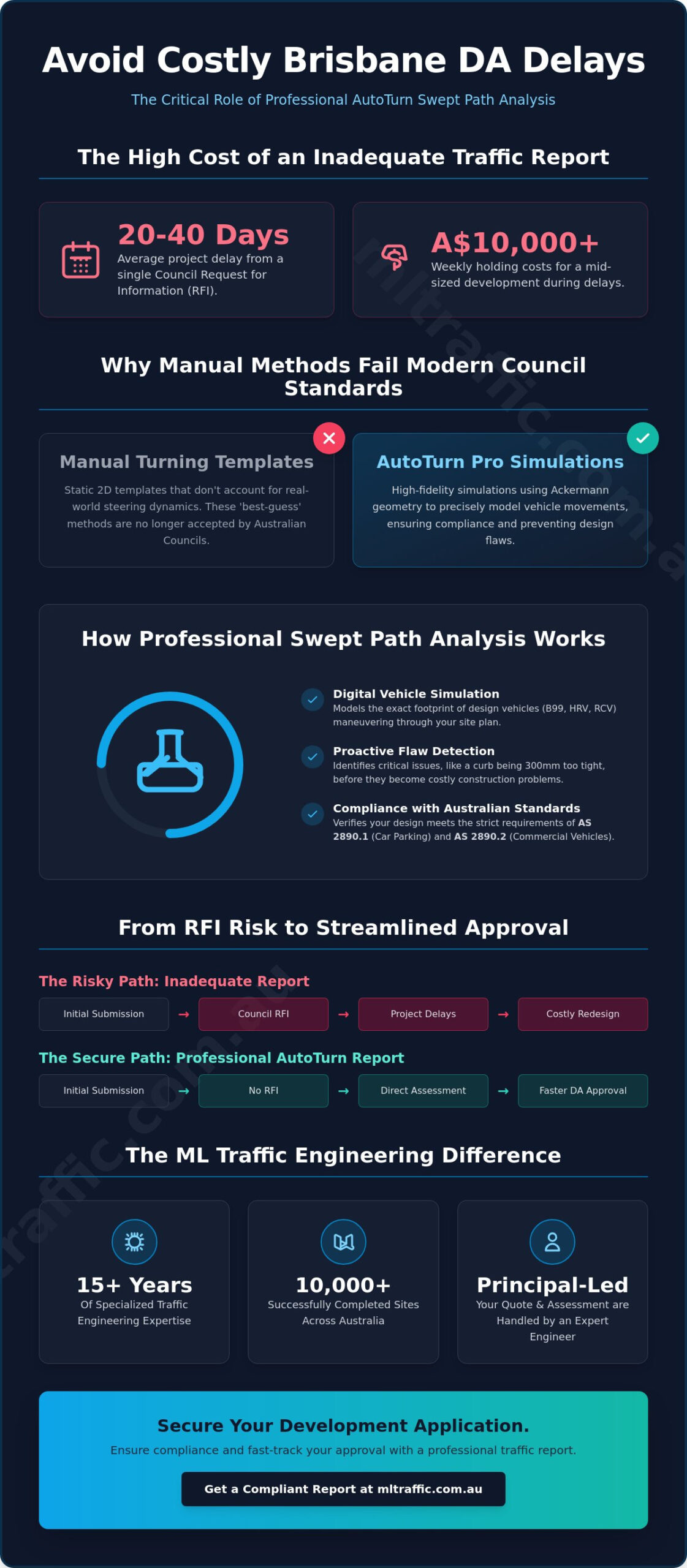
A single Request for Information (RFI) from Brisbane City Council regarding vehicle manoeuvring can delay a development approval by 20 to 40 business days. You already know that uncertainty about vehicle clearance in tight layouts is a primary trigger for these setbacks. It’s frustrating to watch holding costs mount because a traffic report lacks the technical depth required for modern site access design. Securing a professional AutoTurn swept path Brisbane assessment is the most effective way to address these concerns before they reach a planner’s desk.
This article explains how professional swept path analysis ensures your project remains compliant with Australian Standards AS 2890.1 and AS 2890.2. You’ll learn how reliable data eliminates the risk of outdated reports stalling your application. We’ll preview the essential elements of a secure traffic report and show you how to streamline your path to DA approval through meticulous engineering oversight.
Key Takeaways
- Understand why modern Australian Councils reject manual templates and now require professional vehicle swept path assessments to verify maneuverability.
- Learn how AutoTurn swept path Brisbane simulations verify site clearance for heavy vehicles, effectively eliminating costly Council RFIs and DA delays.
- Discover the essential structural requirements for a compliant traffic report, including the scaled vehicle overlays necessary for planning officer approval.
- Benefit from a Principal-led approach where the traffic engineer who provides your quote personally completes the technical assessment to ensure accuracy.
- Secure your development application by leveraging over 15 years of expertise and a proven track record across 10,000+ successfully completed sites.
Table of Contents
-
The Critical Role of Swept Path Analysis in Development Applications
-
How AutoTurn Simulations Solve Complex Site Access Challenges
-
Strategic Benefits: Reducing Council RFIs and Speeding Up Approval
The Critical Role of Swept Path Analysis in Development Applications
Swept path analysis is the technical simulation of a vehicle’s footprint as it maneuvers through a specific layout. It tracks the precise envelope cleared by the vehicle’s body and wheels to ensure no part of the chassis strikes a curb, wall, or structural column. For any developer or architect, this analysis is a non-negotiable component of a traffic report. In the Brisbane market, Council assessors require high-fidelity evidence that proposed designs work in the real world before granting Development Application (DA) approval.
To better understand how these simulations function in a design environment, watch this video:
Accuracy in these reports is critical for project timelines. Using an AutoTurn swept path Brisbane specialist ensures that the simulation reflects real-world physics rather than theoretical guesses. Inaccurate reports lead to Information Requests (IR) from Council. These requests stall projects; they increase holding costs; they force expensive redesigns. For a mid-sized residential or commercial development, holding costs can exceed A$10,000 per week. Getting the swept path right the first time is a financial necessity.
Why Manual Turning Templates Fail Modern Standards
Static 2D templates are no longer accepted by modern Australian Councils. These manual methods are limited because they don’t account for the dynamic nature of steering lock or the transition between different steering angles. AutoTurn software utilizes the principles of Ackermann steering geometry to calculate how different vehicles behave under specific speeds and steering constraints. In tight urban developments or multi-level basements, ‘best-guess’ designs often lead to structural changes post-submission. If a column is placed in a location that prevents a waste vehicle from turning, the cost of rectification during construction is catastrophic.
Meeting National Compliance: AS 2890.1 and AS 2890.2
Compliance is measured against strict Australian Standards. AS 2890.1 governs off-street car parking, while AS 2890.2 covers commercial vehicle facilities. Every DA must prove that the design accommodates the relevant design vehicle. This usually involves the B99 vehicle profile for standard parking and the Heavy Rigid Vehicle (HRV) for loading areas. A detailed AutoTurn swept path Brisbane assessment confirms that these vehicles can enter and exit the site in a forward gear. Reviewing an AS 2890.1 Explained resource helps clarify these technical benchmarks during the initial design phase to avoid compliance failures later.
How AutoTurn Simulations Solve Complex Site Access Challenges
AutoTurn software utilizes advanced algorithms to model the exact footprint a vehicle’s body and wheels occupy during any given maneuver. For a professional AutoTurn swept path Brisbane assessment, this involves mapping specific design vehicles, such as a 12.5m Heavy Rigid Vehicle (HRV) or a 19m articulated vehicle, against the proposed site geometry. This digital testing allows our engineers to run "what-if" scenarios. We identify design flaws, such as a curb radius being 300mm too tight, before a single brick is laid. This proactive approach eliminates the risk of costly physical site modifications after construction.
Simulating Heavy Vehicle and Service Access
Commercial and industrial developments depend on seamless loading dock and refuse collection vehicle (RCV) operations. Most local councils require these vehicles to enter and exit the site in a forward direction to maintain road safety. We use simulations to validate complex three-point turns and reverse maneuvers into confined loading bays. This level of detail is a core requirement for any Swept Path Analysis performed for retail or industrial projects. Our reports ensure that your project meets both local planning codes and relevant Federal approval requirements for infrastructure and environmental standards. We focus on:
-
Validating RCV swept paths for 11m or 12.5m vehicles.
-
Ensuring clearance for emergency service vehicles, including fire appliances.
-
Testing heavy vehicle circulation in high-volume distribution centers.
Managing Tight Urban Envelopes and Basement Ramps
Urban infill projects in Brisbane often face significant spatial constraints. An AutoTurn swept path Brisbane study is essential for identifying "blind spots" or pinch points in narrow driveways and basement entries. We don’t just look at the horizontal path; we evaluate the vertical component as well. This includes verifying ramp grade transitions to ensure vehicles don’t "bottom out" and checking overhead clearances for basement pipes and ducts. We integrate these simulations with sight-line assessments to ensure drivers have adequate visibility of pedestrians at the property boundary. Our team applies AS 2890.1 standards to every project to ensure full compliance. If you’re facing a difficult site layout, contact our senior engineers for a direct assessment.
Strategic Benefits: Reducing Council RFIs and Speeding Up Approval
A Request for Information (RFI) is the primary cause of Development Application (DA) timeline stalls. When Brisbane City Council or neighboring LGAs identify technical gaps in a submission, the assessment clock stops. This delay often lasts several weeks or months. Providing a professional AutoTurn swept path Brisbane assessment at the initial lodgement phase removes technical ambiguity. These diagrams show planning officers exactly how vehicles move through the site without guesswork.
Professional certification by experienced traffic consultants carries significant weight with authorities. We verify every simulation against the Austroads Design Vehicle Guidelines. This ensures the vehicle templates used match the specific requirements for Australian waste trucks, delivery vans, or passenger vehicles. Early swept path testing prevents late-stage architectural redesigns. Changing a basement layout after the design is finalized can cost tens of thousands in additional drafting and engineering fees.
Pre-empting Council Objections with Data
Councils frequently raise objections regarding specific site constraints. These include:
-
Inadequate turning circles for B99 or B85 vehicles.
-
Safety risks at the driveway crossover due to poor sightlines.
-
Reverse maneuvering into high-traffic corridors or narrow laneways.
-
Conflicts between service vehicles and pedestrian paths.
A robust traffic report provides the burden of proof required for approval. For larger developments, a Traffic Impact Assessment supports the DA by quantifying these movements. We use data to show that the proposed design functions safely under real-world conditions. This proactive approach limits the chance of a Council officer requesting a redesign mid-assessment.
The Cost of Inaccuracy: Why Cheap Reports Cost More
A 60-day DA delay due to poor traffic documentation results in substantial financial losses. For a medium-scale residential project, holding costs often exceed A$5,000 per week in interest and overheads. Flawed swept paths lead to unusable parking spaces or narrow ramps that require expensive rectification post-construction. If a parking bay is 200mm too narrow for a compliant turn, it becomes lost revenue or a permanent liability.
Getting the AutoTurn swept path Brisbane analysis right the first time maintains developer credibility. It signals that the project team is competent and the design is buildable. Our senior engineers ensure that the consultant who provides the quote is the one doing the work. This direct accountability prevents the errors often found in outsourced or entry-level documentation.
Essential Components of a Compliant Traffic Report
A professional Vehicle Swept Path & Access Assessment is a technical document that validates a site’s functionality. It’s not enough to show a parking space; the report must prove a vehicle can reach that space safely. Brisbane City Council and other local authorities require specific structural components to grant DA approval. Every report must include scaled diagrams with vehicle overlays that show the precise path of the wheels and the vehicle body. This level of detail is critical for AutoTurn swept path Brisbane projects where site constraints are often tight. Using an AutoTurn swept path Brisbane specialist ensures your report meets all local planning policies and avoids unnecessary delays.
-
Technical Data: Reports must list steering lock angles, safety margins, and the specific vehicle templates used.
-
Regulatory Alignment: All assessments must reference Australian Standards, specifically AS 2890.1 for cars and AS 2890.2 for commercial vehicles.
-
Safety Buffers: Standard clearances, often 300mm for cars and 500mm for heavy vehicles, must be maintained between the vehicle path and any fixed objects like columns or walls.
Checklist for a Council-Ready Swept Path Diagram
A diagram that fails to show the "worst-case scenario" will likely result in a Request for Further Information (RFI). We ensure every diagram includes the correct vehicle class, such as a B99 for standard passenger cars or an HRV for service deliveries. The assessment must demonstrate that vehicles can enter and exit the site in a forward direction. This is a non-negotiable requirement for most developments to ensure public safety on the frontage road. Each maneuver is tested against the physical boundaries of the site to confirm no encroachment occurs during the turn.
Collaborating with Architects and Civil Engineers
Our workflow involves importing CAD files directly into AutoTurn. This seamless integration allows us to identify design flaws early in the process. When we find a driveway ramp grade that’s too steep or a parking aisle that’s too narrow, we provide immediate feedback to the design team. The Role of a Traffic Engineer is to act as a specialist consultant within the multidisciplinary team. By refining the parking layout during the design phase, we help avoid costly revisions during the construction stage. Our senior engineers personally oversee this technical coordination to ensure the final report is accurate and defensible.
Ready to secure your DA approval? Contact ML Traffic Engineers today for a professional assessment from consultants who do the work they quote.
Expert Traffic Engineering: The ML Traffic Difference
Selecting the right consultant for an AutoTurn swept path Brisbane assessment determines whether your DA moves forward or stalls in Council. ML Traffic doesn’t operate like a standard consultancy. We’ve been trading since 2005, completing over 10,000 successfully assessed sites across Australia. Our core philosophy is simple: accountability. The traffic consultant who provides your quote is the same senior engineer who does the technical work. You won’t find your project handed off to a junior graduate once the contract is signed.
Direct access to our principals, Michael Lee and Benny Chen, ensures that every Vehicle Swept Path Assessment meets RPEQ-level accuracy. We understand both the technical engineering requirements and the often complex Council bureaucracy that can delay approvals. Our team brings between 30 and 40 years of individual experience to every project. This provides a level of reliability that large, impersonal firms often struggle to match. We focus on private clients who need their development applications handled with precision and speed.
Personalized Service vs. Large Firm Bureaucracy
Large consultancies often suffer from junior-heavy structures where senior oversight is a final, brief check rather than a constant presence. This leads to errors in driveway ramp grades or sight-line assessments that Council will catch, leading to expensive RFI (Request for Information) cycles. At ML Traffic, we eliminate these gatekeepers. You get a direct line to the experts. This hands-on approach reduces turnaround times and ensures your report is compliant with AS 2890.1 from the first submission. You can Contact ML Traffic for a direct principal consultation to discuss your specific site requirements.
Proven Results Across All Land-Use Types
Our portfolio covers an exhaustive range of developments. We’ve delivered results for residential apartments, childcare centers, medical clinics, service stations, and complex industrial warehouses. Our experience extends to niche projects like temples, bars, and car wash facilities. We maintain a deep understanding of varying Council requirements across Australia, ensuring your AutoTurn swept path Brisbane report aligns with local expectations. We don’t guess; we apply decades of technical knowledge to secure your approvals. Don’t risk your DA timeline on guesswork. Secure your project schedule with a professional swept path assessment that stands up to scrutiny.
Secure Your DA Approval with Precision Engineering
Accurate swept path analysis is the critical factor that separates seamless council approvals from costly Requests for Further Information (RFI). By utilizing advanced AutoTurn simulations, you verify that heavy vehicles and passenger cars navigate site constraints while remaining strictly compliant with Australian Standards like AS 2890.1. This technical precision eliminates guesswork and ensures your development application meets the rigorous requirements set by local authorities.
ML Traffic Engineers brings over 15 years of experience and a track record of 10,000 sites completed to your project. You’ll work directly with our senior principals. This ensures the consultant who provides the quote is the one performing the technical work. We deliver the precise AutoTurn swept path Brisbane developers rely on to solve complex site access challenges and reduce approval timelines. It’s about providing the authoritative data needed to secure your permit without unnecessary delays or bureaucratic hurdles.
Get a Traffic Report that Speeds Up Your DA Approval
We look forward to helping you move your development forward with confidence.
Frequently Asked Questions
What is AutoTurn swept path analysis and why is it used?
AutoTurn swept path analysis is a software-based simulation used to model the horizontal movement of a vehicle. It maps the path of the vehicle body and tire tracks during turns to ensure they don’t strike curbs, walls, or other vehicles. In Brisbane, we use this tool to verify that proposed site layouts comply with Australian Standard AS 2890.1. It’s a critical step for AutoTurn swept path Brisbane projects to prove that design vehicles can navigate the site safely.
Is a swept path analysis mandatory for all development applications?
A swept path analysis isn’t required for every small-scale project, but it’s mandatory for developments with constrained access or high vehicle turnover. Local councils, including Brisbane City Council, require these simulations for most multi-residential, commercial, and industrial applications. If your site involves a basement car park or heavy vehicle loading docks, you’ll need a formal assessment to secure DA approval.
Which vehicle classes are typically used in a swept path assessment?
Assessments utilize standard vehicle templates defined in AS 2890. Residential projects usually focus on the B99 vehicle, which represents the 99th percentile car. For industrial or commercial sites, we simulate Heavy Rigid Vehicles (HRV) or 19-metre articulated vehicles. We select the specific vehicle class based on the expected land use and the requirements of the local planning scheme.
Can an architect perform a swept path analysis instead of a traffic engineer?
Architects often have access to basic simulation tools, but councils generally require a report from a qualified traffic engineer. Professional engineers provide the technical expertise to account for driver error margins and complex maneuvering requirements. We provide RPEQ certified AutoTurn swept path Brisbane assessments that carry the necessary authority for formal council submissions. It’s about ensuring the simulation is accurate and legally defensible.
How much does a professional swept path report typically cost?
The cost of a swept path report varies depending on the number of maneuvers required and the complexity of the site layout. Fees are determined by whether the assessment is a standalone document or part of a full Traffic Impact Statement. Because every project is unique, we provide specific, fixed-fee quotes after reviewing your site plans. You’ll deal directly with our senior engineers to ensure you get a fair price for the technical work required.
What happens if my site fails the swept path simulation?
If a vehicle can’t complete a maneuver without hitting an obstruction, the site design must be adjusted. We don’t just report the failure; we identify the specific clash points and suggest design modifications. This might involve widening a driveway, splaying a corner, or relocating a structural column. Our goal is to find a functional solution that maintains your development’s yield while meeting safety standards.
How long does it take to prepare a compliant traffic report for a DA?
We typically complete a standard swept path assessment within 5 to 10 business days. This timeline depends on the quality of the CAD files provided and the complexity of the movements being tested. Since our principals do the work themselves, there’s no middle-management delay. We understand that DA deadlines are strict and we work to meet your project timeline.
Does the swept path report cover both entry and exit maneuvers?
Yes, a compliant report must demonstrate that a vehicle can safely enter and exit the site. Most councils require vehicles to enter and leave in a forward direction, especially on busy roads. We simulate the entire movement from the street, through the driveway, and into the parking space or loading bay. We also test the exit path to ensure there’s adequate clearance for the vehicle to rejoin traffic safely.
Which areas do you cover?
We are traffic engineers servicing Brisbane, Brisbane City, Fortitude Valley, New Farm, Teneriffe, Kangaroo Point, East Brisbane, South Brisbane, West End, Highgate Hill, Dutton Park, Woolloongabba, Ascot, Clayfield, Albion, Bowen Hills, Newstead, Bulimba, Hawthorne, Morningside, Balmoral, Indooroopilly, Taringa, Toowong, Auchenflower, Milton, Paddington, Red Hill, Bardon, Ashgrove, The Gap, Enoggera, Mitchelton, Aspley, Chermside, Kedron, Stafford, Everton Park, Gordon Park, Wilston, Grange, Alderley, Kelvin Grove, Herston, Lutwyche, Windsor, Nundah, Wavell Heights, Chermside West, Zillmere, Carseldine, Bald Hills, Bracken Ridge, Brighton, Sandgate, Shorncliffe, Deagon, Taigum, Fitzgibbon, Boondall, Virginia, Banyo, Nudgee, Northgate, Hamilton, Hendra, Eagle Farm, Murarrie, Cannon Hill, Seven Hills, Norman Park, Coorparoo, Camp Hill, Carina, Carindale, Mount Gravatt, Upper Mount Gravatt, Mansfield, MacGregor, Robertson, Sunnybank, Sunnybank Hills, Acacia Ridge, Inala, Oxley, Corinda, Graceville, Sherwood, Yeronga, Annerley, Moorooka, Tarragindi, Holland Park, Holland Park West, Coopers Plains, Greenslopes, Fairfield, Yeerongpilly, Stones Corner, Wynnum, Wynnum West, Manly, Manly West, Tingalpa, Hemmant, Lota, Wakerley, Rochedale, Eight Mile Plains, Runcorn, Calamvale, Parkinson, Algester, Doolandella, Forest Lake, Richlands, Darra, Wacol, Archerfield, Rocklea, Salisbury, Nathan, Mount Gravatt East, Wishart, Karawatha, Stretton, Kuraby, Belmont, Chandler, Gumdale, Lytton, Port of Brisbane, Kenmore, Jindalee, Mount Ommaney, Sinnamon Park, Fig Tree Pocket, Chapel Hill, St Lucia, Petrie Terrace, Spring Hill, Wooloowin, Newmarket, Gaythorne, Keperra, Ferny Grove, Upper Kedron, Bridgeman Downs, McDowall, Stafford Heights, Geebung, Pinkenba, Brisbane Airport, Nudgee Beach, Kalinga, Albion (duplicate avoided), Anstead, Bellbowrie, Brookfield, Chelmer, Chuwar, England Creek, Enoggera Reservoir, Jamboree Heights, Karana Downs, Kenmore Hills, Kholo, Lake Manchester, Middle Park, Moggill, Mount Coot-tha, Mount Crosby, Pinjarra Hills, Pullenvale, Riverhills, Seventeen Mile Rocks, Upper Brookfield, Westlake, Banks Creek, Burbank, Drewvale, Durack, Ellen Grove, Heathwood, Larapinta, Mackenzie, Pallara, Sumner, Tennyson, Willawong, Carina Heights, Ransome, Cannon Hill (duplicate avoided), Carindale, Manly, Moreton Island, Bulwer, Cowan Cowan, Kooringal.
Can you help with developments outside of Brisbane, like the Gold Coast or Sunshine Coast?
Yes. While we have deep expertise in Brisbane, our senior engineers have extensive experience securing DA approvals with councils across Queensland, including the Gold Coast, Sunshine Coast, Moreton Bay, Logan, and Ipswich.

Disclaimer
The content on www.mltraffic.com.au, including all technical articles, guides, and resources, is provided for general informational and educational purposes only. It is not intended to constitute professional advice in traffic engineering, transportation planning, development approvals, or any other technical or legal field.
While ML Traffic Engineers makes every reasonable effort to ensure the accuracy, completeness, and timeliness of the information published, we do not provide any warranties or representations (express or implied) regarding its reliability, suitability, or availability for any particular purpose. Any reliance you place on the content is strictly at your own risk.
In no event shall ML Traffic Engineers, its directors, employees, authors, or affiliates be liable for any direct, indirect, incidental, special, consequential, or punitive damages (including, without limitation, loss of profits, data, or business opportunities) arising out of or in connection with the use of, or inability to use, any information provided on this website.
The articles and guides on this site are not a substitute for engaging a qualified, registered professional traffic engineer (such as an NPER or RPEQ engineer) to assess your specific project requirements. For tailored advice, compliance assessments, or traffic engineering services, please contact a competent professional.
This disclaimer may be updated from time to time without notice. By accessing or using this website, you agree to be bound by the most current version of this disclaimer.
