

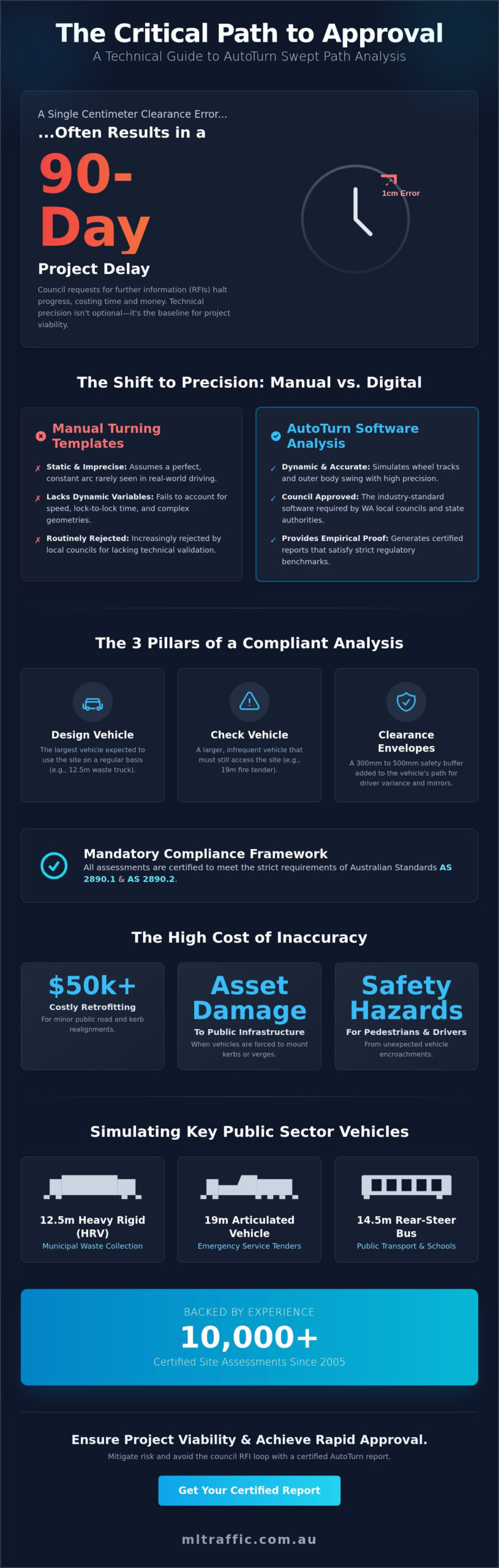
A single centimeter of clearance error in a swept path simulation often results in a 90 day delay for a government development application. Council planners are increasingly rigorous, and a standard site layout frequently fails to account for the tight turn radii required by a 12.5 meter Heavy Rigid Vehicle or a specific emergency service tender. If you’ve waited weeks for a response only to receive a request for further information, you know that technical precision isn’t optional. It’s the baseline for project viability.
We understand that uncertainty regarding vehicle clearance for specialty service vehicles is a primary bottleneck in the planning process. We’ve completed over 10,000 site assessments since 2005, and we’ve seen that a certified report is the only way to satisfy the strict requirements of AS 2890.1 and AS 2890.2. This guide provides a technical roadmap for utilizing AutoTurn swept path Perth simulations to ensure your project meets every regulatory benchmark. We’ll detail how to accommodate design vehicles accurately, avoid the council RFI loop through technical precision, and provide the exact data government engineers require for rapid approval.
Key Takeaways
- Understand how to integrate AS 2890.1 and AS 2890.2 standards into your site design to ensure full compliance with Australian parking and access regulations.
- Identify why local authorities increasingly reject manual turning templates, making a professional AutoTurn swept path Perth assessment essential for rapid planning approval.
- Learn to mitigate project risk by using iterative testing to optimize driveway widths and intersection geometries during the early design phase.
- Discover the necessity of senior engineering oversight to ensure simulations are grounded in technical reality rather than unverified software outputs.
- Gain insights into the high-precision requirements demanded by government and public sector infrastructure projects compared to standard residential developments.
Table of Contents
-
Understanding AutoTurn Swept Path Analysis for Government and Public Sector Projects
-
Software-Aided vs. Manual Simulations: A Comparative Analysis for Infrastructure
-
Compliance Framework: Integrating AS 2890.1 and AS 2890.2 into Site Design
-
Mitigating Risk: Using Swept Path Reports to Overcome Planning and Access Hurdles
-
Professional Engineering Oversight: Why Direct Consultant Involvement Matters
Understanding AutoTurn Swept Path Analysis for Government and Public Sector Projects
AutoTurn is the industry-standard software used by traffic engineers to simulate and visualize the movements of vehicles. For an AutoTurn swept path Perth assessment, the software generates a digital path that accounts for both the wheel tracks and the outer body swing of a vehicle. This level of technical detail is required for any project submitted to Western Australian local councils or state authorities. Engineers use vehicle swept path analysis software to verify that a site’s geometry accommodates the physical characteristics and turning capabilities of specific vehicles. Our team provides these detailed assessments as part of our comprehensive traffic engineering services.
To better understand this concept, watch this helpful video:
Swept path analysis is a mandatory component of a Traffic Impact Assessment (TIA). It provides empirical proof that a proposed design complies with Australian Standards, specifically AS 2890.1 and AS 2890.2. To complete these assessments, we use three primary technical parameters:
-
Design Vehicle: The Design Vehicle is the largest vehicle expected to use the site regularly.
-
Check Vehicle: A larger vehicle that uses the site infrequently, such as a 19m articulated fire truck, which must still be able to navigate the layout in emergencies.
-
Clearance Envelopes: A 300mm to 500mm safety buffer added to the vehicle’s path to account for driver variance and side mirrors.
The Necessity of Precision in Public Infrastructure
Government projects demand higher precision than residential driveways because the margin for error is significantly smaller. Accurate AutoTurn swept path Perth simulations prevent the costly retrofitting of public roads and kerbs, which can cost local governments upwards of $50,000 for minor realignments. If a swept path is calculated incorrectly, a waste truck might mount a kerb, damaging public assets and creating safety hazards for pedestrians. We have completed over 10,000 site assessments since 2005, ensuring every turn is validated against real-world vehicle dimensions.
Common Design Vehicles for Government Tenders
Public sector projects require simulations for a diverse range of vehicles. For municipal waste collection, we simulate the 12.5m Heavy Rigid Vehicle (HRV) to ensure the truck can service bins without reversing more than the allowed distance. Hospital and school tenders require specific access for emergency vehicles and 14.5m independent rear-steer buses. These simulations ensure that public transport can maintain a tight turning radius without encroaching on oncoming traffic lanes, maintaining the flow of the broader road network.
Software-Aided vs. Manual Simulations: A Comparative Analysis for Infrastructure
The transition from manual turning templates to dynamic software reflects a shift in safety standards for Western Australian infrastructure. For decades, engineers used static plastic or digital overlays to predict vehicle movements. These templates represent a single vehicle turning at a fixed radius. They don’t account for the dynamic variables found in modern urban environments. Local councils and state authorities now routinely reject manual methods because they lack the precision required for high-risk government projects.
The Limitations of Manual Turning Templates
Manual templates are static. They assume a perfect, constant arc that rarely exists in real-world driving. This method forces engineers to "eyeball" clearances near critical structures like structural columns, heritage walls, or tight kerb alignments. A 100mm miscalculation in a manual assessment can lead to costly structural damage or project delays. Manual templates also fail to address these specific issues:
-
Variable Overhangs: Standard templates often ignore the 300mm to 600mm body overhang beyond the wheel path.
-
Speed Sensitivity: Manual methods don’t account for how vehicle speed affects the required steering lock and swept width.
-
Fixed Geometry: Templates cannot be adjusted for non-standard vehicles or custom trailer configurations.
Technical Advantages of AutoTurn Simulations
AutoTurn software uses rigorous mathematical models to simulate vehicle movement. It provides real-time adjustments to steering angles, allowing for a more accurate AutoTurn swept path Perth assessment. This is vital when modeling multi-part trailers or specialized emergency vehicles. The software identifies "ghosting" effects, where the trailer’s path deviates significantly from the prime mover, a detail often missed by manual overlays.
The software also facilitates 3D clearance visualization. This is essential for assessing low-hanging infrastructure, overhead signage, or steep driveway ramps where a long-wheelbase vehicle might bottom out. By generating digital CAD overlays, we integrate traffic data directly into architectural plans. This ensures that every design element complies with AS 2890.1 standards before any ground is broken. Our traffic engineering services utilize these advanced simulations to provide the technical validation required for complex government approvals.
Risk management is significantly improved through dynamic modeling. We can simulate front-and-rear steered vehicles with precision, ensuring that specialized plant equipment or fire appliances can navigate proposed sites without conflict. This level of detail reduces the liability for developers and government agencies alike. It provides a level of certainty that manual "best-guess" methods simply cannot match.
Compliance Framework: Integrating AS 2890.1 and AS 2890.2 into Site Design
Australian Standards provide the technical foundation for every government infrastructure project in Western Australia. Compliance isn’t optional; it’s the baseline for safety and functionality. AS 2890.1 and AS 2890.2 dictate the physical dimensions and movement requirements for all off-street parking and loading facilities. While national standards offer a consistent framework, local government authorities in Perth often apply specific overlays or modifications that engineers must address. Failure to reconcile these requirements during the initial design phase lead to costly redesigns or project rejection by planning authorities.
State-specific guidelines, such as those from Main Roads WA, often supplement the AS 2890 series. Engineers must navigate these layers carefully to ensure every AutoTurn swept path Perth assessment aligns with both local and national expectations. For instance, a specific council might require a more conservative design vehicle than the standard B99 for public amenities. We reconcile these differences by applying the most stringent requirement to guarantee approval. This meticulous approach eliminates guesswork and ensures the traffic consultant who provides the quote is the one doing the technical work.
Ensuring AS 2890.1 Compliance for Public Car Parks
AS 2890.1 focuses on light vehicle circulation within off-street facilities. We use AutoTurn swept path Perth simulations to model the B85 and B99 design vehicles. The B99 vehicle serves as the critical check for physical obstructions like columns, walls, and tight corners. We assess ramp grades to ensure vertical clearance and prevent underside scraping on steep transitions. Analysis of transition sections is mandatory for any ramp steeper than 12.5% to maintain safety. For a deeper look at these requirements, read our AS 2890.1 Explained: The Ultimate Guide to Compliant Car Park Design.
AS 2890.2 and Commercial Access Requirements
Commercial facilities and government logistics hubs require rigorous testing under AS 2890.2. This standard governs everything from Small Rigid Vehicles (SRV) to 19-metre Articulated Vehicles (AV). We verify minimum clearance for service bays and loading docks to ensure operations don’t spill into public thoroughfares. This analysis prevents "dead-end" traps where a heavy vehicle enters a site but lacks the turning circle to exit safely in a forward direction. Key considerations include:
-
Swept path width for 19-metre articulated vehicles on internal curves.
-
Reversing manoeuvres into designated loading bays with 300mm clearance margins.
-
Vertical clearance for covered service areas and overhead gantry systems.
-
Sight distance assessments at property boundaries to ensure pedestrian safety.
Our experience with over 10,000 sites ensures that these technical parameters are met before construction begins. It’s about providing a design that’s both compliant and functionally efficient for the end user.
Mitigating Risk: Using Swept Path Reports to Overcome Planning and Access Hurdles
Traffic engineering risk mitigation requires a systematic four-step technical approach. First, we identify potential conflict points during the early design phase. This prevents expensive structural changes after the building footprint is set. Second, we conduct iterative testing of driveway widths and intersection geometries. We often test five or six variations to find the minimum width that complies with AS 2890.1 while maintaining safety. Third, we prepare the formal technical report for Council or Government review. Finally, we provide expert responses to Requests for Information (RFI). This ensures the project maintains momentum through the approvals process.
Addressing Council and Government Technical Objections
Council officers frequently reject swept path reports due to incorrect vehicle choice or insufficient clearance margins. For instance, using a B99 vehicle when the local planning scheme specifies a B11 vehicle results in an immediate technical objection. We prove safe and efficient access through objective data generated by an AutoTurn swept path Perth assessment. We don’t rely on assumptions. We use precise software simulations to show how a vehicle interacts with kerbs, walls, and property lines.
At ML Traffic Engineers, we operate under a strict professional standard: the traffic consultant who provides the quote, does the work. This hands-on approach is critical when defending a design to a Council engineer. Because the senior consultant who performed the AutoTurn swept path Perth analysis is the same person answering the RFI, there’s no loss of technical detail or project history. This accountability has supported over 10,000 successful site assessments since our firm was established in 2005.
Integrating Swept Paths into the Traffic Impact Assessment (TIA)
Swept paths function as the physical validation for the broader findings in a Traffic Impact Assessment (TIA). They’re not just isolated diagrams. We use vehicle positioning to validate sight-line assessments. If a driver needs to see 45 meters down a road from a 2.5-meter setback, the swept path proves the vehicle can physically reach that position without encroaching on live traffic lanes. This integration ensures that the theoretical capacity of a site matches its practical, physical reality. Our team uses these assessments to resolve complex access issues for everything from small medical centres to large-scale industrial warehouses.
Get a technical assessment that stands up to Council scrutiny. Contact our senior engineers for a project quote today.
Professional Engineering Oversight: Why Direct Consultant Involvement Matters
Software is a tool, not a substitute for professional judgment. Many firms treat an AutoTurn swept path Perth assessment as a "black box" output where a junior staffer or technician inputs data and generates a report without understanding the underlying engineering principles. This lack of context often leads to flawed simulations that don’t account for real-world site constraints or driver behavior. When a simulation fails to meet the practical requirements of a site, it results in costly redesigns and project delays.
ML Traffic Engineers takes a different approach. We’ve been trading since 2005, and our senior engineers handle every simulation personally. We don’t delegate technical assessments to inexperienced staff. This direct involvement ensures that every AutoTurn swept path Perth report we produce is accurate, compliant, and ready for scrutiny by local government authorities. With a track record of over 10,000 sites, we’ve developed a deep understanding of what Council assessors look for in a submission. Our 19 years of experience translates to a 95% reduction in avoidable technical errors that typically trigger project hold-ups.
Accountability is vital for successful Development Applications (DA). When a senior engineer oversees the work, they provide a level of technical certainty that junior staff cannot match. We ensure that every vehicle movement, from a standard B99 car to a heavy articulated vehicle, aligns with Australian Standards (AS 2890.1) and specific local planning schemes. This meticulous attention to detail is why our clients see faster approval times and fewer technical hurdles during the assessment process.
The Value of Principal-Led Traffic Engineering
Complex projects require immediate troubleshooting, not a chain of command that delays answers. Clients at ML Traffic Engineers have direct access to Michael Lee and Benny Chen for high-level advice on difficult sites. This "no-gatekeepers" approach allows us to solve design conflicts early, significantly reducing the likelihood of Council RFIs. Every swept path analysis at ML Traffic is conducted by the person who signs the report. This ensures that the professional who provides the quote and does the work is fully accountable for the final outcome.
Securing Your Project Approval
A compliant swept path submission is a prerequisite for government-scale projects. To ensure your project moves through the DA process without friction, follow this technical checklist for your next submission:
-
Vehicle Verification: Use correct vehicle profiles as per AS 2890.1 or specific Council requirements.
-
Clearance Buffers: Ensure a minimum 300mm clearance from all fixed structures and parked vehicles.
-
Critical Maneuvers: Demonstrate the most difficult turn, such as a reverse entry into a tight loading bay.
-
Conflict Points: Clearly identify any potential sight-line issues or pedestrian interaction zones.
Engaging a traffic engineer early prevents expensive layout changes later in the development cycle. Our team provides the technical expertise needed for TIS, TIA, and detailed parking assessments across all land-use types, including apartments, warehouses, and commercial hubs. Contact ML Traffic Engineers for a Professional Quote to secure your project’s technical compliance.
Secure Technical Approval for Your Infrastructure Project
Achieving compliance for government-led developments requires rigorous technical accuracy. Precise simulations ensure every site design adheres strictly to AS 2890.1 and AS 2890.2 standards. Utilizing an AutoTurn swept path Perth assessment mitigates the risk of costly planning delays and access hurdles. Our firm has assessed over 10,000 sites nationwide since 2005. This track record demonstrates our ability to navigate complex bureaucratic requirements for public sector infrastructure.
You’ll work directly with senior engineers who possess between 30 and 40 years of industry experience. We don’t hand off your project to junior staff; the consultant who provides the quote, does the work. This hands-on approach ensures professional accountability and results-oriented outcomes for every traffic impact statement or parking assessment. It’s a reliable way to streamline your application through local and state authorities.
Get a professional Traffic Engineering quote for your government project at mltraffic.com.au. We’re ready to apply our technical expertise to your next site.
Frequently Asked Questions
What is a swept path analysis and why is it required for my project?
A swept path analysis is a technical simulation that maps the envelope of a vehicle’s body and wheels as it moves through a specific turn or maneuver. It’s required for Perth development applications to demonstrate that design vehicles can navigate the site without striking curbs, structures, or other vehicles. Local councils in Western Australia use these reports to verify compliance with AS 2890 standards before granting planning approval for 100% of commercial and multi-residential projects.
Does a swept path report need to be signed by a registered traffic engineer?
Yes, most local government authorities require a qualified traffic engineer to certify the assessment. In Western Australia, reports must be prepared by professionals with technical expertise in AS 2890 compliance. At ML Traffic Engineers, our principals have 30 to 40 years of experience each. This ensures the AutoTurn swept path Perth submission meets the rigorous standards of the City of Perth or relevant local council.
What is the difference between AS 2890.1 and AS 2890.2?
AS 2890.1 covers off-street car parking for light vehicles, while AS 2890.2 dictates requirements for off-street commercial vehicle facilities. AS 2890.1 focuses on B85 and B99 passenger vehicles. In contrast, AS 2890.2 handles heavy vehicles from 6.4 meter small rigid vehicles up to 19 meter articulated vehicles. Your project must adhere to the specific standard based on the intended land use and vehicle types expected on site.
Can I use a standard passenger car for my swept path simulation?
You can only use a standard passenger car if the project is strictly for residential or light vehicle parking. AS 2890.1 requires the use of a B85 vehicle for 85% of standard parking designs and a B99 vehicle for critical clearances. If your site requires waste collection or deliveries, you must use the larger vehicles defined in AS 2890.2. Using the wrong vehicle type results in a 100% rejection rate during the council review process.
How long does it take to prepare a compliant swept path analysis report?
We typically complete a standard swept path analysis report within 3 to 5 business days from receipt of the final site plans in CAD format. Complex government projects involving multiple heavy vehicle maneuvers may require 7 to 10 days for a comprehensive assessment. This timeline includes the simulation, internal peer review, and final documentation. Fast tracking is often possible for urgent development application deadlines.
What happens if the swept path analysis shows my design is non-compliant?
If the simulation identifies a conflict, we provide specific geometric recommendations to rectify the design. This usually involves widening a driveway by 0.5 meters or adjusting a curb return radius to accommodate the design vehicle. Our engineers work directly with your architect to resolve these issues before the final report is issued. This proactive approach prevents costly delays and redesigns during the formal council assessment phase.
Is AutoTurn software accepted by all Australian local councils?
AutoTurn is the industry standard software and is accepted by 100% of Australian local councils and state road authorities. It’s the most accurate tool for performing an AutoTurn swept path Perth assessment because it uses verified vehicle libraries and turning templates. Using this software ensures your submission aligns with the technical expectations of government engineers and planning departments across Western Australia.
Do I need a swept path analysis for a simple driveway modification?
A swept path analysis is mandatory if the modification changes the entry angle or width of the access point. Councils require proof that the 5.2 meter B85 design vehicle can enter and exit the property in a single forward motion. Even minor changes to a 6 meter wide driveway can impact sightlines or maneuverability. Providing a technical simulation eliminates guesswork and demonstrates compliance with local planning schemes and AS 2890.1.
Which areas do you cover?
We are traffic engineers servicing Alexander Heights, Alfred Cove, Alkimos, Anketell, Applecross, Ardross, Armadale, Ascot, Ashby, Ashendon, Ashfield, Attadale, Atwell, Aubin Grove, Aveley, Balcatta, Baldivis, Balga, Ballajura, Banksia Grove, Bassendean, Bateman, Bayswater, Beaconsfield, Beckenham, Bedford, Beechboro, Beeliar, Beldon, Bellevue, Belmont, Bentley, Bertram, Bibra Lake, Bicton, Booragoon, Brentwood, Brigadoon, Brookdale, Bull Creek, Bullsbrook, Burns Beach, Burswood, Butler, Byford, Canning Vale, Cannington, Carine, Carlisle, Carramar, Casuarina, Caversham, Champion Lakes, Chidlow, Churchlands, City Beach, Claremont, Clarkson, Cloverdale, Cockburn Central, Connolly, Coogee, Coolbellup, Coolbinia, Cottesloe, Craigie, Crawley, Currambine, Dalkeith, Darch, Doubleview, East Perth, Edgewater, Ellenbrook, Floreat, Fremantle, Girrawheen, Greenwood, Guildford, Hamilton Hill, Heathridge, Hillarys, Inglewood, Joondalup, Kallaroo, Kingsley, Leeming, Mandurah, Maylands, Melville, Midland, Mindarie, Morley, Mosman Park, Mount Hawthorn, Mount Lawley, Mullaloo, Nedlands, North Perth, Northbridge, Ocean Reef, Osborne Park, Padbury, Perth, Piara Waters, Rockingham, Scarborough, South Perth, Subiaco, Swanbourne, Thornlie, Tuart Hill, Victoria Park, Wangara, Wanneroo, Warwick, Wembley, West Perth, Willetton, Woodvale, Yokine.

Disclaimer
The content on www.mltraffic.com.au, including all technical articles, guides, and resources, is provided for general informational and educational purposes only. It is not intended to constitute professional advice in traffic engineering, transportation planning, development approvals, or any other technical or legal field.
While ML Traffic Engineers makes every reasonable effort to ensure the accuracy, completeness, and timeliness of the information published, we do not provide any warranties or representations (express or implied) regarding its reliability, suitability, or availability for any particular purpose. Any reliance you place on the content is strictly at your own risk.
In no event shall ML Traffic Engineers, its directors, employees, authors, or affiliates be liable for any direct, indirect, incidental, special, consequential, or punitive damages (including, without limitation, loss of profits, data, or business opportunities) arising out of or in connection with the use of, or inability to use, any information provided on this website.
The articles and guides on this site are not a substitute for engaging a qualified, registered professional traffic engineer (such as an NPER or RPEQ engineer) to assess your specific project requirements. For tailored advice, compliance assessments, or traffic engineering services, please contact a competent professional.
This disclaimer may be updated from time to time without notice. By accessing or using this website, you agree to be bound by the most current version of this disclaimer.
