

A single non-compliant turning circle is often the only factor standing between a Melbourne development application and a costly council rejection. You likely understand that meeting the precise requirements of AS 2890.1 and AS 2890.2 is a technical necessity where even a minor miscalculation leads to months of unnecessary delays. Since 2005, we’ve seen how these bureaucratic hurdles can stall private developments across more than 10,000 sites when layouts aren’t rigorously tested against Australian Standards.
This guide explains how a professional AutoTurn swept path Melbourne assessment ensures your development meets every regulatory benchmark to secure rapid council approval. You’ll learn how to optimize car park and loading dock layouts through meticulous vehicle path analysis that maximizes space without sacrificing compliance. We also detail why direct access to an experienced traffic engineer, the same professional who provides your quote and does the work, is the most efficient way to achieve certification and move your project into the construction phase.
Key Takeaways
- Understand why Melbourne councils mandate precise vehicle simulations for crossovers and loading docks to ensure compliance with Australian Standards.
- Learn how to correctly apply AS 2890.1 and AS 2890.2 technical requirements, including the critical distinctions between B85 and B99 design vehicles.
- Identify common modelling errors, such as neglecting ground clearance on steep ramps, that frequently lead to council project rejections.
- Discover why providing CAD files is essential for a professional AutoTurn swept path Melbourne assessment and how to identify your site’s critical vehicles.
- Secure expert results by leveraging senior traffic engineering experience where the consultant providing your quote personally completes the technical work.
Table of Contents
-
Understanding AutoTurn Swept Path Analysis for Melbourne Applications
-
Technical Standards: Applying AS 2890 to Swept Path Simulations
-
Common AutoTurn Modelling Errors That Cause Council Rejection
-
Professional Swept Path Consulting: Why Senior Expertise Matters
Understanding AutoTurn Swept Path Analysis for Melbourne Applications
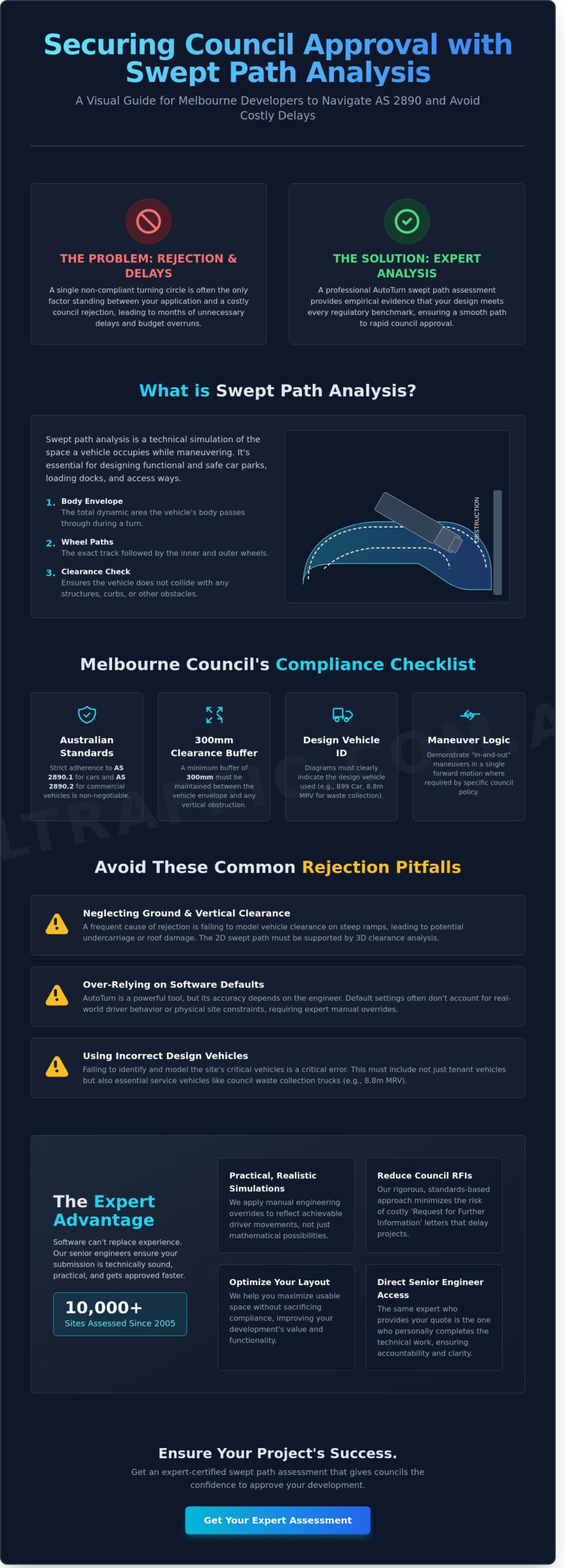
Swept path analysis is the technical calculation of the dynamic envelope a vehicle occupies while performing a turn or maneuver. In the context of an AutoTurn swept path Melbourne application, this simulation ensures that a designated design vehicle can navigate a site without colliding with structures, curbs, or other vehicles. This process is a fundamental requirement for the design of crossovers, basement ramps, and loading docks across all Victorian municipalities.
Melbourne councils mandate these simulations to prevent property damage and maintain public safety. By modeling the exact path of a vehicle, engineers identify potential conflict points before construction begins. This analysis is a critical component of a comprehensive Traffic Impact Assessment (TIA). It provides the empirical evidence required by planning authorities to prove that a development complies with the Victoria Planning Provisions and local transport overlays.
To better understand this concept, watch this helpful video:
The Software vs. The Engineer
AutoTurn is recognized as the industry standard for vehicle swept path analysis software. It allows for the precise modeling of various vehicle classes, from standard B99 cars to 19-metre articulated heavy vehicles. While the software is powerful, its accuracy depends entirely on the input parameters provided by the consultant. Engineering expertise is vital for setting realistic steering lock angles and transition speeds.
At ML Traffic Engineers, we don’t rely solely on automated outputs. Complex site layouts often require manual engineering overrides to account for real-world driver behavior and physical site constraints. A simulation that looks correct on a screen might be impossible for a driver to execute in practice. Our senior engineers review every simulation to ensure it reflects achievable movements rather than just mathematical possibilities.
Council Requirements for Swept Path Diagrams
Victorian councils have specific expectations for swept path diagrams submitted as part of a planning permit application. These diagrams must clearly show the vehicle’s wheel paths and the outer body envelope. Most Melbourne LGAs require the following details:
-
Adherence to Australian Standards (AS 2890.1 for cars and AS 2890.2 for commercial vehicles).
-
A minimum clearance buffer of 300mm between the vehicle envelope and any vertical obstruction like walls or columns.
-
Clear indication of the design vehicle used, such as an 8.8-metre Medium Rigid Vehicle (MRV) for waste collection.
-
Demonstration of "in-and-out" maneuvers in a single forward motion where required by council policy.
For many significant projects, councils require certification from an RPEQ or a senior engineer with decades of experience. This level of oversight ensures that the AutoTurn swept path Melbourne submission is technically sound and reduces the likelihood of costly design revisions during the RFI (Request for Further Information) stage. Professional certification provides the assurance that the proposed access arrangements are safe, functional, and compliant with all relevant planning schemes.
Technical Standards: Applying AS 2890 to Swept Path Simulations
Compliance with Australian Standards is the baseline for any development application in Melbourne. AS 2890.1:2004 dictates the requirements for off-street car parking. AS 2890.2:2018 sets the benchmarks for commercial vehicle facilities. These standards ensure that vehicles can enter, circulate, and exit a site safely without obstructing traffic or damaging infrastructure. Our team applies these technical specs to every AutoTurn swept path Melbourne assessment we conduct. We don’t just guess; we use the exact dimensions specified in the standards to prove a design works before construction starts. This rigorous approach reduces the risk of council RFI (Request for Further Information) letters that delay projects.
Design Vehicles Explained
Designers must distinguish between the B85 and B99 vehicles. The B85 represents the 85th percentile car. It’s used for standard parking bay dimensions and internal aisle widths. The B99 represents the 99th percentile vehicle. It’s larger and requires more clearance. We use B99 profiles for driveway entries and ramp turns to prevent vehicle scraping against walls or columns. For industrial projects, we simulate Heavy Rigid Vehicles (HRV) at 12.5 metres or Articulated Vehicles (AV) at 19 metres. Retail and multi-unit residential projects often require specific waste collection truck simulations, typically 8.8 metres or 10.5 metres long, to satisfy council waste management plan (WMP) requirements. Warehouse designs must account for Medium Rigid Vehicles (MRV) for daily deliveries. Emergency service vehicle access is also a non-negotiable simulation for high-density developments to ensure fire trucks can reach the site safely.
Turning Templates vs. Computer Simulation
Static turning templates from AS 2890 are no longer sufficient for modern council submissions. They’re two-dimensional and don’t account for the complexity of basement ramps or tight urban sites. Dynamic AutoTurn swept path Melbourne simulations provide a realistic representation of vehicle movement. These simulations integrate driveway ramp grades, which must adhere to a maximum 1 in 4 gradient for private use or 1 in 5 for public facilities. We also assess sight-lines at the property boundary to ensure compliance with AS 2890.1 Figure 3.2. This prevents collisions between exiting vehicles and pedestrians. If your project involves complex geometry, you can review our full range of traffic engineering services to see how we manage these technical constraints. We focus on providing accurate data that councils trust. This data is based on over 10,000 completed site assessments across Victoria. The traffic consultant who provides your quote is the one who does the work, ensuring no technical detail is lost in communication.
Common AutoTurn Modelling Errors That Cause Council Rejection
Melbourne municipal councils, including the City of Melbourne and City of Port Phillip, apply rigorous standards when reviewing traffic impact assessments. Errors in an AutoTurn swept path Melbourne simulation often lead to costly delays or Requests for Further Information (RFI). The most frequent mistake involves selecting an incorrect design vehicle for the specific land use. For example, a residential development might require a B85 or B99 vehicle, while a commercial warehouse necessitates a 19-metre articulated vehicle (AV) or a heavy rigid vehicle (HRV) as per AS 2890.2.
Meticulous attention to detail is required to avoid these common pitfalls:
-
Incorrect Vehicle Selection: Using a standard passenger car template when the council requires a service vehicle or a waste collection truck.
-
Ignoring Overhang: Failing to account for the front and rear body swing that extends beyond the wheel path.
-
Vertical Clearance Issues: Neglecting "ground clearance" on steep driveway ramps, which leads to vehicles scraping the pavement.
-
Insufficient Buffers: Providing zero clearance between the vehicle body and structural columns or walls.
The Trap of the "Perfect" Turn
Simulations often depict a "perfect" turn that no human driver can replicate. Engineers sometimes use the absolute minimum turning circle of a vehicle without accounting for the time it takes a driver to turn the steering wheel. This is known as the steering lock rate. If a simulation assumes a vehicle can change direction instantaneously at 10km/h, the resulting path is invalid. Realistic simulations must incorporate a safety margin of at least 300mm to 500mm. Professional Swept Path Analysis identifies these flaws by applying realistic speeds and steering transitions. If the simulation shows a vehicle barely clearing a curb, a real-world driver will likely mount it.
Integration with Civil Features
A functional AutoTurn swept path Melbourne assessment must look beyond the vehicle itself and consider the surrounding infrastructure. Clashes between the simulated path and civil features are a primary cause for council refusal. Designers often overlook the placement of fire hydrants, lighting poles, and bollards that sit within the vehicle’s swing radius. It’s also vital to ensure that the driveway crossover at the property boundary aligns perfectly with the simulated entry and exit paths. If the vehicle requires part of the nature strip to complete a turn, the design is non-compliant. Verification of sight distances is equally critical; landscaping or signage must not obstruct the driver’s line of sight as they follow the simulated path into the public roadway.
How to Prepare Your Site Plans for a Swept Path Assessment
Preparation is the most critical step for a successful AutoTurn swept path Melbourne assessment. Engineers require precise data to ensure simulations reflect real-world vehicle movements accurately. Providing incomplete information leads to delays and potential council rejection.
You must provide site plans in CAD format, specifically DWG or DXF files. PDFs are insufficient for technical assessments because they’re static images that lack the underlying coordinate data needed for precise scaling. CAD files allow the traffic engineer to overlay vehicle templates directly onto your architectural layout. This ensures every millimeter of clearance is accounted for according to Australian Standard AS 2890.1.
Identifying the "critical vehicle" is your next priority. This is the largest vehicle expected to access the site regularly. We analyze specific site features including:
-
Waste collection points: Mapping the path for a 8.8-meter Medium Rigid Vehicle (MRV) or larger.
-
Loading docks: Ensuring heavy rigid vehicles can enter and exit in a forward direction.
-
Basement clearances: Checking that height limits accommodate the required vehicles without striking overhead services.
-
Driveway ramp grades: Verifying that the transition angles don’t cause vehicle scraping.
Information Required by Your Traffic Engineer
Your consultant needs a comprehensive data package to start. This includes detailed floor plans, site sections, and the surrounding road context. You must define the frequency of heavy vehicle movements for the Traffic Impact Assessment (TIA). A site with one weekly delivery has different compliance thresholds than a warehouse with 40 daily movements. If you’re unsure which vehicle templates apply to your specific land use, contact our senior engineers for an initial project review.
Timeline and Turnaround Expectations
The process generally moves from an initial quote to a final council-ready report within 5 to 10 business days. Complex sites with multiple basement levels may require additional time. Early-stage analysis is vital because it saves money. Identifying a conflict between a structural column and a vehicle path during the concept phase prevents expensive redesigns during construction. If you change your architectural layout, the swept path simulation must be rerun. This ensures the final submission to the City of Melbourne or relevant local council is technically sound.
To ensure your development meets all Victorian access standards, book a professional Vehicle Swept Path Assessment today.
Professional Swept Path Consulting: Why Senior Expertise Matters
ML Traffic Engineers brings a specific level of accountability to every project. We’ve completed over 10,000 successful site assessments across Australia since 2005. This volume of work provides a deep understanding of how different Victorian councils interpret access requirements. Our firm operates on a simple principle: the traffic consultant who provides the quote, does the work. This eliminates the communication gaps often found in larger firms where senior staff sell the project and juniors execute the technical drafting. You won’t be passed off to a graduate who lacks the experience to handle complex site constraints.
Leveraging 15 years of experience in traffic engineering allows us to identify and avoid common pitfalls before they become council objections. We understand the nuances of Victorian planning schemes and the specific preferences of inner-city and suburban municipalities. Our approach is based on technical accuracy and a commitment to project delivery. We provide a direct line to senior expertise, ensuring your AutoTurn swept path Melbourne assessment is handled with professional precision from start to finish.
The Value of Hands-On Engineering
Junior-level "drafting only" approaches frequently fail council scrutiny because they lack the engineering intuition to solve spatial constraints. A simple AutoTurn swept path Melbourne assessment requires more than software proficiency. It requires an understanding of vehicle physics and driver behavior. Clients have direct access to our principals, Michael Lee and Benny Chen, for complex queries and technical strategy. We focus on providing practical, results-oriented traffic solutions that prioritize project approval. We don’t just produce drawings; we solve access problems.
Supporting Your Development Application
Council compliance often requires more than a standalone diagram. We integrate swept paths into a comprehensive Traffic Impact Assessment to provide a holistic view of site functionality. Our reports ensure your project meets AS 2890.1 requirements and local planning expectations. If a project reaches a planning appeal stage, we provide expert evidence and representation for VCAT or other authorities. This high-level advocacy is backed by decades of industry experience. We ensure your documentation is robust enough to withstand rigorous technical review.
-
Direct access to senior engineers with 30 to 40 years of individual experience.
-
Compliance with Australian Standards (AS 2890.1) and local council guidelines.
-
Proven track record across residential, commercial, and industrial land uses.
-
Expert evidence and representation for planning appeals if required.
Secure Your Council Approval with Technical Precision
Achieving council approval for your development requires precise technical documentation that leaves no room for error. An accurate AutoTurn swept path Melbourne assessment ensures your site plans comply with AS 2890 standards and eliminates the common modelling mistakes that lead to application rejection. ML Traffic Engineers brings 15+ years of industry experience to your project. We’ve assessed over 10,000 sites across Australia, providing the technical certainty required for complex vehicle movements and driveway ramp grades.
You deal directly with our senior principals on every project because we believe in total accountability. The traffic consultant who provides your quote is the expert who completes the technical work. This hands-on approach removes unnecessary firm bureaucracy and ensures your site layout is both functional and compliant. Don’t risk your planning permit with substandard simulations or junior staff. Our team provides the authoritative data needed to satisfy Melbourne council requirements and move your project forward.
Get a Quote from a Senior Traffic Engineer Today
Frequently Asked Questions
What is the main purpose of an AutoTurn swept path analysis?
An AutoTurn swept path analysis simulates the horizontal path of a vehicle to verify it can navigate a site without striking physical obstructions. It confirms that driveways, car parks, and loading docks meet the spatial requirements of Australian Standard 2890.1 and 2890.2. This technical assessment prevents costly design errors and ensures the site layout accommodates the specific turning circles of the intended vehicles.
Is swept path analysis a mandatory requirement for all Melbourne developments?
Most Melbourne councils require a swept path analysis for multi-unit residential, commercial, or industrial developments as part of the planning permit application. While a single house might not need it, any site with constrained access or a shared driveway typically triggers this requirement. Councils like the City of Melbourne and City of Port Phillip use these simulations to verify that vehicles don’t need to reverse onto main roads.
What vehicle standards do you use for simulation?
Simulations use the design vehicles specified in Australian Standard AS 2890.1:2004 for off-street car parking. We typically model the B85 or B99 passenger vehicle for residential projects. For industrial sites, we use the 19.0 metre articulated vehicle or the 8.8 metre Medium Rigid Vehicle (MRV) as defined in AS 2890.2. These standard templates ensure the AutoTurn swept path Melbourne councils expect is technically accurate.
Can I use a swept path analysis for a residential driveway?
You can use swept path analysis for residential driveways to prove that a car can enter and exit the property in a single forward motion. This is a common requirement for narrow inner-city blocks or battle-axe lots where space is limited. We use the B85 vehicle template to ensure the driveway width and curve radii are sufficient for 85% of passenger vehicles currently on Australian roads.
How much does a typical AutoTurn swept path report cost?
The cost of a report depends on the number of vehicle types simulated and the complexity of the site layout. A simple residential driveway simulation involves less technical work than a multi-level basement car park with 50 spaces. We provide fixed-fee quotes based on the specific requirements of your council’s RFI or planning application. The engineer who provides your quote will be the one performing the technical assessment.
What happens if my site plan fails the swept path simulation?
If a site plan fails the simulation, we identify the specific conflict points and recommend design modifications. This often involves widening a driveway by 300mm or adjusting the angle of a parking bay to improve the turning radius. Our goal is to find a solution that achieves compliance with AS 2890.1 while maintaining the maximum possible yield for your development.
How long does it take to get a swept path report?
A standard AutoTurn swept path Melbourne report is typically completed within 3 to 5 business days after we receive your CAD site plans. Complex industrial sites or large-scale basement car parks might require additional time for detailed modelling. We prioritise urgent requests to help clients meet council RFI deadlines, ensuring your planning permit application stays on schedule.
Do I need a new swept path if I change my car park layout?
You must update your swept path analysis if you change the location of columns, walls, or parking bay dimensions. Even a minor 200mm shift in a structural pillar can render the previous simulation invalid. Councils require the final swept path diagrams to match the current architectural plans exactly to ensure the site remains functional and compliant with safety standards.
Which areas do you cover?
We are traffic engineers servicing Abbotsford, Aberfeldie, Aintree, Airport West, Albanvale, Albert Park, Albion, Alphington, Altona, Altona Meadows, Altona North, Ardeer, Armadale, Arthurs Seat, Ascot Vale, Ashburton, Ashwood, Aspendale, Aspendale Gardens, Attwood, Avondale Heights, Balaclava, Balwyn, Balwyn North, Bangholme, Bayswater, Bayswater North, Beaconsfield, Beaumaris, Bellfield, Bentleigh, Bentleigh East, Berwick, Bittern, Blackburn, Blackburn North, Blackburn South, Bonbeach, Boronia, Box Hill, Box Hill North, Box Hill South, Braeside, Braybrook, Brentford Square, Brighton, Brighton East, Broadmeadows, Brooklyn, Brunswick, Brunswick East, Brunswick West, Bulla, Bulleen, Bundoora, Burnley, Burnside, Burwood, Burwood East, Cairnlea, Camberwell, Campbellfield, Canterbury, Carlton, Carlton North, Carnegie, Caroline Springs, Carrum, Carrum Downs, Caulfield, Caulfield East, Caulfield North, Caulfield South, Chadstone, Chelsea, Chelsea Heights, Cheltenham, Chirnside Park, Clarinda, Clayton, Clayton South, Clematis, Clifton Hill, Coburg, Coburg North, Cocoroc, Coldstream, Collingwood, Coolaroo, Craigieburn, Cranbourne, Cranbourne East, Cranbourne North, Cranbourne South, Cranbourne West, Cremorne, Croydon, Croydon Hills, Croydon North, Croydon South, Dandenong, Dandenong North, Dandenong South, Deer Park, Delahey, Derrimut, Diamond Creek, Diggers Rest, Dingley Village, Docklands, Doncaster, Doncaster East, Donnybrook, Donvale, Doreen, Doveton, Eaglemont, East Melbourne, Edithvale, Elsternwick, Eltham, Eltham North, Elwood, Emerald, Endeavour Hills, Epping, Essendon, Essendon Fields, Essendon North, Essendon West, Fairfield, Fawkner, Ferntree Gully, Ferny Creek, Fitzroy, Fitzroy North, Flemington, Footscray, Forest Hill, Frankston, Frankston North, Frankston South, Gardenvale, Gladstone Park, Glen Huntly, Glen Iris, Glen Waverley, Glenroy, Greensborough, Greenvale, Guys Hill, Hadfield, Hampton, Hampton East, Hampton Park, Harkaway, Hawthorn, Hawthorn East, Heathmont, Heidelberg, Heidelberg Heights, Heidelberg West, Highett, Hillside, Hoppers Crossing, Hughesdale, Huntingdale, Hurstbridge, Ivanhoe, Ivanhoe East, Jacana, Kalkallo, Kealba, Keilor, Keilor Downs, Keilor East, Keilor Lodge, Keilor North, Keilor Park, Kensington, Kew, Kew East, Keysborough, Kings Park, Kingsbury, Kingsville, Knoxfield, Lalor, Langwarrin, Laverton, Laverton North, Lilydale, Lower Plenty, Lynbrook, Lyndhurst, Lysterfield, Macleod, Maidstone, Malvern, Malvern East, Maribyrnong, McCrae, Meadow Heights, Melbourne, Mentone, Mernda, Mickleham, Middle Park, Mill Park, Mitcham, Mont Albert, Mont Albert North, Montmorency, Moonee Ponds, Moorabbin, Mooroolbark, Mordialloc, Mornington, Mount Waverley, Mulgrave, Murrumbeena, Narre Warren, Narre Warren North, Narre Warren South, Newport, Niddrie, Noble Park, Noble Park North, North Melbourne, Northcote, Notting Hill, Nunawading, Oak Park, Oaklands Junction, Oakleigh, Oakleigh East, Oakleigh South, Officer, Ormond, Pakenham, Parkdale, Park Orchards, Pascoe Vale, Pascoe Vale South, Patterson Lakes, Plenty, Point Cook, Port Melbourne, Portsea, Prahran, Preston, Princes Hill, Reservoir, Richmond, Ringwood, Ringwood East, Ringwood North, Ripponlea, Rosanna, Rosebud, Rowville, Roxburgh Park, Rye, Sandhurst, Sandringham, Scoresby, Seabrook, Seaholme, Seddon, Seaford, South Kingsville, South Melbourne, South Morang, South Wharf, South Yarra, Southbank, Spotswood, St Albans, St Helena, St Kilda, St Kilda East, St Kilda West, Strathmore, Sunshine, Sunshine North, Sunshine West, Surrey Hills, Sydenham, Tarneit, Taylors Hill, Taylors Lakes, Templestowe, Templestowe Lower, Thomastown, Thornbury, Toorak, Tottenham, Travancore, Truganina, Tullamarine, Vermont, Vermont South, Viewbank, Wantirna, Wantirna South, Watsonia, Watsonia North, Werribee, Werribee South, West Footscray, West Melbourne, Westgarth, Wheelers Hill, Wildwood, Williamstown, Williamstown North, Windsor, Wonga Park, Wyndham Vale, Yallambie, Yarraville.

Disclaimer
The content on www.mltraffic.com.au, including all technical articles, guides, and resources, is provided for general informational and educational purposes only. It is not intended to constitute professional advice in traffic engineering, transportation planning, development approvals, or any other technical or legal field.
While ML Traffic Engineers makes every reasonable effort to ensure the accuracy, completeness, and timeliness of the information published, we do not provide any warranties or representations (express or implied) regarding its reliability, suitability, or availability for any particular purpose. Any reliance you place on the content is strictly at your own risk.
In no event shall ML Traffic Engineers, its directors, employees, authors, or affiliates be liable for any direct, indirect, incidental, special, consequential, or punitive damages (including, without limitation, loss of profits, data, or business opportunities) arising out of or in connection with the use of, or inability to use, any information provided on this website.
The articles and guides on this site are not a substitute for engaging a qualified, registered professional traffic engineer (such as an NPER or RPEQ engineer) to assess your specific project requirements. For tailored advice, compliance assessments, or traffic engineering services, please contact a competent professional.
This disclaimer may be updated from time to time without notice. By accessing or using this website, you agree to be bound by the most current version of this disclaimer.
