

A “budget” engineering report is often the most expensive mistake a developer can make during the DA process. You’ve likely noticed that quotes for vehicle simulations vary significantly, leaving you to wonder why one firm asks for triple the fee of another. It’s common to feel frustrated by this pricing inconsistency when you’re simply trying to satisfy a council request. Understanding the average cost of a swept path analysis in Australia requires looking beyond the initial quote and focusing on the technical accuracy required for AS 2890 compliance.
This guide provides a transparent look at current market expectations and the specific factors that drive consultancy fees. You’ll learn exactly what should be included in a professional quote to ensure your project avoids the months of delays caused by a rejected submission. We’ll examine the role of industry-standard software like AutoTURN and explain why direct access to senior principals is vital for navigating complex vehicle manoeuvres. By the end of this article, you’ll have the confidence to select a partner who facilitates council approval without hidden costs.
Key Takeaways
- Understand how the average cost of a swept path analysis in Australia is determined by project complexity rather than simple hourly rates, providing you with budget certainty for your development application.
- Identify the primary cost drivers of a professional assessment, including the total number of vehicle manoeuvres required and the specific constraints of your site layout.
- Learn why using non-certified turning templates often leads to council rejections and how professional AutoTURN simulations prevent expensive project delays.
- Discover the significant return on investment gained by avoiding over-designed car parks, which can waste valuable floor space and reduce your overall site yield.
- Ensure your project meets strict AS 2890 compliance standards by working directly with senior traffic engineering principals who perform the technical work personally.
Understanding the Basics of Swept Path Analysis Costs
A swept path analysis is a technical simulation used to determine whether a specific design vehicle can safely and efficiently navigate a proposed site layout. It maps the precise path of a vehicle’s body and wheels during turns and manoeuvres. While some view this as a simple drawing exercise, the average cost of a swept path analysis in Australia reflects a high level of technical rigour and professional accountability. Most professional traffic engineering firms provide project-based quotes for standard DAs. This fixed-fee approach is preferred over hourly rates because it allows developers to budget accurately from the outset.
The fee you pay isn’t just for a digital drawing. It covers the engineer’s professional indemnity insurance and ensures the submission meets strict local government requirements. A single diagram might illustrate a vehicle movement, but a comprehensive traffic report provides the necessary context, justification, and certification that council planners require to approve a development. This reduces the likelihood of costly requests for further information (RFIs) later in the process.
What Does a Standard Quote Include?
Professional quotes typically encompass several technical components. A significant portion of the fee covers the overheads associated with industry-standard swept path analysis software such as AutoTURN. This software requires ongoing licensing to ensure the latest design vehicle profiles are available for simulation. The quote also includes the time required for a qualified engineer to draft vehicle turning templates tailored to your specific site constraints. Finally, you receive a formal, certified document or diagram that is ready for immediate inclusion in your DA submission.
The Role of Australian Standards in Pricing
Compliance with national standards is non-negotiable for council approval. Engineers must interpret and apply AS 2890.1:2004 for off-street car parking and AS 2890.2:2018 for commercial vehicle facilities. This expertise is a key factor in the average cost of a swept path analysis in Australia. Simulating a standard B85 passenger car is generally more straightforward than assessing heavy rigid vehicles (HRV) or waste collection trucks. Larger vehicles have wider turning circles and more complex clearance requirements. These simulations necessitate additional engineering time and technical scrutiny to ensure the design doesn’t fail during the construction phase.
Primary Factors That Influence Your Swept Path Quote
Every development site presents unique spatial constraints. The average cost of a swept path analysis in Australia is directly tied to the complexity of these constraints and the specific demands of the local council. A simple driveway crossover for a residential dwelling requires less engineering time than a multi-level basement car park with tight ramps and heavy vehicle requirements. For a deeper dive into the technicalities of these assessments, you can read our Swept Path Analysis: A Complete Guide.
Number of Manoeuvres and Scenarios
Testing a single entry and exit point is the baseline for most quotes. However, councils often require “worst-case scenario” testing. This involves simulating movements for the most difficult-to-access parking bays or loading docks. If your project requires 3-point turns or complex reversing manoeuvres into a confined waste room, the engineering hours increase. Revisions also play a role. If architectural plans change after the initial simulation, the engineer must re-run the analysis to maintain compliance. Recent academic research on analysis accuracy highlights that even minor plan adjustments can significantly alter vehicle clearance margins.
Vehicle Classification and Standards
The type of “Design Vehicle” specified by the council is a major pricing factor. Standard passenger vehicles like the B85 or B99 are common for residential DAs. Industrial or commercial sites require simulations for heavy rigid vehicles (HRV) or articulated vehicles like B-Doubles. These larger vehicle profiles necessitate greater technical scrutiny.
- Waste management vehicles: 12.5m heavy rigid trucks often require specific clearance heights and turning radii that must be verified against AS 2890.2.
- Emergency services: Fire appliances have unique dimensions and overhangs that must be accommodated for safety certification.
- Industrial logistics: Semi-trailers and B-Doubles require expansive swept paths that often dictate the entire site layout.
Urgency and turnaround times also influence the final quote. While the industry standard is typically 2 to 5 business days, expedited requests to meet a looming DA deadline will attract higher fees. Technical rigour remains the priority regardless of the timeline. If you’re unsure which vehicle profile your council requires, contact our senior principals for a direct consultation.
Comparing Professional Traffic Engineering vs. Budget Options
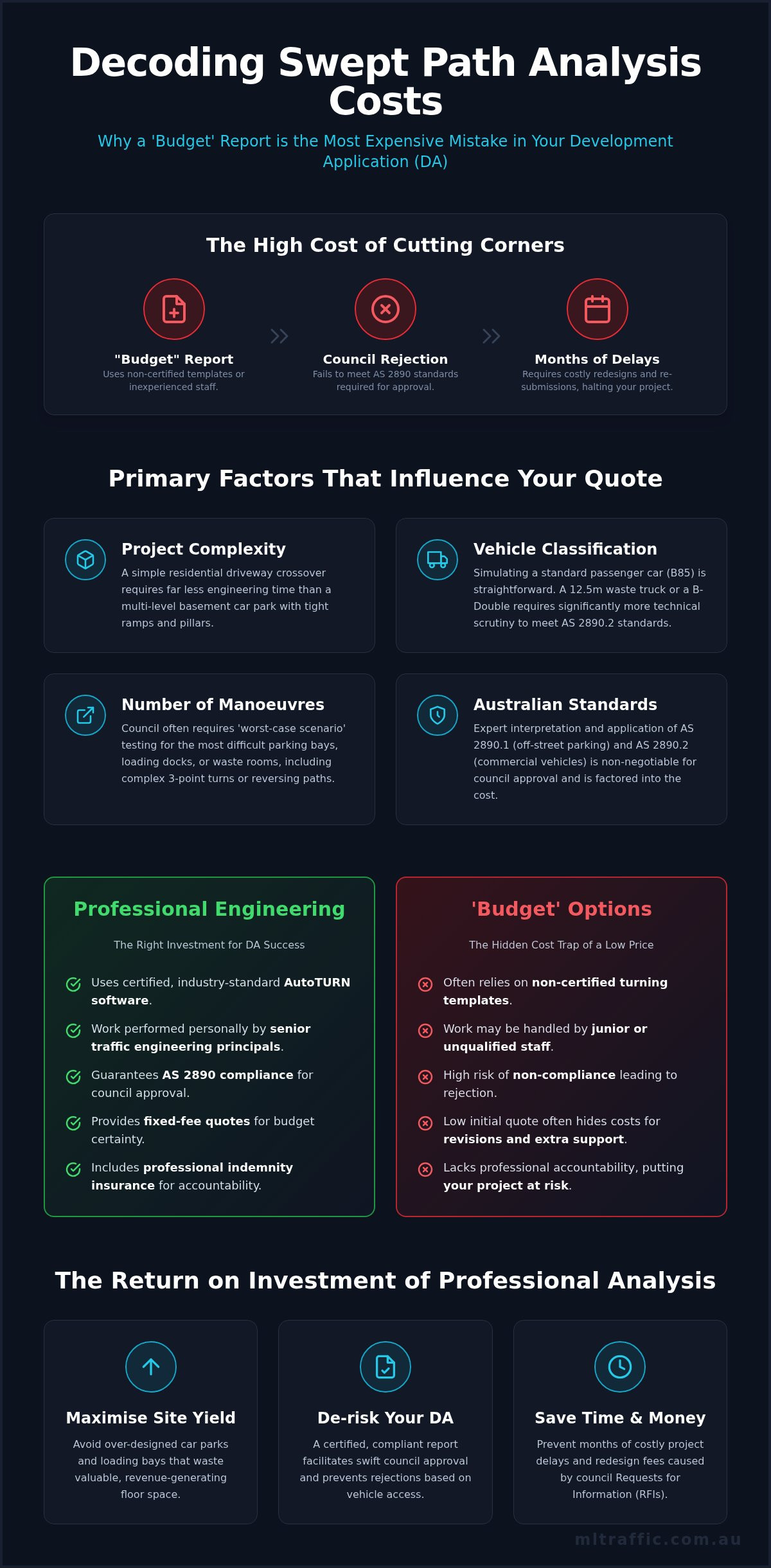
When evaluating the average cost of a swept path analysis in Australia, developers must choose between a basic simulation and a certified engineering assessment. Budget providers often offer lower upfront fees by stripping away the technical rigour required for complex sites. Choosing a low-cost provider might seem efficient, but it frequently results in council planners issuing a Request for Further Information (RFI). These requests halt the assessment process, potentially adding months of delays to your project timeline. A professional report acts as a risk-mitigation tool that justifies the initial investment through faster approvals.
The “Cheap” Report Trap
Many budget services rely on static turning templates often utilised by architects or junior drafters. These templates don’t account for the dynamic steering characteristics of actual vehicles. This technical oversight leads to “kerb strikes” and structural building damage once construction is complete. If a simulation is inaccurate, the physical driveway may be unusable for its intended purpose, such as waste collection or emergency access. Redesigning a driveway after a DA has been lodged is a costly and bureaucratic hurdle. Furthermore, “low-cost” firms often hide their true fees behind expensive charges for every minor revision or council clarification.
Value-Add: Design Advice vs. Simple Simulation
A professional traffic engineer functions as a problem solver, not just a software operator. If a vehicle manoeuvre fails on your current site plan, a seasoned expert suggests specific layout modifications to achieve compliance while maximising floor space. This proactive advice is rarely found in budget quotes. At ML Traffic Engineers, we maintain a “no-gatekeepers” approach. You speak directly to the senior principal who performs the technical work. This direct accountability ensures that the advice you receive is based on decades of experience in council negotiations. For a detailed breakdown of quality standards, consult our Professional Traffic Engineer Services Checklist.
Professional indemnity insurance is another critical factor distinguishing engineering firms from budget drafters. Registered engineers carry substantial insurance to back their certifications. This provides a safety net for developers and gives council authorities the confidence to approve applications without hesitation. When the stakes involve multi-million dollar developments, the security of a certified report is essential. The average cost of a swept path analysis in Australia includes this professional protection, which is absent in non-engineered alternatives.
The ROI of Professional Swept Path Analysis
Investing in a professional assessment pays for itself by preventing the financial drain of a stalled development application. While the average cost of a swept path analysis in Australia is a factor in your feasibility study, the cost of a four-week DA delay often dwarfs the engineering fee. These delays frequently stem from inadequate traffic reports that fail to meet specific council criteria or state road authority standards. A compliant report ensures that your project moves through the approval pipeline without unnecessary friction.
Preventing Council RFIs and Rejections
Council planners and engineers reject swept path diagrams for several technical reasons. Common errors include using the incorrect design vehicle, simulating manoeuvres at unrealistic speeds, or failing to show required 300mm clearances from structural elements. Each Request for Further Information (RFI) requires administrative time and often necessitates a complete redesign of the access points. The administrative cost of responding to these queries without professional engineering support can quickly exceed the initial quote for a high-quality report. Securing first-time approval is the most significant cost-saving factor in any urban project.
Long-Term Operational Savings
Professional analysis prevents the “over-designing” of car parks and loading docks. Inexperienced drafters often create excessively wide driveways or oversized turning circles to “be safe,” which wastes valuable floor space. This lost area could otherwise be utilised for additional parking bays or storage units, directly impacting the site’s yield. Furthermore, ensuring that waste collection vehicles can enter and exit the site in a forward direction is a mandatory requirement for most Australian councils. Failing to account for this leads to long-term operational issues and potential strata litigation.
Protecting structural elements like pillars and walls from vehicle impacts through precise design saves thousands in maintenance costs over the building’s lifecycle. Designing for “first-time” manoeuvres also reduces traffic congestion within the site, improving the experience for residents and commercial tenants. For a deeper understanding of how these technical assessments integrate into your project, you can learn more about the role of a traffic engineer in developments. If you need a compliant report to secure your approval, explore our traffic engineering services to ensure your site layout is both efficient and compliant.
How to Get an Accurate Quote for Your Project
Securing a reliable fee proposal requires providing your traffic engineer with specific project data from the outset. While the average cost of a swept path analysis in Australia varies based on the factors discussed previously, a detailed brief ensures your quote is fixed and inclusive. Avoiding “scope creep” starts with transparency regarding your site’s intended use and the specific expectations of the relevant consent authority. Most developers find that a small amount of preparation prevents the frustration of “hidden” engineering costs later in the DA process.
- Step 1: Provide a clear architectural site plan. Supply your engineer with the most recent site layout. While PDF files are acceptable for initial reviews, providing CAD files in DWG format is essential for precise simulation within AutoTURN.
- Step 2: Identify specific authority requirements. Different councils have unique sets of “standard” vehicles and clearance buffers. Knowing these requirements upfront prevents the need for costly revisions.
- Step 3: Define the vehicles using the site daily. Determine whether your project needs to accommodate standard B99 vehicles, 8.8m medium rigid vehicles (MRV), or specialised 10.2m waste collection trucks.
- Step 4: Request a lump-sum quote. Fixed-fee proposals provide budget certainty for developers. This avoids the uncertainty of hourly rate “creep” that often occurs with less experienced firms.
Information Your Engineer Needs
Accurate CAD files are the foundation of a professional vehicle simulation. They allow the engineer to map your site’s exact geometry, including narrow easements and steep driveway ramps. When requesting your quote, specify the “Design Vehicle” required by the council. If you aren’t sure which vehicle applies, our senior principals can help you identify the correct profile based on the AS 2890 series. Noting physical constraints like low overhead clearances or existing structural pillars ensures the analysis reflects real-world conditions. This level of detail ensures the average cost of a swept path analysis in Australia remains a predictable part of your budget.
Why Choose ML Traffic Engineers?
Australian developers choose ML Traffic Engineers because we provide direct access to senior principals with over 15 years of industry experience. We don’t use junior drafters or “gatekeepers” to perform technical work. This ensures every report is council-ready and fully compliant with national standards. Our expertise spans a vast range of project environments, from tight urban residential blocks to expansive industrial estates. We guarantee that the expert who initiates your relationship is the one performing the technical analysis. This hands-on approach ensures your project secures council approval without costly delays. For professional advice and a fixed-fee proposal, you can Contact ML Traffic Engineers for a Swept Path Quote today.
Secure Your Council Approval with Technical Precision
Choosing a traffic engineering partner based on technical competence rather than the lowest bid is a strategic decision for any Australian developer. The average cost of a swept path analysis in Australia reflects the level of rigour required to satisfy council planners and meet mandatory AS 2890 standards. A professional report is more than just a digital drawing; it’s a critical investment in risk mitigation and site functionality. By prioritising accuracy, you avoid the administrative burden of RFIs and the physical risk of building damage post-construction.
ML Traffic Engineers provides national coverage and over 15 years of specialised expertise in vehicle simulations. We ensure that senior principals perform all technical work personally, maintaining a direct line of communication with you throughout the project. This approach provides the accountability needed for complex DAs. Don’t let inadequate simulations delay your project timeline or result in expensive site redesigns. Get a professional Swept Path Analysis quote from our senior engineers today to move your development forward with confidence.
Frequently Asked Questions
Is a swept path analysis always required for a DA in Australia?
Councils require this assessment whenever vehicle access or manoeuvrability is non-standard or constrained. This often includes basement car parks, narrow driveways, or sites requiring heavy vehicle access. It’s a standard requirement for commercial developments and multi-dwelling residential projects. If you’re modifying a crossover or building near an intersection, expect a council request for this technical simulation. It ensures public safety and road network efficiency by proving vehicles don’t need to reverse onto public roads.
Can an architect perform a swept path analysis to save on costs?
Architects often use basic turning templates, but these lack the technical rigour of a certified engineering report. Councils typically require a qualified traffic engineer to sign off on simulations to ensure compliance with AS 2890 standards. While an architect’s drawing might suffice for preliminary design, a formal DA submission needs the professional indemnity and AutoTURN software expertise that only an engineering consultancy provides. This certification gives council planners the confidence to approve your application without further technical queries.
How long does it typically take to receive a swept path report?
Industry standard turnaround times generally range between 2 and 5 business days for standard projects. This timeframe allows for the preparation of CAD files, the execution of vehicle simulations, and the drafting of the final certified report. Complex industrial sites or large-scale residential developments with multiple vehicle types may require additional engineering time. Providing accurate architectural plans in DWG format at the start of the process helps ensure the quickest possible delivery and reduces technical delays.
What is the difference between AS 2890.1 and AS 2890.2 in terms of cost?
AS 2890.1 governs off-street car parking for passenger vehicles; AS 2890.2 covers commercial vehicle facilities and heavy rigid trucks. Assessments for AS 2890.2 are more complex because heavy vehicles have larger turning circles and restrictive clearance requirements. This complexity influences the average cost of a swept path analysis in Australia, as simulating a 12.5m waste truck requires more technical scrutiny than a standard B85 car. Professional engineers must interpret these different standards to ensure full site compliance.
Do I need a new swept path analysis if I change my driveway design?
Any modification to the physical site layout, including driveway widths, ramp grades, or structural pillar placement, necessitates a revised analysis. Even a minor shift of 100mm can cause a vehicle to strike a kerb or fail to meet mandatory clearance buffers. Updating the simulation ensures the revised design remains compliant with council requirements. It prevents the risk of building a site with access issues that are impossible or incredibly expensive to fix after construction concludes.
Why do councils insist on using specific “Design Vehicles”?
Design vehicles represent the standard dimensions of vehicles expected to use the site. Councils use the B85 or B99 profiles to ensure car parks accommodate the majority of modern SUVs and utes. For service areas, they specify heavy rigid vehicles (HRV) to guarantee that garbage trucks and fire appliances can enter and exit safely. These standard profiles ensure consistency across all developments. They maintain safety for all road users by verifying that large vehicles can manoeuvre safely.
What happens if my swept path analysis shows the vehicle cannot turn?
A failed simulation is an opportunity to fix design flaws before they become construction errors. If the analysis shows a vehicle cannot safely manoeuvre, a traffic engineer provides design advice to modify the layout. This might involve widening a driveway, relocating a structural column, or adjusting a ramp’s curvature. Once the design is updated, the engineer re-runs the simulation to confirm full compliance. This proactive approach ensures your project is ready for council approval and functional use.
Are there hidden costs in a swept path analysis quote?
Transparent engineering firms provide lump-sum quotes to prevent hidden fees. Some budget providers may charge extra for minor revisions, council clarifications, or additional vehicle profiles not mentioned in the initial scope. Confirm that your quote includes a certified report and the necessary simulations for all required design vehicles. Understanding the average cost of a swept path analysis in Australia helps you identify quotes that are suspiciously low. These “cheap” quotes often omit the technical rigour needed for approval.

Disclaimer
The content on www.mltraffic.com.au, including all technical articles, guides, and resources, is provided for general informational and educational purposes only. It is not intended to constitute professional advice in traffic engineering, transportation planning, development approvals, or any other technical or legal field.
While ML Traffic Engineers makes every reasonable effort to ensure the accuracy, completeness, and timeliness of the information published, we do not provide any warranties or representations (express or implied) regarding its reliability, suitability, or availability for any particular purpose. Any reliance you place on the content is strictly at your own risk.
In no event shall ML Traffic Engineers, its directors, employees, authors, or affiliates be liable for any direct, indirect, incidental, special, consequential, or punitive damages (including, without limitation, loss of profits, data, or business opportunities) arising out of or in connection with the use of, or inability to use, any information provided on this website.
The articles and guides on this site are not a substitute for engaging a qualified, registered professional traffic engineer (such as an NPER or RPEQ engineer) to assess your specific project requirements. For tailored advice, compliance assessments, or traffic engineering services, please contact a competent professional.
This disclaimer may be updated from time to time without notice. By accessing or using this website, you agree to be bound by the most current version of this disclaimer.
