

The lowest traffic consulting quote is almost always the most expensive bill you’ll receive. While a cut-price initial fee looks good on a feasibility study, it frequently masks a cycle of “hourly traps” and endless charges for Council clarifications. Many developers find that avoiding budget blowouts on traffic consulting is nearly impossible when their project is handed off to an inexperienced junior engineer who lacks the technical foresight to anticipate regulatory hurdles.
You’ve likely experienced the frustration of receiving a Request for Further Information (RFI) that triggers a fresh wave of unexpected invoices. It’s a common pain point in the DA process, but it isn’t an inevitable part of development. This guide outlines the exact strategies you need to secure total cost certainty for your traffic and parking assessments. We’ll explore how to bypass the “junior hand-off” and why direct access to senior engineering expertise is the only way to ensure faster Council approval with fewer revisions. By the end of this article, you’ll know how to lock in your engineering costs and protect your project’s bottom line from the very first quote.
Key Takeaways
- Identify why low-cost initial quotes often act as loss leaders and how outcome-based pricing eliminates the “hourly trap” during the DA process.
- Learn how technical oversights in Swept Path Analysis or non-compliant car park ramp grades under AS 2890.1 lead to expensive Council clarifications.
- Master the essential steps for avoiding budget blowouts on traffic consulting, including why you should demand senior-led project delivery from the start.
- Discover how providing a complete architectural set before quoting ensures your traffic engineer can provide a truly fixed fee without hidden variations.
- Ensure project feasibility by choosing a consultancy where the principal who quotes the work is the one performing the technical assessment.
The Anatomy of a Traffic Consulting Budget Blowout
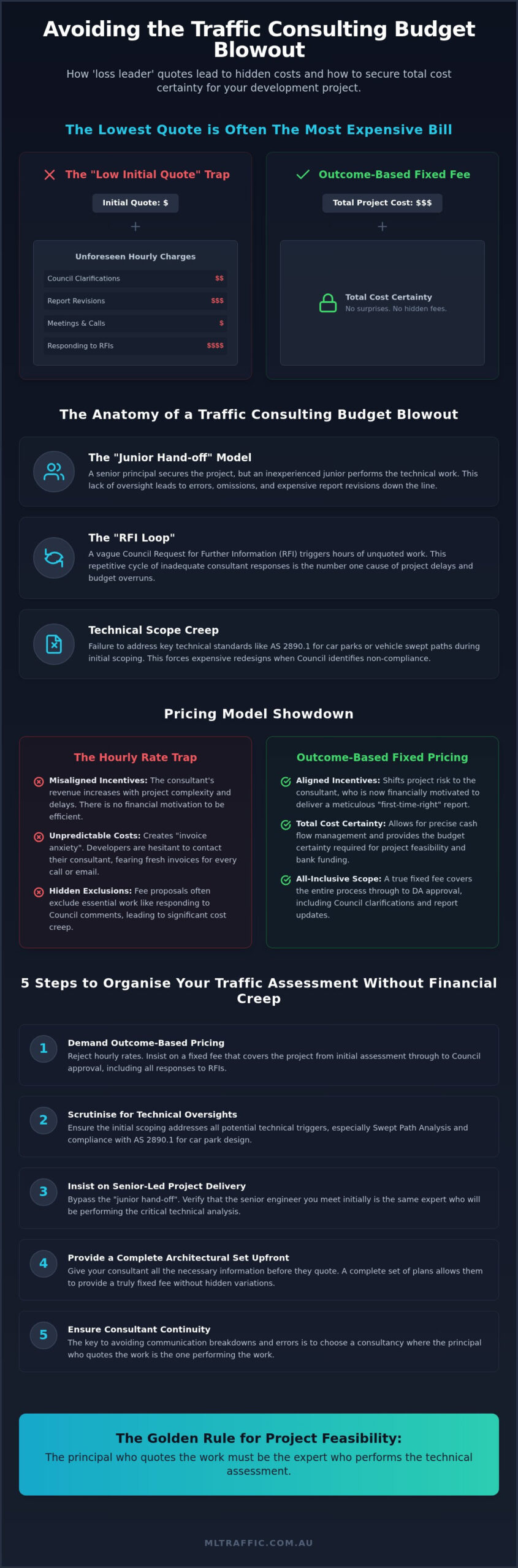
Selecting a consultant based on the lowest initial quote is a common tactical error in property development. These figures are often “loss leaders” designed to secure the appointment rather than reflect the true cost of project delivery. Once the project commences, consultants often recover their margins through variations and hourly charges for work that should have been anticipated during the scoping phase.
A primary driver of this cost creep is the “junior hand-off” model. A senior principal typically attends the initial meeting to demonstrate expertise, but the actual technical writing is delegated to inexperienced staff. This lack of senior oversight results in reports that fail to address complex site constraints. Mistakes made at this early stage inevitably lead to expensive report revisions and design changes later in the process.
The Hidden Costs of Council Clarifications
A single vague comment from a Council officer can trigger ten or more hours of unquoted work. This occurs when the initial Traffic Impact Assessment (TIA) Report lacks the technical depth required to satisfy regulatory scrutiny. We define the “RFI Loop” as the repetitive cycle of Council Requests for Further Information followed by inadequate consultant responses; it is the #1 cause of project delays and budget overruns. Achieving “first-time-right” technical accuracy is the only reliable method for avoiding budget blowouts on traffic consulting.
Scope Creep in Transport Planning
Project requirements frequently evolve during the design phase. If a consultant fails to account for changing land-use intensity or specific requirements like waste management and loading zones early, budget spikes are inevitable. This form of scope creep often stems from a failure to reference Australian Standards, such as AS 2890.1 for car parking, during the initial site scoping. Ignoring these standards during the preliminary design phase forces expensive redesigns once the Council identifies non-compliance in the ramp grades or aisle widths.
Meticulous initial scoping is essential for avoiding budget blowouts on traffic consulting. It ensures that every technical trigger, from vehicle swept paths to intersection analysis, is accounted for before the first report is drafted.
The Hourly Rate Trap vs. Outcome-Based Fixed Pricing
Time-based billing creates a fundamental misalignment of incentives between a developer and their traffic consultant. Under an hourly rate model, the consultant’s revenue increases as a project becomes more complicated or prolonged. This structure provides no financial motivation for the consultant to deliver a “first-time-right” report. Instead, it often rewards inefficiency and poor initial scoping. Transitioning to a fixed-fee model is the most effective strategy for avoiding budget blowouts on traffic consulting because it aligns the consultant’s goals with the project’s success.
Outcome-based pricing, specifically a fixed-fee Traffic Impact Assessment (TIA) Report, shifts the project risk back to the engineering firm. When a fee is locked in from the outset, the consultant is financially incentivised to be meticulous and accurate. This model eliminates the “invoice anxiety” that developers feel every time they need to call their engineer for a quick clarification or a project update.
Evaluating the Real Value of a Quote
A quote based on hourly estimates often ends up costing double or triple the initial figure once Council revisions and RFIs are tallied. Developers must look beyond the initial number and identify “hidden exclusions” in fee proposals. Common exclusions include responding to Council comments or attending meetings, which are often the very tasks that trigger cost creep. True value is found in “Consultant Continuity.” At ML Traffic, we ensure the senior principal who quotes your project is the same expert who performs the technical work. This prevents the communication breakdowns that occur when a project is handed off to a junior staff member. You can contact our senior team directly to discuss your specific site requirements.
Risk Mitigation Through Budget Certainty
Securing project feasibility and bank funding requires precise figures. Lenders look for cost certainty in the preliminary stages of development. A fixed-fee model allows for superior cash flow management because the traffic engineering costs are a known quantity on the pro-forma. This level of transparency is vital for avoiding budget blowouts on traffic consulting during the critical DA phase.
The importance of oversight cannot be overstated. A government report on Cost and Oversight Issues on Major Highway and Bridge Projects highlights how poor cost containment and lack of oversight lead to massive financial discrepancies in transportation infrastructure. While your project may be smaller in scale, the principle remains: fixed pricing forces a higher standard of accountability and technical rigour. Learn more about our fixed-fee services.
Technical Triggers: Where Traffic Reports Often Incur Hidden Costs
Technical oversights in the reporting phase are a primary source of unquoted variations. Avoiding budget blowouts on traffic consulting depends on the precision of the initial technical assessment. When a consultant overlooks a complex requirement, such as detailed intersection analysis or waste management, the resulting RFI forces a total report overhaul. These “technical triggers” often appear mid-way through the DA process, leading to delays and unexpected invoices.
The Complexity of Vehicle Manoeuvrability
Precise swept path analysis is essential for any development involving vehicle movements. Swept Path Analysis is the digital simulation of a specific vehicle’s turning circle to ensure it can navigate site access and internal aisles without striking infrastructure. Inaccurate AutoTURN simulations often result from using incorrect vehicle templates or failing to account for clearance buffers. These errors frequently lead to expensive design changes, such as relocating structural columns or widening driveways, after the plans have been finalised. A senior-led assessment ensures that the vehicle templates used match the actual requirements of the site, whether for a standard passenger car or a heavy rigid vehicle.
Parking Demand vs. Council Requirements
Car park design must strictly adhere to AS 2890.1. A common technical trigger for extra costs is a non-compliant ramp grade, which often requires a complete basement redesign to fix. Similarly, failing to meet AS 2890.2 for heavy vehicle access can derail industrial projects. A rigorous Car Parking Demand Assessment can prevent the financial burden of over-providing parking spaces, which consumes valuable floor area. Conversely, under-providing parking without a technical justification leads to developer contribution spikes or permit refusals.
A simple traffic statement often escalates into a complex SIDRA model if the initial intersection analysis fails to account for peak-hour congestion. Addressing loading and waste management early ensures these “forgotten” components don’t trigger a late-stage Council flag. For example, a Waste Management Plan that fails to account for the vertical clearance of a collection vehicle will require a costly redesign of the loading dock area. Meticulous technical scoping remains the most effective tool for avoiding budget blowouts on traffic consulting.
5 Steps to Organise Your Traffic Assessment Without Financial Creep
Achieving cost certainty requires a structured approach to procurement and data preparation. Developers often face escalating fees because the initial engagement lacked clear boundaries or technical depth. By following these five steps, you can mitigate the risk of unquoted variations and ensure your project stays on budget.
- Step 1: Provide a complete architectural set before requesting a quote. Vague plans lead to vague quotes. When a consultant has to make assumptions about site access or parking layouts, they will inevitably charge for revisions once the design is finalised.
- Step 2: Demand a Senior Engineer lead the project from start to finish. This ensures technical continuity and prevents the errors common in junior-led reports. Continuity is the best defence against the “hourly trap” discussed in previous sections.
- Step 3: Insist on a Fixed-Fee proposal that includes RFI responses. This is the primary tool for avoiding budget blowouts on traffic consulting. If a consultant won’t stand by their technical accuracy by including RFI responses in the fee, they likely anticipate errors or lack confidence in their assessment.
- Step 4: Verify the consultant’s experience with your specific land-use type. A consultant who specialises in residential subdivisions may struggle with the complexities of a Waste Management Plan for a high-density mixed-use development.
- Step 5: Conduct a “Pre-Submission” review. Senior engineers must catch AS 2890 compliance issues, such as ramp grades or sight distances, before the report reaches Council. Catching these early prevents the RFI loop that derails project timelines.
Vetting Your Traffic Consultant
You must ask two critical questions before signing a fee proposal: “Who is actually writing the report?” and “What exactly is excluded?” Many firms use senior principals as “door openers” but delegate the technical work to junior staff. This creates a disconnect that leads to technical errors. Direct access to leadership is a cost-saving feature because it ensures your project benefits from over 15 years of experience in Australian traffic planning. A consultant with a national track record of Council approvals understands how to navigate local government requirements without triggering unnecessary hourly charges.
Preparing Your Site Data
High-quality site data is the foundation of an accurate Traffic Impact Assessment (TIA) Report. Accurate site plans reduce the need for consultant “assumptions” and prevent redundant report drafts. Clear communication regarding the project scope, such as the exact number of dwellings or the intensity of a commercial use, prevents the consultant from heading down the wrong technical path. This level of preparation is essential for avoiding budget blowouts on traffic consulting during the DA phase. Contact our senior principals today to secure a fixed-fee quote for your next project.
Securing Project Feasibility with ML Traffic Engineers
ML Traffic Engineers has over 15 years of experience in Australian traffic planning. We understand that project feasibility depends on precise cost control from the outset. Our fixed-fee model is designed specifically for avoiding budget blowouts on traffic consulting by providing total price certainty for every Traffic Impact Assessment (TIA) Report. Unlike larger firms that operate on billable hours, our focus is on delivering technical compliance without financial creep or hidden variations.
A core pillar of our service is the personnel continuity promise. The senior engineer who quotes your project is the same expert who performs the technical work. This eliminates the “junior hand-off” that frequently leads to the technical errors and Council RFIs discussed in previous sections. By maintaining a direct line between the developer and the senior principal, we ensure that the project’s technical requirements are understood and addressed from the first draft. This accountability preserves your project pro-forma and ensures that traffic engineering costs remain a known quantity throughout the DA process.
A Hands-On Approach to Traffic Engineering
Our “No-Gatekeepers” philosophy ensures faster project turnarounds and direct accountability. You don’t have to navigate through administrative layers to speak with the expert handling your assessment. This senior-level involvement significantly reduces the likelihood of Council RFIs because our reports are built on a foundation of multi-decade expertise and strict adherence to Australian Standards like AS 2890.1. We prioritise technical accuracy to keep your project moving through the approval process without unnecessary delays. Learn more about ML Traffic Engineers and our commitment to senior-led delivery.
National Expertise for Local Approvals
We provide a comprehensive range of services across all Australian land-use types, including residential, commercial, industrial, and mixed-use developments. Our expertise extends to specialised assessments such as Vehicle Swept Path Analysis, Car Parking Demand Assessments, and Waste Management Plans. We are a results-oriented consultancy that dislikes unnecessary bureaucracy. Our goal is to provide the technical documentation you need to secure approval while avoiding budget blowouts on traffic consulting.
Whether your project requires a simple driveway ramp grade assessment or a complex intersection analysis, our team provides the senior-level oversight necessary to protect your project pro-forma. We have delivered thousands of compliant reports that satisfy regulatory scrutiny while maintaining project feasibility. Get a fixed-fee quote for your TIA report today and secure the technical certainty your development requires.
Securing Financial Certainty for Your Next Development
Protecting project feasibility requires a shift from risky hourly billing to outcome-based fixed pricing. The key to avoiding budget blowouts on traffic consulting lies in senior-led technical accuracy and meticulous initial scoping. By ensuring that a senior principal handles your assessment from quote to submission, you eliminate the communication breakdowns and “hourly traps” that frequently derail project timelines and budgets.
ML Traffic Engineers provides the technical rigour necessary to navigate the DA process with confidence. With over 15 years of Australian experience, we offer direct access to senior leadership and a commitment to first-time-right reporting. Our fixed-fee model preserves your pro-forma by locking in costs and removing the financial uncertainty of Council clarifications. Don’t let unexpected variations compromise your project’s bottom line. Request a Fixed-Fee Traffic Assessment Quote today and secure the expert oversight your development deserves. We look forward to helping you achieve a faster, more cost-effective approval.
Frequently Asked Questions
How much does a typical traffic impact assessment cost in Australia?
Traffic engineering fees depend on the specific land-use category and the volume of traffic generated. While some firms use hourly rates that fluctuate, ML Traffic Engineers provides fixed-fee quotes to ensure project feasibility. This approach is the most reliable method for avoiding budget blowouts on traffic consulting. You should always ensure your quote covers the full scope of the DA process, including any technical revisions required by the planning authority.
What is the most common reason for a traffic consulting budget blowout?
The most common cause is the “hourly trap” combined with the delegation of work to junior staff. When a senior principal quotes but an inexperienced engineer writes the report, technical triggers like AS 2890 compliance are often missed. These oversights lead to Council Requests for Further Information (RFIs). Each RFI then generates additional hourly charges for revisions that should’ve been handled correctly in the initial submission.
Can I avoid extra fees if the Council asks for a report revision?
Extra fees are avoidable if you secure an outcome-based fixed-fee agreement that specifically includes responses to Council clarifications. This model shifts the financial risk from the developer to the consultant. If the engineer is confident in their technical accuracy and senior-led oversight, they’ll include these responses in the initial fee. This ensures your project pro-forma remains stable even if the Council requires minor report adjustments.
Why do some traffic engineers quote significantly lower than others?
Low initial quotes often act as loss leaders to secure a project appointment. These proposals frequently hide exclusions, such as fees for Swept Path Analysis or responding to Council RFIs. Consultants using this model often hand projects to junior staff to reduce internal costs. This leads to a cycle of expensive variations later in the process, making the “cheap” quote the most expensive option for the developer.
What technical components should be included in a fixed-fee traffic report?
A robust fixed-fee proposal should encompass all technical assessments required for your specific land-use. This includes a Traffic Impact Assessment (TIA) Report, Vehicle Swept Path Analysis using AutoTURN, and a Car Parking Demand Assessment. It must also cover driveway ramp grade assessments and intersection analysis where congestion is a factor. Ensuring these components are bundled into a single fixed fee is essential for maintaining total budget certainty.
How long does it take to prepare a Council-compliant traffic statement?
Preparation times vary based on project complexity and the quality of the provided architectural plans. A standard Council-compliant traffic statement for a smaller development can usually be completed within 10 business days. Larger projects involving complex intersection modelling or detailed waste management plans may take longer. Providing a complete architectural set at the quoting stage allows the engineer to establish a realistic timeline and a fixed fee.
Is a swept path analysis always required for a development application?
Swept path analysis is necessary for almost all developments involving on-site parking or loading facilities. Council officers require digital proof, typically via AutoTURN simulations, that the design vehicle can enter and exit the site in a forward direction. This is particularly critical for waste collection, emergency access, and heavy vehicle movements. Failing to include this analysis in the initial submission is a common trigger for project delays and RFIs.
What happens if my traffic consultant uses junior staff for my project?
Using junior staff without senior oversight often results in reports that fail to meet Australian Standards. This lack of experience leads to errors in car park design or sight distance assessments, which Council will inevitably flag. These mistakes trigger the “RFI loop” and additional hourly billing. Choosing a firm where the principal who quotes is the one performing the technical work is the best strategy for avoiding budget blowouts on traffic consulting.

Disclaimer
The content on www.mltraffic.com.au, including all technical articles, guides, and resources, is provided for general informational and educational purposes only. It is not intended to constitute professional advice in traffic engineering, transportation planning, development approvals, or any other technical or legal field.
While ML Traffic Engineers makes every reasonable effort to ensure the accuracy, completeness, and timeliness of the information published, we do not provide any warranties or representations (express or implied) regarding its reliability, suitability, or availability for any particular purpose. Any reliance you place on the content is strictly at your own risk.
In no event shall ML Traffic Engineers, its directors, employees, authors, or affiliates be liable for any direct, indirect, incidental, special, consequential, or punitive damages (including, without limitation, loss of profits, data, or business opportunities) arising out of or in connection with the use of, or inability to use, any information provided on this website.
The articles and guides on this site are not a substitute for engaging a qualified, registered professional traffic engineer (such as an NPER or RPEQ engineer) to assess your specific project requirements. For tailored advice, compliance assessments, or traffic engineering services, please contact a competent professional.
This disclaimer may be updated from time to time without notice. By accessing or using this website, you agree to be bound by the most current version of this disclaimer.
