

The most expensive traffic delays occur in the boardroom and planning office, not on the road. In 2024, road congestion cost the Australian economy US$13.8 billion, but for a developer, the real financial impact often stems from months lost to Council RFIs and non-compliant car park designs. Successfully avoiding project delays due to traffic issues requires moving beyond generic templates toward technical precision and regulatory expertise. You already understand that a single error in a driveway ramp grade or a failure to meet AS 2890.6:2022 standards can halt your project’s momentum instantly. It’s a common frustration to face construction stoppages because of a poorly conceived Traffic Guidance Scheme or an intersection analysis that fails to satisfy local road authorities.
Discover how to navigate planning approvals and construction logistics to eliminate costly traffic-related bottlenecks in your next project. This guide provides the strategic framework you need to secure faster DA approvals through rigorous Traffic Impact Assessments. We’ll also detail how to maintain zero downtime using compliant logistics planning that meets the latest March 2026 NSW TCAWS requirements and ensures your site remains fully operational.
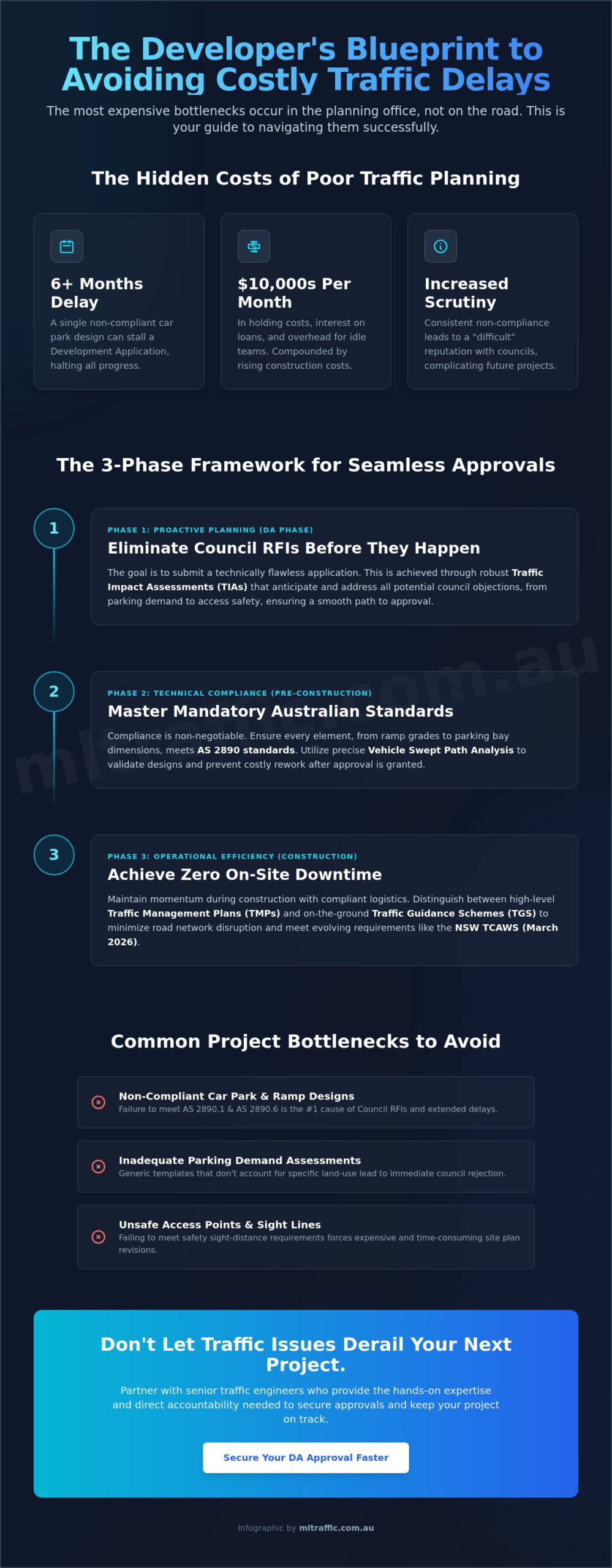
Key Takeaways
- Identify the hidden financial risks of non-compliant car park designs that can stall development applications for six months or more.
- Learn technical strategies for avoiding project delays due to traffic issues by utilizing robust Traffic Impact Assessments to eliminate Council Requests for Further Information (RFIs).
- Master the application of AS 2890 standards and Vehicle Swept Path Analysis to ensure your design meets mandatory Australian requirements before construction begins.
- Establish operational efficiency by distinguishing between Traffic Management Plans and Traffic Guidance Schemes to minimize local road network disruptions during delivery phases.
- Recognize the value of working with senior traffic engineers who provide direct accountability and hands-on expertise throughout the planning and approval process.
Table of Contents
-
The True Cost of Traffic-Related Project Delays in Australia
-
Operational Efficiency: Traffic Management During Construction
The True Cost of Traffic-Related Project Delays in Australia
Traffic-related delays are dual-faceted. They include bureaucratic planning hurdles during the Development Application (DA) phase and on-site logistical disruptions during construction. For developers, avoiding project delays due to traffic issues begins long before the first shovel hits the ground. It starts with ensuring that every technical submission aligns with established traffic engineering principles.
The most damaging "hidden" delay is a non-compliant car park design. When a council planning officer identifies that a ramp grade or a parking bay dimension fails to meet AS 2890.1 standards, the resulting Request for Further Information (RFI) triggers a cycle of redesigns and re-submissions. This isn’t just a paperwork error; it’s a structural bottleneck that prevents other engineering disciplines from finalizing their plans. A single oversight in a swept path analysis can easily stall a project for six months while the design team scrambles to find a compliant solution that doesn’t sacrifice yield.
To better understand how these delays impact the broader construction timeline, watch this helpful video:
Financial consequences are immediate and compounding. Stalled DAs result in significant daily holding costs, including interest on land acquisition loans and overhead for idle project teams. With construction costs in Sydney forecast to rise by 4% in 2026, every month of delay adds tens of thousands of dollars to the final budget. There’s also a serious reputational risk. Developers who consistently submit non-compliant plans gain a reputation for being "difficult" within local councils. This lack of professional diligence can lead to increased scrutiny on future projects, further complicating the approval process.
Why Traffic Engineering is a Critical Path Item
Council planning officers across Australia prioritize traffic impact and safety above almost all other development criteria. If the traffic report is flawed, the entire application is often put on hold regardless of the architectural merits. This creates a ripple effect; structural and civil designs cannot be locked in until the car park layout and access points are approved. Traffic engineering acts as the definitive gatekeeper for successful DA outcomes, determining whether a project moves to construction or remains stuck in a cycle of revisions.
Common Sources of Traffic Bottlenecks
Identifying the root cause of delays is the first step toward avoiding project delays due to traffic issues. Most bottlenecks stem from specific technical failures:
-
Inadequate car parking demand assessments that fail to account for the specific land-use type, leading to immediate council rejection.
-
Poorly designed access points that don’t meet safety sight-distance requirements, necessitating expensive revisions to the site entry.
-
A lack of early-stage consultation with experienced traffic engineering consultants who understand the specific nuances of local government requirements.
Navigating the Planning Phase: Eliminating Council RFIs
The planning phase is often where development timelines stall. While many developers focus on construction logistics, the most significant hurdles occur during the Development Application (DA) process. The avoidable cost of congestion and planning inefficiency translates directly to lost revenue. Securing approval requires a proactive approach to avoiding project delays due to traffic issues by submitting technically sound reports that anticipate council objections before they are raised.
Eliminating Requests for Further Information (RFIs) requires a four step strategic approach:
-
Step 1: Conduct a robust parking demand assessment. Do not rely on generic rates. Your assessment must reflect the specific land use, whether it’s a high density residential complex or a specialized warehouse.
-
Step 2: Ensure compliance from day one. Every driveway ramp grade and access point must meet AS 2890.1 standards. Incorrect grades are a primary trigger for RFIs and expensive architectural redesigns.
-
Step 3: Perform detailed intersection analysis. You must prove that your project will not adversely impact the local road network. Use SIDRA modeling to provide the data council engineers expect.
-
Step 4: Use data-driven arguments. If you are seeking a parking shortfall, justify it with empirical evidence, such as proximity to public transport or historical survey data from similar sites.
The Traffic Impact Assessment (TIA) Framework
A TIA is more than a checklist; it’s a technical defense of your project’s viability. Key components include traffic generation rates, parking provision, and vehicle swept path analysis. Generic reports often fail because they lack site-specific nuances. For a deeper look at these requirements, refer to our Pillar Guide on Traffic Impact Assessments. Providing this level of detail upfront demonstrates professional competence and reduces the likelihood of council scrutiny. If you need immediate technical assistance, our team can provide a Traffic Impact Assessment (TIA) Report tailored to your specific site.
Anticipating Council Concerns
RFIs regarding traffic usually stem from perceived safety risks or insufficient parking. You can counter these concerns by using land-use precedents and historical data to justify your design choices. Engaging a traffic engineering consultant early in the design phase is critical. When the consultant who provides the quote is the one doing the actual technical work, you ensure that no details are lost in communication. This direct accountability is the most effective way of avoiding project delays due to traffic issues and maintaining your project’s critical path.
Technical Compliance: AS 2890 and Swept Path Analysis
Technical compliance represents the most reliable strategy for avoiding project delays due to traffic issues. In Australia, AS 2890.1:2004 (Off-street car parking) serves as the non-negotiable benchmark for developers. While this standard is undergoing official revision as of May 2026 to accommodate the larger dimensions of modern SUVs, adherence to current specifications remains mandatory for council acceptance. Failing to verify these dimensions during the design phase creates a "paper-only" project. These designs appear functional on a screen but result in real-world failures where vehicles scrape undercarriages on non-compliant ramp grades or delivery trucks cannot reach designated loading zones.
Treating compliance as a speed-to-market strategy allows you to bypass the iterative redesign cycles that exhaust project budgets. A technically perfect submission forces council engineers to focus on the merits of the development rather than correcting basic errors. This precision is essential because once a driveway is poured or a basement slab is set, correcting a compliance failure becomes a multi-million dollar liability that can halt a project indefinitely.
Mastering AS 2890.1 Car Park Design
Successful car park design requires meticulous attention to aisle widths, bay sizes, and overhead clearances. The AS 2890.6:2022 standard now dictates mandatory dimensions and bollard placements for accessible parking, which must be integrated into your initial layout to avoid immediate rejection. One of the most frequent causes of project stalling is the driveway ramp grade. If the transition between grades is too abrupt, vehicles will bottom out, necessitating architectural changes that often reduce total parking yield. For a detailed technical breakdown of these requirements, see our AS 2890.1 Ultimate Guide.
The Power of Swept Path Analysis
Swept Path Analysis uses AutoTURN software to simulate the actual movement of vehicles through your site boundaries. It’s the only definitive way to prove that waste collection vehicles and heavy rigid vehicles (HRVs) can navigate your loading areas as per AS 2890.2 requirements. At ML Traffic Engineers Australia, we use B99 vehicle templates to verify that the 99th percentile of passenger cars can access every bay without multiple maneuvers. Swept Path Analysis is the most effective tool for debunking council access concerns because it provides visual, data-backed proof that your design works in practice. This technical certainty is a prerequisite for avoiding project delays due to traffic issues during the final stages of the approval process.
Operational Efficiency: Traffic Management During Construction
Operational efficiency on a construction site is frequently undermined by poor logistical planning. While technical compliance in the DA phase secures the project’s future, a robust operational strategy is required for avoiding project delays due to traffic issues during the actual build. Authorities, including WorkSafe and local councils, increasingly issue work-stop orders for non-compliant traffic control setups. These stoppages don’t just delay the schedule; they inflate costs and damage your reputation with regulators. Effective management requires a clear distinction between high-level strategy and tactical execution on the road.
Scheduling deliveries during off-peak hours is a fundamental requirement for maintaining site momentum. With Sydney commuters losing over 4 days annually to congestion as of May 2026, local councils have zero tolerance for construction vehicles blocking arterial roads during peak periods. Moving heavy vehicle movements to mid-day windows reduces local friction and prevents the reactive complaints that often trigger council inspections. You must also manage vehicle-pedestrian interactions with precision. Failure to separate these movements on-site is a primary cause of safety-related shutdowns that can halt a project for weeks.
Developing a Robust Traffic Management Plan (TMP)
A TMP is a comprehensive document that identifies construction-specific traffic risks and outlines mitigation strategies. It must account for the projected 3.5% growth in the Australian construction industry in 2026, which is placing additional pressure on shared road networks. Proactive stakeholder communication is a core component of a professional TMP. Keeping neighbours and councils informed about major concrete pours or crane mobilizations prevents the complaints that lead to regulatory scrutiny. For a deeper understanding of these requirements, read our TMP Definitive Guide.
TGS vs. TMP: Knowing What You Need
Developers often confuse a high-level strategic TMP with a tactical Traffic Guidance Scheme (TGS). A TMP provides the overarching logic for traffic flow and safety, while a TGS is a detailed diagram showing the exact placement of signs, cones, and barriers. You need a compliant TGS to secure a Road Occupancy Licence (ROL) or a permit to conduct works on a road. As of March 2026, the updated NSW TCAWS manual mandates stricter application of these schemes across all road types. Ensuring your signage and barriers meet Australian Standards is the only way to avoid fines and site closures. If your project requires immediate technical documentation, you can request a professional Traffic Guidance Scheme (TGS) to keep your site compliant and operational.
Selecting the Right Traffic Engineering Partner
Your choice of consultant is the final variable in avoiding project delays due to traffic issues. Large engineering firms often delegate technical tasks to junior staff, which leads to the compliance errors and RFI cycles discussed in previous sections. A Principal-Led approach ensures that a senior engineer with decades of experience handles your specific car park design or swept path analysis. This direct involvement prevents the communication gaps that result in council scrutiny. National expertise in Australian Standards is more valuable than city-specific bias. Standards like AS 2890.1 are federal requirements, and a consultant who has successfully navigated over 10,000 sites across Australia possesses the pattern recognition to identify bottlenecks before they manifest.
Integrate traffic engineering into your project team during the feasibility stage rather than waiting for the DA submission. Early involvement allows for the optimization of site yield while maintaining strict compliance with driveway ramp grades and sight distance requirements. This proactive alignment reduces the risk of expensive architectural redesigns later in the project lifecycle. It ensures technical certainty from day one, allowing your development to proceed without the friction of regulatory pushback.
The ML Traffic Engineers Australia Philosophy
We operate with a direct access model that removes gatekeepers and account managers. You receive authoritative advice directly from our principals, Michael Lee and Benny Chen. Our no-nonsense approach focuses entirely on technical compliance and efficient council negotiations. We have been trading since 2005, providing a foundation of 15+ years of experience in transport planning for diverse land-use types including high-density apartments, industrial warehouses, and complex commercial developments.
Next Steps: Securing Your Project Schedule
Securing your construction timeline starts with a comprehensive quote that covers the full technical scope of your project. We provide a clear framework for all necessary assessments, from intersection analysis to vehicle swept path analysis. Our unique promise is simple: the traffic consultant who provides the quote is the same professional who performs the technical work. This accountability is central to avoiding project delays due to traffic issues and ensuring your submission is correct the first time. Contact ML Traffic Engineers Australia today for a national compliance check or to discuss your specific development requirements.
Securing Project Milestones Through Technical Precision
The path to a successful development is paved with technical accuracy. Shifting traffic engineering from a late-stage hurdle to a feasibility-stage priority is the most effective method for safeguarding your project timeline. By integrating compliant car park designs and precise swept path analysis into your early site layouts, you ensure that avoiding project delays due to traffic issues becomes a built-in feature of your development rather than a reactive crisis handled during the DA phase.
ML Traffic Engineers Australia offers the reliability of over 10,000 sites assessed across the national landscape. Our senior engineers bring between 30 and 40 years of specialized experience to every project, providing a level of meticulous oversight that junior-led firms cannot match. We operate on the fundamental promise that the consultant who provides your quote is the expert who performs the actual work. This ensures direct accountability and technical continuity from your initial engagement through to final council approval.
Don’t let bureaucratic bottlenecks or construction stoppages compromise your ROI. Get a professional traffic engineering quote for your project today and partner with experts who understand the critical path to success. We look forward to helping you secure a faster approval and a more efficient build.
Frequently Asked Questions
What is the most common cause of traffic-related project delays?
The primary cause of delay is the submission of non-compliant car park designs that fail to meet AS 2890.1 standards. This triggers a Request for Further Information (RFI) from council planning officers. These bureaucratic cycles can stall a project for 6 months while architectural redesigns are finalized. Ensuring technical precision in the initial application is the most effective method for avoiding project delays due to traffic issues.
How long does a Traffic Impact Assessment (TIA) usually take to prepare?
A standard Traffic Impact Assessment typically takes between 7 and 14 days to prepare once all necessary architectural plans are received. Complex projects involving intersection modeling or extensive parking surveys may require 3 to 4 weeks. Engaging a consultant who performs the work directly ensures these timelines are met without the delays associated with outsourcing to junior staff.
Can a poorly designed car park lead to a DA rejection?
Yes, a car park design that fails to comply with AS 2890.1 or AS 2890.6 can lead to a formal Development Application (DA) rejection. Council engineers prioritize safety and vehicle maneuverability above all else. If your plans show vehicles scraping on ramp grades or failing to enter and exit the site in a single forward motion, the application is deemed non-compliant and often requires a complete redesign of the basement levels.
What is the difference between AS 2890.1 and AS 2890.2?
AS 2890.1:2004 focuses on off-street parking for passenger cars and light vehicles by dictating bay dimensions and aisle widths. AS 2890.2:2018 governs off-street commercial vehicle facilities, including loading docks and service areas for heavy rigid vehicles (HRVs). Developers must satisfy both standards to ensure that delivery trucks and residents can safely coexist within the same site footprint.
Do I need a traffic engineer for a small-scale development?
Most local government areas require a professional Traffic Impact Statement (TIS) for small-scale developments, including dual occupancies or four-unit townhouse projects. You must prove that the additional traffic generation won’t impact local road safety or parking availability. Professional documentation from a registered engineer provides the technical weight needed to satisfy council planning officers and prevent unnecessary RFI cycles.
What happens if my project doesn’t meet the required parking demand?
If your project cannot meet the minimum parking rates specified in the Council’s Development Control Plan (DCP), you must submit a formal Car Parking Demand Assessment. This report uses empirical data and land-use precedents to justify the shortfall. We analyze proximity to high-frequency public transport and use historical survey data from similar developments to prove that the proposed parking provision is sufficient for actual demand.
Is Swept Path Analysis mandatory for all developments?
Swept Path Analysis is practically mandatory for any development where vehicles must navigate tight turns or shared access points. Councils require visual proof that the 99th percentile vehicle (B99) can enter and exit the site in a forward direction. Using AutoTURN software to verify these movements is the industry standard for avoiding project delays due to traffic issues during the engineering review stage.
How can a Traffic Management Plan (TMP) save me money during construction?
A robust Traffic Management Plan prevents expensive work-stop orders from authorities such as WorkSafe or local councils. Non-compliant setups can lead to immediate site closures and fines exceeding $10,000 for safety violations. By optimizing delivery schedules and ensuring clear vehicle-pedestrian separation, a TMP maintains your construction momentum and prevents the compounding holding costs of an idle site.
Which areas do you cover?
We are traffic engineers servicing Melbourne, Sydney, Brisbane, Gold Coast, Hobart, Perth, Adelaide, Darwin, Canberra and surrounding areas.

Disclaimer
The content on www.mltraffic.com.au, including all technical articles, guides, and resources, is provided for general informational and educational purposes only. It is not intended to constitute professional advice in traffic engineering, transportation planning, development approvals, or any other technical or legal field.
While ML Traffic Engineers makes every reasonable effort to ensure the accuracy, completeness, and timeliness of the information published, we do not provide any warranties or representations (express or implied) regarding its reliability, suitability, or availability for any particular purpose. Any reliance you place on the content is strictly at your own risk.
In no event shall ML Traffic Engineers, its directors, employees, authors, or affiliates be liable for any direct, indirect, incidental, special, consequential, or punitive damages (including, without limitation, loss of profits, data, or business opportunities) arising out of or in connection with the use of, or inability to use, any information provided on this website.
The articles and guides on this site are not a substitute for engaging a qualified, registered professional traffic engineer (such as an NPER or RPEQ engineer) to assess your specific project requirements. For tailored advice, compliance assessments, or traffic engineering services, please contact a competent professional.
This disclaimer may be updated from time to time without notice. By accessing or using this website, you agree to be bound by the most current version of this disclaimer.
