

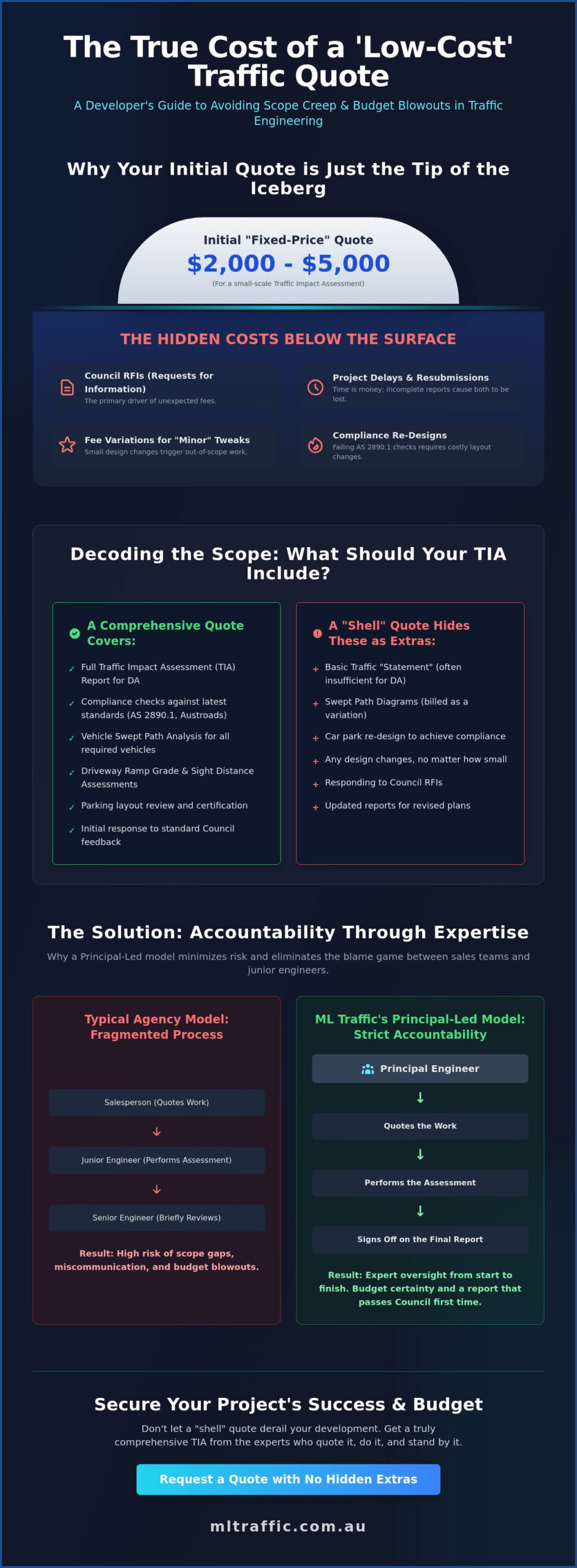
A low-cost traffic quote is frequently the most expensive document a developer signs. While a small-scale Traffic Impact Assessment (TIA) typically costs between $2,000 and $5,000, hidden gaps in the initial scope can quickly drive those figures higher when Council issues a Request for Information (RFI). Successfully avoiding scope creep with traffic consultants isn’t just about reading the fine print; it’s a technical foresight exercise. You need to know if your consultant has accounted for the April 2026 updates to the Consultants for Engineering Projects Manual or the latest Austroads Publication AGTM02-26 before work begins.
It’s frustrating when "fixed-price" agreements dissolve into a series of fee variations because of minor design tweaks or standard Council feedback. You deserve budget certainty and a report that sails through the DA process without constant price hikes. At ML Traffic Engineers Australia, we ensure the expert who quotes the work is the one who performs the assessment to maintain strict accountability. This guide explains how to define project boundaries and vet technical quotes to prevent budget blowouts. You’ll learn to manage Council expectations effectively and ensure your TIA report complies with the 2025 revisions to AS 2890.1 from the outset. We’ll show you how to identify a quote that covers everything from Vehicle Swept Path Analysis to Driveway Ramp Grade Assessments without hidden extras.
Key Takeaways
- Define the technical boundaries of a Traffic Impact Assessment (TIA) to distinguish between standard reporting and out-of-scope variations.
- Identify Council Requests for Information (RFIs) as the primary driver of cost increases and learn to mitigate them through early technical foresight.
- Spot the specific red flags of “shell” quotes when avoiding scope creep with traffic consultants to ensure your initial fee covers mandatory compliance assessments.
- Implement a structured change control process to manage design shifts and maintain project timelines during the Development Application (DA) phase.
- Understand why principal-led consultancies reduce risk by ensuring the senior engineer who quotes the work is the one responsible for the final technical report.
Table of Contents
-
Understanding the Core Deliverables of a Traffic Engineering Engagement
-
Identifying Common Triggers for Scope Creep in Australian Traffic Planning
-
Evaluating the Quote: How to Spot an Incomplete Scope of Work
-
Best Practices for Maintaining Project Boundaries During the Approval Phase
-
Strategic Selection: Why Principal-Led Consultancies Minimise Scope Creep
Understanding the Core Deliverables of a Traffic Engineering Engagement
Scope creep is a persistent risk in technical projects. Understanding What is Scope Creep? helps developers identify when a project is drifting beyond its original intent. In traffic engineering, this drift often starts because the client and the consultant don’t agree on what a standard Traffic Impact Assessment (TIA) actually includes. A TIA is a technical report that analyzes how a proposed development affects the surrounding road network. The Traffic Impact Assessment (TIA) serves as the primary document for Council Development Application (DA) approval. If the deliverables aren’t defined at the outset, you’ll likely face unexpected fees later.
To better understand this concept, watch this helpful video:
Choosing the correct report type is the first step in avoiding scope creep with traffic consultants. For minor developments, a simple Traffic Statement might suffice. However, major projects or high-use sites require a full TIA. If you budget for a basic Statement but Council demands a comprehensive impact assessment, you’ve already lost control of the project costs. Expert consultants will identify the required report level before they issue a quote.
TIA Reports vs. Swept Path Analysis: Knowing the Boundaries
A TIA provides the data and analysis, but swept path analysis is a distinct technical task. This process uses specialized software to simulate vehicle movements on your site. While vehicle maneuvering diagrams are essential for proving compliance with AS 2890, they aren’t always included in a basic TIA quote. If these diagrams aren’t explicitly listed, they often appear as a variation later. You must also distinguish between car park design as an architectural layout and the technical engineering certification of ramp grades and sight distances. Architecture focuses on aesthetics and space; engineering focuses on compliance and safety.
What Falls Outside a Standard Traffic Assessment?
Developers must understand that the role of a traffic engineer is advisory and analytical. We don’t provide physical traffic control, road construction, or street lighting plans. Those tasks belong to civil contractors and electrical engineers. A standard traffic scope also excludes detailed structural engineering. Knowing these boundaries is vital for avoiding scope creep with traffic consultants. If you expect your traffic expert to manage event traffic or design drainage systems, you’ll see immediate and justified fee hikes. Stick to the technical assessments to keep your budget predictable.
Identifying Common Triggers for Scope Creep in Australian Traffic Planning
Scope creep in traffic engineering is rarely the result of a single error. It’s usually triggered by external regulatory pressure or sudden shifts in the development’s design parameters. Successfully Understanding and Managing Scope Creep requires developers to anticipate technical obstacles before they appear on a Council RFI. For instance, a standard AS 2890.1 compliance check often reveals that a proposed driveway ramp grade exceeds mandatory limits. This discovery forces a redesign of the entire car park layout, a task that falls well outside a standard reporting fee. Avoiding scope creep with traffic consultants depends on identifying these technical flashpoints during the quoting stage rather than during the assessment.
Inadequate initial site data is another major trigger for budget blowouts. If a surveyor doesn’t provide accurate levels or sight-line data, the traffic engineer cannot confirm compliance with Australian Standards. When these issues emerge later, they require additional site visits and revised Sight Distance Assessments. These "discoveries" aren’t the consultant’s fault, but they do lead to price hikes that frustrate developers who expected a fixed-price outcome.
Council RFIs and Iterative Redesigns
Council Requests for Information (RFIs) are the most frequent driver of additional consultancy fees in Australia. A vague or demanding response from a planning officer can lead to multiple rounds of revisions that weren’t in the initial quote. Developers often face unexpected requirements for detailed intersection analysis or complex SIDRA modeling mid-way through the approval process. It’s vital to ensure your consultant includes at least one round of Council response in their initial fee. Without this provision, every minor clarification becomes a billable variation. If you’re unsure what your current quote covers, reviewing a comprehensive list of traffic engineering services can help you identify missing components before you sign an agreement.
Changing Development Parameters Mid-Project
Mid-project design changes are a significant technical trigger for fee hikes. Shifting a driveway location by as little as one metre can invalidate an entire Vehicle Swept Path Assessment. This requires the engineer to re-run simulations for every design vehicle, from waste trucks to delivery vans. Similarly, changing land-use types fundamentally alters trip generation rates. Converting a warehouse into a retail space, for example, dramatically increases Car Parking Demand Assessment requirements. Developers must also avoid the "while you’re at it" trap. When architects request minor tweaks to car park layouts, they often don’t realize these changes require updated sight-distance assessments and compliance certifications. Each tweak resets the technical clock and adds to the final bill.
Evaluating the Quote: How to Spot an Incomplete Scope of Work
A low-cost traffic quote is rarely a bargain; it’s usually a shell. In the traffic engineering industry, developers often encounter "Commodity Quotes" that offer a low initial fee but hide a long list of exclusions. These quotes typically cover only the bare minimum required for a Statement of Environmental Effects but ignore the technical depth Council actually demands. Avoiding scope creep with traffic consultants requires a forensic review of the proposal before any contracts are signed. An "Expert Quote" is comprehensive and realistic, reflecting the true technical requirements of the site from day one.
Compliance is the most common area where "shell" quotes fail. A proposal that doesn’t explicitly reference AS 2890.1 and other relevant Australian Standards is a significant red flag. Without these benchmarks, your report won’t meet the mandatory checklist used by Council officers. At ML Traffic Engineers Australia, we operate on a specific accountability metric: the traffic consultant who provides the quote, does the work. This ensures the senior engineer who understands your project’s constraints is the one actually performing the assessment, preventing the "hand-off" errors that lead to budget blowouts.
The Danger of the "Under-Quote" and Post-Contract Variations
Junior engineers at large, impersonal firms often miss critical site constraints during the quoting phase. They might ignore complex parking demand issues or fail to notice a difficult driveway incline. When these technical hurdles emerge during the assessment, the firm will issue a post-contract variation. Principal-led consultancies like ML Traffic Engineers Australia avoid this by involving senior staff at the earliest stage. This senior involvement ensures that the quote accounts for the actual complexity of the project, not just a template-based estimate. You pay for expertise upfront rather than paying for "discoveries" later.
Essential Line Items Every Traffic Engineering Quote Needs
To ensure you’re getting a complete scope, verify that the following technical tasks are included as line items:
-
Sight Distance and Ramp Grade Assessment: Verification that the proposed access points meet safety and compliance standards.
-
Specific Vehicle Types for Swept Path Analysis: The quote should specify which vehicles are being modeled, such as a Small Rigid Vehicle (SRV) versus a Heavy Rigid Vehicle (HRV).
-
Council Query Provision: A realistic allowance for responding to standard Council requests for further information.
-
RPEQ/NER Certification: Confirmation that the final report will be signed by a registered professional engineer where required by state legislation.
If these items are missing, your project is at high risk for variations. Ensuring these details are in the initial scope is a vital strategy for avoiding scope creep with traffic consultants. For a clear understanding of what a professional engagement should include, you can view our full range of traffic engineering services.
Best Practices for Maintaining Project Boundaries During the Approval Phase
Active management of your technical team is the only way to ensure a project stays on track and within budget. Avoiding scope creep with traffic consultants requires a proactive management discipline that continues long after the initial quote is signed. You must establish a clear "Change Control" process before work begins. This process dictates that any task not explicitly listed in the original fee proposal must be flagged and approved in writing before the consultant starts the work. Without this structure, minor requests from architects or planners quickly accumulate into significant fee variations that disrupt your financial forecasting.
Early collaboration is a critical preventative measure. You should ensure your traffic consultant is part of the initial design meeting with the project architect. If an architect designs a car park layout that ignores the mandatory technical requirements or fails to account for the necessary driveway ramp grades, the traffic engineer will eventually have to demand a redesign. This causes expensive rework that could have been avoided with ten minutes of technical oversight at the concept stage. Developers should also consolidate all Council feedback into a single, comprehensive package before sending it to the consultant. Sending piecemeal emails for every minor Council comment creates administrative bloat and increases the risk of conflicting instructions.
Establishing a Clear Communication Protocol
Internal team confusion is a frequent trigger for scope drift. You should define a single point of contact within your development team to manage all correspondence with the traffic engineer. This prevents the "too many cooks" scenario where an architect, planner, and developer all issue different instructions for the same report. Setting firm expectations for turnaround times on Council RFIs is also essential. Use a "Scope Tracker" to log every request that falls outside the initial fee agreement. This log provides a factual basis for discussing variations before they appear on a final invoice, maintaining transparency throughout the DA process.
Managing Stakeholder Expectations and Council Pushback
Council officers sometimes request assessments that exceed the legal requirements for a specific land use. You should use your traffic engineering report as a shield against unreasonable demands. An experienced consultant can distinguish between a "nice to have" request and a mandatory regulatory requirement. For example, if a planner asks for a complex intersection analysis for a small-scale apartment block, a seasoned expert can negotiate directly with Council engineers to scale back the scope based on the April 2026 engineering manual standards. This negotiation prevents you from paying for unnecessary technical modeling that adds no value to the approval outcome.
If you want to secure your project budget against unforeseen technical variations, contact our senior engineers at ML Traffic Engineers Australia for a comprehensive, principal-led quote.
Strategic Selection: Why Principal-Led Consultancies Minimise Scope Creep
Large engineering firms often operate with a top-heavy sales structure. A senior partner might provide the initial quote, but the technical work is frequently handed off to a junior graduate. This "hand-off" error is a primary cause of budget blowouts. The junior engineer often lacks the foresight to identify technical roadblocks that a seasoned expert would have spotted during the initial site review. Avoiding scope creep with traffic consultants is significantly easier when you eliminate the gap between the person who promises the scope and the person who executes it.
The ML Traffic Engineers model is built on direct accountability. We operate on a simple principle: the expert who quotes your project is the one who completes the report. This ensures that the technical constraints identified at the start are managed throughout the entire assessment. Michael Lee and Benny Chen provide direct access to their expertise, ensuring that no technical details are lost in internal firm bureaucracy. By leveraging over 15 years of experience and a track record of over 10,000 sites across Australia, we anticipate Council requirements before they’re even asked.
The "Quote-to-Execution" Integrity Model
Senior staff involvement reduces the need for "learning on the job" at your expense. A junior engineer might spend hours researching a specific driveway grade standard that a principal engineer knows by heart. This efficiency is built into the initial fee rather than being added as a billable variation later. Technical mastery prevents the "discovery" of major compliance issues late in the DA process. When a principal handles the work, they identify sight-line constraints and parking demand issues during the first hour of analysis, not the last. This foresight is the most effective tool for avoiding scope creep with traffic consultants.
Ensuring Compliance Without the Guesswork
A deep understanding of traffic impact assessment nuances prevents over-scoping. Inexperienced consultants often recommend expensive and unnecessary technical modeling because they don’t have the confidence to negotiate with Council engineers. We focus on a "right first time" approach to car park design and vehicle access, ensuring every report meets Australian Standards without redundant analysis. This precision protects your project timeline and your budget from unnecessary technical bloat. If you require a reliable partner for your next development application, contact ML Traffic Engineers for a transparent, principal-led quote.
Securing Your Project Budget Through Technical Foresight
Effective project management depends on technical clarity from the first quote. You’ve seen that avoiding scope creep with traffic consultants is achieved by defining report boundaries, vetting for mandatory AS 2890.1 compliance, and maintaining a strict change control process during Council negotiations. Junior-led "hand-off" models are the primary cause of budget blowouts; senior accountability is the cure. It’s about ensuring your consultant has the foresight to anticipate technical roadblocks before they become expensive variations.
ML Traffic Engineers provides the technical certainty your development application requires. We leverage over 15 years of industry experience and a track record of 10,000+ sites successfully assessed nationwide to ensure your TIA report is right the first time. Our senior staff are involved in every project, ensuring the person who quotes the work is the one who delivers the results. Get a transparent, expert quote from ML Traffic Engineers today. With the right technical partner, you can navigate the DA process with predictable costs and absolute compliance. Your project’s success is built on reliable data and expert execution.
Frequently Asked Questions
How do I know if a Council request is outside my original scope?
Compare the Council’s Request for Information (RFI) directly to the technical line items in your signed fee proposal. If Council requests a SIDRA intersection analysis or a detailed Car Parking Demand Assessment and these aren’t listed as deliverables, the work is a variation. Standard Traffic Impact Assessment (TIA) reports focus on site access and trip generation. They don’t automatically include complex modeling of distant road networks or external intersections.
What is a reasonable allowance for Council RFI responses in a quote?
A professional quote must include one round of basic technical clarifications to address standard Council queries. Complex developments often require more intensive negotiations with road authorities. Ensuring your agreement includes a provision for responding to standard queries is a key step in avoiding scope creep with traffic consultants. If Council issues multiple RFIs due to major mid-project design changes, these will require additional billable hours.
Can a traffic consultant guarantee Council approval?
No engineering consultant can guarantee a specific outcome from a local government authority. We provide technical evidence of compliance with Australian Standards, such as AS 2890.1, to support your Development Application (DA). While we use our 15 years of experience to anticipate technical objections, the final decision rests with the Council. Our role is to provide a robust, defensible report that minimizes the risk of technical rejection.
Why do some traffic consultants charge significantly more for Swept Path Analysis?
Pricing differences reflect the complexity of the vehicle types being modeled and the site constraints. Modeling a standard 8.8m Medium Rigid Vehicle (MRV) is simpler than simulating a 19m articulated truck in a tight urban basement. Professional Swept Path Analysis requires specialized software and senior technical expertise to ensure maneuvers are realistic. Lower quotes often exclude these specific vehicle simulations, leading to expensive variations during the assessment phase.
What happens if the architect changes the driveway location after the traffic report is finished?
Any shift in site access requires a full revision of the traffic assessment. Moving a driveway by even one metre invalidates previous Sight Distance Assessments and Swept Path Analysis simulations. The engineer must re-run all technical models and update compliance certifications for AS 2890.1 standards. Because this requires re-performing core technical tasks, it’s almost always treated as a billable variation outside the initial project scope.
Is it cheaper to hire a general civil engineer for traffic reports?
The initial fee might seem lower, but generalists often lack the specific technical foresight required for complex traffic assessments. General civil engineers may miss nuances in parking demand or intersection capacity that trigger extensive Council RFIs. These delays and the subsequent rework often cost more than hiring a specialist from the start. Specialized traffic engineers provide the meticulous analysis needed to prevent unforeseen budget blowouts.
How can I prevent my traffic consultant from billing for extra meetings?
Establish a clear communication protocol and meeting limit at the start of the engagement. Your initial quote should state exactly how many site visits or project team meetings are included in the fixed fee. If you require attendance at additional Council meetings or design workshops, request a fixed rate for these events beforehand. This transparency is a vital part of avoiding scope creep with traffic consultants during the approval phase.
Does a Traffic Management Plan (TMP) include the physical traffic control?
A Traffic Management Plan (TMP) or Traffic Guidance Scheme (TGS) is a technical certification document; it doesn’t include the physical placement of bollards or traffic controllers. We provide the certified plans required for Council or TMR approval. You must hire a separate traffic control contractor to implement the physical measures on the road. Our scope is strictly limited to engineering planning, design, and compliance certification.
Which areas do you cover?
We are traffic engineers servicing Melbourne, Sydney, Brisbane, Gold Coast, Hobart, Perth, Adelaide, Darwin, Canberra and surrounding areas.

Disclaimer
The content on www.mltraffic.com.au, including all technical articles, guides, and resources, is provided for general informational and educational purposes only. It is not intended to constitute professional advice in traffic engineering, transportation planning, development approvals, or any other technical or legal field.
While ML Traffic Engineers makes every reasonable effort to ensure the accuracy, completeness, and timeliness of the information published, we do not provide any warranties or representations (express or implied) regarding its reliability, suitability, or availability for any particular purpose. Any reliance you place on the content is strictly at your own risk.
In no event shall ML Traffic Engineers, its directors, employees, authors, or affiliates be liable for any direct, indirect, incidental, special, consequential, or punitive damages (including, without limitation, loss of profits, data, or business opportunities) arising out of or in connection with the use of, or inability to use, any information provided on this website.
The articles and guides on this site are not a substitute for engaging a qualified, registered professional traffic engineer (such as an NPER or RPEQ engineer) to assess your specific project requirements. For tailored advice, compliance assessments, or traffic engineering services, please contact a competent professional.
This disclaimer may be updated from time to time without notice. By accessing or using this website, you agree to be bound by the most current version of this disclaimer.
