Relying on static Austroads templates alone is the fastest way to have your Development Application (DA) rejected by council. While these diagrams provide a necessary baseline, they rarely account for the operational reality of a 26 metre vehicle navigating a constrained industrial site. You likely recognise that securing a compliant B-double swept path analysis is a non-negotiable requirement for modern commercial projects; however, the risk of losing valuable site yield to oversized or unworkable driveways remains a constant concern for developers across Australia.
This guide provides the technical clarity needed to master heavy vehicle access requirements, ensuring your development meets the latest Australian Standards and secures certain approval. We will examine the critical shift from static AP-G34-23 templates to dynamic software simulations and how adhering to AS 2890.2:2018 protects your infrastructure from damage. You will learn how to produce a council-ready site plan that maximises your building footprint while guaranteeing that heavy vehicles can safely enter and exit in a forward gear, as required by the National Class 2 B-double Authorisation Notice 2026. By applying these expert principles, you can eliminate bureaucratic delays and move your project toward construction with confidence.
Key Takeaways
- Understand the technical mechanics of 25m and 26m articulated configurations and how trailer off-tracking dictates site access requirements.
- Identify the correct application of Austroads AP-G34-23 templates to establish compliant design vehicle dimensions and turning radii for your project.
- Leverage dynamic B-double swept path analysis using AutoTURN software to overcome the limitations of static templates in complex or constrained site layouts.
- Ensure strict adherence to AS 2890.2:2018 by maintaining mandatory clearance margins of 300mm to 600mm to protect infrastructure and future-proof the development.
- Streamline the DA approval process by providing certified traffic engineering reports that verify safe, “forward-in, forward-out” vehicle movements for council planners.
The Complexity of B-double Manoeuvring in Australian Developments
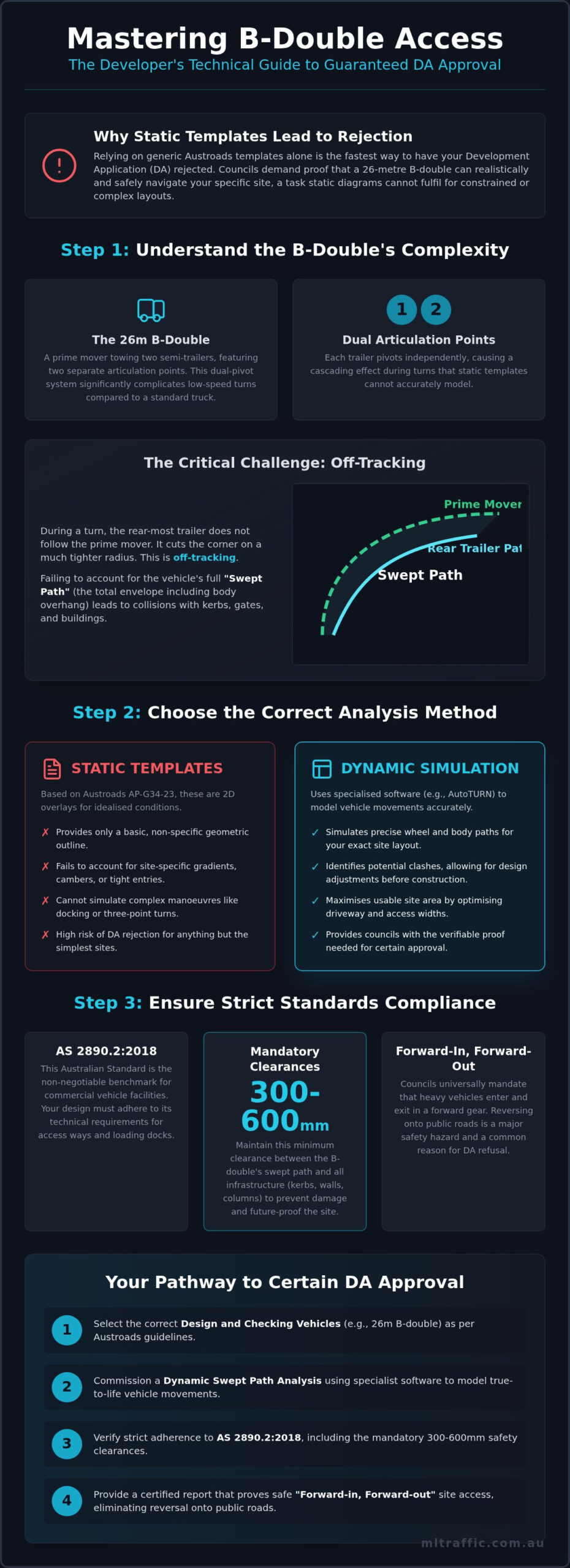
A B-double is an articulated vehicle consisting of a prime mover pulling two semi-trailers. In Australian industrial and commercial contexts, these vehicles typically operate in 25 metre or 26 metre configurations. Designing for these vehicles requires a deep understanding of their unique physical characteristics. Unlike a standard semi-trailer, a B-double features two separate articulation points. This dual-pivot system significantly complicates low-speed turns, as each trailer responds differently to the steering inputs of the prime mover.
The primary challenge in B-double access is a phenomenon known as off-tracking. When the prime mover enters a turn, the rear-most trailer does not follow the lead unit’s arc. Instead, the rear wheels “cut” the corner, following a tighter path than the front wheels. A professional swept path analysis is essential to map these movements accurately. It distinguishes between the “wheel path,” which tracks the tyres’ contact with the pavement, and the “swept path,” which accounts for the total envelope created by the vehicle’s body overhang. Failing to account for this overhang often leads to collisions with gate posts, signage, or structural columns.
To better understand this concept, watch this helpful video:
Why B-doubles are a “High-Risk” Design Vehicle
B-doubles are classified as high-risk design vehicles because their spatial requirements are vastly superior to Heavy Rigid Vehicles (HRVs). While an HRV might navigate a tight corner with a 12.5 metre radius, a B-double frequently requires a 15 metre or 20 metre turning circle. This disparity forces developers to implement wider driveways and deeper gate setbacks to avoid “clipping” kerbs or obstructing traffic flow. If the B-double swept path analysis is inaccurate, the site may become functionally unworkable for modern logistics providers, leading to costly post-construction modifications.
Regulatory Drivers: AS 2890.2 and Council Expectations
Compliance with Australian Standard AS 2890.2:2018 is the benchmark for commercial vehicle facilities. This standard dictates the technical requirements for loading docks and access ways. Councils prioritise safety and efficiency; they almost universally mandate that heavy vehicles enter and exit a site in a forward gear. Reversing on public roads is a major safety hazard and a common reason for DA refusal. This detailed assessment is a critical component of a broader Traffic Impact Assessment, providing the empirical proof that your site can handle high-productivity vehicles without compromising public infrastructure.
Understanding Austroads Turning Path Templates for Heavy Vehicles
Austroads publication AP-G34-23, Edition 4.0, serves as the definitive reference for vehicle dimensions and turning path templates across Australia. These templates provide a standardised geometric representation of how a vehicle occupies space during a turn. For a B-double swept path analysis, selecting the correct template is the foundational step in ensuring site compliance. Each template illustrates the outermost body outline and the innermost wheel path, allowing engineers to visualise the “swept envelope” required for safe passage. This envelope must be clear of all physical obstructions, including kerbs, bollards, and building corners.
Engineers must distinguish between a “Design Vehicle” and a “Checking Vehicle” when applying these templates. A Design Vehicle dictates the primary geometry of the facility, such as the width of a standard loading bay. A Checking Vehicle, typically a 25 metre or 26 metre B-double, is used to verify that the site can accommodate larger combinations under highly controlled, low-speed conditions. This dual-layered approach ensures that while the site remains efficient for daily operations, it can safely facilitate occasional heavy arrivals without risking damage to the infrastructure.
Navigating the AP-G34 Template Library
Identifying the correct B-double template requires an assessment of the specific land-use type and the available manoeuvring space. Austroads provides templates for various turning circles, typically 12.5 metre, 15 metre, and 20 metre radii. The standard 12.5 metre radius turn is the baseline for most industrial sites where space is at a premium. Speed parameters also play a critical role; a 5 km/h turn represents a crawl speed typical of tight loading docks, whereas a 15 km/h turn is more appropriate for entry and exit points on public roads. Selecting a template with an inappropriate speed or radius will result in an unworkable site plan.
Performance Based Standards (PBS) and Custom Vehicles
Standard Austroads templates are often insufficient for modern logistics hubs utilising Performance Based Standards (PBS) vehicles. The PBS scheme allows for innovative vehicle designs that may have different articulation points or lengths than the prescriptive 26 metre B-double. In these instances, a custom vehicle profile must be developed to reflect the actual dimensions of the fleet. These high-productivity vehicles often require larger manoeuvring areas, and relying on standard templates can lead to site failures. If your project involves non-standard freight combinations, you should consult an expert for a specialised assessment to ensure every centimetre is accounted for.
Static Templates vs. Dynamic Swept Path Analysis: Choosing the Right Method
While Austroads templates establish the geometric baseline for vehicle movements, they remain static snapshots of theoretical turns. A B-double swept path analysis for a complex Development Application requires a more rigorous approach than simply overlaying a PDF curve onto a site plan. Static templates assume a constant radius turn and do not account for the transition period where a driver turns the steering wheel to reach full lock. In contrast, dynamic software simulations provide a centimetre-perfect representation of how a 26 metre vehicle interacts with specific site constraints.
Council traffic engineers increasingly demand dynamic simulations because they reflect operational reality. A software-generated plot accounts for the steering rate and the mechanical limits of the prime mover, ensuring that the proposed access is physically possible for a human driver. If a site plan relies on a static template that ignores these transition distances, the result is often a “paper-only” solution that fails during the first week of site operations. This discrepancy is a primary reason for DA rejections in industrial precincts.
The “Static Template” Trap for Developers
Relying on static templates often leads to one of two costly outcomes: over-designing or under-designing. Over-designing occurs when a developer wastes valuable site yield on oversized driveways because they used a generic template that didn’t account for the vehicle’s actual capabilities. Conversely, under-designing leads to operational failure where trucks hit kerbs or gate posts because the template could not be accurately aligned with a non-standard intersection angle. Furthermore, static 2D templates cannot account for varying driveway gradients. A B-double navigating a steep ramp requires different clearance margins than one on a flat surface, a detail that only dynamic analysis can verify.
The AutoTURN Advantage for DA Approvals
AutoTURN software allows engineers to simulate real-world driver behaviour, including variable speeds and steering lock adjustments. This capability is essential for designing loading docks that require reversing manoeuvres. A static template cannot illustrate a multi-part shunt or a three-point turn, both of which are common requirements in constrained logistics hubs. By using dynamic simulations, we can prove to council that a B-double can safely dock without obstructing the public road or damaging on-site infrastructure. To ensure your project meets these technical standards, you can learn more about our Vehicle Swept Path Analysis services. These simulations provide the empirical evidence required to secure approval while protecting your building footprint from unnecessary wastage.
Ensuring Compliance with AS 2890.2 and Council Requirements
Adherence to AS 2890.2:2018 is the primary requirement for all off-street commercial vehicle facilities in Australia. A compliant B-double swept path analysis must demonstrate specific clearance margins to be considered workable. For low-speed manoeuvring within a site, a minimum clearance of 300mm is required between the vehicle’s swept path and any fixed object. In higher-speed areas or locations with high pedestrian activity, this margin often increases to 600mm. These buffers are non-negotiable; they provide the necessary safety gap for driver variance and vehicle mechanical tolerances.
Designing for the “worst-case scenario” vehicle is a critical strategy for future-proofing an industrial asset. While a current tenant might only operate Heavy Rigid Vehicles (HRVs), a site designed solely for that vehicle will be physically incapable of accommodating a 26 metre B-double in the future. This limitation significantly reduces the long-term value and flexibility of the development. Balancing this requirement against car parking yield is a common challenge. Large turning circles consume substantial ground area, often at the expense of car bays. To resolve this conflict, it is essential to integrate heavy vehicle requirements early in the Car Park Design process to ensure both user groups can operate safely without compromising the building footprint.
Loading Dock and Driveway Design Checklist
Successful site access depends on several technical factors that go beyond simple turning circles. Use the following checklist to evaluate your site layout:
- Entry and Exit Gates: The driveway must be long enough to ensure a 26 metre vehicle is completely clear of the public road before it reaches a security gate or stopping point.
- Splay Requirements: Optimising corner splays at the property boundary minimises the time a vehicle occupies the opposing lane during a turn, which is a key safety metric for council.
- Vertical Clearances: While 4.5 metres is the standard vertical clearance, steep ramp gradients can cause the trailer body to “swing” vertically, necessitating additional height to prevent structural damage.
Common Pitfalls That Lead to Council Refusal
Councils frequently reject DAs that rely on “illegal” manoeuvres to make a site work. A common example is a design that requires a B-double to cross the centre line of a public road to complete its turn. This is rarely permitted on high-volume roads. Insufficient run-up distances are another frequent failure; articulated vehicles require a straight section of road to stabilise before entering a tight turn. Finally, many layouts neglect the danger of “blind side” reversing. Loading docks should be designed for “sight side” (driver side) reversing whenever possible to maximise visibility and safety. If you need to verify your site layout against these standards, contact our senior engineers for a certified assessment.
Securing DA Approval with Professional Traffic Engineering Reports
A certified B-double swept path analysis provides a level of technical rigour that architectural sketches cannot match. While an architect focuses on the aesthetic and structural elements of a building, a traffic engineer focuses on the physical dynamics of vehicle movement. Councils require empirical evidence that a 26 metre vehicle can navigate a site without encroaching on protected zones or crossing centre lines. A professional report removes the ambiguity that often leads to prolonged assessment periods or outright rejections.
These assessments are rarely standalone documents. They are a critical component of a comprehensive Traffic Management Plan (TMP). A TMP outlines how all vehicle types, from passenger cars to heavy freight combinations, will safely interact within the site and on the surrounding road network. Integrating swept path data into the TMP ensures that loading schedules and traffic flow are based on actual physical constraints rather than theoretical assumptions. This level of detail is essential for high-productivity industrial hubs where operational efficiency is paramount.
ML Traffic Engineers Australia provides senior-led consultancy, ensuring that the expert who initiates the project is the one performing the technical work. This continuity is vital for complex developments where a minor error in turning radii can result in a site that is functionally unworkable. Early-stage involvement protects your project yield by identifying the minimum required manoeuvring area before the building footprint is finalised, preventing the need for costly site retrofitting after construction has commenced.
What to Expect in a Professional Swept Path Report
A professional report is a technical resume for your site’s functionality. It includes high-resolution AutoTURN simulations showing the exact entry, manoeuvring, and exit paths for the design vehicle. If the site requires a deviation from standard Austroads templates, the report provides the necessary technical justification to satisfy council planners. Most importantly, it includes a formal certification of compliance with AS 2890.2 by a qualified Traffic Engineer. This certification transfers the technical risk from the developer to the consultant, providing council with the assurance they need to grant approval.
Streamlining the Council Approval Process
Clear, professional diagrams are designed to pre-empt council queries and Requests for Information (RFIs). When a traffic engineer provides a detailed simulation, it leaves little room for subjective interpretation by council assessors. Having an expert advocate during the DA phase is invaluable, especially when negotiating complex access arrangements or Performance Based Standards (PBS) vehicle access. Professional documentation demonstrates to the consent authority that the development has been designed with meticulous attention to safety and regulatory compliance. Contact ML Traffic Engineers Australia to discuss your specific B-double access requirements and ensure your development is compliant from the outset.
Securing Your Development’s Operational Success
Mastering the technical requirements for heavy vehicle access is the difference between a rejected DA and a high-performing industrial asset. You now understand that while Austroads templates provide a baseline, a dynamic B-double swept path analysis is the only way to prove operational feasibility to council planners. Prioritising “forward-in, forward-out” movements and maintaining strict AS 2890.2 clearance margins ensures your site remains safe, efficient, and future-proofed against changing logistics needs.
ML Traffic Engineers has completed over 10,000 projects since 2005. We ensure senior principal involvement in every assessment to guarantee technical accuracy and full compliance with AS 2890.2. This meticulous approach eliminates the risk of costly site retrofitting and streamlines the approval process. Professional traffic engineering is an investment in your project’s long-term viability and site yield.
Get a Professional Swept Path Analysis for Your Development
We look forward to helping you secure a compliant and efficient site layout.
Frequently Asked Questions
What is the standard length of a B-double vehicle in Australia?
Standard B-doubles in Australia are typically 25 or 26 metres in length. These specific dimensions are used in Austroads design templates to establish the baseline for access assessments. While some Performance Based Standards (PBS) vehicles may vary in length, the 26 metre configuration is the standard “worst-case” vehicle used for most industrial site designs and compliance checks.
Can I use a 19m semi-trailer template if I eventually want B-double access?
No, you cannot use a 19 metre semi-trailer template to justify B-double access. A B-double is significantly longer and features dual articulation points that create a much larger swept envelope than a single articulated vehicle. Designing for a 19 metre vehicle will result in driveways and loading areas that are physically too small, leading to operational failure and potential structural damage.
Does council allow B-doubles to reverse from a public road into a site?
Councils almost never allow B-doubles to reverse from a public road into a private site. Standard planning requirements dictate that all heavy vehicles must enter and exit in a forward gear. This “forward-in, forward-out” mandate is a critical safety measure designed to prevent traffic congestion and reduce the risk of collisions on public thoroughfares during delivery operations.
What is the minimum turning radius required for a 26m B-double?
The absolute minimum turning radius for a 26 metre B-double is 12.5 metres, but this is only suitable for crawl speeds in highly constrained areas. For standard design purposes, engineers typically use a 15 metre or 20 metre radius. A larger radius reduces tyre scrub and mechanical wear while making the manoeuvre significantly safer and easier for the driver to execute.
How much clearance is required between the swept path and a structural pillar?
AS 2890.2:2018 requires a minimum clearance of 300mm between the vehicle’s swept path and any fixed object like a structural pillar. In areas with higher speeds or where pedestrians are present, this margin should increase to 600mm. These buffers are essential to account for minor driver errors and vehicle body swing during the turn to prevent costly property damage.
Is swept path analysis mandatory for all industrial development applications?
A professional B-double swept path analysis is mandatory for most industrial and commercial Development Applications where heavy vehicle access is required. Councils use these diagrams as empirical evidence to verify that the proposed site layout is functionally workable. Without this technical proof, a DA is likely to be rejected or delayed by a formal Request for Information (RFI).
What software do traffic engineers use for B-double turning simulations?
Traffic engineers predominantly use AutoTURN software to conduct a B-double swept path analysis. This industry-standard tool allows for dynamic analysis, accounting for steering lock, speed, and articulation limits. Unlike static templates, AutoTURN provides a centimetre-perfect representation of how a specific vehicle will interact with the unique constraints of your site plan, ensuring full regulatory compliance.
Can a B-double turn in a standard 12.5m radius cul-de-sac?
A standard B-double generally cannot turn comfortably in a 12.5 metre radius cul-de-sac without multiple shunts or mounting the kerb. While a 12.5 metre radius is the theoretical minimum for the vehicle, real-world operational requirements usually necessitate a radius of at least 15 metres. Relying on the absolute minimum often leads to infrastructure damage and subsequent council refusal of the design.

Disclaimer
The content on www.mltraffic.com.au, including all technical articles, guides, and resources, is provided for general informational and educational purposes only. It is not intended to constitute professional advice in traffic engineering, transportation planning, development approvals, or any other technical or legal field.
While ML Traffic Engineers makes every reasonable effort to ensure the accuracy, completeness, and timeliness of the information published, we do not provide any warranties or representations (express or implied) regarding its reliability, suitability, or availability for any particular purpose. Any reliance you place on the content is strictly at your own risk.
In no event shall ML Traffic Engineers, its directors, employees, authors, or affiliates be liable for any direct, indirect, incidental, special, consequential, or punitive damages (including, without limitation, loss of profits, data, or business opportunities) arising out of or in connection with the use of, or inability to use, any information provided on this website.
The articles and guides on this site are not a substitute for engaging a qualified, registered professional traffic engineer (such as an NPER or RPEQ engineer) to assess your specific project requirements. For tailored advice, compliance assessments, or traffic engineering services, please contact a competent professional.
This disclaimer may be updated from time to time without notice. By accessing or using this website, you agree to be bound by the most current version of this disclaimer.
