
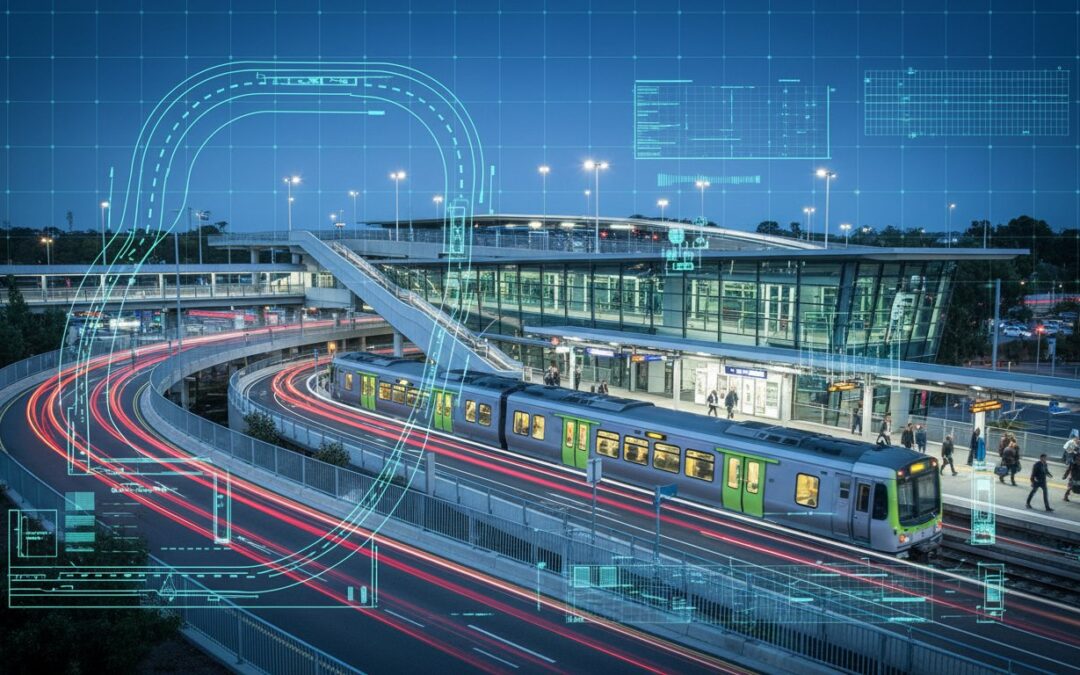
The highest cost of building near a major transport hub isn’t the land; it’s the unnecessary basement levels required by rigid parking quotas. Most developers understand the frustration of meeting strict council requirements while trying to avoid the massive expenses associated with deep excavation. When you’re planning a balaclava station car park or a similar high-density development, the risk of a DA rejection based on traffic impact can stall your progress for months. You shouldn’t have to sacrifice project viability to satisfy generic parking rates that ignore the reality of public transport proximity.
This case study demonstrates how expert traffic engineering and data-driven Car Parking Demand Assessments secure planning approvals while significantly reducing required spaces. You’ll discover how we apply AS 2890.1 compliance and vehicle swept path analysis to justify optimized parking rates and minimize construction costs. We’ll show you the exact technical strategies used to satisfy Clause 52.06 requirements and the Department of Transport and Planning, ensuring your project moves from application to approval without unnecessary delays.
Key Takeaways
- Understand how to integrate private parking with commuter flow in Transport-Oriented Developments (TOD) to ensure efficient traffic circulation.
- Ensure your project meets AS 2890.1:2004 requirements for User Class 3 parking to avoid costly design revisions during the planning phase.
- Learn how a professional Car Parking Demand Assessment justifies providing fewer spaces for a balaclava station car park by utilizing local transport data.
- Use Vehicle Swept Path Analysis to demonstrate that heavy vehicles can enter and exit your development in a forward direction as required by council.
- Discover how direct access to senior traffic engineers streamlines the Request for Further Information (RFI) process to accelerate your DA approval.
The Complexity of Station-Adjacent Car Parking Design
Designing a development adjacent to a major rail hub presents technical hurdles that standard suburban sites never encounter. Transport-oriented developments (TODs) generate unique traffic flow patterns characterized by high-volume, short-duration peaks during the morning and evening. When planning a balaclava station car park, engineers must account for the intense saturation of the local road network. Standard parking layouts frequently fail in these environments because they apply generic templates to highly specific urban contexts. They often overlook the friction between private vehicle movements and constant commuter foot traffic.
Balancing the needs of private residents with commercial visitors and public transport users is a meticulous process. The proximity of Balaclava railway station means that every vehicle entry point must be analyzed for its impact on pedestrian safety and public transport efficiency. A poorly designed access point leads to queuing that blocks through-traffic. This triggers immediate pushback from council and increases the risk of DA rejection. Our role is to ensure that the balaclava station car park design integrates seamlessly with existing infrastructure.
To better understand the dynamics of high-demand parking environments, watch this video:
Urban Density and Access Challenges
High-density station precincts require sophisticated multi-modal integration. We must manage vehicle ingress and egress while prioritizing the safety of thousands of daily commuters. Access points near busy station entrances are particularly sensitive. Technical requirements often dictate that vehicles must enter and exit in a forward direction to maintain sight lines. Modern traffic engineering also addresses the ‘last mile’ problem. This involves incorporating specific provisions for rideshare zones, delivery bays, and bicycle storage alongside traditional parking. If your traffic impact statement doesn’t address these multi-modal interactions, you’ll likely face a costly Request for Further Information (RFI).
Regulatory Framework for Australian Station Precincts
Australian planning schemes view developments within a 400m to 800m station radius through a specific regulatory lens. Authorities often encourage reduced parking rates to promote public transport use. However, they also demand rigorous proof that the development won’t overflow into local streets. This is a delicate balance. A professional Traffic Impact Assessment (TIA) provides the data-driven justification needed to satisfy council and state transport authorities. It’s not just about counting spaces; it’s about proving the operational viability of the entire site. Learn more about our TIA services to see how we secure approvals for complex station-adjacent projects through expert analysis and compliance.
Meeting AS 2890.1 Standards for High-Turnover Parking
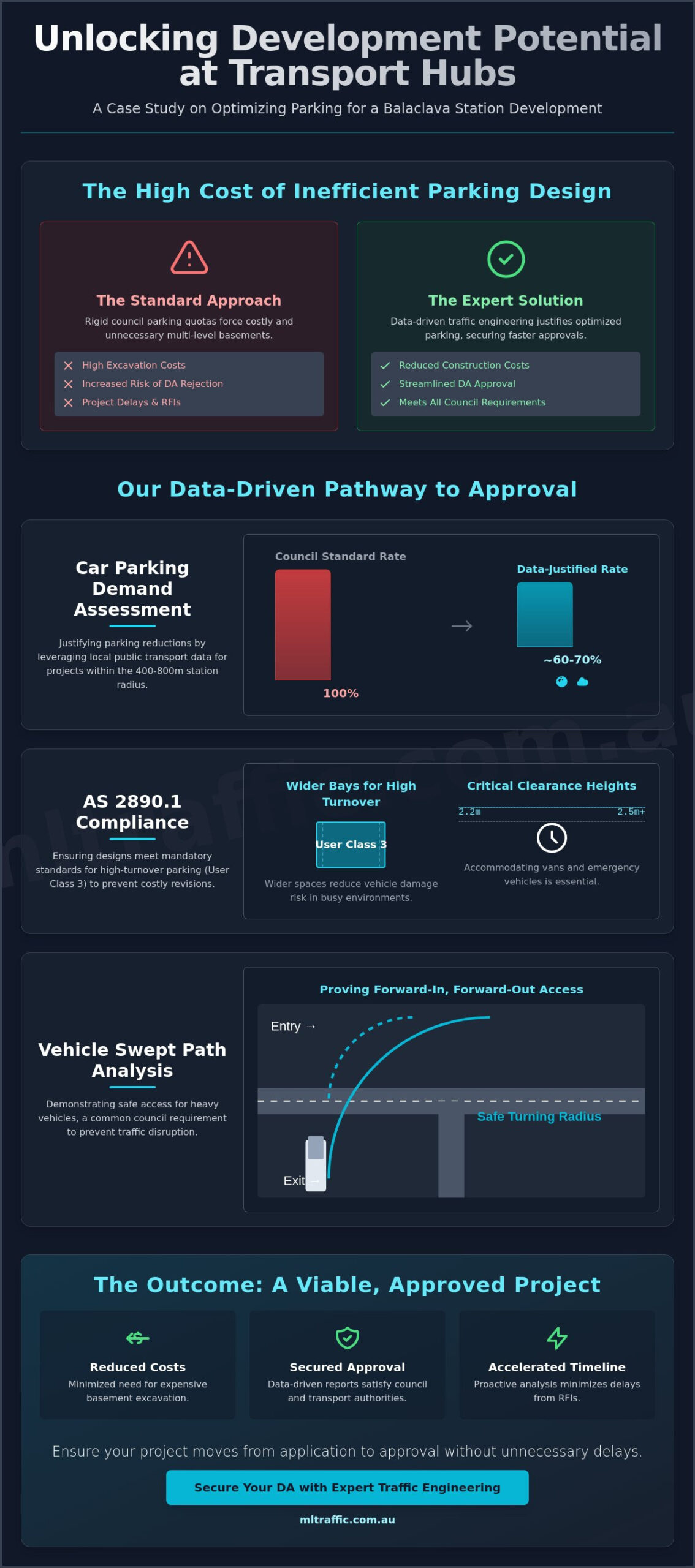
Compliance with AS 2890.1:2004 isn’t a suggestion; it’s a mandatory requirement for any development application involving off-street parking. In high-demand environments like a balaclava station car park, the margin for technical error is zero. The Commuter Car Park Projects audit highlights how evidence-based planning and adherence to technical benchmarks are critical for the success of transport infrastructure. We categorize station-adjacent parking as User Class 3. This classification covers short-term, high-turnover parking where users are often in a hurry. These bays require greater width than residential or staff parking to accommodate frequent movements and reduce the risk of vehicle damage.
Clearance heights are equally critical. We design for a minimum of 2.2 metres for standard cars, but van and emergency vehicle access often requires 2.5 metres or more. If these heights aren’t factored into the initial structural design, the basement becomes non-compliant. We also address ramp grades and transitions with precision. A ramp that’s too steep or lacks proper transitions will cause vehicles to scrape, leading to long-term operational issues and potential liability for the developer. If you’re unsure about your current layout, you can contact our senior engineers for a preliminary design review.
Off-Street Parking Compliance Checklist
- Bay Dimensions: Standard bays must meet the 2.4m to 2.6m width requirement depending on the user class. Small car spaces are only permitted under specific council ratios.
- Aisle Widths: For 90-degree parking, a minimum aisle width of 5.8 metres is typically required to allow for safe two-way movement and easy entry.
- Sight Distances: We ensure a 2.0m x 2.5m clear sight triangle at the property boundary. This is vital for pedestrian safety near busy station entrances.
Driveway and Access Engineering
Calculating ramp grades requires more than a simple percentage. We must factor in the change in grade (the “breakover angle”) to ensure compliance with AS 2890.1. For a balaclava station car park, managing queuing at the entry point is also a priority. If the entry gate or ramp design causes vehicles to wait on the public road, the council will likely reject the DA due to traffic obstruction. We use technical simulations to ensure wait times remain within acceptable limits. For a deeper dive into these requirements, read our AS 2890.1 Explained: The Ultimate Guide to Compliant Car Park Design.
Car Parking Demand Assessments: Justifying Reductions Near Rail Hubs
A Car Parking Demand Assessment is a technical study that justifies providing fewer parking spaces than required by standard planning codes. Most council requirements are based on broad land-use categories. These generic codes don’t account for the specific dynamics of transport-oriented sites. For a development near a balaclava station car park, relying on these rates often leads to significant over-provision. We use empirical data to prove that residents and visitors in these precincts exhibit lower car ownership and usage rates compared to suburban averages.
Analyzing Public Transport Accessibility Levels (PTAL) is central to this process. Research indicates that for every 10% improvement in public transport service, there’s an associated 0.9% to 1.2% reduction in car parking demand. By demonstrating high accessibility, we can often justify supply reductions between 20% and 40%. The financial implications are significant. Reducing even a single basement level can save hundreds of thousands of dollars in excavation and structural costs. This often makes the difference between a project that is financially viable and one that is stalled by high construction overheads.
When is a Parking Reduction Possible?
Reductions are most feasible for developments within a 400m to 800m walking distance of high-frequency rail. We often supplement these assessments with a Green Travel Plan. This plan includes commitments to sustainable transport options, such as enhanced bicycle facilities or car-share pods, to further offset parking needs. Our data-driven approach has successfully overcome conservative council estimates by proving that actual peak demand for a balaclava station car park precinct is often 30% lower than the statutory requirement. This allows developers to repurpose space for more valuable uses.
Conducting a Parking Occupancy Survey
A rigorous parking occupancy survey measures the availability of on-street spaces within a defined catchment area, typically 200 metres from the site. We conduct these surveys during peak demand periods to provide a realistic snapshot of local capacity. The results are then integrated into the Traffic Impact Statement to demonstrate that any minor overflow can be absorbed by the existing road network without causing saturation. A Parking Demand Assessment is a technical justification used to support planning departures by demonstrating that proposed parking supply aligns with actual operational needs rather than theoretical quotas.
Vehicle Swept Path Analysis for Complex Access
Vehicle swept path analysis is a non-negotiable component of a successful development application. In the tight physical constraints of a balaclava station car park precinct, standard turn radii often don’t apply. We use AutoTURN software to simulate the exact movement of vehicles through every ramp, aisle, and intersection. This simulation proves to council that the proposed layout is operationally sound and won’t lead to localized gridlock or structural damage from vehicle impacts. It’s a proactive way to address the technical concerns of planning officers who are often wary of high-density station developments. Without this data, a project faces significant delays during the Request for Further Information (RFI) stage.
We prioritize the ‘B99’ vehicle turn circle requirements to ensure long-term usability. The B99 represents the 99.8th percentile of vehicles on Australian roads, including large modern SUVs and utility vehicles. Ensuring that these larger passenger vehicles can navigate the car park without reversing into aisles is a core requirement of AS 2890.1. By visualising these paths, we identify potential conflict points between turning vehicles and pedestrians before a single brick is laid. This visualisation is particularly important when designing for station hubs where foot traffic is constant and unpredictable. Our models account for the dynamic nature of these precincts, providing a meticulous level of detail that generic site plans lack.
Designing for Service and Delivery Vehicles
Councils strictly require that waste and delivery trucks enter and exit the site in a forward direction. Reversing onto a busy station-frontage road is a major safety risk and a common reason for DA refusal. Swept path analysis is critical for loading dock approval because it proves heavy vehicles have sufficient manoeuvrability. We also model turns for larger SUVs to ensure ramp transitions don’t cause bottlenecks. For more technical details, visit our Swept Path Analysis: A Complete Guide for Australian Developments.
Pedestrian Safety at Station Entrances
Station precincts are high-volume pedestrian zones. We analyse sightlines for vehicles exiting a balaclava station car park to ensure drivers see commuters well before crossing the footpath. This includes implementing traffic calming measures like speed humps within the internal design. Compliance with AS 2890.6 for disabled access is also mandatory, requiring specific shared zones in the swept path model to ensure safe boarding. If you need a technical review of your access design, book a Vehicle Swept Path Analysis today.
Securing Planning Approval for Transport-Oriented Developments
Securing planning approval for developments in high-demand precincts requires a strategic alignment between technical data and regulatory expectations. When you propose a project near the balaclava station car park, you enter a highly scrutinized planning environment. Local councils and state transport authorities prioritize safety and network efficiency above all else. A comprehensive Traffic Impact Statement (TIS) serves as your primary risk mitigation tool. It transforms your project from a theoretical proposal into a technically viable development. Our principal-led approach ensures that the engineer who provides your quote is the same expert who performs the assessment. This direct accountability eliminates the communication gaps often found in larger, bureaucratic firms.
Navigating the Request for Further Information (RFI) process is where many projects stall. Councils often challenge parking reductions or access designs that seem too aggressive for the local context. We close the gap between your architectural vision and engineering reality by providing the empirical evidence needed to satisfy these queries. Whether it’s a Car Parking Demand Assessment or a detailed Intersection Analysis, our reports are designed to withstand the most rigorous technical reviews. We don’t just provide a document; we provide a defensible strategy that supports your development goals and minimizes construction overheads.
Working with ML Traffic Engineers Australia
We’ve been trading since 2005 and have successfully completed assessments for over 10,000 sites nationally. Our experience spans every conceivable land-use, from high-rise apartments and bars to temples and warehouses. Clients receive direct access to our senior consultants, Michael Lee and Benny Chen. Their combined experience of over 70 years in the field means your project benefits from deep-seated expertise and a proven track record of DA approvals. We understand the specific nuances of Australian Standards and local planning schemes inside and out. About ML Traffic Engineers Australia.
Next Steps for Your Project
Getting started is straightforward. We provide transparent quotes that reflect the actual technical work required for your specific site. A council-ready traffic report for a project near a balaclava station car park typically requires a detailed site analysis and demand assessment. We prioritize accuracy and compliance to ensure your application moves through the system without unnecessary delays. Our team is hands-on and results-oriented, focusing entirely on securing your approval with optimized parking and access designs. Contact our expert team today to discuss your project requirements and receive a professional fee proposal.
Streamline Your Transport Hub Development Approval
Designing for high-demand precincts requires a meticulous approach to traffic engineering. You’ve seen how data-driven demand assessments and precise swept path simulations move a project from a vision to a compliant reality. These technical strategies are essential for securing approval for a balaclava station car park while minimizing excavation costs. Our specialists focus on providing defensible reports that satisfy both local councils and state transport authorities. We bridge the gap between architectural goals and the technical requirements of the Australian Standards.
ML Traffic Engineers has assessed over 10,000 sites nationally, bringing decades of experience to every development application. We ensure senior staff involvement in every project to maintain the highest standards of AS 2890 compliance. This direct involvement means you’re always working with an expert who understands the specific nuances of your site. Don’t let bureaucratic hurdles or rigid parking quotas stall your progress. Get a professional traffic assessment quote from our senior engineers today and move your project toward a successful planning outcome. We look forward to helping you achieve an optimized design that meets all regulatory expectations.
Frequently Asked Questions
Is a traffic impact assessment required for all developments near stations?
A Traffic Impact Assessment (TIA) is mandatory for most developments situated near high-demand transport hubs. Councils require these reports to verify that new vehicle movements won’t compromise pedestrian safety or disrupt public transport efficiency. We provide detailed assessments that analyze local road saturation and site-specific traffic generation to ensure your project meets these regulatory expectations.
How much parking can I reduce if my site is next to a major rail hub?
You can typically justify a 20% to 40% reduction in parking supply through a professional Car Parking Demand Assessment. Research indicates that for every 10% improvement in public transport service, there’s an associated 0.9% to 1.2% reduction in car parking demand. We use this empirical data to prove that your development doesn’t require the generic quotas set by local council codes.
What is the difference between AS 2890.1 and AS 2890.2?
AS 2890.1 governs off-street parking for light vehicles, while AS 2890.2 covers commercial vehicle facilities. If your project includes a loading dock or waste collection area, you must comply with both standards. We ensure your car park design accommodates passenger vehicles and the significantly larger turn radii required for heavy service vehicles.
Can I use small car spaces to meet my parking quota?
Small car spaces are permitted, but councils often limit their use to a specific percentage of the total supply, frequently around 25%. These spaces must strictly adhere to the dimensions specified in AS 2890.1 and be clearly identified with signage. We help you optimize your balaclava station car park layout by strategically placing these bays in tighter areas of the basement.
What is a swept path analysis and why does council ask for it?
A swept path analysis is a technical simulation that tracks the path of a vehicle’s body and wheels during a turn. Councils demand this to prove that vehicles can enter and exit your site in a forward direction without striking curbs, walls, or other vehicles. It’s an essential requirement for high-density precincts where maneuvering space is limited.
How do I ensure my driveway ramp is compliant with Australian Standards?
Compliance depends on the precise calculation of ramp grades and the inclusion of proper transitions to prevent vehicle scraping. AS 2890.1 specifies maximum gradients and the required length of transition sections at both the top and bottom of the ramp. We provide Driveway Ramp Grade Assessments to verify these technical details before you submit your development application.
What happens if my development application is rejected due to parking issues?
If your application is rejected, you’ll likely face a Request for Further Information (RFI) or a formal refusal. We specialize in stepping in at this stage to provide the data-driven justification or design modifications needed to overcome council objections. Our senior engineers focus on resolving traffic issues through meticulous assessment and compliant design revisions.
Can a traffic engineer help with a Green Travel Plan?
Yes, we prepare Green Travel Plans to support parking reduction requests for projects near a balaclava station car park. These plans outline sustainable transport alternatives, such as car-sharing pods or enhanced bicycle facilities, to lower the site’s overall car dependency. This technical document is often the key to securing a parking waiver in high-accessibility zones.

Disclaimer
The content on www.mltraffic.com.au, including all technical articles, guides, and resources, is provided for general informational and educational purposes only. It is not intended to constitute professional advice in traffic engineering, transportation planning, development approvals, or any other technical or legal field.
While ML Traffic Engineers makes every reasonable effort to ensure the accuracy, completeness, and timeliness of the information published, we do not provide any warranties or representations (express or implied) regarding its reliability, suitability, or availability for any particular purpose. Any reliance you place on the content is strictly at your own risk.
In no event shall ML Traffic Engineers, its directors, employees, authors, or affiliates be liable for any direct, indirect, incidental, special, consequential, or punitive damages (including, without limitation, loss of profits, data, or business opportunities) arising out of or in connection with the use of, or inability to use, any information provided on this website.
The articles and guides on this site are not a substitute for engaging a qualified, registered professional traffic engineer (such as an NPER or RPEQ engineer) to assess your specific project requirements. For tailored advice, compliance assessments, or traffic engineering services, please contact a competent professional.
This disclaimer may be updated from time to time without notice. By accessing or using this website, you agree to be bound by the most current version of this disclaimer.
