
A single non-compliant ramp grade often triggers an immediate Development Application rejection, potentially costing developers over A$25,000 in redesign fees and months of avoidable holding costs. It’s a common frustration for project managers who see their floor space ratio diminished by inefficient layouts that fail to meet specific basement car park design standards. You likely understand that balancing maximum parking yield with rigid local council requirements is the most difficult part of the early design phase.
We’ve seen how confusing overlaps between AS 2890.1 and local Development Control Plans lead to expensive structural changes after the concrete is already poured. This guide simplifies those complexities, providing the technical precision required to master ramp gradients, swept path clearances, and sight-line assessments. You’ll learn exactly how to align your project with Australian regulatory frameworks to secure a smooth approval. We will examine the critical engineering benchmarks that transform a risky layout into a compliant, high-performance parking facility.
Key Takeaways
-
Understand why AS 2890.1:2004 serves as the technical foundation for underground parking and how basement environments demand stricter compliance than surface lots.
-
Master the "Three Pillars" of basement geometry—gradient, clearance, and circulation—to eliminate ramp grade errors that frequently trigger expensive mid-construction redesigns.
-
Learn to navigate the critical gap between basement car park design standards and local Development Control Plans (DCPs) to ensure your project meets specific council requirements.
-
Future-proof your development by integrating 2026 EV charging mandates and utilizing Swept Path Analysis to verify real-world vehicle maneuverability.
-
Discover how a professional Traffic Impact Assessment (TIA) acts as an insurance policy to streamline your development application and secure planning approval.
Table of Contents
-
Understanding the Core Basement Car Park Design Standards (AS 2890.1)
-
The Council Factor: Bridging the Gap Between AS 2890 and Local DCPs
-
Securing Planning Approval: The Traffic Assessment Advantage
Understanding the Core Basement Car Park Design Standards (AS 2890.1)
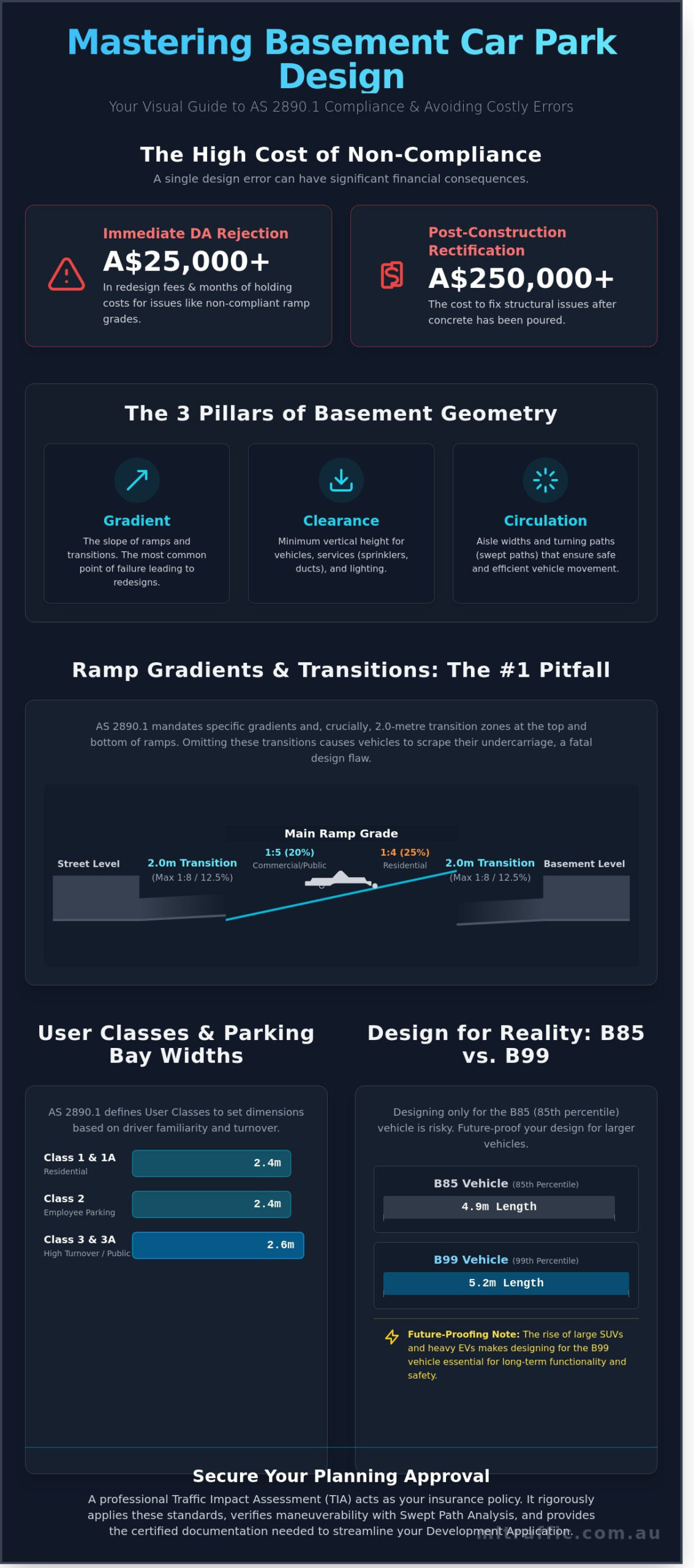
AS 2890.1:2004 serves as the primary technical benchmark for off-street car parking in Australia. While surface lots offer some spatial flexibility, basement car park design standards are exceptionally rigid. Fixed concrete columns, specific ramp grades, and restricted overhead clearance heights create a high-stakes environment where every millimetre matters. If a design fails to meet these metrics, the cost of structural rectification after the concrete slab is poured can exceed A$250,000 for even minor adjustments.
To visualize how these standards translate into a functional subterranean environment, watch this 3D animation:
The Standard categorizes parking into a "User Class" system. This system dictates the required Parking space design standards based on the expected duration of stay and driver familiarity. Class 1 and 1A are reserved for residential or long-term parking where users know the layout. Class 2 covers employee parking. Class 3 and 3A are for short-term, high-turnover environments like shopping centres or medical clinics. A Class 3A space requires a wider 2.6-metre bay to account for frequent entry and exit, whereas a Class 1 space might only require 2.4 metres.
Legally, AS 2890.1 isn’t always a standalone law, but it’s effectively mandatory across Australia. Most local councils incorporate the Standard directly into their Development Control Plans (DCPs). If your basement design doesn’t comply with the Standard, you won’t receive a Development Application (DA) approval. It’s the baseline requirement for safety, accessibility, and functional traffic flow.
The Role of AS 2890.1 in the Planning Process
Traffic engineers use these standards to certify that a development is viable. We focus on "Deemed-to-Satisfy" solutions, which means the design meets the exact pre-calculated measurements set out in the Standard. This path reduces friction with council planners and speeds up the approval timeline. For professional certification and technical assessments, you can view the specific capabilities on the ML Traffic Engineers services page.
B85 vs. B99 Vehicles: Designing for Reality
The Standard relies on two design vehicle templates: the B85 and the B99. The B85 represents the 85th percentile vehicle (4.9 metres long), while the B99 represents the 99th percentile (5.2 metres long). Designing a basement solely around B85 dimensions is a risk. It often leads to scraped columns and significant liability for the developer. By 2026, the Australian car market will be even more saturated with large SUVs and heavy EVs. These vehicles often exceed the 2004 standard’s expectations for width and turning circles. Meticulous planning must account for these larger footprints to ensure the basement car park design standards remain functional for the next 30 years.
Critical Dimensions: Ramps, Headroom, and Aisle Widths
Successful projects always adhere to rigorous basement car park design standards to ensure safety and functionality. Design isn’t merely about fitting the maximum number of vehicles into a subterranean space; it’s about the physics of vehicle movement. The three pillars of basement architecture are Gradient, Clearance, and Circulation. When these aren’t balanced, the facility becomes a liability rather than an asset.
Ramp grade errors are the most frequent cause of expensive structural redesigns during the construction phase. If the gradient is too steep or the transition is too abrupt, vehicles will scrape their undercarriages or bumpers. This physical failure is often discovered too late, leading to costly concrete remediation or unusable spaces. Professional designers prioritize these metrics from the initial site plan.
Ramp Gradients and Transition Zones
AS 2890.1 defines maximum allowable grades based on the facility type. Residential basements allow for a steeper 1 in 4 (25%) gradient, while commercial or public car parks are limited to 1 in 5 (20%). Developers often attempt to save space by pushing these limits, but failing to include a 2.0-metre transition zone at the top and bottom of the ramp is a fatal error. These zones prevent "sumping" at the bottom and "grounding" at the peak by gradually adjusting the vehicle’s approach angle.
-
1:4 Grade: Maximum for private residential use.
-
1:5 Grade: Maximum for commercial or public use.
-
Breakover Angle: Must be calculated for every steep entry to accommodate longer wheelbase vehicles.
Vertical Clearance and Headroom Standards
Vertical clearance is a non-negotiable metric. A 2.2-metre minimum is standard for general parking areas, but this increases to 2.5 metres for accessible (disabled) parking spaces. The Standards Australia AS 2890.1 revision emphasizes that modern SUVs and 4WDs require more generous spatial allocations than vehicles from 20 years ago. Structural engineers must account for overhead services early in the process.
Pipes, cable trays, and sprinkler heads often reduce effective headroom by 200mm to 400mm. If the structural slab is set at exactly 2.2 metres, the finished space will be non-compliant once the plumbing is installed. We recommend a "clear height" approach where the structural ceiling is set at 2.6 metres to allow for a 2.2-metre finished clearance.
Aisle Widths and Blind Aisles
Aisle widths for 90-degree parking typically fluctuate between 5.8 and 6.2 metres. Squeezing these dimensions to fit an extra bay is a false economy. Narrow aisles result in "unusable" bays where drivers must perform multiple-point turns, leading to vehicle damage and lower property valuations. Optimising these dimensions is a critical component of basement car park design standards.
Blind aisles present a specific challenge. Every dead-end aisle must include a 1.0-metre extension beyond the final parking bay. This allows drivers to maneuver out of the space without reversing the entire length of the basement. A professional traffic engineering assessment ensures these dimensions are optimized for both compliance and user experience. Ignoring the blind aisle rule often results in 15% of your parking bays being practically inaccessible for larger vehicles.
The Council Factor: Bridging the Gap Between AS 2890 and Local DCPs
The most common misconception in the industry is that meeting the Australian Standard guarantees a Development Application (DA) approval. It doesn’t. While AS 2890 provides the technical framework for basement car park design standards, local Council Development Control Plans (DCPs) frequently impose more restrictive requirements. If a conflict exists between the Standard and the DCP, the local planning controls almost always take precedence. You must check the specific Local Government Area (LGA) planning portal to identify these variations before finalizing any basement footprint.
Identifying which document governs your site requires a hierarchy-based approach. The Local Environmental Plan (LEP) sets the legal zoning and permissible uses, while the DCP provides the granular design detail. We’ve seen projects since 2005 where developers assumed AS 2890.1 was the final word, only to have Council demand a total redesign because local "amenity" or "character" clauses overrode the national minimums. The Statement of Environmental Effects (SEE) is your primary tool for addressing these gaps. It isn’t just a box-ticking exercise; it’s a legal justification required under the Environmental Planning and Assessment Act 1979 to prove your design meets the objectives of the local area.
Common Council-Specific Overlays
Many metro councils demand dimensions that exceed national standards. For instance, the City of Sydney often requires 2.5m wide bays for residential flat buildings, which is 100mm wider than the 2.4m minimum in AS 2890.1. Queuing distance is another critical variable. While the Standard might suggest a specific distance, a Council DCP might mandate a 6m or 12m queuing area within the property boundary to prevent vehicles from idling on public footpaths. In LGAs like Ku-ring-gai, "soft entry" landscaping requirements can eat into 15% to 20% of your available basement ramp area, forcing a deeper excavation to recover lost spots.
Negotiating Non-Compliance with Council
When site constraints like heritage foundations or narrow frontages make "Deemed-to-Satisfy" (DTS) solutions impossible, we pivot to a Performance-Based Solution. This approach relies on technical merit rather than rigid rule-following. A Traffic Engineer plays a vital role here by providing Vehicle Swept Path Assessments and Sight-Line Assessments to prove the design remains safe and functional despite the deviation. We use empirical data to show that a 5.4m wide driveway can work where the DCP demands 6m, provided the traffic volume is low enough.
The "one-size-fits-all" approach fails when dealing with nuanced basement car park design standards across different Sydney or Melbourne LGAs. Professional justification is the difference between a prompt approval and a costly Land and Environment Court appeal. At ML Traffic, our senior engineers have between 30 and 40 years’ experience each in navigating these bureaucratic hurdles. The traffic consultant who provides your quote is the one who does the work, ensuring no technical detail is lost in translation. If you’re facing pushback from a planning officer regarding your basement layout, contact ML Traffic to secure expert justification for your design variations.
-
Check the DCP for bay width increases (e.g., 2.5m vs 2.4m).
-
Verify internal queuing lengths to avoid blocking pedestrian traffic.
-
Assess landscaping setbacks that might force a ramp redesign.
-
Use a Traffic Impact Statement (TIS) to justify Performance-Based Solutions.
Future-Proofing: EV Charging, Swept Paths, and Safety
Designing a basement today requires looking three to five years ahead. The National Construction Code (NCC) 2025 updates have fundamentally changed how we approach basement car park design standards. It’s no longer just about fitting the maximum number of cars into a concrete box; it’s about managing power loads, heat dissipation, and precision vehicle movement. Failing to account for these shifts during the DA stage leads to costly retrofits or rejected occupancy certificates.
Mandatory Swept Path Analysis (AutoTURN)
Councils no longer accept static 2D drawings as proof of access. They require dynamic simulations using AutoTURN software to prove that a B99 vehicle (the 99th percentile car) can maneuver safely. This analysis isn’t just for the main ramps. It must demonstrate that the "most difficult" parking bay in the basement is accessible with a maximum of a three-point turn. This usually involves bays tucked behind structural columns or those at the end of dead-end aisles. ML Traffic Engineers utilizes senior engineers for all AutoTURN assessments to ensure the simulations reflect actual driver behavior rather than idealized computer paths. If the software shows a 50mm clearance, a senior engineer knows that’s a real-world collision risk.
EV Infrastructure and Load Management
The NCC 2025 and 2026 standards mandate that new multi-unit residential buildings provide EV charging infrastructure for 100% of car spaces. While you don’t need to install every charger immediately, the "EV Ready" status requires:
-
Dedicated space in switchboards for additional circuit breakers.
-
Installed cable trays capable of carrying the weight and heat of full-capacity wiring.
-
Load management systems to prevent the building’s peak demand from tripping the local grid.
Spatial planning is a common failure point. A wall-mounted charger often protrudes 150mm to 300mm into a space. If your aisle width is already at the minimum 5.8m requirement, these chargers cannot obstruct the vehicle path. You must design wider bays or recessed wall niches to accommodate the hardware without violating basement car park design standards set by AS 2890.1.
Lithium-Ion Fire Safety and Ventilation
Lithium-ion battery fires present a specific risk profile. They burn at higher temperatures and release toxic gases that standard residential ventilation isn’t always equipped to handle. Fire authorities are increasingly looking for enhanced smoke extraction rates in zones where high-density EV charging occurs. Bay spacing also comes into play; some fire engineers now recommend fire-rated barriers or increased gaps between vehicles to prevent "thermal runaway" from spreading between cars. This impacts your total yield, so these safety factors must be locked in during the initial layout phase.
Pedestrian Protection and Sightlines
Safety standards at the property boundary are non-negotiable. AS 2890.1 requires a clear sight triangle of 2.0m by 2.5m at the exit point. This ensures a driver can see a pedestrian on the footpath before the nose of the car crosses the boundary line. In tight urban sites, designers often try to place columns or service risers in these areas. This is a critical error that will result in a failed inspection. You must keep these zones completely clear of obstructions higher than 1.1m to ensure total visibility.
Get your design right the first time with expert technical oversight. Contact ML Traffic Engineers for a compliant swept path assessment.
Securing Planning Approval: The Traffic Assessment Advantage
A professional traffic report acts as a technical insurance policy for your development application. It prevents the common pitfall of receiving a Request for Further Information (RFI) from Council, which can delay a project by months. When your basement car park design standards are backed by a certified engineer, you provide Council planners with the data they need to approve the project without hesitation. This report proves that every ramp grade, turning circle, and parking bay complies with the rigid requirements of AS 2890.1.
There’s a significant difference between a Traffic Impact Statement (TIS) and a full Traffic Impact Assessment (TIA). A TIS is a concise document typically used for smaller developments where traffic increases are minimal. A TIA is a comprehensive study required for larger residential or commercial hubs. It involves complex intersection modeling and analysis of the broader road network. Submitting a TIS when a TIA is required is a guaranteed way to see your DA rejected. We ensure you lodge the correct documentation from day one.
Traffic engineers do more than just check boxes; they optimize space. We often find "hidden" parking spots through precise design tweaks. By using vehicle swept path software, we can identify areas where aisle widths or column placements can be adjusted by as little as 200mm to unlock an extra bay. In a high-density Australian suburb, a single extra parking spot can add A$50,000 to A$100,000 to the total project value. Our final DA-ready checklist includes:
-
Verification of B85 and B99 vehicle turning templates.
-
Ramp transitions and "dead floor" clearances to prevent vehicle scraping.
-
Sight-line assessments at the property boundary to ensure pedestrian safety.
-
Compliance with User Class 1A or 2 dimensions for residential basements.
-
Detailed queuing analysis to prevent driveway congestion.
The Traffic Consultant Who Does the Work
The ML Traffic signature is simple: the consultant who provides the quote, does the work. We don’t use a "bait and switch" model where a senior partner signs the contract and a junior graduate writes the report. You get direct access to principals Michael Lee or Benny Chen throughout the entire process. This direct line of communication speeds up the approval process because technical queries are answered instantly by the person who performed the analysis. You can see this technical expertise in action by visiting the ML Traffic video gallery, which showcases how we use swept path analysis to solve complex basement constraints.
Next Steps for Your Project
Getting your basement design certified starts with a detailed fee proposal. We review your architectural drawings and provide a fixed-price quote within 24 hours. For projects scheduled in 2026, our standard turnaround time for a TIA report is 10 to 15 business days. This timeframe allows for thorough modeling while keeping your DA submission on track. Don’t risk a costly DA rejection by DIY-ing your basement car park design standards. Contact us to ensure your project meets every Australian regulatory requirement from the start.
Secure Your Planning Approval with Engineering Precision
Navigating basement car park design standards requires balancing technical AS 2890.1 requirements with the specific demands of local Council Development Control Plans. You’ve seen how critical ramp grades, headroom, and swept path assessments are to a successful project. Since 2005, ML Traffic Engineers has specialized in bridging this gap. We’ve delivered results for over 10,000 sites across Australia, providing the technical certainty needed to avoid costly design revisions.
Our firm operates on a no-nonsense basis. You’ll have direct access to senior engineers who handle everything from initial assessments to complex Council negotiations; there are no gatekeepers here. The consultant who quotes your project is the one who completes the work. It’s a reliable, hands-on approach that ensures your design is compliant and ready for construction. Get your basement car park design certified by the experts at ML Traffic. We look forward to helping you move your development forward with confidence.
Frequently Asked Questions
What is the minimum ceiling height for a basement car park in Australia?
The minimum ceiling height for a standard basement car park is 2.2 metres according to AS 2890.1. If the basement includes accessible parking spaces, AS 2890.6 requires a minimum vertical clearance of 2.5 metres. These measurements must be clear of all obstructions including overhead pipes, sprinklers, and ducting. Our engineers verify these clearances at the lowest point of the structure to ensure compliance.
Can I use a steeper ramp grade than 1:4 if I have a small site?
No, a gradient of 1:4 (25%) is the absolute maximum allowable ramp grade for private or residential car parks under AS 2890.1. Many local councils are even more restrictive, often capping gradients at 1:5 (20%) within their Development Control Plans. If your site is constrained, you must optimize the internal layout through professional basement car park design standards rather than exceeding these safety limits.
Does every basement car park need a Swept Path Analysis for Council approval?
Most Australian councils require a Swept Path Analysis for any development where the layout involves tight turns or non-standard ramp widths. We use B85 and B99 vehicle templates to simulate movements and prove that cars won’t strike columns or walls. This technical evidence is a mandatory component for approximately 95% of Development Applications in metropolitan areas like Sydney and Melbourne.
What are the AS 2890.6 requirements for accessible parking in basements?
AS 2890.6 requires accessible spaces to be 2.4 metres wide, paired with an adjacent 2.4 metre wide shared loading zone. The entire area must maintain a 2.5 metre vertical clearance to accommodate high-top conversion vehicles. You must also install a dedicated bollard in the shared zone to prevent obstruction. These standards are non-negotiable under the Disability Discrimination Act 1992.
How much space do I need to leave for a blind aisle extension?
You must provide a 1.0 metre extension at the end of any blind aisle that serves more than six parking spaces. This requirement, found in AS 2890.1 Clause 2.4.2, ensures drivers have sufficient room to maneuver when exiting the final space. Failing to include this 1,000mm gap is a common reason for Council to reject a basement floor plan during the initial assessment.
Are EV charging stations mandatory in new Australian basement car parks in 2026?
The National Construction Code (NCC) 2022 already mandates EV-ready infrastructure for all new buildings. For Class 2 residential buildings, developers must provide electrical distribution boards and cable trays to 100% of parking spaces. While the physical chargers aren’t always required at the point of construction, the capacity to install them must exist to meet the Australian Government’s 2030 emissions targets.
What is the difference between AS 2890.1 and a Council DCP?
AS 2890.1 is the national technical standard for off-street car parking, while a Council Development Control Plan (DCP) is a local planning policy. AS 2890.1 provides the engineering baseline, but the DCP often introduces more stringent requirements for ramp widths or parking ratios. When these documents conflict, the more restrictive local Council policy usually takes precedence during the DA process.
How do I calculate the transition grade for a basement ramp?
Calculate your transition grade by designing a 2.0 metre long section at exactly half the gradient of the main ramp. If your main ramp grade is 25% (1:4), you must include a 12.5% (1:8) transition at both the top and bottom. This prevents vehicles from scraping their undercarriage or bumpers. We apply these precise basement car park design standards to ensure every ramp is functional and safe.
Which areas do you cover?
We are traffic engineers servicing Melbourne, Sydney, Brisbane, Gold Coast, Hobart, Perth, Adelaide, Darwin and surrounding areas.

Disclaimer
The content on www.mltraffic.com.au, including all technical articles, guides, and resources, is provided for general informational and educational purposes only. It is not intended to constitute professional advice in traffic engineering, transportation planning, development approvals, or any other technical or legal field.
While ML Traffic Engineers makes every reasonable effort to ensure the accuracy, completeness, and timeliness of the information published, we do not provide any warranties or representations (express or implied) regarding its reliability, suitability, or availability for any particular purpose. Any reliance you place on the content is strictly at your own risk.
In no event shall ML Traffic Engineers, its directors, employees, authors, or affiliates be liable for any direct, indirect, incidental, special, consequential, or punitive damages (including, without limitation, loss of profits, data, or business opportunities) arising out of or in connection with the use of, or inability to use, any information provided on this website.
The articles and guides on this site are not a substitute for engaging a qualified, registered professional traffic engineer (such as an NPER or RPEQ engineer) to assess your specific project requirements. For tailored advice, compliance assessments, or traffic engineering services, please contact a competent professional.
This disclaimer may be updated from time to time without notice. By accessing or using this website, you agree to be bound by the most current version of this disclaimer.
