
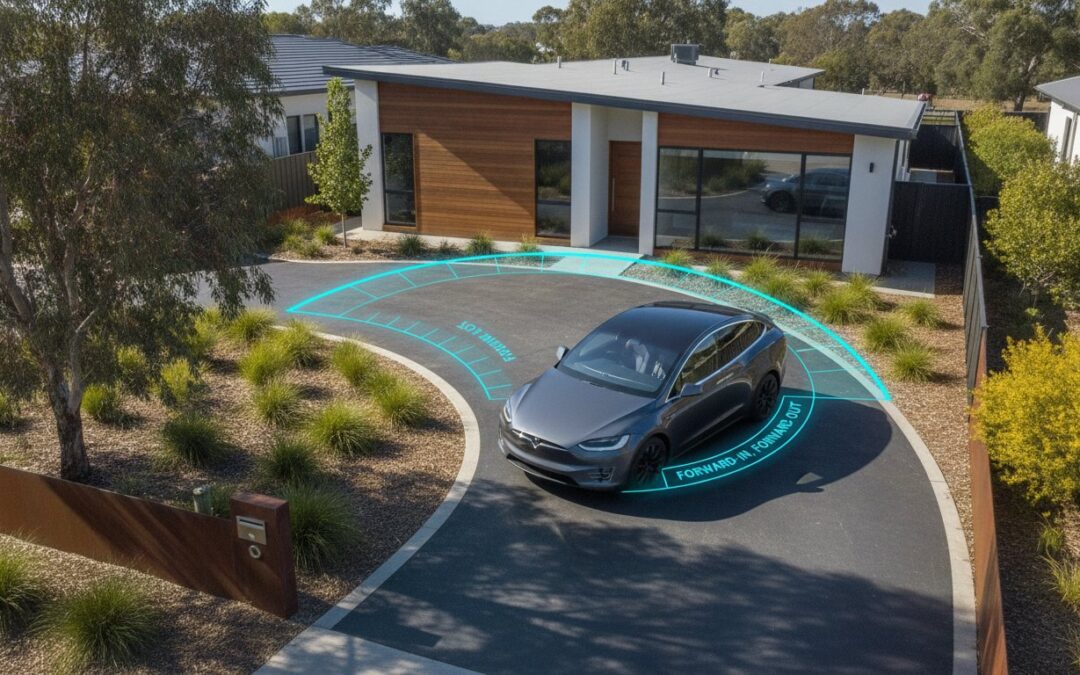
Relying on the minimum driveway widths found in local planning instruments is the fastest way to trigger a Request for Information (RFI) or a flat refusal from Council. You’ve likely spent weeks perfecting a subdivision layout only to find that modern SUVs simply cannot perform the required “forward-in, forward-out” manoeuvres within your design. It’s frustrating when standard compliance isn’t enough to satisfy a meticulous planning officer who demands absolute proof of safe access and functional turning circles.
This article will show you how to implement technical traffic solutions for battle-axe blocks that satisfy even the most stringent Council engineering requirements. We’ll cover the critical role of B85 and B99 vehicle swept path analysis, driveway ramp grade assessments, and the specific engineering strategies needed to maximise site yield without compromising access safety. You’ll learn how to navigate the gap between theoretical standards and the practical realities of modern vehicle dimensions to secure your DA approval with confidence and avoid costly, late-stage redesigns.
Key Takeaways
- Identify the core conflict between maximising site yield and meeting Council’s strict access safety requirements for rear-lot subdivisions.
- Learn how to apply technical traffic solutions for battle-axe blocks using AutoTURN software to verify B85 and B99 vehicle swept paths.
- Master the “forward-in, forward-out” mandate to ensure all vehicles can exit the site safely without reversing onto public thoroughfares.
- Avoid vehicle grounding on steep terrain by adhering to Australian Standards for driveway ramp grade assessments and maximum allowable gradients.
- Synthesise technical data into a professional Traffic Impact Assessment (TIA) report to address Council concerns and secure a successful DA outcome.
Understanding Traffic Access Challenges in Battle-Axe Developments
The battle-axe block, characterised by a secluded rear lot accessed via a narrow “handle,” presents a unique set of engineering hurdles. While these lots are popular for their privacy, the access strip is the primary point of failure during the Development Application (DA) process. Council scrutiny focuses almost exclusively on this handle because it represents the critical interface between private vehicle movements and public road safety. Developers often attempt to minimise the handle width to maximise site yield, but this frequently conflicts with the technical requirements for safe vehicle passage.
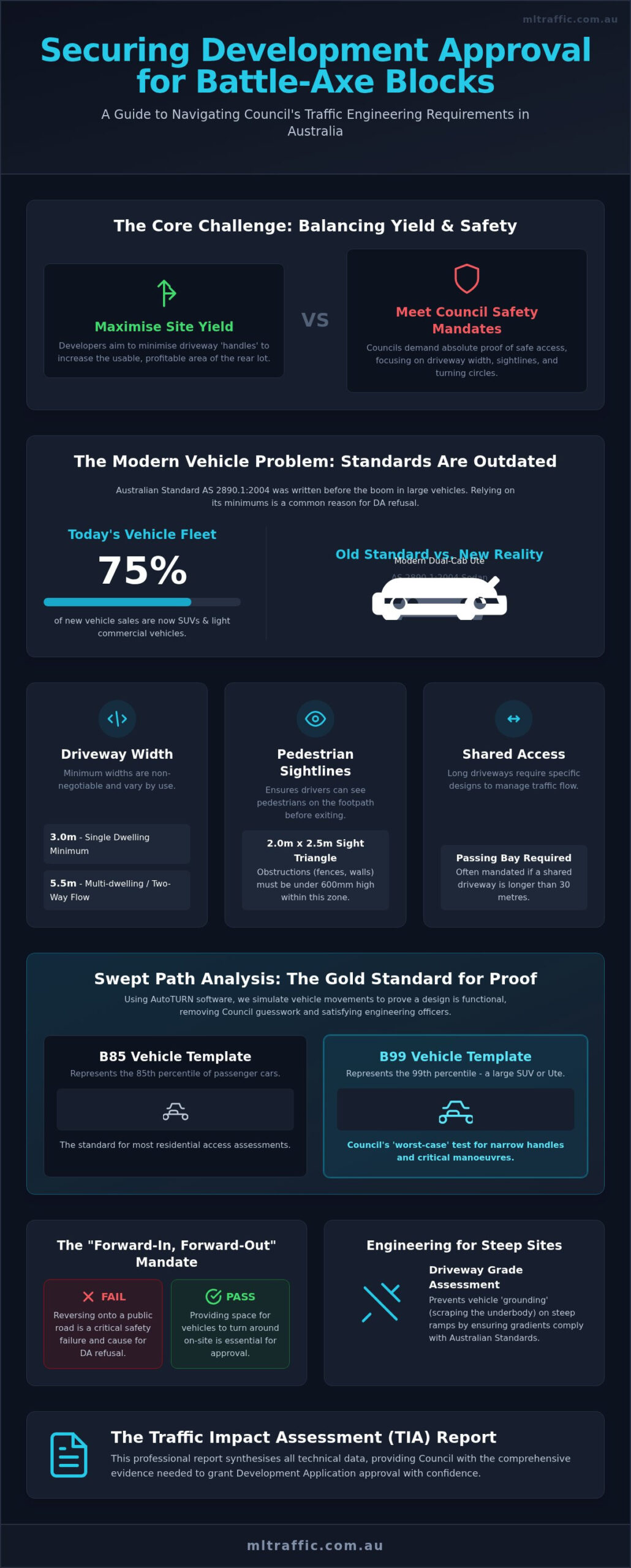
Effective traffic solutions for battle-axe blocks must account for a significant shift in Australian vehicle demographics. Industry data indicates that SUVs and light commercial vehicles now account for approximately 75% of new car sales in Australia. Traditional driveway designs based on smaller sedan dimensions are increasingly obsolete. Modern engineering must accommodate these larger wheelbases and wider turning circles to prevent property damage and ensure functional access that meets current safety expectations.
The Handle Problem: Width and Sightline Constraints
Driveway width requirements are strictly governed by local planning schemes and Australian Standard AS 2890.1. While a single dwelling might only require a 3.0m wide pavement, multi-dwelling developments often necessitate widths of 5.5m at the street entry to allow for simultaneous two-way flow. A common cause for DA refusal is the failure to provide adequate pedestrian sightlines at the property boundary. Engineering for these sites requires specific attention to the following:
- Sight Triangles: Maintaining clear visibility zones, typically 2.0m by 2.5m, where obstructions like fences or letterboxes cannot exceed 600mm in height.
- Boundary Obstructions: Managing landscaping and existing structures that impede a driver’s view of the footpath.
- Pavement Strength: Ensuring the handle can support the axle loads of heavy rigid vehicles, such as waste collection or emergency services, if required by Council.
Shared Access vs. Private Driveways
When multiple dwellings share a single rear lot, or when two battle-axe blocks are created side-by-side, shared access through a reciprocal easement is often the most efficient use of space. However, this creates complex traffic flow dynamics. Engineering these shared handles requires strategic placement of passing bays to prevent vehicle queuing on the public road. If a driveway is longer than 30 metres, Council often mandates a passing bay to ensure an entering vehicle doesn’t have to reverse back onto the street when encountering an exiting car. We focus on organising these spaces to maintain high site yield while meeting every safety mandate.
Swept Path Analysis: Proving Vehicle Manoeuvrability
Swept Path Analysis is the technical process of calculating the dynamic space a vehicle requires to complete a turn. It is the gold standard for DA evidence because it removes the guesswork from site access. Councils rely on these simulations to confirm that a proposed site layout is actually functional. Without this technical proof, a battle-axe subdivision is likely to face immediate rejection due to perceived safety risks. We use industry-standard AutoTURN software to generate these reports, simulating real-world movements that account for both wheel paths and body overhangs.
For most residential developments, we apply the B85 vehicle template, which represents the 85th percentile of passenger cars. However, for critical safety manoeuvres or narrow handles, Councils often mandate the B99 template. This represents the 99th percentile, essentially a “worst-case scenario” large vehicle. Proving that a B99 vehicle can navigate your site ensures that even the largest SUVs can enter and exit without striking boundary walls, letterboxes, or landscaping. This level of technical rigour is essential when presenting traffic solutions for battle-axe blocks to a Council engineering officer.
AutoTURN Simulations for Modern Vehicle Dimensions
Relying solely on the dimensions in AS 2890.1:2004 is increasingly risky for developers. These standards were established over two decades ago and don’t fully reflect the larger dimensions of modern Australian dual-cab utes and 4WDs. When designing traffic solutions for battle-axe blocks, we look beyond the minimums. We calculate the exact swept path of modern vehicles to ensure the driveway is wide enough for the actual cars residents drive. Our AutoTURN simulations include 300mm clearance margins to account for the reality of human driving; this prevents RFIs regarding tight “lock-to-lock” steering requirements that Council officers often flag as unrealistic.
Designing Turning Heads and Reversing Bays
Effective battle-axe design requires a dedicated turning area to facilitate forward-entry and forward-exit. The choice between a T-shaped and Y-shaped turning head is an engineering decision based on the available building envelope. T-shaped heads are often more space-efficient, while Y-shaped designs offer better ergonomics for drivers. In many jurisdictions, if the driveway handle is particularly long, we must also prove that a medium or heavy rigid vehicle can turn. This is critical for waste collection and fire services. Ensuring these vehicles don’t have to reverse hundreds of metres down a narrow handle is a non-negotiable safety requirement. Our team can provide a Vehicle Swept Path Analysis to verify your design before it reaches the Council’s desk.
Solving the Forward-In, Forward-Out Requirement
The “Forward-In, Forward-Out” mandate is a non-negotiable requirement for almost all modern battle-axe developments. Councils strictly forbid designs that force residents to reverse onto the public road. This isn’t just a matter of convenience; it’s a critical safety measure. Reversing from a narrow, often obscured driveway handle into live traffic or across a pedestrian footpath creates an unacceptable risk profile. Providing effective traffic solutions for battle-axe blocks requires demonstrating that every vehicle can enter the site, turn around, and exit in a forward direction. This is especially vital on collector roads where higher traffic volumes make reversing manoeuvres significantly more hazardous.
In tight subdivisions where every square metre counts, justifying a dedicated turning head can be difficult. However, smart engineering allows us to integrate these areas into the existing driveway or parking layout. By widening specific sections of the “axe” head or utilising the space in front of garages, we can facilitate the required manoeuvres without drastically reducing the building footprint. The goal is to create a layout that feels intuitive for the driver while meeting the technical requirements of the planning officer.
Turning Templates and Manoeuvring Space
Achieving a compliant turn requires a clear understanding of the minimum radius for B85 and B99 vehicles. A standard residential vehicle typically requires a minimum outer turning radius of approximately 6.3 metres. We often use “blind” aisles or small driveway extensions as functional turning space. These are essentially dead-end sections of pavement that provide the “pocket” needed for a vehicle to swing its front or rear around. Council engineers look for technical proof that these manoeuvres are achievable in a maximum of three movements. If a simulation shows a five-point turn is necessary, the design will likely be flagged as impractical and subsequently refused.
Compliance with AS 2890.1 for Off-Street Parking
Proper alignment with Australian Standards ensures that car spaces are positioned to allow the first move of the exit to be forward-facing. This means the layout must provide enough depth for a vehicle to reverse out of a bay and align itself toward the exit handle within the property boundaries. For detailed specifications on bay widths and lengths, refer to our AS 2890.1 guide. We calculate the “swept path envelope” for every movement to ensure no part of the vehicle body or wheel path strikes structural columns, fences, or parked cars. This precision is what separates a successful DA from a costly RFI. Meticulous planning of these envelopes allows us to maximise the available building area while maintaining full compliance.
Engineering for Steep Sites: Driveway Ramp Grade Assessments
Steep battle-axe blocks introduce the risk of vehicle grounding, where the chassis contacts the pavement. This usually occurs at the “crest” or “sag” of a driveway ramp. For battle-axe subdivisions, the handle often traverses significant topographical changes. Australian Standard AS 2890.1 specifies that the maximum allowable grade for a private driveway is generally 1 in 4 (25%). However, simply staying under this limit doesn’t guarantee compliance or functionality. A design that meets the raw percentage might still cause a vehicle to bottom out if the transitions aren’t engineered correctly.
A qualified Traffic Engineer must certify that the ramp design accommodates low-clearance vehicles. This certification is a core component of providing robust traffic solutions for battle-axe blocks on undulating terrain. Without a formal Driveway Ramp Grade Assessment, Councils will often flag the design as high-risk for vehicle damage. We use specific longitudinal sections to model the vehicle’s path, ensuring that the front and rear bumpers don’t scrape at any point during the ascent or descent.
Calculating Change of Grade
Abrupt changes in slope are the primary cause of grounding. To mitigate this, we implement the 2-metre transition rule. This involves inserting a 2-metre section of pavement at a grade that is the average of the two adjoining slopes. This engineering technique accounts for the “break-over” angle of modern vehicles, ensuring the undercarriage clears the crest. When designing traffic solutions for battle-axe blocks, we provide longitudinal sections (side-view profiles) to Council engineers as definitive proof of compliance. These diagrams map the car’s clearance throughout the entire length of the handle, removing any ambiguity from the assessment process.
Drainage and Surface Considerations
Steepness also dictates material choice. Any driveway exceeding a 1 in 5 grade typically requires a non-slip surface, such as broom-finished concrete or specific pavers, to ensure traction in wet weather. Integrating drainage is equally technical. Drainage grates must be flush-mounted to avoid creating “steps” that trigger grounding. Additionally, the intersection between the private ramp and the public footpath must be managed carefully. The grade must flatten out significantly before crossing the property boundary to ensure pedestrian safety and prevent the vehicle from “bottoming out” as it enters the public road. If your site has significant elevation changes, you can request a Driveway Ramp Grade Assessment to ensure your design meets all regulatory standards.
The Traffic Impact Assessment (TIA): Your Path to Approval
A Traffic Impact Assessment (TIA) is mandatory for the majority of battle-axe subdivisions. It serves as the formal technical justification for your development. While previous sections detailed individual engineering components like swept paths or ramp grades, the TIA report synthesises these elements into a single, cohesive argument for Council approval. By consolidating technical traffic solutions for battle-axe blocks into a professional report, ML Traffic Engineers Australia addresses potential safety concerns before they become grounds for a formal refusal.
When site constraints are extreme, the role of the Traffic Engineer is to provide expert justification for any necessary deviations from standard planning codes. Councils are generally more receptive to minor non-compliance if it’s backed by rigorous data and certified by an experienced professional. This proactive approach significantly reduces the likelihood of “stop-the-clock” requests for information (RFI), which can delay projects for several months. A well-prepared TIA ensures that the planning officer has all the necessary evidence to make a favourable determination.
Key Components of a Battle-Axe Traffic Report
A comprehensive TIA for a rear-lot development must include several technical layers to be considered valid by Council engineering departments. These components include:
- Site Description and Proposal Analysis: A detailed breakdown of the proposed land-use and the physical constraints of the access handle.
- Parking Demand Assessment: Providing empirical evidence that the site can accommodate its own parking needs without impacting street parking availability.
- Sight Distance Certification: Verifying that drivers exiting the handle have a clear view of pedestrians and oncoming traffic according to AS 2890.1. This includes calculating the required sight triangles based on the specific speed environment of the frontage road.
The Value of Senior Principal Involvement
Having a senior principal from ML Traffic Engineers Australia personally perform the technical work and sign off on the report adds significant weight during the Council assessment phase. This level of expertise is often the difference between a smooth approval and a protracted dispute. Our “no-gatekeepers” approach means you have a direct line to the expert handling your project, which allows for faster revisions if Council requests minor adjustments. This professional oversight is crucial when the TIA is used to support a Statement of Environmental Effects (SEE). It provides the planning officer with the assurance that the traffic solutions for battle-axe blocks have been meticulously vetted by a seasoned expert with over 15 years of industry experience.
Secure Your Battle-Axe DA with Engineering Precision
Securing a successful Development Application for a rear-lot subdivision depends on the precision of your access design. It’s no longer enough to meet minimum standards. Implementing technical traffic solutions for battle-axe blocks requires a move away from generic compliance toward site-specific engineering that accounts for modern vehicle dimensions. By prioritising B99 swept path analysis and ensuring strict adherence to “forward-in, forward-out” mandates, you eliminate the primary reasons for Council refusal. A professional Traffic Impact Assessment synthesises these technical requirements into a robust argument for approval, providing the data needed to justify your site layout.
ML Traffic Engineers Australia brings over 15 years of specialist experience to every project. We provide national coverage for all Australian Councils, with every report prepared directly by our senior principals to ensure the highest standard of technical accuracy and accountability. Contact ML Traffic Engineers Australia today for a compliant Traffic Impact Assessment for your battle-axe project. With the right engineering evidence, your complex subdivision can move from the drawing board to successful construction.
Frequently Asked Questions
What is the minimum driveway width for a battle-axe block in Australia?
The minimum driveway width is generally 3.0 metres for a single dwelling. For developments where two or more dwellings share a handle, requirements often increase to 5.5 metres at the street frontage to allow for simultaneous two-way traffic. You must also account for a 0.5-metre clearance on both sides of the pavement. These dimensions ensure that emergency vehicles can access the rear lot without obstruction or delay.
Do I always need a swept path analysis for a rear-lot development?
Yes, a swept path analysis is a standard requirement for almost all rear-lot developments. Councils demand this technical proof to verify that vehicles can navigate the narrow handle and turn within the site boundaries. We use AutoTURN software to simulate the movements of B85 and B99 vehicles. This analysis is a core component of providing effective traffic solutions for battle-axe blocks, as it removes any ambiguity regarding the functionality of your layout.
Can I reverse out of a battle-axe driveway onto a public road?
Reversing out of a battle-axe driveway onto a public road is strictly prohibited by almost all Australian Councils. This mandate exists because the narrow nature of the handle strip significantly limits a driver’s visibility of pedestrians and oncoming traffic. You must provide a dedicated turning area on-site to facilitate forward-entry and forward-exit. Failing to prove this movement in your DA submission is one of the most common reasons for immediate application refusal.
What is the maximum allowable ramp grade for a residential driveway?
The maximum allowable ramp grade for a private residential driveway is 1 in 4 (25%) according to AS 2890.1. However, any grade steeper than 1 in 8 requires transition zones at the top and bottom to prevent vehicle grounding. These transitions are typically 2 metres long and use an intermediate grade to smooth the change in slope. We provide longitudinal sections to certify that your specific ramp design won’t cause damage to low-clearance vehicles.
How much parking do I need to provide for a battle-axe subdivision?
Parking requirements are determined by your local Council’s Development Control Plan (DCP) and Local Environmental Plan (LEP). Most jurisdictions require one to two off-street spaces per dwelling, plus a dedicated visitor space for multi-dwelling subdivisions. We perform a Car Parking Demand Assessment to prove your design meets these mandates. This ensures that the development doesn’t create overspill parking issues on the public street, which is a major concern for planning officers.
Why is forward-entry and forward-exit required by Council?
Forward-entry and forward-exit are required to maintain the safety of the public road network and footpaths. Drivers exiting a long, narrow handle in reverse have extremely limited sightlines, creating a high risk for collisions with cyclists and pedestrians. By mandating that vehicles exit in a forward direction, Council ensures the driver has maximum visibility of the environment. This requirement is central to all traffic solutions for battle-axe blocks and is non-negotiable in modern urban planning.
What happens if my site cannot fit a standard turning circle?
If a standard turning circle does not fit, we engineer alternative turning heads such as T-shaped or Y-shaped reversing bays. These designs allow for a compliant three-point turn within a smaller footprint. We can also integrate the turning area into the garage apron or driveway extensions. The goal is to prove that a B85 vehicle can complete the manoeuvre without striking any property boundaries or structures, even when space is at a premium.
Does a traffic engineer need to visit my site in person?
A physical site visit is not always mandatory if a high-quality topographical survey is provided. We primarily use CAD data and AutoTURN software to model vehicle movements and ramp grades. However, our senior principals review every project to ensure the desktop analysis matches the real-world constraints of the site. If there are unique obstructions or complex sightline issues, we may recommend a targeted inspection to verify the technical data before finalising your report.

Disclaimer
The content on www.mltraffic.com.au, including all technical articles, guides, and resources, is provided for general informational and educational purposes only. It is not intended to constitute professional advice in traffic engineering, transportation planning, development approvals, or any other technical or legal field.
While ML Traffic Engineers makes every reasonable effort to ensure the accuracy, completeness, and timeliness of the information published, we do not provide any warranties or representations (express or implied) regarding its reliability, suitability, or availability for any particular purpose. Any reliance you place on the content is strictly at your own risk.
In no event shall ML Traffic Engineers, its directors, employees, authors, or affiliates be liable for any direct, indirect, incidental, special, consequential, or punitive damages (including, without limitation, loss of profits, data, or business opportunities) arising out of or in connection with the use of, or inability to use, any information provided on this website.
The articles and guides on this site are not a substitute for engaging a qualified, registered professional traffic engineer (such as an NPER or RPEQ engineer) to assess your specific project requirements. For tailored advice, compliance assessments, or traffic engineering services, please contact a competent professional.
This disclaimer may be updated from time to time without notice. By accessing or using this website, you agree to be bound by the most current version of this disclaimer.
