
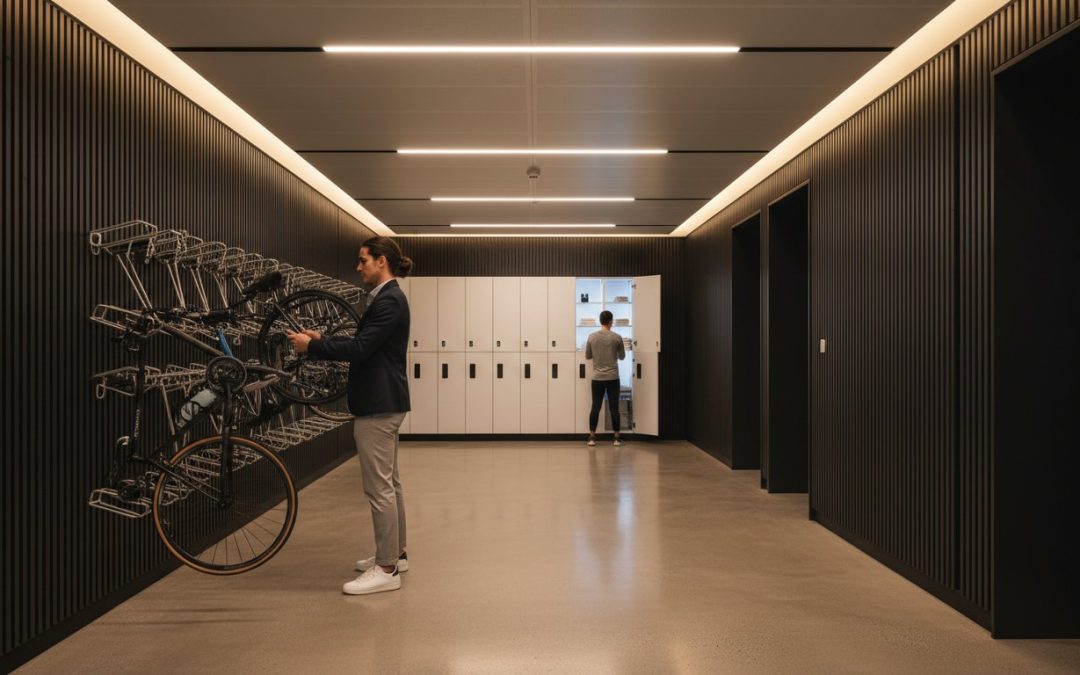
Navigating the 36-page AS 2890.3 document while balancing conflicting local council DCPs can feel like a major roadblock to your development application. For many developers, the challenge isn’t just understanding what the bicycle parking design guidelines australia requires; it’s about implementing them without sacrificing valuable floor space to inefficient layouts. When technical standards clash with local requirements, the result is often a delayed DA approval and missed opportunities for high-tier Green Star or NABERS ratings.
This guide simplifies the complexities of modern compliance, providing you with a clear roadmap to master current regulations for 2026 and beyond. You will learn how to align Australian Standards with specific council expectations to fast-track your approvals and optimise every square metre of your site. Whether you are aiming for sustainability certifications or simply a functional, compliant parking solution, the expert insights ahead ensure your project remains both efficient and fully authorised. By the end of this article, you will have the practical knowledge to turn a technical headache into a streamlined, space-saving asset for your next development.
Key Takeaways
- Learn how to align your project with the latest bicycle parking design guidelines australia to ensure your development meets the strict ‘Active Transport’ requirements of major city councils.
- Master the technical nuances of AS 2890.3:2015, including the specific distinctions between Class 1, 2, and 3 facilities required for modern compliance.
- Discover how to design functional End-of-Trip (EoT) facilities that integrate lockers and showers to create a seamless, professional journey from street to desk.
- Avoid costly DA delays by identifying common design errors, such as neglecting bicycle swept paths or failing to meet mandatory locker-to-rack ratios.
- Understand the strategic advantage of integrating bicycle parking into a comprehensive Traffic Impact Assessment to streamline your approval process.
Table of Contents
- Why Bicycle Parking is a Dealbreaker for Australian DAs in 2026
- Decoding AS 2890.3:2015 – The Core of Australian Standards
- Beyond the Rack: Designing Functional End-of-Trip (EoT) Facilities
- 5 Common Bicycle Parking Design Mistakes That Delay Council Approval
- Navigating Complex Transport Planning with ML Traffic Engineers
Why Bicycle Parking is a Dealbreaker for Australian DAs in 2026
In 2026, failing to integrate compliant bicycle parking into your development application (DA) is a fast track to a formal refusal or a costly Request for Further Information (RFI). As major hubs like Sydney, Melbourne, and Brisbane pivot aggressively toward “Active Transport” strategies, the bicycle parking design guidelines australia requires are no longer optional extras; they are core components of Australian planning law. At ML Traffic Engineers, we have seen a significant shift where councils now prioritize micro-mobility with the same rigour once reserved for heavy vehicle swept paths.
To better understand how these facilities are being integrated near major Australian transport hubs, watch this helpful video:
The financial impact of non-compliance is substantial. Retrofitting a basement to meet AS2890.3 standards after the concrete has been poured can cost upwards of A$10,000 per space in structural modifications and lost GFA. Furthermore, your project’s Traffic Impact Assessment (TIA) relies on these facilities to justify “mode shift” credits. By providing high-quality bicycle storage, we can often argue for a reduction in mandatory car parking spots, potentially saving your project hundreds of thousands in excavation costs.
The Role of Local Government Area (LGA) Requirements
While AS2890.3 provides the national framework, your local Council’s Development Control Plan (DCP) often mandates higher rates than the national standard. Whether you are navigating NSW’s Future Transport 2056 or Victorian planning overlays, you must identify the specific parking rates for your land-use type early. A “one-size-fits-all” approach does not work; a warehouse in Western Sydney has vastly different requirements than a mixed-use tower in Southbank.
Green Star and NABERS: Beyond Minimum Compliance
In 2026, “deemed-to-satisfy” is the bare minimum. To attract premium commercial tenants, developers are moving toward best-practice design that exceeds the bicycle parking design guidelines australia baseline. Integrating high-end End-of-Trip (EoT) facilities-including e-bike charging stations and ventilated lockers-is now a prerequisite for achieving 5 or 6-star Green Star and NABERS ratings, directly influencing the building’s market valuation and long-term yield.
Decoding AS 2890.3:2015 – The Core of Australian Standards
Designing compliant bicycle parking is about more than just finding an empty corner in a basement. The AS 2890.3:2015 standard represents a significant evolution from its 1993 predecessor, shifting focus toward the functional space a cyclist actually requires. For developers and architects, adhering to these bicycle parking design guidelines australia is the only way to ensure a project meets both local council requirements and the practical needs of end-users.
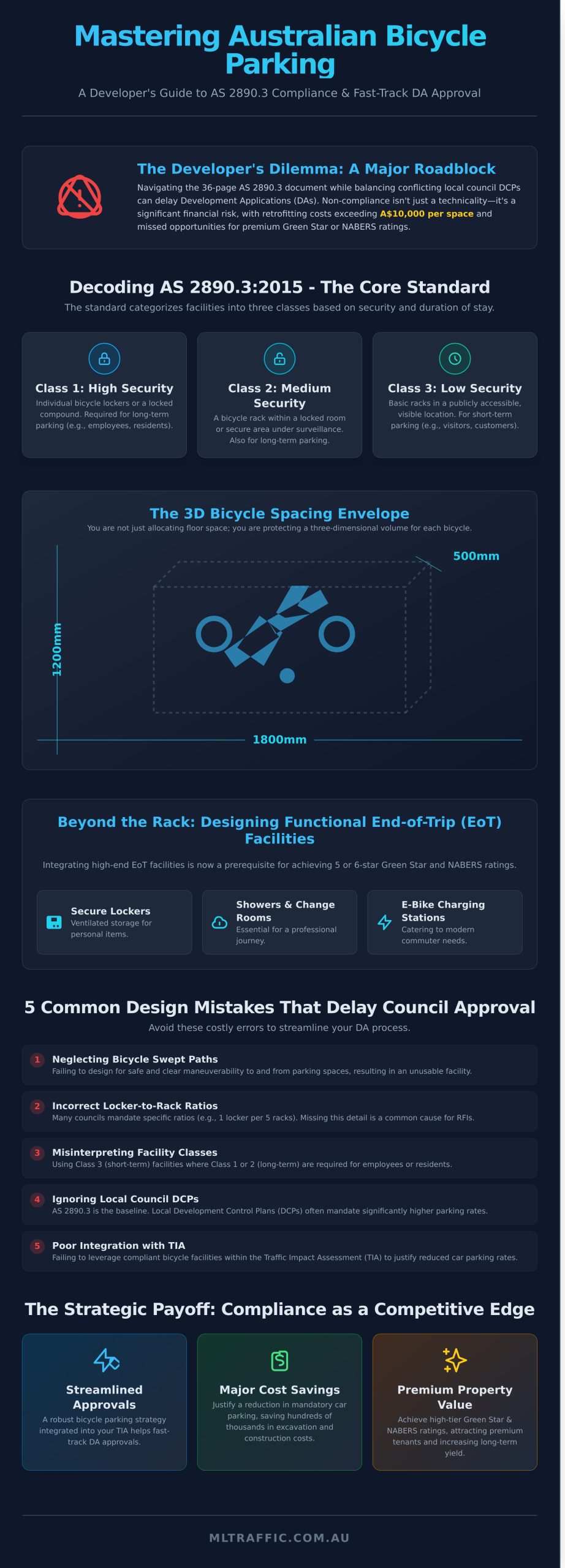
The standard categorizes facilities into three distinct classes based on security and intended duration of stay. Understanding these is critical for the initial site planning phase:
- Long-term parking: Requires high-security Class 1 or Class 2 facilities (typically for residents or employees).
- Short-term parking: Utilises Class 3 facilities for visitors staying less than several hours.
The Spacing Envelope: Visualising the 3D Requirement
AS 2890.3:2015 defines the ‘bicycle spacing envelope’ as a three-dimensional volume. You are not just allocating floor space; you are protecting a volume of 1800mm in length, 1200mm in height, and 500mm in width. While AS 2890.3 provides the mandatory framework, referencing Austroads design and installation guidelines can offer additional best-practice insights for complex site layouts where space is at a premium.
Key spatial considerations include:
- Vertical vs. Horizontal: Vertical staggered racks can save up to 40% of floor space but require higher ceilings (minimum 2200mm).
- Aisle Widths: A minimum 1500mm aisle is generally required to allow two bikes to pass or for a user to manoeuvre a bike into a rack without obstruction.
Class 1 vs. Class 2 Facilities: Which Does Your Project Need?
The choice between classes depends entirely on the user profile and the required security level. Mistaking a Class 3 rack for a Class 2 solution is a common reason for DA revisions.
- Class 1 (High Security): Individual lockers or private garages. These provide the highest level of protection against weather and theft, essential for high-value e-bikes in residential or commercial hubs.
- Class 2 (Medium Security): Locked compounds or communal bike rooms accessible only via key, code, or swipe card. This is the standard for most modern office ‘End of Trip’ (EoT) facilities.
- Class 3 (Low Security): Publicly accessible racks, such as the ‘U-rail’. These must support the bicycle frame and at least one wheel to be compliant.
At ML Traffic Engineers, we ensure your plans don’t just look good on paper but function seamlessly in practice. Getting the dimensions right the first time prevents costly retrofits during the construction phase.
Beyond the Rack: Designing Functional End-of-Trip (EoT) Facilities
Successful bicycle parking design guidelines Australia dictate that a facility is only as effective as its usability. To truly encourage active transport, developers must look beyond the rack and provide comprehensive End-of-Trip (EoT) facilities. This includes secure lockers, high-quality showers, and dedicated change rooms that allow a commuter to transition professionally from the road to the office.
We advocate for the “Seamless Journey” concept. This approach ensures a logical flow from the street entry to the parking zone, and finally to the amenities. A common technical oversight occurs at the basement entry. We integrate bike parking layouts with Vehicle Swept Path Analysis to ensure that cyclist ingress does not conflict with passenger vehicles or delivery vans. If your layout doesn’t account for these movements, it may fail safety audits during the DA process. Learn more about our parking design services to ensure your basement layout is both compliant and safe.
Accessibility and the ‘Last 50 Metres’
The “last 50 metres” is often where design failures occur. Bicycle paths must be physically separated from heavy vehicle loading docks to mitigate risk. Furthermore, clear signage and wayfinding are frequently overlooked council requirements that are essential for intuitive navigation. For upper-level storage, lift dimensions must be carefully verified; if a lift cannot comfortably fit a standard bicycle without tilting it, the facility fails the functional test of the bicycle parking design guidelines Australia.
High-Density Solutions: Dynamic and Two-Tier Racks
In constrained urban sites, two-tier (gas-assisted) racks are the industry standard for doubling parking capacity within the same footprint. However, designers must avoid common compliance traps. Per AS2890.3, you cannot rely solely on vertical or tiered storage; a 20% horizontal minimum rule usually applies to accommodate users with heavy e-bikes or limited lifting ability. Additionally, always coordinate with hydraulic and electrical consultants. We often see overhead services, such as fire sprinklers or cable trays, installed at heights that prevent the upper tier of a rack from fully extending, rendering half the investment useless.
5 Common Bicycle Parking Design Mistakes That Delay Council Approval
Failing to adhere strictly to bicycle parking design guidelines australia is a primary reason for Request for Information (RFI) letters from Council. These delays are costly and preventable. To ensure your Development Application (DA) moves forward, avoid these five frequent design errors:
- Ignoring the ‘Swept Path’ of the Bicycle: Just like cars, bicycles require a specific turning radius. Designers often squeeze racks into tight corners without accounting for the space needed to maneuver a bike into position.
- Inadequate Locker-to-Rack Ratios: Many Local Government Area (LGA) standards require a specific percentage of secure lockers (Class 1) versus simple racks (Class 2 or 3). Relying solely on racks often leads to non-compliance.
- Poor Passive Surveillance: Placing bike rooms in “dead zones” or isolated basement corners invites theft. Councils look for “eyes on the street” or proximity to high-traffic areas to ensure user safety.
- Overlooking E-Bike Power Requirements: With the surge in micro-mobility, failing to provide dedicated General Purpose Outlets (GPOs) for charging is a major oversight in modern commercial and residential designs.
- Relying on Generic Templates: A layout that worked in one municipality may fail in another. Every Council has unique Development Control Plans (DCPs) that override general templates.
The E-Bike Revolution: New Standards for 2026
By 2026, most Australian developments will be required to provide dedicated lithium-ion battery charging infrastructure. Designing for the future means incorporating fire-rated storage zones to mitigate thermal runaway risks. Additionally, you must now account for “Cargo Bikes.” These non-standard cycles require significantly larger footprints-often up to 2.5 metres in length-which must be integrated into your bicycle parking design guidelines australia strategy to meet evolving accessibility requirements.
How to Fix Non-Compliant Designs Before Submission
The most efficient way to secure approval is through a professional pre-DA review. By utilizing a Vehicle Swept Path Assessment, we can digitally simulate bicycle movement to prove your layout is functional and safe. If site constraints make 100% compliance with AS2890.3 impossible, a qualified traffic engineer can negotiate with Council on your behalf, providing a merit-based justification that prevents a flat refusal. For expert assistance with your next submission, contact the team at ML Traffic Engineers.
Navigating Complex Transport Planning with ML Traffic Engineers
Integrating compliant cycling facilities into a development requires more than just following a checklist. At ML Traffic Engineers, we incorporate bicycle parking requirements directly into a comprehensive Traffic Impact Assessment (TIA) to ensure your project meets the bicycle parking design guidelines australia demands from the outset. This holistic approach prevents costly redesigns and ensures seamless integration with vehicle swept paths and pedestrian access.
With over 15 years of experience and a track record of more than 10,000 sites across Australia, we understand the technicalities and bureaucratic hurdles of transport planning. Our “Senior Engineer” promise sets us apart: the traffic consultant who provides your quote is the same expert who performs the technical work. You get direct access to seasoned professionals who take full accountability for your project’s success. Contact Michael or Benny for a direct consultation to discuss your site-specific requirements.
National Coverage, Local Expertise
We provide expert traffic engineering services across all major Australian markets, including Sydney, Melbourne, Brisbane, and Perth. Our exhaustive land-use experience is a testament to our versatility; we have successfully delivered reports for high-rise apartments, temples, bars, warehouses, shopping centres, and childcare facilities. For projects in Queensland, we provide RPEQ-certified reports, ensuring full compliance with state-specific professional engineering standards and local council regulations.
Your Next Steps for DA Approval
Securing DA approval requires meticulous documentation. Our process begins with an initial site audit where we assess:
- Access points and clearance heights for cyclists.
- Spatial efficiency of the proposed parking layout.
- Compliance with the latest bicycle parking design guidelines australia (AS2890.3).
- Integration with broader car parking demand assessments.
To get started, simply provide your architectural plans, and we will provide a fixed-fee quote for your bicycle parking and traffic report. We focus on providing the technical certainty you need to move your development forward without friction. Explore our about page to see our track record and discover why developers across Australia trust us with their transport planning needs.
Securing Your DA Approval with Compliant Bicycle Parking
Mastering the bicycle parking design guidelines australia is a critical hurdle for any successful Australian development in 2026. As we’ve explored, strict adherence to AS 2890.3:2015 and the integration of seamless End-of-Trip facilities are no longer optional extras; they are essential components for a smooth council approval process. By prioritizing functional layouts and avoiding common design pitfalls early in the planning phase, you ensure your project remains on track and avoids the high costs of late-stage revisions.
At ML Traffic Engineers, we take the guesswork out of complex transport planning. With over 15 years of industry experience and a proven track record of more than 10,000 successful site assessments, we provide the technical authority your project requires. We believe in accountability, which is why you get direct access to our principal engineers-the expert who quotes your project is the one performing the work. We are ready to help you navigate these technical requirements with precision and reliability.
Let’s ensure your development is fully compliant and ready for success. Get a Professional Traffic Engineering Quote for Your Development today and take the next step toward a seamless approval.
Frequently Asked Questions
What is the current Australian Standard for bicycle parking?
The primary regulation is AS 2890.3:2015. This standard provides the technical framework for the design, location, and installation of parking facilities. It ensures that any bicycle parking design guidelines australia follows are functional and safe for all users. Compliance with this standard is essential for obtaining development approval, as it specifies the minimum dimensions and security levels required for different types of developments across the country.
Does my development need showers and lockers to be compliant?
While AS 2890.3 focuses on the parking hardware, your local Council’s Development Control Plan (DCP) or the National Construction Code (NCC) often mandates “End-of-Trip” (EoT) facilities. For commercial office developments, providing showers and lockers is typically a mandatory requirement to encourage sustainable commuting. We recommend checking your specific local government requirements early in the design phase to ensure your floor plan accounts for these essential amenities.
Can I use vertical bike racks to save space in a small basement?
Absolutely. Vertical racks are an excellent space-saving solution for constrained basement layouts. However, they must be installed with correct staggered heights and horizontal spacing to prevent handlebar interference. AS 2890.3:2015 outlines specific clearance requirements for these systems. When designed correctly, vertical racks can significantly increase your parking density without compromising accessibility, making them a persuasive choice for high-density residential or commercial projects in urban areas.
How many bicycle parking spaces are required for a commercial office?
The exact number of spaces is not dictated by the Australian Standard itself, but by your local Council’s LEP or DCP. Typically, requirements are calculated based on the Net Lettable Area (NLA) or the number of employees. For example, a common rate is one space per 200sqm of office space. Our team can help you navigate these complex calculations to ensure you meet the specific quotas required for your DA and avoid costly redesigns.
What is the difference between Class 1, 2, and 3 bike parking?
These classes define security levels. Class 1 provides the highest security, typically consisting of individual fully enclosed lockers. Class 2 involves locked compounds or communal cages accessible only via a key or electronic swipe card, ideal for residents or employees. Class 3 refers to fixed rails or racks in public areas intended for short-term visits. Choosing the right class is vital for meeting the security needs of your specific user group and satisfying Council requirements.
Are there specific requirements for E-bike charging in 2026?
As we move toward 2026, the National Construction Code and local authorities are increasingly mandating E-bike charging infrastructure. This involves providing dedicated power outlets (GPOs) within Class 1 and Class 2 facilities. Beyond just power access, you must also consider fire safety regulations regarding lithium-ion battery charging. Integrating these features now ensures your bicycle parking design guidelines australia strategy remains future-proof and adds significant long-term value to your commercial or residential development.
How do I ensure my bike parking design passes a Council DA?
The most reliable way to pass a Council DA is to provide a detailed traffic engineering report that demonstrates 100% compliance with AS 2890.3. This includes clear diagrams showing spacing, aisle widths, and swept path analysis if necessary. Councils look for “fit-for-purpose” designs that are easy to use. Engaging a professional consultant to review your plans ensures that technical oversights do not lead to costly delays or formal requests for further information.
What is a ‘bicycle spacing envelope’ and why does it matter?
The bicycle spacing envelope is the three-dimensional space a parked bike occupies, plus the room needed for a person to maneuver it. According to the standard, a typical envelope is 1800mm long by 500mm wide. Ignoring these dimensions leads to “ghost” spaces-spots that look good on a 2D plan but are physically impossible to use. Correct envelope planning ensures your facility is functional, safe, and fully compliant with Australian accessibility requirements.
Which areas do you service?
We are traffic engineers covering Melbourne, Sydney, Brisbane, Gold Coast, Hobart, Perth, Adelaide, Darwin and surrounding areas.
