
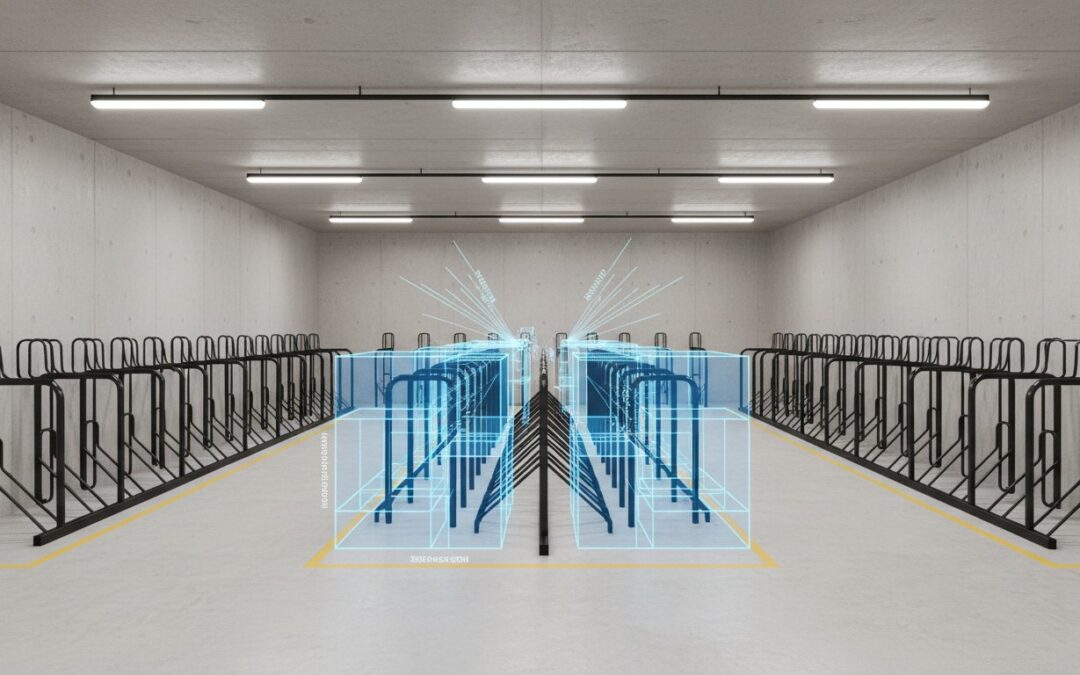
A compliant bicycle parking facility isn’t defined by the hardware you bolt to the floor, but by the invisible “Bicycle Spacing Envelope” that surrounds it. If you’ve ever waded through the 36 pages of AS 2890.3:2015, you know how easily a minor spacing error can lead to a DA rejection. Getting your bicycle rack dimensions wrong doesn’t just risk council approval; it compromises the efficiency of your entire car park layout. We understand the pressure to maximize yield in limited basement spaces while adhering to rigid regulatory frameworks.
This guide provides the technical clarity you need to master the spatial requirements of the Australian Standards. You’ll learn the exact dimensions for the mandatory 1800mm x 1200mm x 500mm envelope and the critical requirement for at least 20% horizontal, ground-level spaces. We’ll also preview how specific planning schemes in cities like Sydney and Melbourne impact your design, ensuring your CAD drawings are accurate and your project remains compliant.
Key Takeaways
- Learn why the “Bicycle Spacing Envelope” is the mandatory foundation for all AS 2890.3 compliant parking layouts.
- Master the specific bicycle rack dimensions (1800mm x 1200mm x 500mm) required to secure council approval for your development application.
- Understand the critical 20% minimum requirement for horizontal ground-level spaces to ensure accessibility compliance.
- Identify the standard 1500mm aisle width specifications necessary for safe and efficient user access in high-density basement environments.
- Discover how to integrate compliant bicycle parking into a professional Car Park Design to streamline the certification process.
Understanding the AS 2890.3 Bicycle Spacing Envelope
The Australian Standard AS 2890.3:2015 defines the “Bicycle Spacing Envelope” as the fundamental design unit for all compliant facilities. It’s a common mistake in development applications to focus solely on the physical hardware. In reality, council assessors review the three-dimensional volume of space required to accommodate both the bicycle and its user. This envelope ensures that the facility remains functional and accessible. Accurate bicycle rack dimensions must account for this 1800mm by 1200mm by 500mm volume to pass technical audits and avoid costly site plan revisions.
To better understand the physical footprint of these systems, watch this helpful video showing a typical multi-bike installation:
The Three Dimensions of Compliance
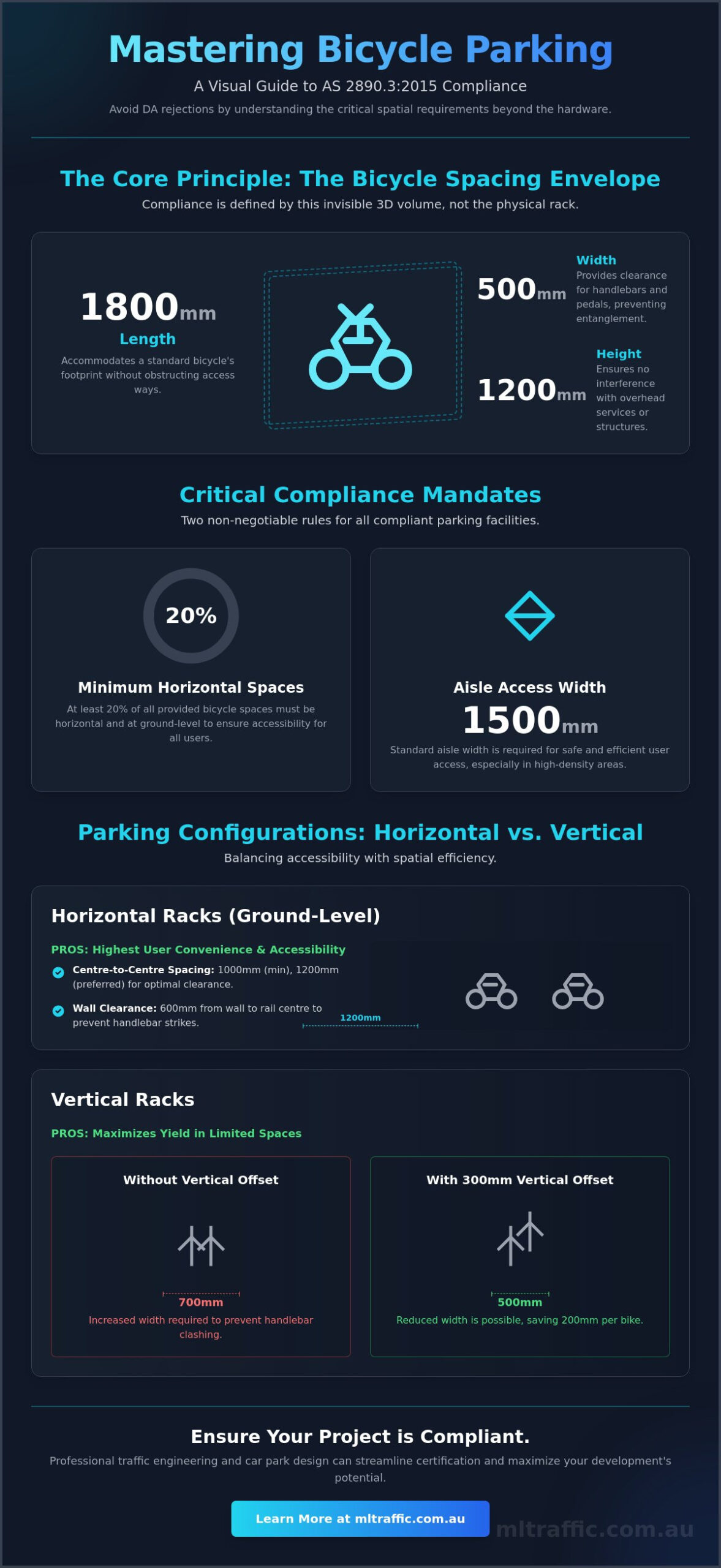
The spacing envelope is a rigid requirement. The length is set at 1800mm, which represents the non-negotiable horizontal footprint of a standard bicycle. This length allows for the front and rear wheels to be positioned without obstructing common access ways. The width requirement of 500mm provides the necessary clearance for handlebars and pedals, which prevents entanglement between adjacent bikes. Finally, the 1200mm height standard ensures that wall-mounted or multi-tier systems don’t interfere with overhead services or structural beams.
A Bicycle parking rack must be positioned within this specific envelope so the user can reach the locking points. Design plans that fail to provide this clearance often face DA rejection. The envelope must include enough buffer for a person to maneuver the bike into position and secure it with a lock without striking neighboring equipment.
Static vs Dynamic Parking Envelopes
Modern developments often use dynamic racks to maximize yield in tight basement spaces. These systems, such as sliding or pivoting racks, allow bicycles to shift horizontally or swing out into the access aisle. While these are excellent for high-density projects, they don’t exempt you from the AS 2890.3:2015 standards. The spacing for dynamic systems is calculated differently than static racks.
You must ensure that even when the rack is in its most extended or pivoted position, it doesn’t compromise the minimum required aisle widths. Integrating these complex mechanical systems into a broader Car Park Design requires professional precision. We verify these movements through detailed spatial analysis to ensure that the increased density doesn’t result in a non-compliant, unusable facility.
Horizontal vs Vertical Bicycle Rack Dimensions
Choosing between horizontal and vertical configurations is a balance of accessibility and spatial efficiency. Horizontal racks provide the highest level of user convenience but demand significant floor area. Vertical systems offer a reduced footprint, yet they require meticulous adherence to spacing standards to remain functional. Under AS 2890.3:2015, at least 20% of your total provision must be horizontal, ground-level spaces to accommodate users who cannot lift their bicycles. The Austroads Bicycle Parking Guidelines emphasize that while vertical storage saves space, it shouldn’t be used exclusively in high-turnover areas where ease of access is paramount.
When designing vertical layouts, the bicycle rack dimensions are determined by the height of the mounting points. If you use a staggered height configuration with a 300mm vertical offset between adjacent hooks, you can maintain a 500mm horizontal width. Without this vertical offset, the width must increase to 700mm to prevent handlebar clashing. This 200mm difference per bike is often the deciding factor in meeting yield targets in basement parking zones. Integrating these specifications into a professional Car Park Design ensures your layout passes council scrutiny while maximizing available floor area.
Horizontal Rack Layouts (Class B & C)
Horizontal layouts, often classified as Class B or C facilities, typically utilize parallel rails or “U-rails.” These rails require a minimum spacing of 1000mm centre-to-centre, though 1200mm is the preferred industry standard for optimal clearance. You must also maintain a 600mm distance from any wall to the centre of the rail to prevent handlebars from striking the structure. End-of-row clearance is equally critical; a minimum of 300mm is required from the end of the rail to any perpendicular obstruction to allow for pedestrian movement and bike positioning.
Vertical and Staggered Wall Racks
Vertical racks significantly reduce the depth of the parking zone but introduce height-based complexity. The 300mm vertical offset rule is the primary method for maintaining 500mm width compliance. To ensure accessibility, the maximum height for a front wheel hook shouldn’t exceed 1500mm from the finished floor level. If the racks aren’t staggered, the 700mm width requirement applies to every unit in the row. This increased width often negates the space-saving benefits of vertical storage, making staggered systems the standard choice for high-density residential and commercial basements. We verify these bicycle rack dimensions during the design phase to ensure they meet the physical capabilities of a diverse range of riders.
Aisle Widths and Access Requirements
Designing a compliant bicycle facility requires more than just plotting bicycle rack dimensions on a floor plan. You must provide adequate maneuvering space, known as the access aisle, to allow cyclists to enter, park, and exit without obstruction. For standard horizontal or vertical configurations, AS 2890.3 mandates a minimum aisle width of 1500mm. This space is calculated from the edge of the bicycle spacing envelope, not from the center of the rack itself. Providing less than this minimum standard makes it impossible for users to pivot their bikes into position without striking adjacent equipment.
Aisle width requirements increase significantly for more complex storage solutions. If your design utilizes bicycle lockers or multi-tier racks, the aisle width must expand to 2000mm. This extra space accommodates the door swing of lockers or the pull out mechanism of a top tier rack. Failing to provide this clearance renders the facility non-functional and is a primary cause for council rejection. A critical engineering step often overlooked is integrating these zones with Vehicle Swept Path Analysis. In a basement car park, bicycle parking is often tucked into corners or behind car bays. You must verify that the turning envelope of a B85 or B99 vehicle doesn’t encroach upon the bicycle access aisle or the parking envelope itself.
Shared Access Aisles in Car Parks
In high-density developments, cyclists often share access driveways with motor vehicles. This configuration requires strict adherence to AS 2890.1 standards for car park design. You must ensure that sight distances are maintained at all conflict points. Cyclists shouldn’t be forced into blind spots created by structural columns or tight ramp transitions. If the driveway serves as the primary bicycle access, its width and grade must be assessed to ensure it safely accommodates both modes of transport simultaneously.
Obstacle-Free Maneuvering Zones
An obstacle-free zone is a strictly defined area where no structural or mechanical elements can intrude. This includes structural columns, downpipes, fire hydrants, and electrical conduits. Even a minor intrusion of a pipe into the 1500mm aisle can invalidate the entire row’s compliance. Turning radii are equally important. A cyclist requires a clear path to turn 90 degrees into a parking bay, especially when using long-frame e-bikes. Additionally, ensure that door swings for secure bicycle rooms don’t open into the required maneuvering space of the bicycle rack dimensions or the access aisle.
Council Requirements for Development Applications
Securing council approval for your development application hinges on more than just meeting a numerical quota of parking spots. Assessors require evidence that the proposed facility is functional, accessible, and strictly compliant with national standards. These details must be meticulously documented within your Traffic Impact Assessment (TIA) Report. A primary cause for DA rejection is the failure to demonstrate that the bicycle rack dimensions and their associated access aisles don’t conflict with other basement utilities or vehicle swept paths.
Local government areas across Australia now prioritize active transport as a core planning objective. Beyond basic compliance, developers often seek higher Green Star or NABERS ratings to attract premium commercial tenants. Achieving these ratings frequently involves exceeding minimum DCP requirements, such as providing e-bike charging infrastructure or dedicated zones for non-standard bicycles. Given that 43% of Australian cyclists now ride for transport as of 2026, councils are increasingly vigilant about the quality and security of these facilities. If you need to ensure your project meets these rigorous standards, ML Traffic Engineers Australia provides a certified Car Park Design that integrates all regulatory mandates.
The 20% Ground-Level Mandate
The 20% horizontal minimum rule is a non-negotiable requirement of AS 2890.3:2015. This mandate stipulates that at least 20% of the total bicycle parking provision must consist of horizontal, ground-level spaces. This ensures inclusive access for riders who cannot lift their bicycles into vertical or multi-tier racks. It’s also essential for the growing number of e-bike users; e-bikes now constitute 17% of national bicycle trips and are significantly heavier than traditional models. Planning for these spaces early in the design phase prevents the need for costly structural changes after a council audit identifies a lack of accessible parking.
End-of-Trip (EOT) Facility Integration
A compliant design must logically connect the bicycle storage area with End-of-Trip facilities like showers and lockers. Council certification often requires these facilities to be located on the same level or via a direct, accessible path. You must account for the spatial footprint of lockers, which requires a 2000mm aisle width when positioned opposite bicycle racks. Additionally, signage and wayfinding must be clearly marked on your CAD drawings. Failure to show a clear, obstacle-free path from the site entry to the EOT zone is a common reason for project delays during the DA review process.
Professional Traffic Engineering and Certification
Certification is the final safeguard against non-compliance in the development process. While a manufacturer provides the physical equipment, they lack the legal standing to certify that your site plan meets the specific requirements of AS 2890.3:2015. Engaging a certified Traffic Engineer ensures that the allocated bicycle rack dimensions are not just compliant on paper but fully integrated into the building’s operational flow. We provide the professional accountability required to sign off on technical drawings, bridging the gap between hardware procurement and council certification.
A critical part of this engineering process is the verification of safety through Vehicle Swept Path Analysis. In high-density basements, bicycle parking is often located in the peripheral “dead zones” of car parks. We use advanced modelling to ensure that the turning envelope of a B85 or B99 vehicle never encroaches upon the bicycle spacing envelope. This precision prevents property damage and protects cyclists in shared access environments. By coordinating the bicycle facility with the broader Car Park Design, we eliminate the spatial conflicts that frequently trigger council requests for information (RFIs) or project delays.
Site-Specific Design Optimisation
Urban developments often require a delicate balance between car parking yield and bicycle provision mandates. We specialise in optimising these tight spaces, particularly in basement conversions where structural columns and low-clearance services create significant obstacles. By meticulously applying the technical standards for staggered and vertical systems, we can often increase bicycle capacity without sacrificing valuable car spaces. Our senior principals are directly involved in this optimisation process, ensuring that every design decision is backed by over 15 years of practical experience in the Australian market.
Getting Your DA Approved
ML Traffic Engineers Australia assists developers by preparing the technical reports necessary for a successful council outcome. We understand the specific nuances of local planning schemes and how they augment the national standards. Our reports translate complex spatial data into a clear, authoritative document that simplifies the assessor’s review process. By providing direct access to our senior leadership, we ensure that your project benefits from high-level expertise and personnel continuity throughout the life of the project. Contact ML Traffic Engineers Australia today to discuss your site-specific requirements and secure a compliant bicycle parking assessment.
Achieve Seamless Project Certification with Compliant Parking Design
Mastering the technical requirements of AS 2890.3 is the only way to ensure your development application withstands council scrutiny. We’ve established that compliant bicycle parking is a multi-dimensional engineering challenge where hardware selection is secondary to spatial clearance. By correctly applying the bicycle rack dimensions and access standards discussed, you protect your development from the risks of DA rejection and inefficient floor use. Accurate CAD documentation of the spacing envelope is the foundation of a functional, high-yield basement layout.
ML Traffic Engineers Australia brings over 15 years of technical expertise to every project. Our senior principals remain hands-on, ensuring that the same expert who assesses your site is the one certifying your final drawings. This level of accountability is essential for high-density urban developments where every millimetre of clearance matters. We eliminate the bureaucratic friction of the certification process through meticulous planning and direct communication with local authorities. Contact ML Traffic Engineers Australia for a Compliant Bicycle Parking Assessment to secure your project’s technical approval and operational success.
Frequently Asked Questions
What are the minimum dimensions for a standard bicycle parking space?
The minimum dimensions for a standard bicycle parking space are defined by the 1800mm length, 1200mm height, and 500mm width spacing envelope. These dimensions are non-negotiable under AS 2890.3:2015 to ensure the bicycle fits within the designated footprint without obstructing other users. Every site plan must accurately reflect these bicycle rack dimensions to pass council technical audits and avoid DA rejection during the assessment phase.
Does AS 2890.3 require a certain percentage of horizontal parking?
Yes, AS 2890.3:2015 mandates that at least 20% of all bicycle parking spaces in a facility must be horizontal, ground-level spaces. This requirement ensures the facility remains accessible to users with heavier e-bikes or those physically unable to use vertical hanging systems. Planning for this 20% floor-level allocation is a critical component of a compliant Car Park Design and is frequently scrutinized by local government assessors.
How wide does the access aisle need to be for a bike room?
The required width for an access aisle is 1500mm for standard horizontal and vertical parking configurations. This width provides the necessary maneuvering space for a cyclist to pivot their bike into a rack without striking adjacent equipment. However, if your facility includes bicycle lockers or multi-tier systems, the aisle width must increase to 2000mm to accommodate door swings and the pull-out mechanisms of the upper tiers.
Can bicycle parking share space with a car park driveway?
Bicycle parking can share space with a car park driveway provided it adheres to the safety and sight distance requirements of AS 2890.1. Designers must ensure that the parking area doesn’t encroach on the vehicle swept paths. We verify these shared environments through detailed spatial analysis to prevent conflict points between motor vehicles and cyclists. This integration is essential for high-density basement projects where floor space is limited.
What is the required vertical offset for staggered bike racks?
A vertical offset of 300mm is required between adjacent racks to maintain a 500mm horizontal width. If the racks are installed at the same height, the required width increases to 700mm to prevent handlebars from clashing. Using a staggered height configuration is a primary method for maximizing bicycle capacity in commercial and residential developments while strictly adhering to the bicycle rack dimensions mandated by national standards.
Are there specific dimensions for bicycle lockers?
Standard bicycle lockers typically require a footprint of 1800mm in length, 1200mm in height, and 800mm in width. While the internal dimensions accommodate the bicycle, the external layout must also provide a 2000mm access aisle. This increased aisle space is mandatory to allow the locker door to open fully without obstructing the movement of other cyclists or vehicles within the car park environment.
How do dynamic bike racks save space in a development?
Dynamic bike racks save space by allowing bicycles to slide horizontally or pivot into the access aisle when needed. This functionality reduces the fixed horizontal footprint required for each unit while still providing full access to the bicycle. These systems are particularly effective in high-density urban developments where maximizing yield is a priority. However, the design must ensure that the expanded rack position doesn’t violate minimum aisle width standards.
What height should a vertical bike rack be installed at?
Vertical bike racks should be installed so the front wheel hook is no higher than 1500mm from the finished floor level. This height restriction is designed to ensure the facility remains usable for a broad range of riders. If the installation exceeds this height, it may be deemed non-compliant during a council audit. Proper mounting height is essential for maintaining the accessibility standards required for a successful development application.

Disclaimer
The content on www.mltraffic.com.au, including all technical articles, guides, and resources, is provided for general informational and educational purposes only. It is not intended to constitute professional advice in traffic engineering, transportation planning, development approvals, or any other technical or legal field.
While ML Traffic Engineers makes every reasonable effort to ensure the accuracy, completeness, and timeliness of the information published, we do not provide any warranties or representations (express or implied) regarding its reliability, suitability, or availability for any particular purpose. Any reliance you place on the content is strictly at your own risk.
In no event shall ML Traffic Engineers, its directors, employees, authors, or affiliates be liable for any direct, indirect, incidental, special, consequential, or punitive damages (including, without limitation, loss of profits, data, or business opportunities) arising out of or in connection with the use of, or inability to use, any information provided on this website.
The articles and guides on this site are not a substitute for engaging a qualified, registered professional traffic engineer (such as an NPER or RPEQ engineer) to assess your specific project requirements. For tailored advice, compliance assessments, or traffic engineering services, please contact a competent professional.
This disclaimer may be updated from time to time without notice. By accessing or using this website, you agree to be bound by the most current version of this disclaimer.
