

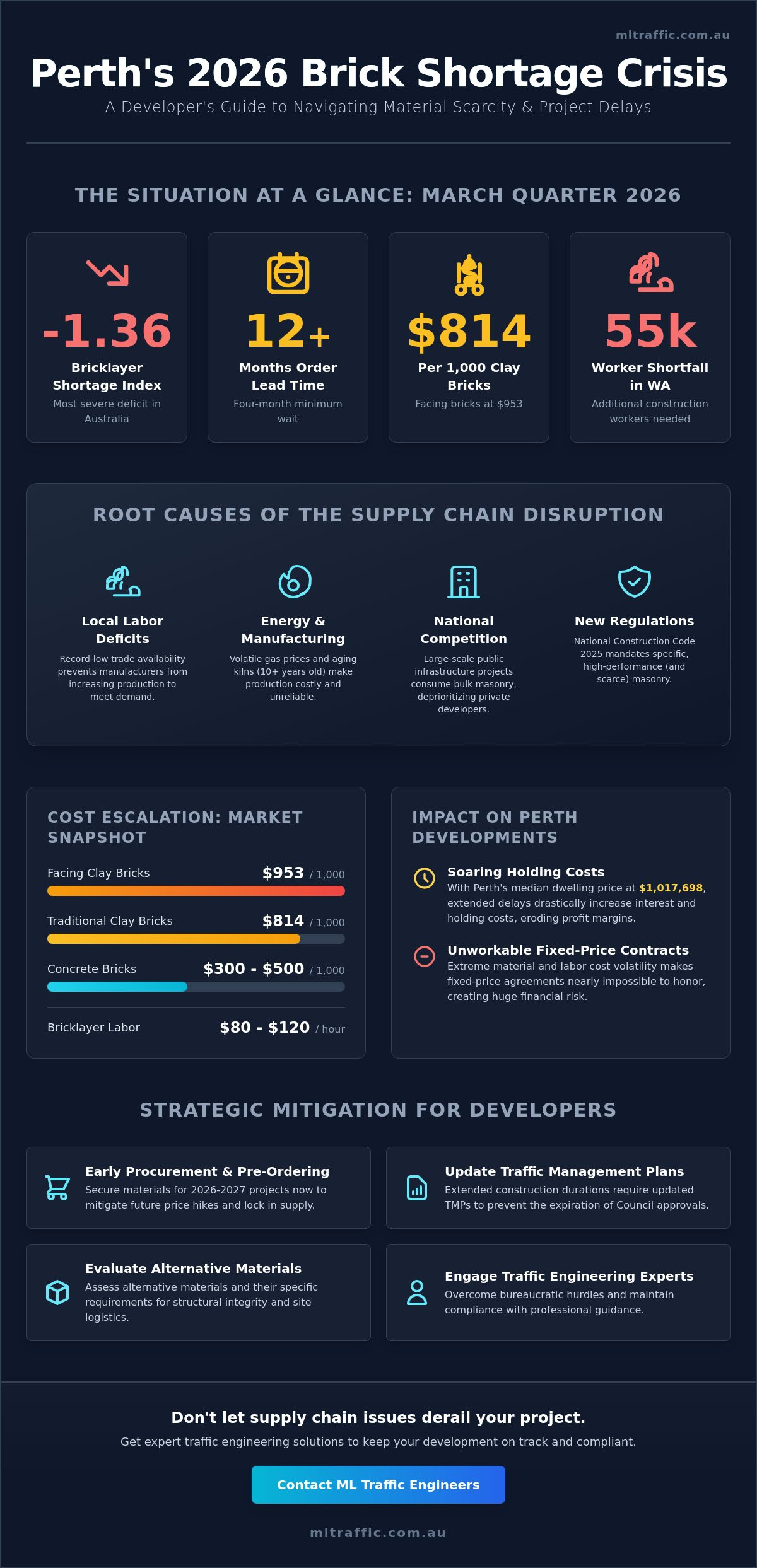
Perth’s bricklaying trade shortage index reached -1.36 in the March quarter of 2026, marking the most severe trade deficit in any Australian capital. This brick shortage perth developers are currently navigating has extended order lead times to four months and pushed traditional clay brick prices to $814 per 1,000. It’s a challenging environment where material scarcity directly impacts your project’s bottom line and delivery schedule.
We understand that unpredictable timelines and rising holding costs are jeopardizing your development’s feasibility, especially as Perth’s median dwelling price hit $1,017,698 in April 2026. You’ll discover the specific causes behind this 2026 shortage and learn how to adapt your development and traffic planning to mitigate these delays. We’ll outline strategies to keep your development applications moving under the State Development Act 2025 and provide technical methods to optimize site logistics while you wait for materials. Our focus is on providing the data you need to maintain compliance with the National Construction Code 2025 while managing a restricted supply chain.
Key Takeaways
- Identify the economic and labor-related drivers of the brick shortage perth is currently facing to better forecast project timelines and budgets.
- Understand why extended construction durations require updated Traffic Management Plans (TMP) to prevent the expiration of local Council approvals.
- Implement early procurement and pre-ordering strategies for 2026-2027 projects to secure essential materials and mitigate rising holding costs.
- Evaluate alternative building materials and their specific requirements for structural integrity and site-specific traffic logistics.
- Access professional traffic engineering expertise to overcome bureaucratic hurdles and maintain development application compliance during supply chain crises.
Table of Contents
-
Understanding the 2026 Brick Shortage in Perth and Its Current Impact
-
Root Causes of Construction Material Supply Chain Disruptions
-
How Material Shortages Affect Traffic Planning and Development Approvals
-
Strategic Mitigation: Managing Project Timelines Amidst Scarcity
-
Navigating Development Hurdles with Expert Traffic Engineering
Understanding the 2026 Brick Shortage in Perth and Its Current Impact
The brick shortage perth is currently experiencing has reached a critical threshold as of April 2026. Traditional clay bricks now cost $814 per 1,000, while facing clay bricks have climbed to $953. These price hikes are paired with a bricklayer shortage index of -1.36, which is the most severe deficit among all Australian capital cities. Developers are facing a market where material scarcity is no longer a temporary hurdle but a structural reality that dictates project viability.
Both residential and large-scale commercial developments are struggling with lead times that now frequently surpass 12 months. This delay creates a massive financial burden. With the Perth median dwelling price reaching $1,017,698 in April 2026, the interest on holding costs during a year-long wait for masonry can compromise a project’s entire profit margin. The shortage affects various products, including "commons" and "Longreach" bricks at $2.10 each, as well as concrete bricks ranging from $300 to $500 per 1,000.
To better understand the local impact on the trade, watch this helpful video:
The Scale of the Supply Gap in Western Australia
Kiln production capacity in 2026 cannot keep pace with the current building boom. Western Australia requires an additional 55,000 construction workers to meet demand, yet trade availability remains at record lows. This labor gap prevents local manufacturers from running the additional shifts needed to deliver "Maxi" bricks and other high-demand masonry. The result is a backlog that delays project completion certificates and final handovers. For commercial developers, these delays translate to missed occupancy dates and significant liquidated damages.
Why This Shortage Differs from Previous Years
The current brick shortage perth is fundamentally different from the global supply chain crisis of 2021. While previous issues were linked to international shipping disruptions, the 2026 crisis stems from local labor deficits and monopoly concerns within the Western Australian market. Fixed-price construction contracts are now nearly impossible to maintain. Builders must account for bricklayer labor costs that range between $80 and $120 per hour.
Additionally, all new construction must now comply with the National Construction Code 2025, published on February 1, 2026. This code introduces stricter requirements for energy efficiency and condensation management. These regulations often mandate specific, high-performance masonry products that are currently the hardest to source. The compounding effect of these new regulations and material scarcity makes 2026 a uniquely difficult year for development planning and execution.
Root Causes of Construction Material Supply Chain Disruptions
Energy price volatility is a primary driver of the current supply gap. Brick production requires immense thermal energy to maintain kiln temperatures. Fluctuating gas prices throughout 2025 and early 2026 have forced manufacturers to adjust production volumes to remain viable. Many kilns in Western Australia haven’t received significant technological upgrades in over 10 years. This lack of modern efficiency makes the local industry vulnerable to rising operational costs and sudden plant failures.
The brick shortage perth is currently battling is also a byproduct of competition with national infrastructure projects. Large-scale government works across Australia are consuming bulk masonry and concrete supplies at an unprecedented rate. Private developers must compete with these high-priority projects for a limited pool of resources. This competition often leaves smaller residential and commercial sites at the end of the queue for delivery.
Energy and Manufacturing Constraints
The BCEC Construction Industry Report highlights that skilled labor shortages extend deep into the manufacturing sector. It’s not just about a lack of bricklayers on site. There’s a deficit of specialized technicians required to operate and maintain high-output kilns. Manufacturing downtime for routine maintenance has increased by 18% since February 2026 because parts and qualified personnel are difficult to secure. These delays at the factory gate create a compounding backlog that ripples through the entire construction timeline.
Logistics and Transport Bottlenecks
Securing the materials is only half the challenge. Transporting them to the site presents its own set of technical hurdles. A critical shortage of heavy vehicle drivers across Western Australia means that delivery windows are increasingly narrow and unreliable. Port congestion at Fremantle continues to delay the import of essential raw additives and kiln machinery components. These disruptions make it difficult to maintain a steady construction flow.
These logistical failures require sophisticated traffic engineering solutions to manage site access. When deliveries are delayed by weeks, the original site management plans often become obsolete. Developers must implement more robust logistics modeling to handle erratic arrival schedules and limited on-site storage capacity. If your project is facing these delivery challenges, you can contact our senior engineers to discuss a revised site logistics strategy that keeps your project compliant with local regulations.
How Material Shortages Affect Traffic Planning and Development Approvals
The 12-month+ lead times for masonry products don’t just stall physical construction; they create significant regulatory risks. Most Council development approvals include strict commencement dates. If the brick shortage perth prevents you from reaching a specific construction milestone, your permit may lapse. This requires a formal application for an extension of the term of approval under the City of Perth’s Local Planning Scheme No. 2 or relevant local government framework. Proving that delays are beyond the developer’s control is essential for a successful extension.
Extended build times also mean that site-specific safety plans remain active longer than originally intended. A site that sits dormant or in a state of partial completion for an extra six months still requires active management. Developers must ensure that all temporary traffic control measures, hoarding, and site access points remain compliant with Australian Standards (AS 2890.1) throughout the entire duration of the delay. Failure to maintain these standards can lead to costly council infringements or the suspension of work orders.
The Risk of Approval Expiry and Extensions
To secure a DA extension, you must provide clear evidence of external supply chain constraints. Local councils require technical documentation to prove that the project remains viable and that the delay hasn’t altered the original planning intent. A professional Traffic Impact Assessment (TIA) supports these requests. It demonstrates that the proposed land use and access arrangements still align with the current traffic environment, even if the surrounding road network has changed since the initial approval date.
Site Logistics and Heavy Vehicle Access
Irregular material deliveries disrupt standard logistics. Instead of a steady flow of trades, projects now experience "feast or famine" delivery cycles. When a large shipment of "Maxi" or "Longreach" bricks finally arrives, your site must be capable of receiving it without obstructing public thoroughfares. An outdated Traffic Management Plan (TMP) often fails to account for these sudden, high-volume delivery windows.
If you’re forced to store materials on-site for months to prevent further delays, your internal circulation routes may become restricted. This necessitates a revised Swept Path Analysis. We use technical modeling to ensure that heavy vehicles can still enter and exit the site in a forward gear without striking stored masonry. Proper planning prevents the safety implications of long-term material hoarding on public road verges, which is a common point of friction with local councils during the 2026 building boom.
Strategic Mitigation: Managing Project Timelines Amidst Scarcity
Early procurement is no longer optional for Perth developers. For projects slated for late 2026 or early 2027, you must place orders immediately to account for the current four-month lead times. We recommend implementing buffer-focused scheduling by adding a 20% time contingency to all masonry-dependent milestones. Transparent communication with stakeholders is critical. Informing local councils of specific supply constraints as early as April 2026 can facilitate smoother negotiations if you eventually need to adjust your construction timeline.
Managing the brick shortage perth requires a shift in how you sequence site activity. Instead of following a linear build path, many successful firms are now ‘front-loading’ non-masonry works. This keeps trades active on-site while waiting for brick deliveries. This approach helps mitigate the rising holding costs associated with Perth’s $1,017,698 median dwelling price. It also prevents the total loss of momentum that often leads to project abandonment during supply chain crises.
Alternative Materials and Construction Methods
Many developers are abandoning traditional masonry in favor of timber framing or pre-cast concrete panels. Pre-cast systems offer significantly shorter on-site assembly times, though they require higher upfront coordination. Switching materials mid-project is a complex cost-benefit decision. It often triggers a legal requirement for a new Traffic Impact Assessment. Timber and pre-cast deliveries involve different vehicle classes and arrival frequencies compared to standard brick transport. You must verify that your site access can accommodate the larger articulated vehicles often used for pre-cast panels before committing to a material change.
Optimizing Site Management for Efficiency
The ‘Just-in-Time’ delivery model is currently a high-risk strategy. On-site stockpiling is a more reliable alternative, but it creates immediate spatial challenges. You may need to redesign your internal site flow to accommodate large material deposits without violating Australian Standards. Temporary car park layouts can be repurposed as loading zones or storage bays during the early stages of construction.
This repurposing requires professional Car Park Design to ensure that even with reduced capacity, the site remains compliant with AS 2890.1. Efficient use of space prevents the need for off-site hoarding, which reduces double-handling costs and logistical complexity. If your project requires a technical review of site logistics to accommodate material stockpiling, request a quote from our senior engineers today to ensure your site remains functional and compliant.
Navigating Development Hurdles with Expert Traffic Engineering
The brick shortage perth is currently experiencing has introduced a level of volatility that standard development applications (DA) aren’t designed to handle. When material scarcity forces a change in construction methodology or extends a project timeline by 12 months, the original traffic and parking assessments often require immediate technical updates. ML Traffic Engineers Australia acts as a professional partner to ensure that these bureaucratic hurdles don’t lead to further costly delays or the expiration of your planning permits. Our focus is helping private clients navigate their development applications with precision and technical authority.
Why Professional Traffic Reports Matter Now More Than Ever
Accurate data is the only way to prevent your application from stalling in the approval pipeline. Local councils in 2026 are under pressure to accelerate housing supply through the State Development Act 2025 while maintaining strict safety standards. ML Traffic Engineers Australia’s services provide the technical validation required for both national and local compliance. We’ve been trading since 2005. This gives our team over 21 years of experience in navigating complex planning environments and the specific requirements of the City of Perth’s Local Planning Scheme No. 2.
Our experience covers over 10,000 sites across a vast range of land-use types, including apartments, bars, temples, and warehouses. This breadth of knowledge allows us to anticipate Council concerns before they become formal objections. When supply chain disruptions mandate on-site material stockpiling, we provide the technical modeling to prove that site access remains safe and functional. We use industry-standard tools for Vehicle Swept Path Assessment and Sight-Line Assessment to ensure every project meets Australian Standards (AS 2890.1).
Streamlining Your Development Application
High-stakes projects in a crisis environment require accountability. Our unique firm signature is simple: "The traffic consultant who provides the quote, does the work." This hands-on approach ensures that the person defending your project during a Council meeting is the same expert who performed the technical analysis. You have direct access to our principals, Michael Lee and Benny Chen. Their names, qualifications, and direct mobile numbers are available to ensure that urgent projects receive the senior-level attention they require without the interference of middle-management bureaucracy.
Certification of traffic and parking arrangements by a registered professional provides the technical certainty needed to keep your development moving forward. If you require an urgent Traffic Impact Statement (TIS), a Traffic Impact Assessment (TIA), or a Car Parking Demand Assessment to support a DA extension due to the brick shortage perth, you can contact ML Traffic Engineers Australia for a rapid, authoritative quote. We provide the expertise needed to manage site logistics and maintain compliance in a restricted supply chain.
Securing Project Viability in a Restricted Supply Chain
The brick shortage perth developers are navigating requires a transition from reactive building to proactive technical planning. Success in 2026 depends on early material procurement and the ability to adapt site logistics when lead times exceed 12 months. Maintaining compliance with the National Construction Code 2025 and Australian Standards (AS 2890.1) is non-negotiable for securing occupancy certificates. Expert traffic and parking assessments provide the technical foundation needed to justify development application extensions during supply chain disruptions.
ML Traffic Engineers Australia offers over 15 years of consultancy experience across more than 10,000 successful sites nationwide. You receive direct access to our senior principals; this ensures that the consultant who quotes your project is the one who performs the technical work. This senior-led approach minimizes bureaucratic friction and protects your project’s timeline against external market volatility. Secure your project’s future with a professional Traffic Impact Assessment from ML Traffic Engineers Australia. With the right technical strategy, your development can remain on track despite the current industry challenges.
Frequently Asked Questions
How long is the current brick shortage in Perth expected to last?
Current projections indicate that the deficit will persist through late 2026. Lead times for standard orders are currently four months as of April 2026. The HIA Trades Availability Index for bricklayers reached -1.36 in the March quarter, which suggests that labor shortages will continue to delay project completions. You should plan for restricted supply and elevated masonry costs through the remainder of the 2026-2027 financial year.
Can I switch building materials if my bricks are delayed by six months?
You can switch materials, but it requires a formal amendment to your building permit and potentially your development approval. Transitioning from masonry to timber framing or pre-cast concrete panels can reduce lead times. It’s important to recognize that this change often necessitates an updated Traffic Impact Statement. Different materials involve different delivery vehicle classes. You must verify that your site access remains compliant with AS 2890.1 for these larger vehicles.
Do I need to update my Traffic Management Plan if my build is delayed?
You must update your Traffic Management Plan (TMP) if construction extends beyond the dates specified in your initial council approval. Councils require active TMPs to reflect current site conditions and any changes to the surrounding road network. If your site remains partially completed for an extra six months, your safety protocols require a professional review. This ensures that hoarding and temporary access points don’t create sight-line hazards for public traffic.
Will local councils grant DA extensions due to the brick shortage?
Most local governments will grant Development Application (DA) extensions when you provide technical proof of external supply chain delays. The State Development Act 2025 supports streamlining these processes for major projects. You must submit documentation showing that the brick shortage perth is the primary cause of your stalled progress. A senior-led traffic report can validate that your project still meets all transport requirements despite the extended construction timeline.
How does the brick shortage affect the cost of traffic engineering services?
The brick shortage perth developers are facing doesn’t directly change engineering fee structures, but it may increase the volume of reporting required. Extended build times often lead to the expiration of temporary traffic permits. This means you might need multiple Swept Path Analyses or revised Parking Demand Assessments as site layouts change to accommodate stored materials. Investing in accurate data early prevents the much higher costs associated with council infringements.
What are the best alternatives to traditional bricks for Perth developments in 2026?
Timber framing and pre-cast concrete are the most effective alternatives in the current 2026 market. These methods bypass the bricklayer deficit and the long wait times for clay masonry. Pre-cast panels allow for rapid on-site assembly but require specialized heavy vehicle access. You must evaluate the logistical impact of these materials on your site’s swept path requirements. This ensures that large delivery trucks can maneuver safely without hitting existing structures.
Can a Traffic Impact Assessment help me get faster council approval?
A professional Traffic Impact Assessment (TIA) accelerates the approval process by addressing potential safety concerns before they lead to formal Council objections. These reports reduce the risk of "Requests for Further Information" (RFI), which are a major source of delay. By providing technical data on car parking demand and vehicle movements upfront, you demonstrate compliance with local planning schemes. This builds confidence with council engineers and leads to a faster determination.
What happens if my site access needs to change due to material stockpiling?
Changing your site access to accommodate stockpiling requires a revised Vehicle Swept Path Assessment. You must prove that service vehicles and delivery trucks can still enter and exit the site in a forward gear. If masonry is stored on public road verges, you’ll need specific council permits and updated hoarding plans. We use technical modeling to ensure these changes don’t compromise sight-lines or pedestrian safety according to Australian Standards.
Which areas do you cover?
We are traffic engineers servicing Alexander Heights, Alfred Cove, Alkimos, Anketell, Applecross, Ardross, Armadale, Ascot, Ashby, Ashendon, Ashfield, Attadale, Atwell, Aubin Grove, Aveley, Balcatta, Baldivis, Balga, Ballajura, Banksia Grove, Bassendean, Bateman, Bayswater, Beaconsfield, Beckenham, Bedford, Beechboro, Beeliar, Beldon, Bellevue, Belmont, Bentley, Bertram, Bibra Lake, Bicton, Booragoon, Brentwood, Brigadoon, Brookdale, Bull Creek, Bullsbrook, Burns Beach, Burswood, Butler, Byford, Canning Vale, Cannington, Carine, Carlisle, Carramar, Casuarina, Caversham, Champion Lakes, Chidlow, Churchlands, City Beach, Claremont, Clarkson, Cloverdale, Cockburn Central, Connolly, Coogee, Coolbellup, Coolbinia, Cottesloe, Craigie, Crawley, Currambine, Dalkeith, Darch, Doubleview, East Perth, Edgewater, Ellenbrook, Floreat, Fremantle, Girrawheen, Greenwood, Guildford, Hamilton Hill, Heathridge, Hillarys, Inglewood, Joondalup, Kallaroo, Kingsley, Leeming, Mandurah, Maylands, Melville, Midland, Mindarie, Morley, Mosman Park, Mount Hawthorn, Mount Lawley, Mullaloo, Nedlands, North Perth, Northbridge, Ocean Reef, Osborne Park, Padbury, Perth, Piara Waters, Rockingham, Scarborough, South Perth, Subiaco, Swanbourne, Thornlie, Tuart Hill, Victoria Park, Wangara, Wanneroo, Warwick, Wembley, West Perth, Willetton, Woodvale, Yokine.

Disclaimer
The content on www.mltraffic.com.au, including all technical articles, guides, and resources, is provided for general informational and educational purposes only. It is not intended to constitute professional advice in traffic engineering, transportation planning, development approvals, or any other technical or legal field.
While ML Traffic Engineers makes every reasonable effort to ensure the accuracy, completeness, and timeliness of the information published, we do not provide any warranties or representations (express or implied) regarding its reliability, suitability, or availability for any particular purpose. Any reliance you place on the content is strictly at your own risk.
In no event shall ML Traffic Engineers, its directors, employees, authors, or affiliates be liable for any direct, indirect, incidental, special, consequential, or punitive damages (including, without limitation, loss of profits, data, or business opportunities) arising out of or in connection with the use of, or inability to use, any information provided on this website.
The articles and guides on this site are not a substitute for engaging a qualified, registered professional traffic engineer (such as an NPER or RPEQ engineer) to assess your specific project requirements. For tailored advice, compliance assessments, or traffic engineering services, please contact a competent professional.
This disclaimer may be updated from time to time without notice. By accessing or using this website, you agree to be bound by the most current version of this disclaimer.
