

We are traffic engineers servicing Brisbane metropolitan area. Navigate Brisbane City Council’s requirements with confidence and secure your Development Application approval with an expert traffic engineering report.
Brisbane’s transport landscape is undergoing its most significant transformation in decades. For developers and commuters alike, the launch of the Brisbane Metro and the redesigned bus network presents both opportunities and complex challenges. If you’re feeling uncertain about how new bus transfers impact your site’s accessibility, or anxious about how to address these changes in a development application, you are not alone. The full scope of the brisbane metro travel impacts is now a critical factor for securing Council approval and requires expert assessment.
This guide is designed to provide that clarity. We will dissect the new M1 and M2 routes, clarifying their benefits and operational details. More importantly, we provide a professional framework for updating your Traffic Impact Assessments and car parking demand calculations for transit-oriented sites. Read on to gain the confidence to navigate the new network and ensure your project meets Council’s evolving requirements without costly delays or objections.
Key Takeaways
- Learn why pre-Metro traffic data is now obsolete and how to adjust your Traffic Impact Assessment for a successful development application.
- Discover how proximity to Metro stations can help justify reduced on-site parking, potentially strengthening your proposal with Brisbane City Council.
- Understand the real-world brisbane metro travel impacts, including the ‘transfer penalty’ and how new commuter patterns affect site accessibility.
- Master the concept of ‘Last Mile’ connectivity to demonstrate how your development seamlessly integrates with the new high-frequency transport network.
Table of Contents
- The Brisbane Metro Reality: More Than Just a New Bus Route
- Quantifying Travel Impacts: Winners and Losers in the New Network
- Why the Metro Changes Everything for Brisbane Property Developers
- Navigating Traffic Impact Assessments (TIA) in the Post-Metro Landscape
- How ML Traffic Engineers Helps You Navigate Brisbane’s Evolving Infrastructure
The Brisbane Metro Reality: More Than Just a New Bus Route
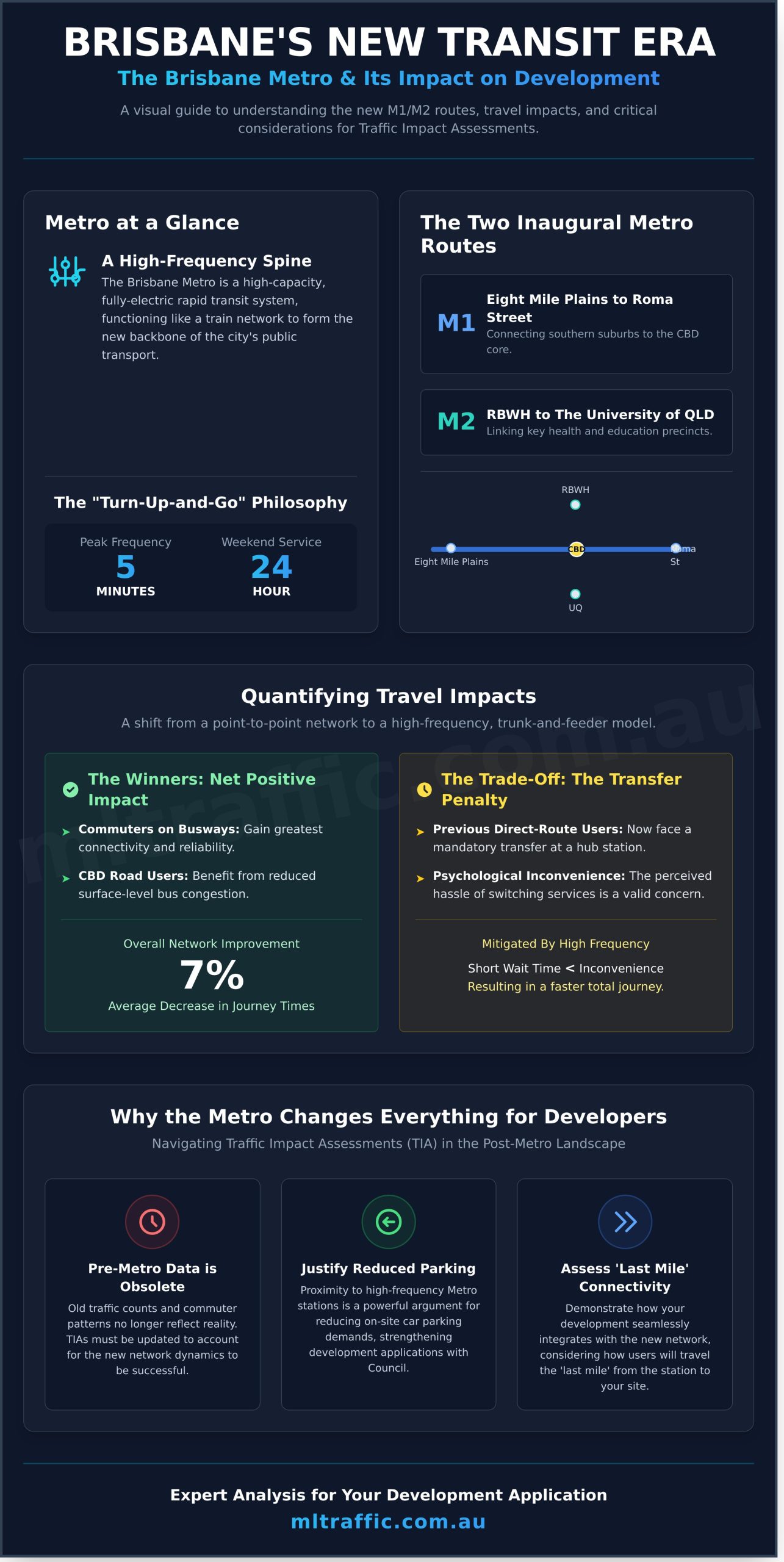
To understand the full scope of brisbane metro travel impacts, it is essential to move beyond the idea of it being just another bus service. The Brisbane Metro is a high-capacity, fully-electric rapid transit system designed to function like a train network. Its two inaugural lines, the M1 (Eight Mile Plains to Roma Street) and M2 (Royal Brisbane and Women’s Hospital to The University of Queensland), form the new backbone of the city’s public transport, connecting key suburban hubs directly with the CBD.
To see how this new infrastructure is taking shape, this video provides a recent project update:
A critical component of this network is the Adelaide Street tunnel, which resolves one of the CBD’s most persistent bus congestion points. By diverting Metro services underground, surface-level traffic is streamlined, improving travel times for all road users. With major works concluding, 2026 marks the first full operational year of a truly integrated “hub and spoke” network, where suburban bus routes feed into high-frequency Metro stations. For a detailed technical and historical look at the project, the Brisbane Metro project overview on Wikipedia offers a comprehensive resource.
The “Turn-Up-and-Go” Philosophy
The system’s core principle is reliability through frequency. During peak periods, a Metro vehicle will arrive every five minutes, effectively eliminating the need for commuters to consult a timetable. This shift towards a “turn-up-and-go” service reduces wait times at key stations like King George Square and fosters greater reliance on public transport. Furthermore, the introduction of 24-hour services on weekends is a significant catalyst for Brisbane’s late-night economy, providing safe and consistent transport options.
Infrastructure Milestones in 2026
The completion of several key infrastructure projects by 2026 has fundamentally altered CBD traffic dynamics. These milestones include:
- Cultural Centre Station Precinct: A major upgrade has transformed this area into a multi-modal interchange, improving pedestrian flow and connectivity between bus, Metro, and train services.
- Victoria Bridge Conversion: The permanent conversion of Victoria Bridge into a dedicated “green bridge” for Metro, bus services, pedestrians, and cyclists has removed a significant volume of private vehicle traffic from the city’s core.
This strategic redistribution of traffic has necessitated adjustments to private vehicle routes, encouraging the use of alternative crossings like the William Jolly Bridge and Captain Cook Bridge to access the CBD.
Quantifying Travel Impacts: Winners and Losers in the New Network
The implementation of the Brisbane Metro system is a significant transport network intervention designed to improve efficiency. Brisbane City Council reports an average 7% decrease in journey times across the network, a substantial gain in aggregate. However, the distribution of these benefits is not uniform. The primary brisbane metro travel impacts are best understood by analysing the trade-offs between direct routes and overall system reliability, creating clear winners and some commuters who perceive a loss.
The core change is a shift from a point-to-point network to a high-frequency, trunk-and-feeder model. This creates a new dynamic for commuters, particularly regarding transfers.
Journey Time Savings vs. Transfer Frequency
For many, the most tangible change is the introduction of a mandatory transfer. The psychological “transfer penalty”-the perceived inconvenience of switching services-is a valid concern for commuters who previously enjoyed a single-seat journey. However, a data-driven assessment reveals a net benefit. At interchanges like Eight Mile Plains, the high frequency of Metro services significantly reduces wait times, making the total journey faster despite the transfer. Suburbs with direct busway access, such as those along the South East and Northern Busways, see the greatest gains in connectivity and reliability.
Congestion Relief in the CBD
A primary objective of the Metro project was to reduce bus congestion on CBD surface streets. The Adelaide Street tunnel is a critical component, engineered to remove approximately 150 buses per hour from street level. This has a significant ripple effect:
- Improved Amenity: The North Quay and Adelaide Street precincts benefit from enhanced pedestrian safety and “walkability” due to reduced bus traffic.
- Vehicle Travel Times: The reallocation of road space has altered private vehicle traffic patterns. While some lanes previously used by buses are now available for general traffic, other changes may affect travel times. For a detailed overview of these structural changes, you can refer to the official Brisbane Metro updates from the Council.
Ultimately, the analysis of brisbane metro travel impacts shows a strategic move towards a more efficient, high-capacity public transport spine, albeit one that requires a behavioural shift from some users.
Why the Metro Changes Everything for Brisbane Property Developers
The Brisbane Metro is not merely an upgrade to the city’s bus network; it is a fundamental shift in urban planning that directly affects property development applications. For developers, understanding the full scope of the brisbane metro travel impacts is critical for maximising site potential and achieving development approval (DA). The project’s scale, detailed in the official Brisbane Metro project scope and funding documents, signals a permanent change in how Brisbane City Council assesses transport infrastructure and land use.
Transit-Oriented Development Opportunities
Proximity to a Metro station is now a key factor in determining development potential. Sites located within an 800-metre radius of a Metro station are prime candidates for Transit-Oriented Development (TOD). This designation can support applications for increased site yield and building height. Crucially, it provides a strong basis for negotiating reduced car parking rates. A professionally prepared Traffic Impact Assessment (TIA) can leverage a site’s access to high-frequency public transport to justify a significant parking shortfall, directly improving project feasibility by converting car park space into gross floor area (GFA).
Changes to Site Access and Swept Path Requirements
While the Metro creates opportunities, it also introduces new technical constraints. Streets designated as Metro corridors will prioritise bus movements, leading to new restrictions on vehicle access for adjacent properties. Managing the interface between a private driveway and a dedicated bus lane requires meticulous planning and assessment. For this reason, a detailed Swept Path Analysis is more critical than ever. It is no longer sufficient to demonstrate that a design vehicle can enter and exit a site; the analysis must prove it can be done safely and efficiently without impeding the new, high-frequency Metro services.
Some stakeholders dismiss the Metro as “just a bus,” but this overlooks its core function. The Metro’s integration with the existing busway and its high-capacity, bi-articulated vehicles create a transport spine that fundamentally alters TIA modelling. The strategic connections at hubs like Buranda and UQ Lakes amplify these effects, creating a network that Council views as a genuine alternative to private car dependency. Ignoring these changes in your DA is a significant risk.
Navigating Traffic Impact Assessments (TIA) in the Post-Metro Landscape
The completion of the Brisbane Metro fundamentally alters the assumptions underpinning traditional Traffic Impact Assessments (TIAs). A report submitted to Council based on pre-Metro data is no longer sufficient; it requires a forward-looking approach grounded in the new public transport reality. Successfully navigating this landscape means adapting your TIA strategy to address five critical steps.
- Step 1: Re-evaluating Baseline Traffic Counts. Existing traffic models are now outdated. Your TIA must begin by re-calculating baseline traffic, factoring in the significant mode shift from private vehicles to the high-capacity Metro network.
- Step 2: Assessing “Last Mile” Connectivity. A modern TIA must analyse how people will travel the final distance from a Metro station to your site. This includes a detailed assessment of pedestrian pathways, cycling infrastructure, and e-mobility access points.
- Step 3: Calculating Parking Demand with 2026 Data. Relying on outdated census figures is a common and critical error. Parking demand must be calculated using projected 2026 mode share data that accurately reflects the new transport options.
- Step 4: Demonstrating “No Worsening”. It is essential to prove your development will not negatively impact the operational efficiency of the surrounding high-frequency public transport network, a key consideration for Council.
- Step 5: Engaging an RPEQ-Certified Engineer. All technical assessments must be certified by a Registered Professional Engineer of Queensland (RPEQ) to be accepted by Brisbane City Council.
The Importance of RPEQ Certification
Brisbane City Council mandates RPEQ certification to ensure all TIAs meet stringent safety, design, and legislative standards. This is a non-negotiable quality assurance measure. As seasoned consultants, the team at ML Traffic Engineers provides the necessary RPEQ oversight to ensure full compliance. This expertise helps you avoid common pitfalls that result in costly Information Requests (IRs) and project delays from Council.
Parking Demand and AS 2890.1 Compliance
The updated brisbane metro travel impacts create a clear case for reduced parking provisions in many developments. However, any proposed reduction must be rigorously justified against the strict geometric requirements of Australian Standard AS 2890.1. A successful argument requires robust data, not assumptions. Furthermore, proposals must include enhanced bicycle parking and end-of-trip facilities that meet the new commuter expectations of 2026 and beyond.
How ML Traffic Engineers Helps You Navigate Brisbane’s Evolving Infrastructure
Navigating the complexities of a major infrastructure project like the Brisbane Metro requires more than just standard traffic advice; it demands seasoned, local expertise. For developers, architects, and town planners, understanding these changes is critical for Development Application (DA) success. At ML Traffic Engineers Pty Ltd, we provide direct, principal-level support to ensure your project successfully addresses all traffic and transport considerations without the risk of costly delays.
Our Hands-On Approach
At ML Traffic Engineers Pty Ltd, we operate on a simple, effective principle: the senior traffic consultant who provides your quote is the same RPEQ-certified engineer who completes the technical work. This hands-on approach eliminates the communication gaps common in larger firms, ensuring accountability and direct access to an expert who intimately understands your project’s details. With over 15 years of dedicated experience navigating Brisbane City Council’s unique requirements, our advice is both practical and proven.
Our track record, encompassing over 10,000 successful sites across Australia, demonstrates our capability to manage any challenge. We specialize in translating the complex brisbane metro travel impacts into clear, persuasive reports that satisfy Council’s rigorous standards. This includes a full suite of services for all land-use types:
- Traffic Impact Assessments (TIAs)
- Vehicle Swept Path Analysis
- Car Parking Demand Assessments
- Construction Traffic Management Plans (CTMPs)
Get Started on Your Next Project
The most effective way to protect your project timeline and budget is to secure expert traffic advice before your site layout is finalized. Early engagement allows us to proactively identify and resolve potential issues related to site access, driveway design, parking compliance, and local network performance. This foresight is crucial for developments located near new Metro infrastructure.
By addressing the brisbane metro travel impacts early, we help you create a robust application that anticipates Council’s questions. To discuss your next project, contact us for a direct consultation with our principals, Michael Lee or Benny Chen. You can also explore our full range of services to see how we support your development from concept to final approval.
Secure Your Project’s Success in a Post-Metro Brisbane
The Brisbane Metro is set to redefine the city’s transport network, creating significant opportunities and challenges for developers and commuters. As we’ve explored, this is more than a new bus route; it’s a fundamental shift that will alter property viability and the very requirements for development approval. For any project to succeed, understanding these changes is not just beneficial-it is critical.
Proactively addressing the brisbane metro travel impacts is the key to navigating the updated landscape for Traffic Impact Assessments. The complexity of this new system demands expert analysis to ensure your development application is robust, compliant, and positioned for a smooth approval process. This is where specialist experience becomes your greatest asset.
At ML Traffic Engineers, our RPEQ-certified principals bring over 15 years of specialist expertise from more than 10,000 successful development sites. We provide direct, authoritative guidance to ensure your project meets all requirements. Get a Professional Traffic Assessment for Your Brisbane Project and move forward with the confidence that comes from proven expertise.
Frequently Asked Questions
How has the Brisbane Metro improved travel times for commuters?
The Brisbane Metro significantly reduces travel times by operating on dedicated busways, bypassing general traffic congestion. Its high-capacity vehicles and high-frequency schedule minimise wait times, while infrastructure upgrades like the Adelaide Street tunnel have streamlined routes into the CBD. This integrated system alleviates previous bottlenecks, providing commuters with a more reliable and efficient journey, particularly during peak hours. This is a key benefit among the overall Brisbane Metro travel impacts.
Will my property development near a Metro station require less parking?
Proximity to a Metro station can justify a car parking reduction under Brisbane City Council’s planning scheme. Developments within a specified walking distance may be eligible for reduced rates based on Transit Oriented Development (TOD) principles. However, this is not automatic. A professional Car Parking Demand Assessment is required to demonstrate to Council that the reduced parking provision is appropriate for the development’s specific use and the high level of public transport accessibility.
What is the difference between the Brisbane Metro and a standard bus service?
The Brisbane Metro is a high-frequency, high-capacity rapid transit system, not a standard bus service. It utilises large, bi-articulated electric vehicles that carry significantly more passengers than a standard bus. Crucially, it operates on a dedicated busway, including new tunnels, which separates it from general traffic congestion. This infrastructure, combined with its “turn-up-and-go” frequency, provides a service level more akin to a light rail or train network.
Do I need a new Traffic Impact Assessment if my DA was submitted before the Metro launch?
If your Development Application (DA) is still under assessment or requires changes, Council will likely require an updated Traffic Impact Assessment (TIA). The launch of the Metro has fundamentally altered traffic patterns, public transport patronage assumptions, and network performance in key areas. A pre-Metro TIA would not accurately reflect these new conditions. It is critical to ensure your assessment is based on current, post-launch data to satisfy Council requirements and avoid delays.
How does the Adelaide Street tunnel impact traffic flow in the CBD?
The Adelaide Street tunnel is a critical component for improving CBD traffic flow. By moving Metro and other bus services underground between North Quay and the King George Square station, it removes a significant volume of heavy vehicles from surface-level traffic. This segregation reduces conflicts between buses, general traffic, and pedestrians on Adelaide Street. The result is improved travel time reliability for all road users and a safer, more amenable environment at street level.
What is a “turn-up-and-go” service and how does it affect local traffic?
A “turn-up-and-go” service means public transport runs at such a high frequency-typically every few minutes during peak periods-that passengers do not need to consult a timetable. For local traffic, this reliability and convenience incentivises a mode shift away from private cars. Over time, this can reduce congestion on surrounding roads and decrease local parking demand, which are significant considerations for any traffic assessment of nearby developments.
Can ML Traffic Engineers help with DAs outside of the Brisbane CBD?
Yes. While we have extensive experience assessing the Brisbane Metro travel impacts within the CBD, our expertise covers all of Southeast Queensland and beyond. ML Traffic Engineers has successfully completed thousands of projects for private clients across numerous council areas, including Logan, Ipswich, Moreton Bay, and the Gold Coast. Our senior engineers are fully versed in the specific planning schemes and requirements of each local government authority.
What suburbs do you cover within Brisbane Metropolitan Area?
We are traffic engineers servicing Brisbane, Brisbane City, Fortitude Valley, New Farm, Teneriffe, Kangaroo Point, East Brisbane, South Brisbane, West End, Highgate Hill, Dutton Park, Woolloongabba, Ascot, Clayfield, Albion, Bowen Hills, Newstead, Bulimba, Hawthorne, Morningside, Balmoral, Indooroopilly, Taringa, Toowong, Auchenflower, Milton, Paddington, Red Hill, Bardon, Ashgrove, The Gap, Enoggera, Mitchelton, Aspley, Chermside, Kedron, Stafford, Everton Park, Gordon Park, Wilston, Grange, Alderley, Kelvin Grove, Herston, Lutwyche, Windsor, Nundah, Wavell Heights, Chermside West, Zillmere, Carseldine, Bald Hills, Bracken Ridge, Brighton, Sandgate, Shorncliffe, Deagon, Taigum, Fitzgibbon, Boondall, Virginia, Banyo, Nudgee, Northgate, Hamilton, Hendra, Eagle Farm, Murarrie, Cannon Hill, Seven Hills, Norman Park, Coorparoo, Camp Hill, Carina, Carindale, Mount Gravatt, Upper Mount Gravatt, Mansfield, MacGregor, Robertson, Sunnybank, Sunnybank Hills, Acacia Ridge, Inala, Oxley, Corinda, Graceville, Sherwood, Yeronga, Annerley, Moorooka, Tarragindi, Holland Park, Holland Park West, Coopers Plains, Greenslopes, Fairfield, Yeerongpilly, Stones Corner, Wynnum, Wynnum West, Manly, Manly West, Tingalpa, Hemmant, Lota, Wakerley, Rochedale, Eight Mile Plains, Runcorn, Calamvale, Parkinson, Algester, Doolandella, Forest Lake, Richlands, Darra, Wacol, Archerfield, Rocklea, Salisbury, Nathan, Mount Gravatt East, Wishart, Karawatha, Stretton, Kuraby, Belmont, Chandler, Gumdale, Lytton, Port of Brisbane, Kenmore, Jindalee, Mount Ommaney, Sinnamon Park, Fig Tree Pocket, Chapel Hill, St Lucia, Petrie Terrace, Spring Hill, Wooloowin, Newmarket, Gaythorne, Keperra, Ferny Grove, Upper Kedron, Bridgeman Downs, McDowall, Stafford Heights, Geebung, Pinkenba, Brisbane Airport, Nudgee Beach, Kalinga, Albion (duplicate avoided), Anstead, Bellbowrie, Brookfield, Chelmer, Chuwar, England Creek, Enoggera Reservoir, Jamboree Heights, Karana Downs, Kenmore Hills, Kholo, Lake Manchester, Middle Park, Moggill, Mount Coot-tha, Mount Crosby, Pinjarra Hills, Pullenvale, Riverhills, Seventeen Mile Rocks, Upper Brookfield, Westlake, Banks Creek, Burbank, Drewvale, Durack, Ellen Grove, Heathwood, Larapinta, Mackenzie, Pallara, Sumner, Tennyson, Willawong, Carina Heights, Ransome, Cannon Hill (duplicate avoided), Carindale, Manly, Moreton Island, Bulwer, Cowan Cowan, Kooringal.
Can you help with developments outside of Brisbane, like the Gold Coast or Sunshine Coast?
Yes. While we have deep expertise in Brisbane, our senior engineers have extensive experience securing DA approvals with councils across Queensland, including the Gold Coast, Sunshine Coast, Moreton Bay, Logan, and Ipswich.
