
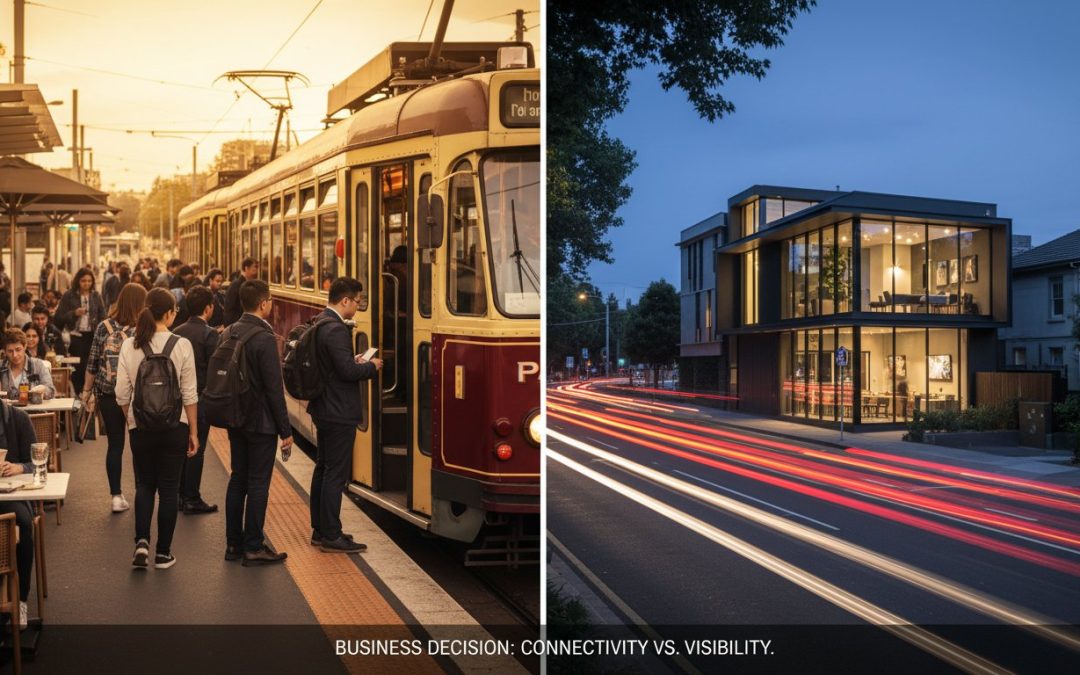
Selecting the optimal site for a new cafe is the most critical commercial decision an operator will make. The choice between a location in a bustling public transport hub and a site with high exposure on a main arterial road presents a complex problem. A miscalculation can result in a costly long-term lease on an underperforming asset and significant delays during the Development Application (DA) process due to unforeseen access or parking issues.
This definitive guide provides the necessary technical framework for this decision. The detailed assessment required for a cafe to compare activity centre locations with high public transport accessibility with less commercial locations with high road traffic exposure is a core component of a successful business case. We will analyse the critical differences in customer access, parking requirements under Australian Standards, traffic generation, and their direct impact on operational profitability. You will gain the expert insight needed to confidently choose a site based on objective data, not assumptions.
Key Takeaways
-
Align your business model by understanding site differences. Our guide helps you, for cafe, compare activity centre locations with high public transport accessibility with less commerciallocations with high road traffic exposure.
-
Our frameworks make it simple, for cafe, compare activity centre locations with high public transport accessibility with less commerciallocations with high road traffic exposure to find the best site.
-
Use quantitative data and traffic tools for an objective assessment. This is vital when you, for cafe, compare activity centre locations with high public transport accessibility with less commerciallocations with high road traffic exposure.
-
Your location choice directly impacts your DA approval path. This is a direct result of how you for cafe compare activity centre locations with high public transport accessibility with less commerciallocations with high road traffic exposure.
Table of Contents
-
Defining the Landscape: Activity Centres, Accessibility, and Exposure
-
The Case for High Public Transport Accessibility: The Pedestrian-First Model
-
The Case for High Road Traffic Exposure: The Visibility-First Model
-
The Traffic Engineer’s Toolkit: How to Make a Data-Driven Decision
Defining the Landscape: Activity Centres, Accessibility, and Exposure
The commercial success of a cafe, restaurant, or small retail business is fundamentally tied to its location. The decision is not merely about finding an empty shopfront; it is about strategically positioning the business to capture a target market. Making a data-informed decision requires a clear framework, especially when, for a cafe, you compare activity centre locations with high public transport accessibility with less commercial locations with high road traffic exposure. This section dissects these two common but distinct location strategies—accessibility versus exposure—to establish the technical definitions required for a proper analysis.
The following video provides a practical overview of this critical decision-making process.
What is an ‘Activity Centre’ in Australian Planning?
In Australian urban planning, an ‘Activity Centre’ is a designated area that serves as a hub for commercial, community, and civic functions. These centres are structured in a hierarchy to manage growth and services. This framework is critical because local council planning schemes heavily influence zoning and what type of development is permissible. The typical hierarchy includes:
-
Metropolitan Activity Centres: The largest centres with the most diverse range of services.
-
Major Activity Centres: Sub-regional hubs serving a broad surrounding area.
-
Neighbourhood Activity Centres: Smaller, localised centres meeting daily community needs.
Analysis of High Public Transport Accessibility
This strategy involves selecting a site based on its proximity to major public transport infrastructure like train stations, tram stops, or significant bus interchanges. Success is measured by pedestrian catchment, walkability scores, and the density of the surrounding residential and commercial population. These areas are often part of a broader urban planning strategy known as transit-oriented development, which focuses on capturing consistent foot traffic from daily commuters and local residents who frequent the area on foot.
Analysis of High Road Traffic Exposure
This strategy prioritises visibility to vehicular traffic. Locations are characterised by significant frontage on a main arterial road, a state-controlled road, or a busy intersection. The primary metric for success here is traffic volume, often measured as Annual Average Daily Traffic (AADT). The business model is geared towards capturing ‘passing trade’—customers who are travelling by car and are attracted by prominent signage and convenient access, rather than those who have planned a visit as a destination.
The Case for High Public Transport Accessibility: The Pedestrian-First Model
Locations adjacent to major public transport hubs—such as train stations, ferry wharves, and busy bus interchanges—operate on a pedestrian-first model. This strategy leverages the consistent and, most importantly, predictable flows of people that are a daily feature of these activity centres. The viability of this model is predicated on capturing a fraction of this high-volume foot traffic. A key analysis for a cafe is to compare activity centre locations with high public transport accessibility with less commercial locations with high road traffic exposure; the former relies entirely on predictable pedestrian metrics, a cornerstone of modern data-driven site selection.
Customer Profile & Peak Trading Hours
The primary customer base consists of daily commuters, local residents using transit services, and employees from nearby commercial offices. Consequently, trading patterns are sharply defined. Peak hours are concentrated during the morning (pre-work, 7:00-9:00 AM) and evening (post-work, 4:30-6:30 PM) commuter rushes. Mid-day trade is highly dependent on the density of surrounding offices, retail, and residential populations that can sustain foot traffic outside of these peak transit times.
Key Advantages for Cafe Operations
Opting for a location with high public transport accessibility provides several distinct operational benefits:
-
High Volume Foot Traffic: These sites offer a guaranteed, non-stop stream of potential customers throughout the day, reducing the need for extensive marketing to generate initial traffic.
-
Reduced Parking Requirements: A significant advantage is the minimal dependency on providing dedicated customer parking. This can simplify the development application process and reduce costs associated with car parking compliance under Australian Standards.
-
Loyal Customer Base: The daily, repetitive nature of commuting fosters a loyal customer base. A cafe can become an integral part of a commuter’s daily routine, leading to highly predictable revenue.
Potential Challenges and Limitations
Despite the high potential, these locations present considerable challenges that require careful assessment:
-
High Rental Costs: Prime real estate in transport hubs carries a significant rental premium, with leasing costs in cities like Sydney or Melbourne often being among the highest in the country (often calculated in A$ per square metre).
-
Logistical Constraints: Supplier access can be severely restricted. Deliveries may be limited to specific off-peak windows, complicating inventory management and daily operations.
-
Service Disruption Vulnerability: The business is directly exposed to the reliability of the transport network. Industrial action, trackwork, or major service disruptions can immediately and drastically reduce customer flow.
-
Intense Competition: These prime locations attract a high density of competitors, including major chains and other small operators, all vying for the same commuter dollar.
The Case for High Road Traffic Exposure: The Visibility-First Model
Selecting a site on a high-traffic road prioritises visibility above all else, effectively turning the cafe into a permanent billboard. When you, for a cafe, compare activity centre locations with high public transport accessibility with less commercial locations with high road traffic exposure, the roadside model targets a distinct demographic: drivers, tradespeople, and commuters seeking convenience. This strategy relies on constant visual exposure to attract customers. However, its success is critically dependent on overcoming significant logistical hurdles, primarily parking and safe vehicle access. The benefits of exposure must be carefully weighed against these operational challenges.
Customer Profile & ‘Passing Trade’
The primary customer base for a high-traffic road location consists of impulse buyers and convenience seekers. Unlike the destination-focused patron of a town centre cafe, these customers are often captured en route to another location. This model attracts a wider, less localized customer base from across a region, rather than a specific neighbourhood. Consequently, trading can be more evenly spread throughout the day, capturing morning commuters, midday workers, and afternoon traffic flows.
Key Advantages for Cafe Operations
The operational advantages of a roadside location are directly linked to its car-centric nature. The key benefits include:
-
Unmatched Brand Visibility: The site acts as free advertising to thousands of potential customers daily, building brand recognition at no extra cost.
-
Streamlined Logistics: Direct road access simplifies operations for suppliers and food delivery services (e.g., Uber Eats, DoorDash), reducing turnaround times.
-
Service Model Potential: These locations are ideal for incorporating high-demand, convenience-focused models such as a drive-thru or dedicated ‘click and collect’ parking bays.
Critical Challenges: Parking and Access
While visibility is a major asset, it is rendered ineffective without functional access. Customer car parking is a non-negotiable requirement and often a major planning hurdle. Meeting Australian local council parking requirements under their Development Control Plans can be a complex and costly barrier, often dictating the financial viability of a site. A professional traffic assessment is required to analyse factors like poorly designed entry and exit points (ingress/egress), which can deter customers and create safety risks. A detailed understanding, supported by data-driven mobility analysis, is essential to ensure that the site’s high traffic volume does not become a liability through constant congestion.
The Traffic Engineer’s Toolkit: How to Make a Data-Driven Decision
Choosing the right location for a new cafe cannot be left to guesswork or intuition. A successful business plan and, critically, a council Development Application (DA) submission, must be underpinned by objective, quantifiable data. Engaging a professional traffic engineering consultant moves your decision-making process from subjective preference to empirical analysis. This upfront investment is essential for minimising commercial risk and providing council with the evidence required for approval.
Pedestrian and Traffic Volume Surveys
To truly understand a site’s potential, we must measure its activity. Pedestrian counts quantify actual foot traffic past a potential storefront, with surveys timed to capture peak periods like the morning commute and lunch rush. Similarly, traffic volume data, such as Annual Average Daily Traffic (AADT), verifies the real-world exposure of a main road location. The detailed analysis provided by a traffic engineer allows you to objectively, for cafe, compare activity centre locations with high public transport accessibility with less commercial locations with high road traffic exposure, ensuring your final choice is based on verifiable facts.
Parking Demand and Supply Analysis
Adequate parking is a frequent point of concern for local councils. A professional parking assessment involves a thorough audit of existing on-street and off-street parking availability within a reasonable walking distance of the site. We then calculate the likely parking demand your cafe will generate based on its size and proposed operating hours, using council-specific rates and Australian Standards. This analysis forms the core of a formal Car Parking Demand Assessment report required for your DA.
Site Access & Safety Assessment
A location’s viability also depends on safe and efficient access. This involves a technical review of proposed driveway locations to ensure they provide adequate sight lines for vehicles entering and exiting the site. We also analyse potential conflict points between vehicles, pedestrians, and cyclists. For sites requiring regular deliveries, a Swept Path Analysis is conducted to confirm that service and delivery trucks can access the property safely and efficiently without endangering the public or disrupting traffic flow.
By commissioning these technical assessments, you provide the necessary evidence to support your application and make a commercially sound decision. For expert traffic engineering advice on your next project, contact the consultants at mltraffic.com.au.
From Analysis to Approval: Navigating Council Requirements
Selecting the perfect site is a major milestone, but it is only the first step. The next critical phase is securing council approval through a Development Application (DA). Your location choice directly dictates the complexity of this process. When you for cafe compare activity centre locations with high public transport accessibility with less commercial locations with high road traffic exposure, the council’s scrutiny on traffic, parking, and access will vary significantly. Proactive planning and professional documentation are essential to demonstrate due diligence and streamline the approval pathway.
Understanding Council Parking Requirements
Local councils across Australia enforce minimum parking rates for new developments, typically calculated based on gross floor area or the number of seats. A ‘parking shortfall’ occurs when your proposed site cannot provide the required number of on-site car spaces. This can lead to significant council-imposed levies or even a refusal of your DA. A formal Car Parking Demand Assessment can be used to justify your proposed parking arrangement to the council, often by demonstrating reliance on public transport or available on-street parking.
The Role of a Traffic Impact Assessment (TIA)
A Traffic Impact Assessment (TIA) is a standard requirement for most new commercial developments, including cafes. This technical report provides council with a detailed analysis of the traffic and parking implications of your proposed business. A comprehensive TIA addresses key council concerns, including:
-
Parking demand and compliance with Australian Standards (AS 2890.1).
-
Safety and efficiency of vehicle access and egress points.
-
Projected traffic generation and its effect on the local road network.
-
Road safety for vehicles, pedestrians, and cyclists.
Engaging an experienced team ensures this critical document is robust and meets all regulatory standards from the outset.
Future-Proofing Your Chosen Location
A successful cafe requires long-term strategic vision. Before committing to a site, consider the future of the surrounding area. Are there planned road upgrades or new public transport projects that could benefit or hinder your business? How will large-scale residential or commercial developments nearby impact foot traffic, competition, and parking? A strategic review of local planning instruments can help identify these long-term opportunities and threats, ensuring your investment is secure. Navigating these requirements demands specialist expertise. Contact ML Traffic Engineers to ensure your DA is supported by professional traffic and parking analysis.
Final Assessment: Data-Driven Decisions for Cafe Site Selection
Choosing the optimal site for a new cafe involves a critical decision between the pedestrian-focused model of a public transport hub and the visibility-first model of a high-traffic road. The ideal location is not a matter of guesswork; it requires a detailed, objective analysis of traffic patterns, pedestrian movements, and parking availability to forecast success and mitigate risks.
A comprehensive assessment is the only way to properly for cafe compare activity centre locations with high public transport accessibility with less commerciallocations with high road traffic exposure. This data-driven approach moves beyond simple observation to provide the quantitative evidence needed to satisfy council requirements and secure your development application approval.
With over 15 years of experience and more than 10,000 sites assessed across Australia, ML Traffic Engineers provides the expert analysis required. Our clients receive direct access to senior engineers for every project, ensuring your investment is backed by robust data. Contact our expert traffic consultants for a quote on your project.
Make an informed decision and build your new cafe on a foundation of certainty.
Frequently Asked Questions
How much parking does a cafe typically need to provide for council approval?
The required number of parking spaces is determined by the local council’s specific planning scheme or Development Control Plan (DCP). Parking rates for a cafe or ‘food and drink premises’ are typically calculated based on the Gross Floor Area (GFA) or the number of seats. For example, a council might require 1 space per 25m² of GFA. These requirements vary significantly between jurisdictions, making a site-specific assessment essential for compliance before you commit to a lease or purchase.
What is a ‘parking shortfall’, and can my development be approved with one?
A ‘parking shortfall’ occurs when your proposed development provides fewer car parking spaces on-site than the number stipulated by council regulations. Approval with a shortfall is possible but requires a robust justification, typically presented in a formal Car Parking Demand Assessment. This report must demonstrate that the lower provision will not negatively impact the surrounding road network. The case is often strongest in locations with high public transport access and available on-street parking.
Do I need a formal traffic report for a small takeaway coffee shop?
A formal traffic report may still be required, even for a small operation. The need is determined by council triggers, which can include the site’s location on a classified road, changes to existing access driveways, or an intensification of use. When you for cafe compare activity centre locations with high public transport accessibility with less commercial locations with high road traffic exposure, sites on busy roads are more likely to require a Traffic Impact Statement (TIS) to satisfy council requirements.
How does a corner location impact a cafe’s traffic and parking assessment?
A corner location offers high visibility but introduces traffic engineering complexities. The assessment must consider vehicle access, ensuring safe sight lines for vehicles entering and exiting the site from two different road frontages. It also requires careful planning to minimise conflict between pedestrians and vehicles at the intersection. Councils will scrutinise access arrangements to ensure they comply with Australian Standards (AS 2890.1) and do not compromise road safety or intersection performance.
Can on-street parking be counted towards my required number of spaces?
Generally, on-street parking cannot be directly counted towards the number of spaces your development is required to provide on-site. Council regulations mandate that required parking must be contained within the property boundary. However, the availability of ample, unrestricted on-street parking can be a critical supporting argument in a Car Parking Demand Assessment. It can be used to justify a parking shortfall by demonstrating sufficient local capacity to absorb customer demand.
What is the first step in getting a traffic assessment for my proposed site?
The first step is to engage a qualified traffic engineering consultant. You should provide the consultant with the full site address and any preliminary plans or a clear description of your proposed cafe, including its size (GFA), seating numbers, and operating hours. This initial information allows the consultant to conduct a preliminary review of council requirements and provide a detailed fee proposal outlining the specific traffic reports needed for your Development Application (DA).
Which areas do you service?
We are traffic engineers covering Melbourne, Sydney, Brisbane, Gold Coast, Hobart, Perth, Adelaide, Darwin and surrounding areas.
